
Hire Developers in Hungary


Key takeaways:
Companies use React development services to build new web applications or improve existing ones. Before hiring a team, decide whether you need a new product or help with an application you already have. React 19, released in December 2024, brought changes to forms, data handling, and rendering. Developers need to account for these changes when building new applications or updating older ones.
React developers build user interfaces, create reusable components, connect applications to APIs, and fix performance problems. Some companies take responsibility for the entire project, while others provide developers who join your internal team.
If you’re building a new application, look for developers with experience in architecture, testing, and deployment. For an existing product, check whether the team can work with your code, update old dependencies, and fix performance issues. Your choice also depends on whether you have someone internally who can manage the development work.
React teams usually handle two types of work: building new applications and improving existing ones. What you need depends on your application’s current state, technical needs, and project goals.
If you’re building a new product, React developers can create its frontend from scratch. They can also add features or update an existing application without rebuilding everything.
Common React development services include:
A React development agency can take responsibility for the entire frontend or provide developers to support your team. The right arrangement depends on your project and how much work your internal developers can handle.
You don’t always need to rebuild your frontend. Sometimes, an application works well enough, but outdated code makes changes slow and expensive.
React developers can help with:
For example, a React team might fix a customer dashboard that becomes slower as more data loads. They could also replace an unsupported library that prevents developers from adding new features safely.
React developers mainly work on the frontend. You may need separate specialists for UI/UX design, backend development, or infrastructure unless your contract includes these services.
Mobile development requires different skills. Our React Native development guide explains how teams build mobile applications with React Native.
Before contacting providers, decide whether you need a new application, extra features, or improvements to existing code. This will help you compare offers based on the work your project actually requires.
Before hiring an offshore React team, decide whether you need a new application or improvements to an existing one. Each requires different skills, team sizes, and ways of working.
Sometimes, a project that starts with a few new features turns into a larger update once developers review the existing code.
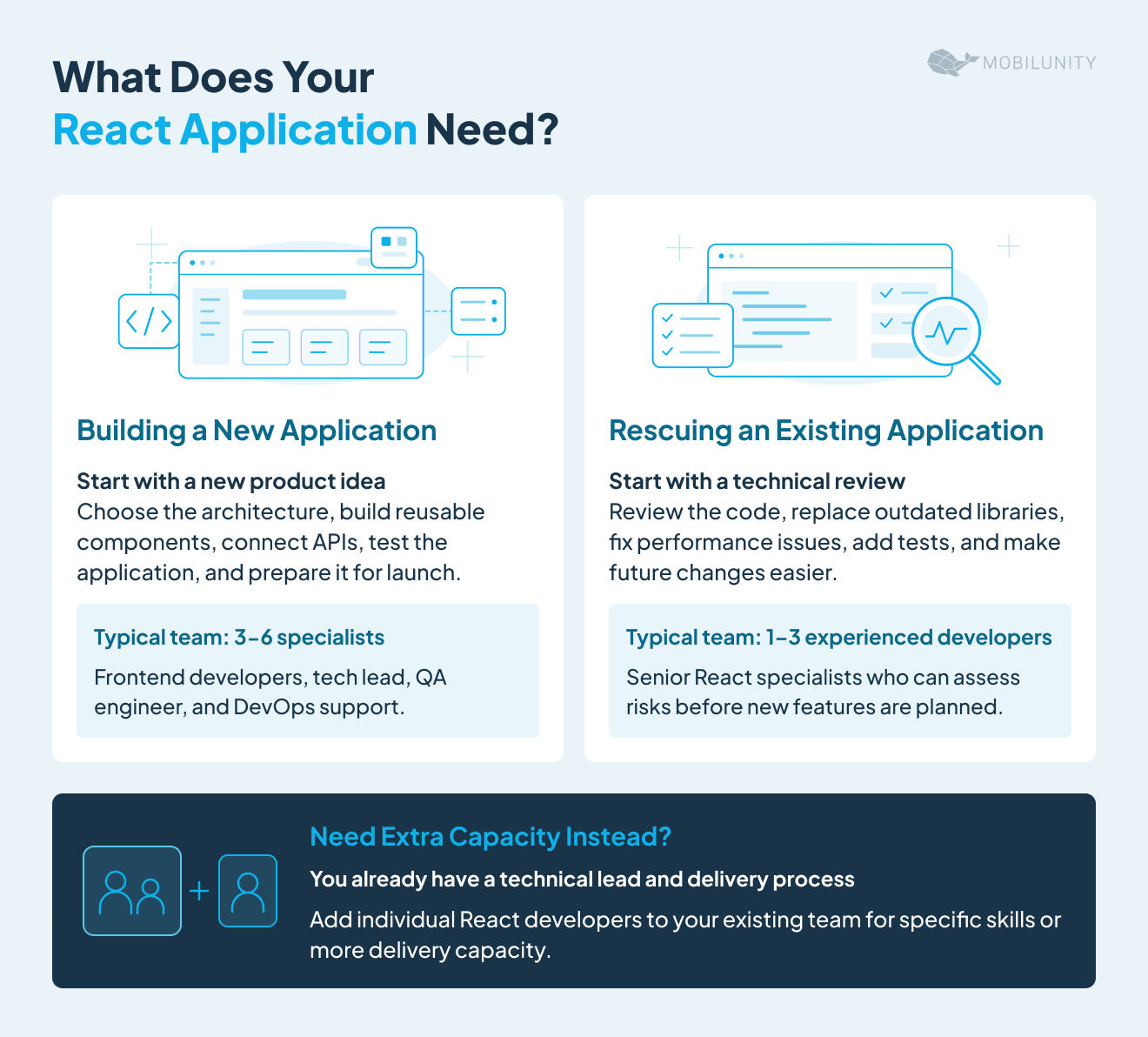
A new React project may need 3 to 6 specialists, depending on its size. Your team could include frontend developers, a tech lead, a QA engineer, and a DevOps specialist.
Before development starts, the team needs to choose a framework, plan how data moves through the application, and decide how to connect APIs. Developers should also agree on testing and deployment.
The official React documentation recommends frameworks for new applications. Next.js and React Router offer built-in ways to manage navigation, data loading, and rendering.
This approach works for new SaaS products, customer portals, internal dashboards, and other web applications.
An existing React application may only need one to three developers. They should start by reviewing the code to find problems that make updates difficult.
For example, you might want to add a reporting dashboard. But developers could discover outdated libraries, confusing data flows, or missing tests that make the work more complicated.
Fixing these issues first can prevent bugs and repeated work during future releases.
These projects often start with a technical review. If you only need someone to assess your application and recommend improvements, React consulting may be a better choice than hiring a full development team.
If you already have a tech lead and an established development process, you may only need extra developers.
You can hire React developers to fill specific skill gaps or help your existing engineers handle more work. Each developer joins your current team and works on assigned tasks.
A dedicated React development team is different. You hire several developers who work together as a separate group on a shared project or product.
In both cases, your company manages the work. If you need an external provider to take responsibility for project delivery, consider a managed development service instead.
React development costs depend on developers’ experience, team size, and project type. A new application may need several specialists, while an existing product might only need one experienced developer.
According to the data from Mobilunity’s tech recruitment team in September 2026, our monthly React developer costs are:
These rates cover monthly developer costs, not just salaries. You can also check React developer salaries for more information about costs.
A rescue project may initially cost more per developer because it requires senior technical judgment. A new build usually costs more overall when it needs several developers working simultaneously.
Before signing, confirm the notice period, minimum commitment, and whether the monthly fee covers additional specialists.
The main cost difference lies in what you pay on top of developer compensation. In-house hiring comes with recruitment expenses, employee benefits, equipment, and ongoing HR costs. Offshore staffing usually combines several of these expenses into one monthly fee.
In-house hiring also requires a longer commitment. You need to recruit, onboard, and retain employees, even when your development workload changes. Offshore staffing offers more flexibility, although contract terms may limit how quickly you can reduce your team.
Before comparing offers, check what’s included in the monthly fee and who handles recruitment, equipment, and employee administration. This will give you a more accurate picture of your total hiring costs.
Offshore React development lets you hire frontend developers from a wider talent pool, often at lower costs than local hiring. These developers can help you build new features, fix performance issues, or maintain an existing application.
This approach works for startups developing their first products and established companies that need extra support for ongoing development.
React developers can make applications faster by fixing unnecessary component updates, slow rendering, and inefficient data processing. For example, they can improve a dashboard that freezes when users load large amounts of data.
React also lets developers reuse components across different pages. If you need to update a form or navigation menu, they can change the shared component instead of editing each page separately.
As your application grows, developers need to add features without breaking what already works. React’s reusable components can make this easier and help keep the code organized.
An offshore team can also fix bugs, update old libraries, and maintain automated tests. This helps prevent problems when you release new features.
Still, the results depend on your developers’ skills and the condition of your application. React itself won’t fix poorly written code or prevent performance issues.
When you outsource React development, you can hire developers from Ukraine and other Eastern European countries without asking them to relocate. This gives you more candidates to choose from, especially if local recruitment is difficult.
Time zones can also work in your favor. Kyiv is usually two hours ahead of London and seven hours ahead of New York. A 3 p.m. meeting in Kyiv would typically be 1 p.m. in London or 8 a.m. in New York.
Remote work is already common in software development. According to the 2025 Stack Overflow Developer Survey, 45% of US respondents worked remotely. For many companies, offshore hiring simply means working with developers in another country rather than another city.
The arrangement works best when developers have experience with your type of application and enough shared working hours to communicate with your team.
React outsourcing works best when developers have experience with your application type and enough shared working hours to communicate with your team.
React has changed a lot in recent years. New features, updated framework recommendations, and performance tools affect how developers build and maintain applications.
If your application uses older React tools, you may need to update libraries, replace unsupported packages, or change parts of the code. Knowing about these changes will help you understand what work your offshore React team needs to do and why.
The following changes are particularly relevant to companies planning new React applications or updating existing products.
| Change | Date | What It Means for Your Budget |
| Create React App deprecated | February 14, 2025 | Existing applications may need migration to a supported framework or build tool |
| React 19 released | December 5, 2024 | Upgrades may require dependency updates, compatibility checks, and testing |
| React Compiler 1.0 released | October 7, 2025 | Adoption requires evaluating existing optimization code and testing application behavior |
| Framework-first recommendation | Current React documentation | New projects need framework selection; existing SPAs may require architectural assessment |
| INP became a Core Web Vital | March 12, 2024 | Slow user interactions may require profiling and frontend performance improvements |
You don’t necessarily need to rebuild your application because React has changed. The cost of updating it depends on your React version, libraries, code structure, and existing performance issues.
On February 14, 2025, the React team deprecated Create React App for new projects. If your application still uses it, developers should check whether moving to a newer framework or build tool makes sense.
Many applications built between 2018 and 2022 may still use Create React App. Before planning a migration, developers need to review the project’s configuration, libraries, and deployment process.
React 19 was released on December 5, 2024. Applications that run older versions may benefit from an upgrade, but developers should check compatibility first.
Updating React can also mean replacing outdated libraries, fixing code that no longer works, and testing existing features. The work involved depends on your application’s current state.
React Compiler 1.0 was released on October 7, 2025. It can automatically improve how React components render, reducing the need for some manual performance fixes.
Before adopting it, developers should check compatibility, review existing optimizations, and test whether it improves application performance. Some manual optimizations may no longer be needed.
The official React documentation also recommends frameworks for new applications.
If you already have a working single-page application (SPA), you may not need to move to a framework. Ask your team what problems the change would solve and how much work it would require.
On March 12, 2024, Interaction to Next Paint (INP) replaced First Input Delay as a Core Web Vital.
INP measures how quickly a page responds when someone clicks, types, or interacts with it. React applications can score poorly if complex components take too long to render or JavaScript slows down the page.
Before paying for performance improvements, ask developers to measure your application’s INP. They should show which pages are slow, explain why, and estimate the cost of fixing them.
This gives you a clearer idea of what needs work and how much you should budget.
The main difference between nearshore and offshore React development is the time zone. Nearshore developers usually share more working hours with your team, while offshore developers may work on a different schedule.
Your choice depends on how closely your teams need to work together and how often developers need quick answers or feedback.
Your developers don’t need to work the same hours all day. They can build components, write tests, and fix bugs independently.
Shared working hours matter most for:
For example, US companies that hire React developers in Ukraine can schedule meetings during their shared morning hours. Developers can then continue with their tasks independently.
Clear instructions and written decisions also help prevent delays when team members work in different time zones.
Nearshore developers may cost more than offshore specialists, depending on their location. The higher rate may be worth paying if your project needs frequent meetings and quick decisions.
This matters most at the start of a project, when developers need to discuss requirements and agree on technical decisions. Once the team has a clear plan, offshore developers can work more independently.
The same time zone challenges apply to React Native development, although mobile applications require different technical skills.
When comparing providers, focus on how many working hours your teams can share. Even three hours of reliable overlap may be enough if everyone communicates clearly and follows an agreed process.
You don’t need deep React knowledge to choose a development company. Asking the right questions can help you see whether its developers have the skills your project needs.
Look at their recent projects, the results they’ve achieved, and what clients say about their work. These tell you more than general claims about technical expertise.
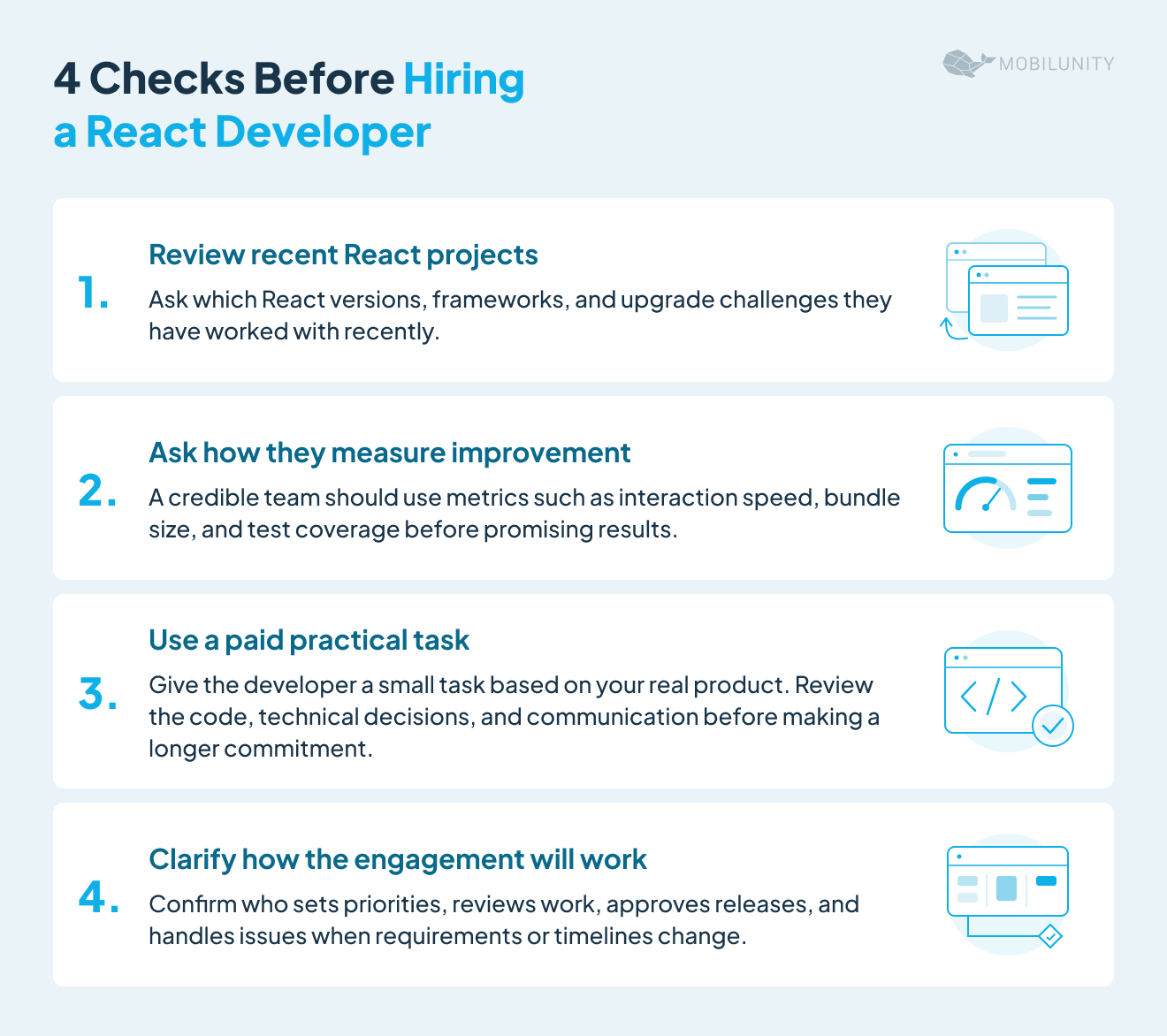
1. Ask About Their Recent React Projects
Ask which React versions the developers used in their last three projects. Check whether they worked with Create React App and how they handled its deprecation.
If they have experience with React 19, ask how they managed upgrades, library compatibility, and testing. If they used older versions, find out why they chose to keep them.
Look for developers who can explain their technical decisions and show how those choices worked in real projects.
2. Ask How They Measure Results
Before suggesting improvements, a React development company should check how your application performs. Ask which metrics the team will track and how it will measure the results.
These might include Interaction to Next Paint (INP), JavaScript bundle size, or automated test coverage.
If developers promise a faster application without measuring its current performance, ask how they plan to estimate the work.
3. Speak With Two Relevant Clients
Ask for two client references from companies similar to yours in size and project needs. Experience with large enterprises doesn’t always translate well to a small startup.
Speak with both clients. Find out whether the developers met deadlines, reported problems early, and resolved technical issues.
Also ask how the company handled changes in requirements or unexpected delays.
4. Check Their Approach to Existing Code
If you already have a React application, ask what developers need to review before giving you a price.
They should examine your code, libraries, and performance data. They may also need to discuss existing bugs and why previous developers made certain technical decisions.
Be careful if a company suggests rebuilding your application without reviewing the code first.
Sometimes, starting over makes sense. But developers should explain why they can’t fix the problems or update the application gradually.
A good proposal should explain which problems the team found, how it plans to fix them, and what the work will cost.
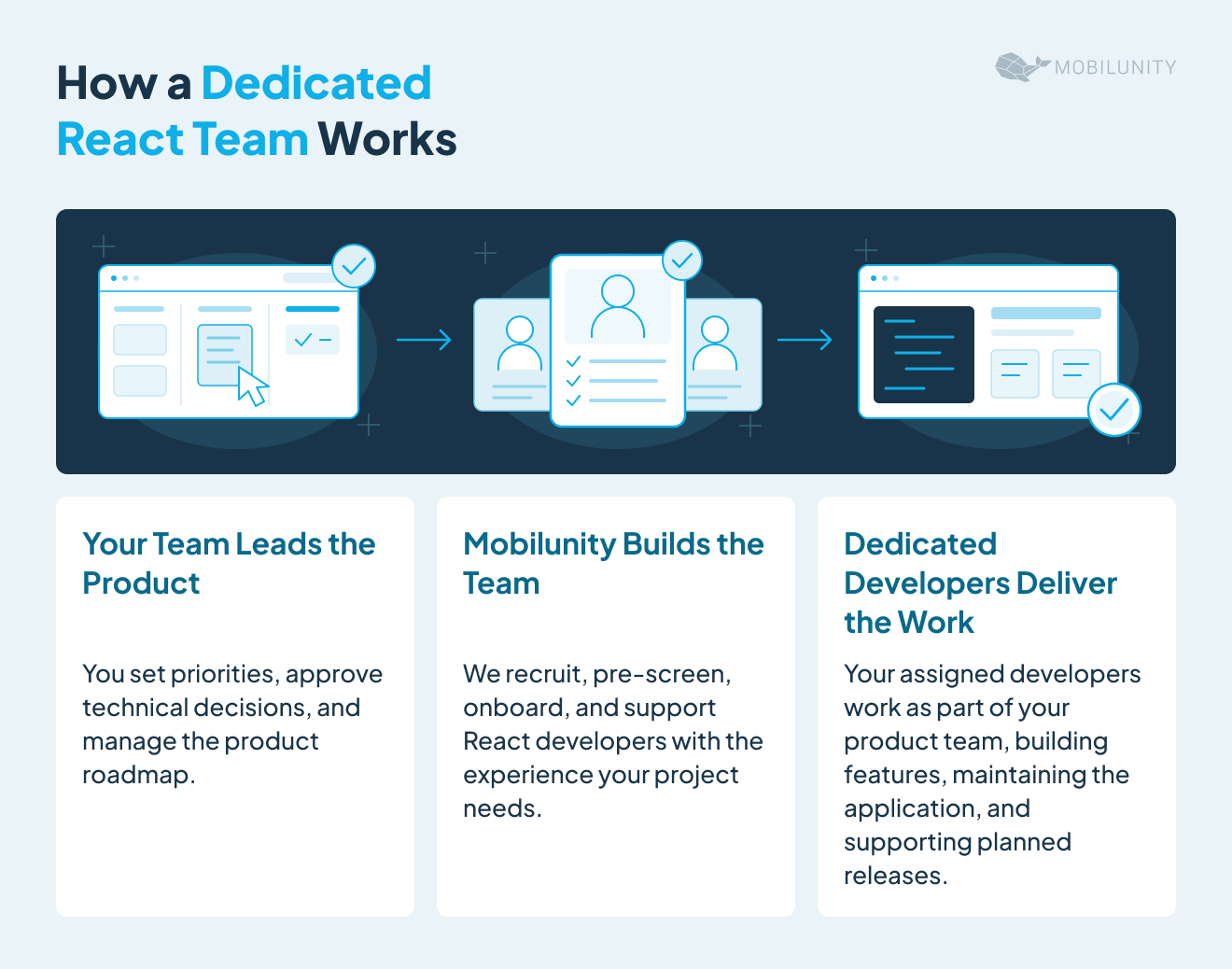
Founded in 2010 and based in Kyiv, Ukraine, Mobilunity helps companies hire dedicated React developers and build offshore development teams. Unlike React development companies that manage entire projects, Mobilunity provides developers who work under the client’s technical leadership.
Companies can use Mobilunity’s React team service to build new applications, add features, or maintain existing products. The model works particularly well for businesses that already have a tech lead but need more frontend developers.
As of October 2026, Mobilunity has a 4.8/5 rating on Clutch with hourly rates of $25-$49 and a $10,000 minimum project size.
The QRATES case study shows how this model supported a Japanese vinyl crowdfunding and production platform. During a partnership spanning more than three years, Mobilunity expanded the dedicated team from one to five people in under 18 months, adding frontend and backend developers, project management and automated QA. Working alongside the client’s in-house team, frontend developers improved the interface and reduced load times, while automated testing helped address release quality issues.
For companies researching where to find React developers, Mobilunity offers an alternative to hiring freelancers individually. It’s worth considering among the best React JS development company options if you need a dedicated team for ongoing work. However, you’ll need someone internally to manage development and take responsibility for delivery.

Disclaimer: All salaries and prices mentioned within the article are approximate numbers based on the research done by our in-house Marketing Research Team. Please use these numbers as a reference for comparison only. Feel free to use the contact form to inquire on the specific cost of the talent according to your vacancy requirements and chosen model of engagement.