














 Estonia
 Latvia
 Ukraine
 Poland
 Lithuania
 Romania
 Croatia
 Serbia
 Bulgaria
 Greece
 Slovenia
 Montenegro
 Costa Rica
 Mexico
 Brazil
 Chile
Chile Argentina
 Uruguay
How to Hire Java Developers: Skills, Interviews, Rates and Timelines
When hiring a Java developer, evaluate the engineer’s technical judgment rather than Java knowledge alone. Strong candidates can explain how they solve production problems, make technical decisions, and choose between different approaches. Test their understanding of transactions, concurrency, JVM performance, persistence, testing, and dependency management. Ask about problems they’ve handled on real projects, what went wrong, and how they decided on a solution. These answers reveal more about their ability to work on your project than a checklist of Java frameworks and tools.
Cost varies by seniority, location, and hiring model. An in-house hire also brings employer contributions, benefits, recruitment, and equipment costs. Mobilunity typically provides highly relevant Java devs’ CVs within 5 business days; in most cases, even sooner. Our candidates’ trial-period success rate is 97%, and the retention rate for provided developers over the past 12 months is 94%. The full hiring process usually takes 3-6 weeks.
Define the Java Role Before You Start Hiring
Before you write a Java developer job description, decide what you need the engineer to do. Java developer responsibilities can vary considerably from one project to another. Two senior Java experts can have very different backgrounds. One may excel at designing new Spring Boot services, while another knows how to untangle large legacy systems. The profile you need depends on the project’s scope and technical requirements.
This distinction becomes especially important when you hire developers by technology. The language or framework on a candidate’s resume doesn’t necessarily tell you whether their background fits your project.
Your interview should reflect that. Start with projects on the candidate’s resume and ask why they made certain technical choices. Why did they choose one technology over another? What made a particular refactor difficult? What would they do differently now? You want to hear how they reached decisions, not whether they can recite Java or Spring concepts.
For a greenfield Spring Boot service, look for an engineer comfortable making architectural decisions with few existing constraints. They may need to define service boundaries, design APIs, choose data-access patterns, and decide how the application handles failures. Ask candidates to walk you through similar decisions from previous projects and explain the tradeoffs they considered.
The same principle applies to roles that overlap with Java but require different expertise. Android developers, for example, need mobile-specific knowledge alongside their programming skills. Backend Java experience alone doesn’t prepare someone for every Android project.
Legacy maintenance and strangler migration need a different kind of engineer. Understanding the business domain can count for more than knowledge of the latest framework release. The developer needs to trace dependencies, understand why old code behaves as it does, and change it without disrupting a live system. Someone who immediately proposes a rewrite may be less suitable than someone who first asks what should stay.
When you hire Java developers for team extension on an existing platform, prioritize fit with the engineering environment you already have. Your Java version, architecture, frameworks, testing practices, and deployment process are largely decided. You need someone who can get comfortable with an established codebase, follow existing conventions, and contribute without trying to redesign the platform around their preferences.
In the end, you’re assessing the developer’s engineering judgment, not how many frameworks they know. Ask candidates about decisions they have actually made and problems they have worked through. How they explain those choices will tell you more about their fit for your project than a long list of Java technologies on a resume.
Six Java Developer Skills to Check Before You Hire
A resume can show which frameworks and tools a candidate has used, but not how they handle problems with them in production. The Java developer skills worth testing show how candidates apply their technical knowledge in practice: how they investigate failures, choose between approaches, and recognize when a familiar solution no longer fits.
These priorities also differ across technology stacks. Python developers, for example, face different runtime, concurrency, and dependency challenges, so their technical assessment should reflect those differences.
You don’t need a long technical assessment for each area. Ten minutes per skill is enough to explore it with a targeted question and follow-up.
1. Spring and Dependency Injection
An experienced Java developer should understand Spring beyond annotations and configuration. They should know how dependency injection affects object lifecycles and recognize when bean scope, proxy behavior, or transaction boundaries create unexpected results.
A good answer usually starts with a production issue the candidate had to investigate. A transaction may have ended too early, or a singleton may have held state intended for one request. A method may also have behaved differently outside the expected proxy path. The candidate should explain how they traced the behavior and why their fix worked.
10-minute check: Ask: “Tell me about a Spring bean-scope or transaction-boundary problem you caused or had to fix.” Follow with: “How did you know where the problem was?” Someone who has faced this issue should explain how they identified and fixed it, rather than simply describing how the @Transactional annotation works.
2. Concurrency
Java gives developers several ways to run work concurrently, from threads and executors to higher-level concurrency tools. Writing concurrent code is relatively easy. Predicting how it behaves under contention, failure, and load takes much more judgment.
This is also an area where Python compared with Java, requires a different interview approach. The languages have different runtime and concurrency models, so questions shouldn’t transfer unchanged between them.
Strong candidates don’t reach for concurrency automatically. They first consider whether the task needs it and which abstraction fits. They should also recognize common risks such as race conditions, shared mutable state, deadlocks, and exhausted thread pools.
10-minute check: Give them a simple scenario: an API needs to make several independent calls to external services before returning a response. Ask how they would approach it and why. Then add a constraint, such as one service becoming very slow. Focus on how they adapt their approach when the situation changes, rather than whether they mention a particular API or class.
3. JVM Behavior Under Load
This is particularly useful when you hire for a senior role. A developer who has operated Java applications in production should understand how they behave under increasing memory pressure. They should also recognize when garbage collection starts consuming too many resources.
They don’t need to know every detail of how garbage collection works, but they should know how to investigate related problems. Look for experience with heap usage, garbage collection pauses, memory allocation, profiling, and GC logs. Strong candidates base their conclusions on what they find during the investigation, not assumptions.
10-minute check: Ask: “A Java service becomes slower as traffic increases, but CPU usage doesn’t explain the slowdown. What would you investigate?” Follow with: “Have you ever read a GC log? What were you looking for?” The value lies in their investigation process, not whether they name every JVM flag.
4. Persistence and ORM
ORM tools can reduce repetitive database work, but they can also hide inefficient queries and performance problems. An experienced Java developer should recognize problems such as N+1 queries and unexpected lazy loading that causes unnecessary database calls. More importantly, they should know when a more direct approach would yield better results.
Good candidates don’t treat Hibernate, JPA, or SQL as competing camps. They use the level of abstraction that fits the problem. They should be comfortable inspecting generated queries and moving to explicit SQL when performance or query complexity justifies it.
10-minute check: Ask about a database performance problem caused by an ORM. How did they discover it? What did they change? Then ask when they would choose SQL instead. Look for a reason based on performance, query complexity, or control over database operations, rather than a personal preference for ORM or SQL.
5. Testing Discipline
Strong Java developers know that more tests don’t automatically mean safer software. They decide what belongs in a fast unit test and what requires an integration test against real infrastructure. They also consider whether the test suite remains fast and manageable as the codebase grows.
For integration testing, tools such as Testcontainers can help developers test how the application works with real databases, queues, and other services. The more important signal is how the candidate thinks about test boundaries, reliability, and execution time.
10-minute check: Ask: “Your integration test suite now takes 40 minutes. What would you do?” A good candidate should investigate why it is slow before simply removing tests or adding more hardware. Listen for ideas around test scope, unnecessary setup, parallel execution, and separating fast feedback from slower checks.
6. Build and Dependency Hygiene
Maven and Gradle do more than compile Java code. On a mature project, developers need to understand dependency resolution, version conflicts, build reproducibility, and the security implications of third-party libraries.
A senior candidate should also know that a vulnerable package may enter the project indirectly through another dependency. When a transitive dependency has a known CVE, they should first establish whether the application uses the affected component and which dependency introduced it. From there, they can decide whether to upgrade, override, exclude, or replace it.
10-minute check: Give the candidate this situation: “A security scan finds a high-severity CVE in a transitive dependency. What do you do next?” Look for a structured investigation rather than an immediate version bump. They should consider where the dependency came from, whether the vulnerability affects the application, what upgrade paths exist, and what needs testing after the change.
These six checks focus less on what a Java developer can remember and more on how they work through real engineering problems. That distinction becomes increasingly useful for senior hires, where production judgment often tells you more than framework knowledge alone.
Seven Java Interview Questions and What to Listen For
Targeted Java developer interview questions should reveal whether a candidate has dealt with the challenges your role involves. Skip terminology checks and focus on situations from their previous projects. Ask about production failures, difficult technical choices, and decisions that required them to weigh different options.
You don’t need deep Java knowledge to assess how candidates explain their experience. Listen for what went wrong, how they investigated it, what they changed, and why. Candidates with firsthand experience should be able to explain that process clearly. A technical interviewer should still verify the quality of their decisions and solutions.
1. Describe a transaction boundary you got wrong
This question asks the candidate to discuss their own mistake, not explain how transactions work in theory.
What to listen for: A clear sequence from symptom to diagnosis. They should explain what the application was doing, why the transaction behaved differently than expected, and what they changed. Strong answers may mention Spring transaction behavior, propagation, or where the transaction started and ended, but the reasoning is more important than the terminology.
Memorized-answer signal: They define @Transactional or transaction isolation but never describe an actual problem they caused or fixed.
2. Have you ever read a GC log? What did it tell you?
This is particularly useful for senior candidates because it moves the conversation from writing Java to operating it in production.
What to listen for: A real reason they opened the log, such as latency spikes, memory pressure, or long garbage collection pauses. They should explain what they found and how that information affected their next step.
Memorized-answer signal: They can name garbage collectors or JVM settings but can’t describe what they would look for in a GC log.
3. Walk me through an N+1 query problem you found in production
You are testing whether the candidate notices what an ORM can hide from them.
What to listen for: How they first detected the problem, whether through slow requests, database monitoring, logs, or query inspection. Then listen for how they confirmed the cause and fixed it. The answer should connect the code to what was happening in the database.
Memorized-answer signal: They explain what an N+1 query is and immediately name a standard fix, without discussing diagnosis or consequences.
4. When did you last use raw SQL instead of the ORM, and why?
A good Java developer shouldn’t be committed to an ORM simply because the project uses one.
What to listen for: A specific case where SQL gave them more control, clarity, or acceptable performance. The candidate should also recognize what they gave up by stepping outside the ORM rather than presenting raw SQL as automatically better.
Memorized-answer signal: “ORMs are slow” or “SQL is faster,” with no example or explanation of why the change was appropriate.
5. A transitive dependency has a CVE and no patched version. What do you do?
There isn’t one correct answer because the goal is to see how the candidate handles an imperfect situation.
What to listen for: They first establish whether your application is actually exposed to the vulnerability. From there, they may investigate the dependency path, available mitigations, exclusions, overrides, alternative libraries, or an upgrade of the parent dependency. Good answers also consider the risks introduced by the fix itself.
Memorized-answer signal: “Upgrade the dependency” without noticing that the question explicitly says no patched version exists.
6. Tell me about a concurrency problem you’ve had to diagnose
Concurrency knowledge becomes much easier to judge when the candidate has to connect it to something that actually happened.
What to listen for: A recognizable symptom, such as inconsistent results, thread-pool exhaustion, deadlocks, or requests that stalled under load. They should explain how they narrowed down the cause and why their solution addressed it.
Memorized-answer signal: A list of threads, locks, executors, or concurrency utilities with no connection to a production problem.
7. When is the JVM the wrong choice?
This question tests technical judgment and honesty rather than Java knowledge. A senior Java developer should be able to recognize projects where their primary technology isn’t the best fit.
Don’t confuse the JVM choice with the Java language itself. Scala developers, for example, also build applications on the JVM but use a different programming language and development approach.
What to listen for: Context rather than a blanket rule. The candidate might discuss startup time, memory constraints, deployment environment, existing team expertise, or a workload better served by another technology. Strong answers explain the conditions behind the choice.
Memorized-answer signal: “Java can handle anything,” or the opposite: claims that other languages are faster or better without explaining when those differences affect a project.
Taken together, these questions give you something a terminology quiz cannot: evidence of how the candidate has handled real engineering problems. You aren’t looking for seven perfect answers. You’re looking for someone who can explain what happened, what they did, and why they made that choice.
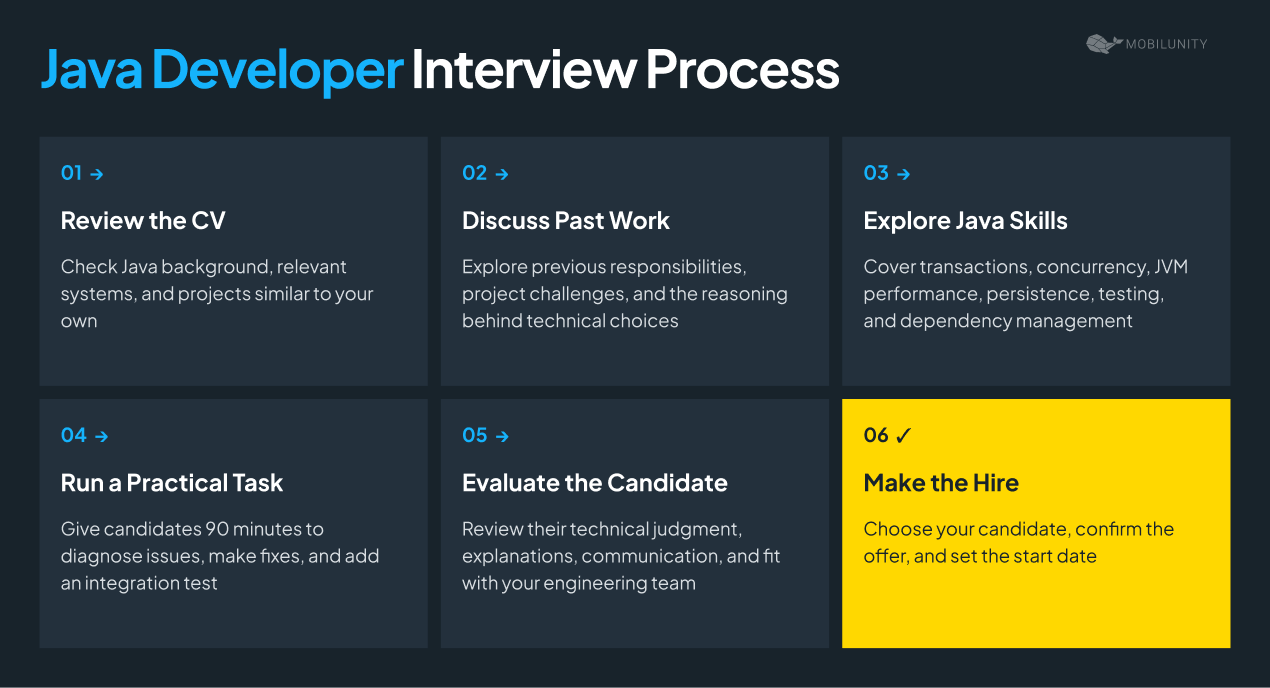
A Practical 90-Minute Java Assessment
This 90-minute task is designed for mid-level and senior Java developers working with Spring Boot backend applications. It tests common persistence and transaction issues without requiring candidates to build a feature from scratch. To keep the assessment within 90 minutes, provide a working starter project with the database and test environment already configured. If you plan to hire Java developers for a Java environment other than Spring Boot, adapt the task to reflect the production problems they will handle.
You can send candidates the following task:
Java screening task
We’ve provided a small Spring Boot application with an existing endpoint. The endpoint works, but it has two problems:
- Loading a list of orders generates far more database queries than expected
- Updating an order can leave related data in an inconsistent state if part of the operation fails
Your task:
- Identify and fix both problems
- Add one integration test that verifies the expected behavior
- Explain each problem and your fix in no more than two sentences
- Keep the existing API response unchanged
Please spend no more than 90 minutes on the task. Don’t add features or refactor unrelated parts of the application.
You can check whether the candidate followed the task requirements, but a Java specialist should review the technical implementation. Use these four points to structure that review:
| What to Check | What to Look For |
| N+1 query | The issue is fixed, and the candidate can show how they verified that unnecessary queries are gone |
| Transaction boundary | The candidate explains where they placed it and why that location makes sense |
| Integration test | The test covers the endpoint and its database interaction instead of mocking every dependency |
| Explanation | A nontechnical reader can understand the original problems and why each change solves them |
Use a fictional or purpose-built starter project and state that the exercise is for assessment only. The company should not reuse the candidate’s solution in a commercial product.
Java Developer Costs by Seniority
How much does it cost to hire a Java developer? The number depends on their seniority, experience, and the hiring model you choose. Salary alone doesn’t show the full cost of a hire. You also need to consider the additional expenses that come with each hiring model.
Location also shapes what you’ll pay. Java developers in Poland, for example, have different salary expectations from developers in other European markets.
For comparison, the table below shows gross monthly salaries and total monthly costs for Java developers in Ukraine. Data covers junior, middle, and senior developers, giving you a practical benchmark for planning your hiring budget.
Java Developer Gross Salary and Costs in Ukraine*
| Seniority | Gross Monthly Salary | Monthly Cost |
| Junior | $1,000 – $2,200 | $2,450 – $3,700 |
| Middle | $2,200 – $4,200 | $3,650 – $5,700 |
| Senior | $4,200 – $5,700 | $5,650 – $7,200 |
*As per Mobilunity in-house tech recruiting team research done in September 2026
Java has a large talent pool, but developers at the same seniority level can still differ significantly in technical depth. Production experience, architecture skills, and knowledge of complex systems can push rates toward the upper end of each range. For demanding roles, these differences can affect cost more than the developer’s location.
What Does an In-House Java Developer Really Cost in Different Countries?
A Java developer salary is only part of what you spend on an in-house hire. The average US Java developer earns about $106,000 annually as of September 2026. Once you add employer contributions and benefits, the estimated annual cost rises to around $133,100.
The difference also varies considerably by country. The table below compares salary with employer contributions and estimated benefits across eight markets.
Estimated Annual In-House Java Developer Cost*
| Average Annual Gross Salary | Employer Taxes / Contributions | Estimated Benefits | Estimated Annual In-House Cost | |
| US | $106,000 | $10,000 | $17,100 | $133,100 |
| Canada | $60,700 | $4,400 | $4,300 | $69,400 |
| Germany | $66,700 | $14,800 | $2,400 | $83,900 |
| UK | $72,500 | $9,900 | $3,200 | $85,600 |
| Switzerland | $121,200 | $7,800 | $8,600 | $137,600 |
| Denmark | $77,100 | $1,300 | $6,700 | $85,100 |
| France | $49,700 | $15,900 | $300 | $65,900 |
| Spain | $37,500 | $12,400 | $700 | $50,600 |
Sources: salary.com | bls.gov | irs.gov | ca.indeed.com | canada.ca | statcan.gc.ca | kununu.com | gtai.de | uk.indeed.com | gov.uk | ons.gov.uk | jobs.ch | bsv.admin.ch | businessindenmark.virk.dk | oecd.org | fr.indeed.com | urssaf.fr | service-public.gouv.fr | es.indeed.com | ine.es | boe.es | destatis.de | aba-online.de | bmas.de
*All rates are as of September 2026
These figures give you a more accurate view of hiring costs than comparing salaries alone. For example, Germany’s average salary is around $66,700, but estimated annual employment costs reach $83,900. In the US, the difference between salary and estimated total cost is more than $27,000.
The same distinction applies when comparing an employee’s salary with a Java developer hourly rate from another hiring model. An hourly or monthly rate may already cover costs that an employer pays separately for an in-house employee.
Recruitment also adds to the initial hiring cost, although it isn’t included in the table. Internal recruiter time, job advertising, agency fees, and interviews all require additional budget. You may also pay the full employment cost while a new developer learns your codebase and becomes productive.
For this reason, compare hiring models on total cost rather than salary or hourly rates alone. It gives you a more realistic basis for deciding where and how to hire your Java developers.
Which Hiring Model Fits Your Java Project?
The right hiring model depends on how long you need the developer and how much project knowledge they must retain. A freelancer can handle a specific, short-term project effectively, while a long-lived Java platform often needs developers who stay and build knowledge over time.
Companies that need external engineering capacity can also use IT staff augmentation. This broader model can cover individual specialists or larger teams, depending on the project and staffing needs.
In-House Java Developer
In-house hiring suits companies that want Java expertise to stay within the organization long term. Developers work directly within your engineering structure and build knowledge of the product, architecture, and business domain.
Java has a large talent pool, so sourcing candidates is rarely the main challenge. Screening takes more effort because Java backgrounds vary widely. A developer experienced with new Spring Boot services may not suit a legacy monolith that requires careful maintenance.
You also take responsibility for recruitment, payroll, benefits, equipment, retention, and ongoing HR management. That additional work can make in-house hiring less practical when you need to expand an engineering team quickly.
Freelance Java Developer
Freelancers can be a good choice for work with a clear scope and endpoint. Examples include building a small service, adding an integration, or completing a defined migration task.
This model becomes less suitable when understanding the existing system is a large part of the job. A developer maintaining a Java monolith may spend months learning its dependencies, business rules, and historical decisions. Replacing that person means rebuilding much of that knowledge.
For a six-week integration project, however, a dedicated developer may add commitment you don’t need. In this case, a freelancer can offer a simpler arrangement.
Dedicated Java Developers
A dedicated development team fits long-running projects where developers need to build and retain codebase knowledge. When you hire dedicated Java developers, they work with your existing processes and engineering team while remaining employed by the provider.
The main advantage is continuity. Companies that hire dedicated Java developers can keep the same engineers maintaining services, handling migrations, learning business rules, and supporting the platform as it changes. The provider handles employment and administrative responsibilities, while you manage the technical work.
This model isn’t designed for every project. A small service with fixed requirements and a short deadline rarely needs a long-term dedicated setup. A freelancer may offer a better fit in that situation.
The differences become clearer when you compare how each model works in practice:
| Factor | In-House Developers | Freelancers | Dedicated Development Team |
| Cost | Salary, employer costs, and benefits | Hourly or fixed project fee | Monthly rate through the provider |
| Time to start | Longer due to recruitment and onboarding | Often faster for well-defined projects | Depends on recruitment and project requirements |
| Retention | Strong fit for long-term roles | Less predictable for ongoing work | Built around long-term cooperation |
| IP protection | Covered by the employment agreement | Depends on the contractor agreement | Covered by the agreement with the provider |
| Management effort | You handle employment and HR responsibilities | You manage the freelancer directly | Provider handles employment; you manage the developer’s work |
The right cooperation model comes down to the kind of project you have. An in-house developer becomes part of your company and stays close to the product. Contracting a freelancer makes sense if you have a defined project with a clear finish line. Dedicated developers suit ongoing development, especially when understanding the codebase and business logic takes time.
Red Flags to Watch for When Hiring a Java Developer
A strong CV doesn’t always reflect how a developer works in practice. These six red flags highlight areas worth checking during the first interview.
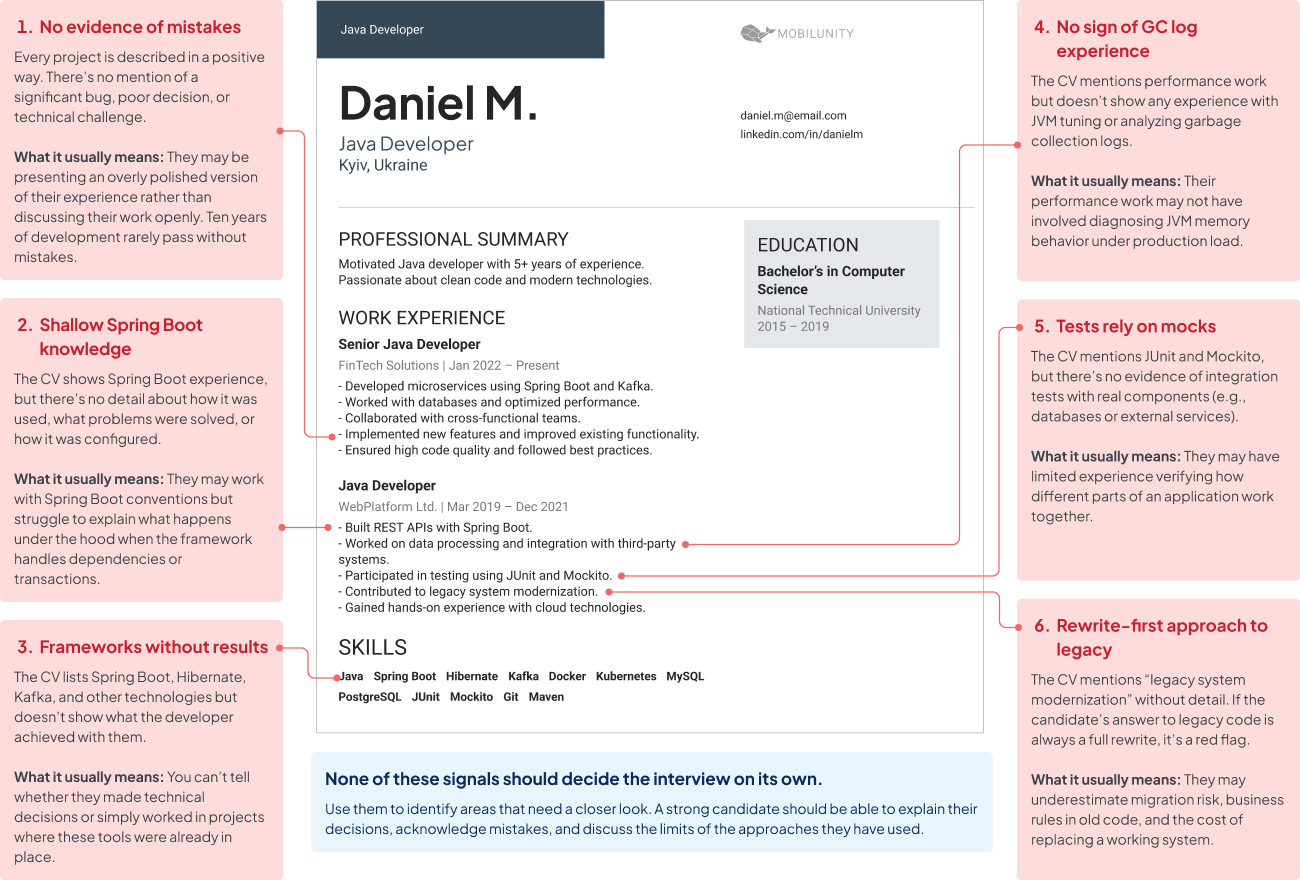
1. Their CV Lists Frameworks but Not Results
What you see: The CV names Spring Boot, Hibernate, Kafka, and other technologies but says nothing about what the developer achieved.
What it usually means: You can’t tell whether they made technical decisions or simply worked in projects where those technologies were already in place.
2. They Can’t Name a Bug They Caused
What you see: An experienced developer can’t recall a significant bug, poor decision, or technical mistake from their previous projects.
What it usually means: They may be presenting an overly polished version of their experience rather than discussing their work openly. Ten years of development rarely pass without mistakes.
3. They Know Spring Boot but Can’t Explain What It Does
What you see: The candidate works comfortably with Spring Boot conventions but struggles to explain what happens when the framework handles dependencies or transactions.
What it usually means: Their knowledge may be enough for familiar tasks but weaker when framework defaults stop producing the expected behavior.
4. They Claim Performance Experience but Have Never Read a GC Log
What you see: The candidate highlights Java performance work but has never examined a garbage collection log.
What it usually means: Their performance work may not have involved diagnosing JVM memory behavior under production load.
5. Their Tests Rely Almost Entirely on Mocks
What you see: Their examples contain unit tests with mocked dependencies but no integration tests against databases or other real components.
What it usually means: They may have limited experience verifying how different parts of an application behave when they run together.
6. Their Answer to Legacy Problems Is Always a Rewrite
What you see: When discussing difficult legacy code, the candidate repeatedly proposes replacing the existing system with a new one.
What it usually means: They may underestimate migration risk, business rules hidden in old code, and the cost of replacing a working system.
None of these signals should decide the interview on its own. Use them to identify areas that need a closer look. The same principle applies when you hire a C# developer or recruit for another backend technology. Strong candidates should explain their decisions, acknowledge mistakes, and discuss the limits of approaches they have used.
How Long It Takes, Brief to First CV
Java is one of the faster technology stacks for us to staff. We typically match clients with suitable candidates within 3-5 business days. In most cases, we share the first relevant CV within five business days, and often sooner.
The full hiring process usually takes 3-6 weeks. The exact timeline depends on the role requirements, interview stages, and how quickly you make hiring decisions.
Week 1: Define the Role and Meet the First Candidates
On day one, we discuss your project, technical requirements, and the seniority level you need. Once we agree on the candidate profile, our recruiters start the search. During the first week, we source and vet Java developers and send suitable CVs for your review. We typically match clients with candidates within 3-5 business days.
Weeks 2-4: Interview and Select Your Developer
You interview the shortlisted candidates and assess their technical skills and fit with your team. We coordinate each stage and can support technical interviews when additional Java expertise is needed. Once you choose a candidate, we handle the offer and contracting process. The timeline at this stage also depends on how quickly you provide feedback after interviews.
Weeks 5-6: Contract and Onboarding
For dedicated hires, the final stage covers contracting and preparation for the developer to join your team. We typically complete these steps during weeks five and six. Java itself rarely slows the search. Requirements such as fintech experience, specific domain knowledge, location restrictions, or on-site work can reduce the available candidate pool. For a standard remote Java role, you can expect the full process to take around 3-6 weeks. You’ll usually receive the first matching candidates much earlier, often during the first week.