Hire Developers in Hungary


Key takeaways:
A React Native development company can build and maintain your iOS and Android apps with one development team. When evaluating React Native development companies, check what they’ve released recently. Since August 31, 2026, Google Play has required new apps and updates to target Android 16 (API level 36), with some exceptions. Ask potential developers whether they’ve successfully released an app or update under these requirements.
Recent projects tell you more than an impressive portfolio. Find out which React Native versions the developers have worked with and how they handle native modules and framework upgrades. Ask who takes responsibility when an app store rejects a release. You’ll also need to decide whether you want a company to manage the project or dedicated developers to join your existing team. The right choice depends on your technical resources, your app’s current state, and how much control you want over development.
Some companies want to build a new mobile app, while others need support with maintenance or major upgrades to an existing product.
Each project calls for different skills, timelines, and levels of involvement from the development team.
The type of work determines which developers you need and how they will work with your team.
1. Full App Development
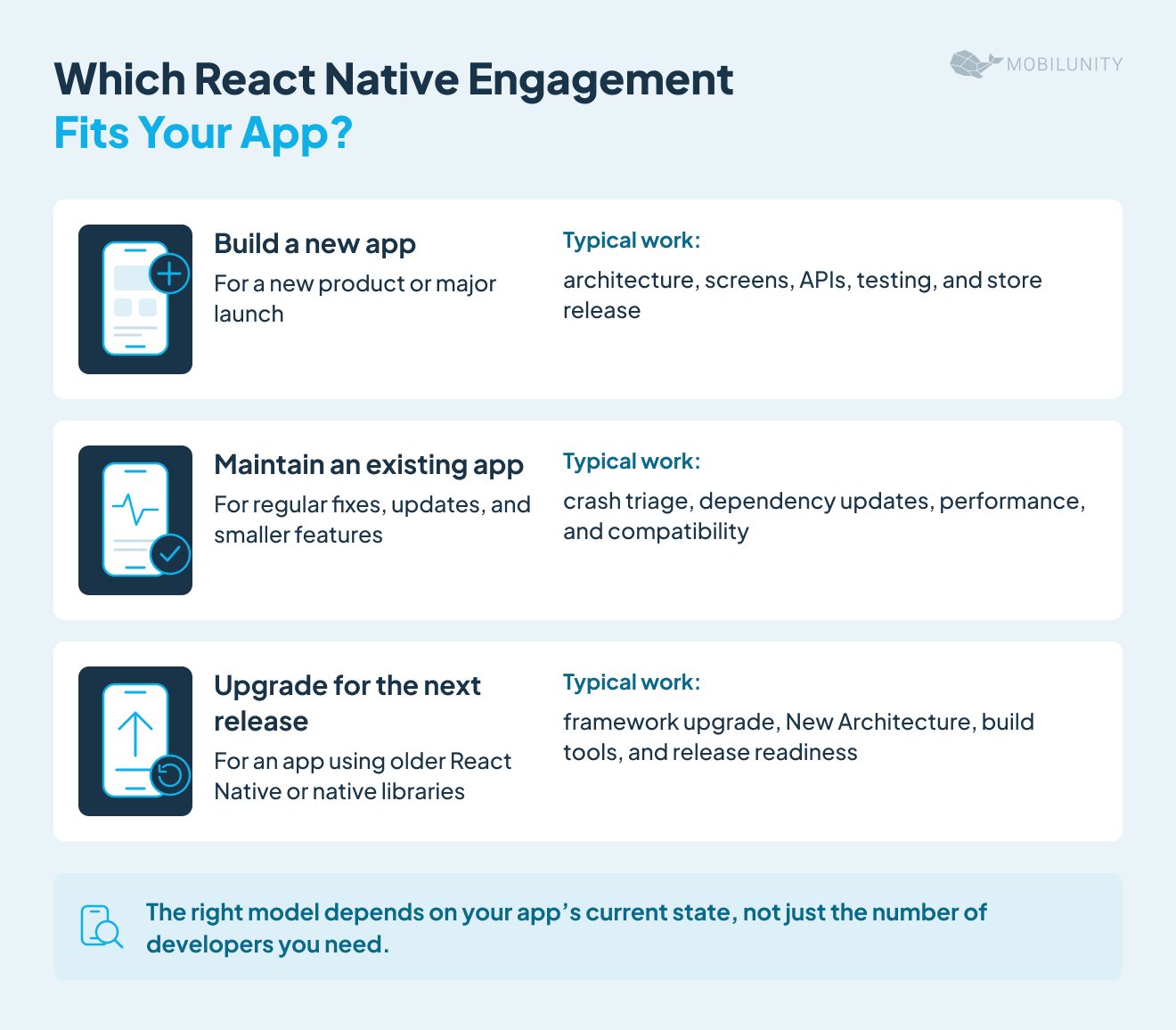
Full app development suits startups building their first mobile product or established companies launching a new app.
Developers take the app from initial setup to release. Their work covers architecture, interface development, API integrations, testing, and submission to the Apple App Store and Google Play.
Depending on the project, you may also need UI/UX designers, backend engineers, and QA specialists. A React native app development company can manage the entire project, or you can hire dedicated developers to work under your own technical lead.
2. Ongoing Maintenance
Ongoing maintenance works for companies that already have a React Native app but need extra developers to keep it running.
Typical tasks include:
Most apps don’t need a large team for routine maintenance. One or two experienced developers may be enough, depending on the app’s complexity and workload.
Working with the same developers over time also has its advantages. They get to know the codebase, which makes it easier to investigate problems and deliver updates.
3. React Native Upgrade Projects
Some React Native apps still work well but run on outdated framework versions or native libraries. These applications may need a technical upgrade before their next release.
Developers may need to update React Native, move to the New Architecture, replace incompatible libraries, or modify native iOS and Android code. They must also check whether the changes affect navigation, animations, device permissions, or third-party integrations.
Unlike routine maintenance, an upgrade has a specific goal. The project can end once the updated application passes testing and is ready for release.
React Native upgrades have become a common task for development teams. Apple and Google regularly change app store requirements, and older tools or libraries can make publishing updates difficult.
The New Architecture can also cause compatibility issues. Apps that rely on older native modules may need code changes before developers can upgrade React Native.
As a result, an app may work perfectly well for existing users but struggle to meet the requirements for its next release.
That doesn’t mean the company needs to rebuild it. A technical review can show which framework versions, libraries, and native components need updating.
Mobilunity’s dedicated development teams model works well for companies building new apps or maintaining existing ones over time.
Developers work directly with the client’s team, while Mobilunity handles recruitment, candidate screening, HR interviews, and onboarding. Its support continues after developers join the team, with HR assistance, back-office services, and annual performance reviews. Mobilunity can also help with technical interviews upon request. The client remains in charge of daily tasks, technical decisions, and project delivery.
Dedicated developers can also handle framework upgrades, particularly when the work requires several specialists over several months. For smaller upgrades, one experienced React Native developer may be enough.
React Native developers do more than build app screens and connect APIs. They also fix technical issues, maintain existing features, and prepare updates for release.
The work you need depends on your app’s current state, technical requirements, and the expertise available within your team.
Feature development. Developers add new screens, navigation, and API integrations or improve existing features. They also write tests to catch problems before release.
Framework upgrades. Developers update React Native and third-party libraries to keep applications compatible with newer versions. Larger upgrades may also require changes to native code and project settings.
Native module development. Some features require direct access to iOS or Android functionality. Developers use Swift, Objective-C, Kotlin, or Java when existing React Native libraries cannot support those requirements.
App store submission and release management. Developers prepare builds, configure app settings, fix submission errors, and help publish updates to the Apple App Store and Google Play.
Performance optimization. Developers investigate slow startup times, lagging screens, and excessive memory use. They use profiling tools to find the cause and check whether their fixes improve performance.
Crash triage. Developers examine crash reports, reproduce errors, and fix the underlying problems. They also check which devices, operating system versions, or app releases are affected.
Some mobile features require skills that go outside standard React Native development.
For example, home screen widgets, advanced device integrations, and newer operating system features may need native iOS or Android code. If React Native doesn’t support a feature through an existing library, developers must build the native functionality themselves.
For Apple-specific projects, offshore iOS development offers direct access to Swift and Apple’s frameworks. For Android-specific requirements, offshore Android development relies on Kotlin, Java, and the Android SDK.
Some React Native developers are comfortable with native code, while others mainly work with JavaScript and TypeScript. Check their experience with the specific platform features your app needs before hiring.
Before hiring React Native developers, decide who will manage the app’s builds and releases.
Tools like Expo EAS Build can simplify creating iOS and Android builds. However, developers still need to configure the project, manage credentials, and prepare releases.
Make sure your agreement answers two questions:
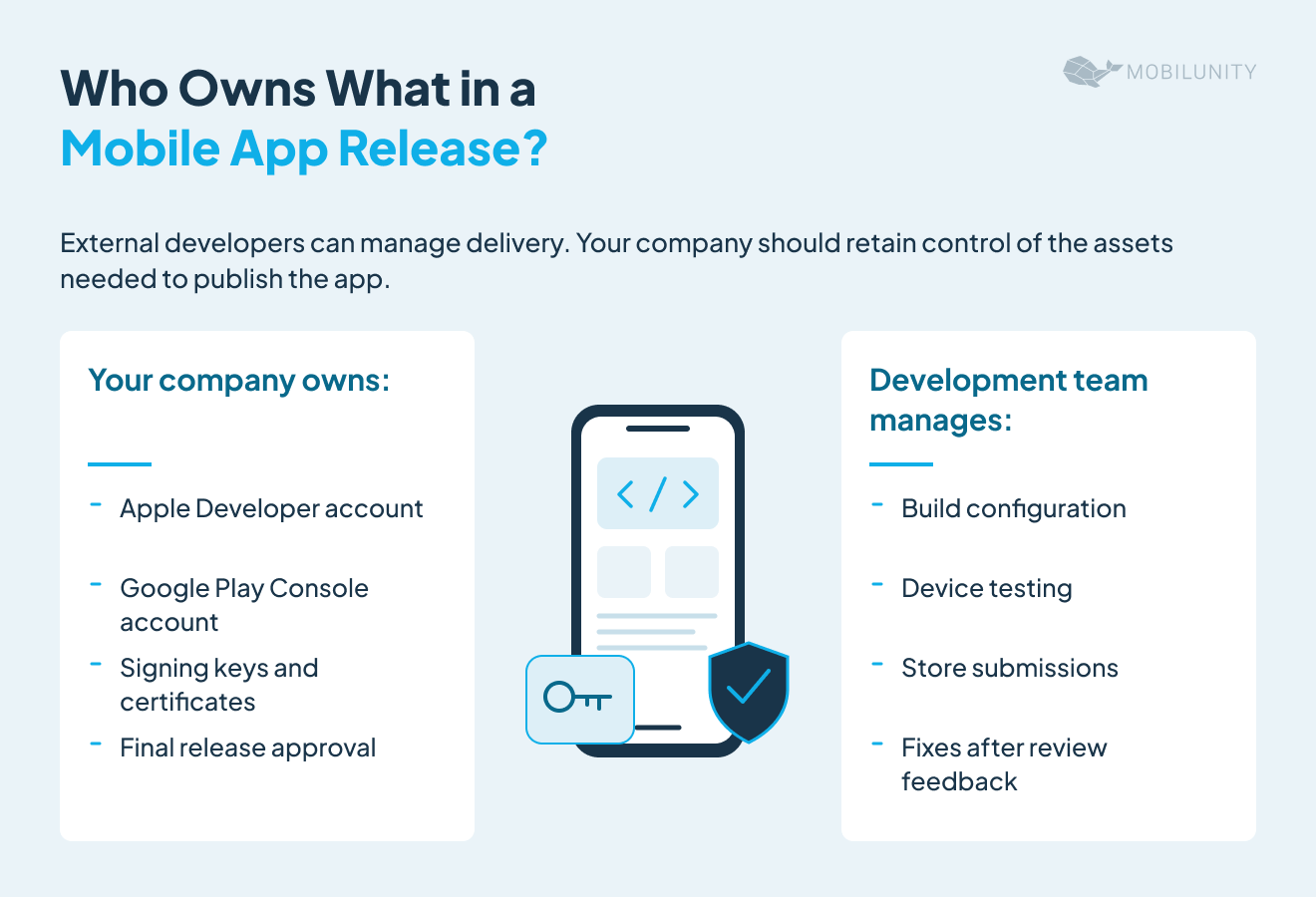
Your company should own its app store accounts and signing credentials, even if external developers handle submissions.
Agreeing on these responsibilities early can help avoid delays when the app is ready for release.
The cost of a React Native team depends on the project’s scope and the developers’ experience. Building a new app usually requires more resources than maintaining an existing one. Framework upgrades may need a smaller team, but developers with stronger native iOS and Android skills.
According to Mobilunity’s September 2026 recruitment team research, monthly costs range from $2,750-$3,800 for junior React Native developers, $3,750-$6,000 for mid-level developers, and $5,950-$7,500 for seniors.
These figures represent what clients pay Mobilunity, not developer salaries. Your total monthly cost depends on team size and developer seniority.
According to Glassdoor, senior React Native developers in the US earn between $100,000 and $170,000 annually in total pay, with a median of $129,000.
Employers also need to cover payroll taxes, benefits, recruitment, equipment, and other employment expenses. These costs add to the annual budget for an in-house developer.
With Mobilunity, companies pay a monthly rate for dedicated developers instead. Clients retain responsibility for technical decisions, daily development work, and project delivery.
Publishing a mobile app adds costs, whether you work with in-house or external developers.
You’ll need Apple and Google developer accounts, signing credentials, test devices, and a process for releasing updates. Apple’s Developer Program also charges an annual membership fee.
Your company should own its app store accounts and control the signing keys. Before starting work, agree on who will configure builds, test the app on devices, and handle store submissions.
These responsibilities can affect your budget and how quickly you can release updates.
When hiring React Native developers, working-hour overlap matters more than physical distance. Your team needs enough shared time to discuss technical issues, review code, and coordinate releases.
The right hiring model depends on how closely developers must work with your internal team.
In-house developers typically work the same hours as your product managers, designers, and engineers. They can discuss problems as they arise and coordinate releases directly with the team.
However, you still pay salaries, benefits, and other employment costs when the workload slows down.
Nearshore development works well when you need regular contact with your developers but don’t want to expand your local team.
For example, Kyiv is generally two hours ahead of London, so developers in both cities can work together for most of the day.
This makes it easier to hold daily meetings, review code, and resolve technical issues without long delays.
Offshore development can work just as well when developers and clients have enough shared working hours.
Kyiv is generally seven hours ahead of New York. This gives Ukrainian developers some overlap with US teams, particularly when they adjust their schedules.
Companies that outsource React Native development should agree on working hours before starting. What matters is whether developers can join meetings and resolve issues when needed.
Mobile app releases need some extra planning because Apple and Google decide when to review submissions. They may reject an update or request changes outside your developers’ working hours.
Before submitting an app, decide who will check store notifications, respond to review issues, and arrange urgent fixes.
This applies to both local and offshore teams. Someone should be responsible for the release until the app is approved.
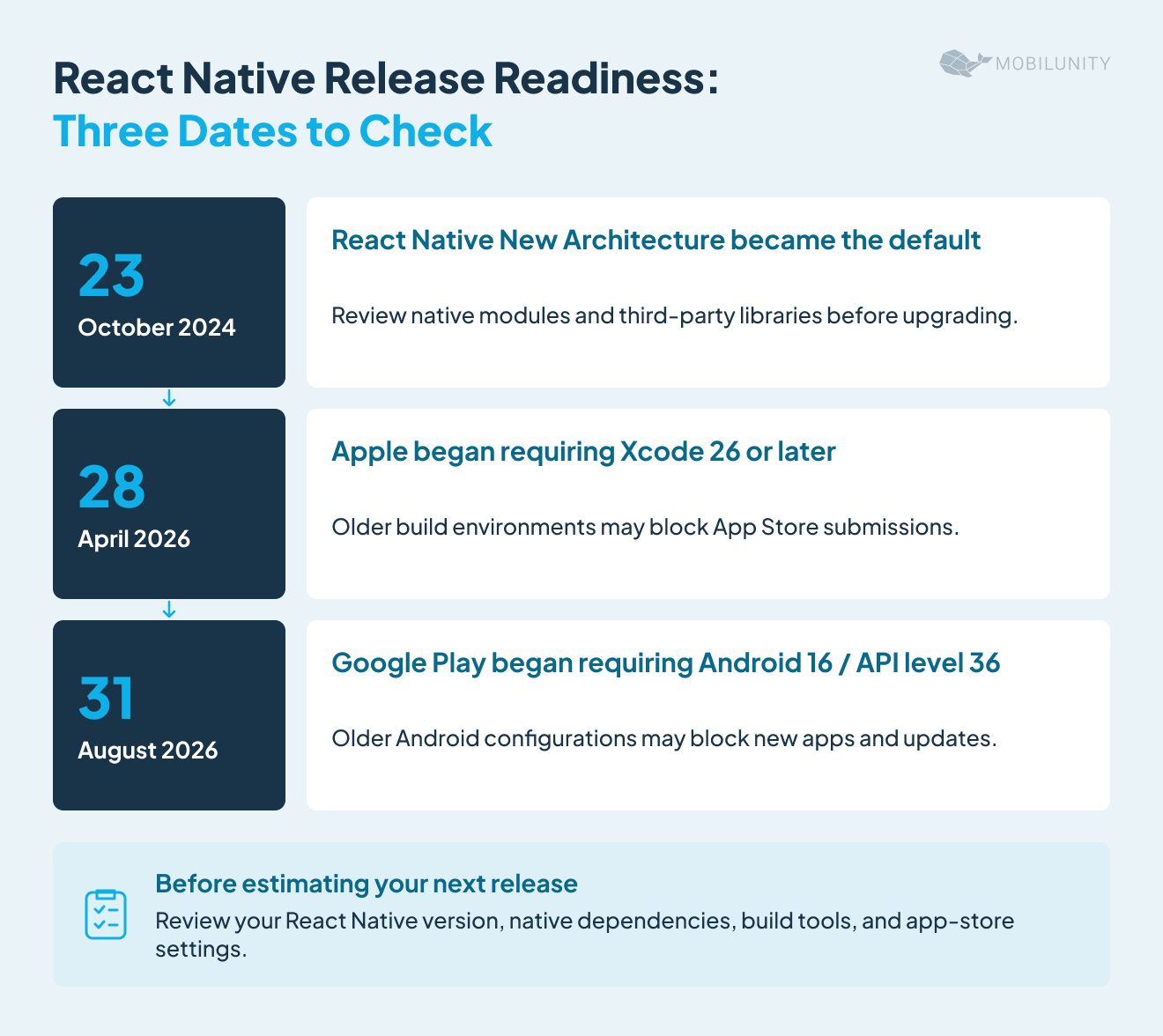
An older React Native app may still work well for users but no longer meet the requirements for publishing updates. Google and Apple introduced new submission requirements in 2026, so developers may need to update their tools and project settings.
Apps built with older React Native versions may also need changes to native libraries before developers can upgrade the framework.
| Date | Requirement | What It Can Block |
| October 23, 2024 | React Native 0.76 introduced the New Architecture as the default | Upgrades involving incompatible native modules and third-party packages |
| April 28, 2026 | Apple requires App Store Connect uploads to use Xcode 26 or later | iOS submissions built with older Xcode versions |
| August 31, 2026 | Google Play requires new apps and updates to target Android 16 (API level 36) | Android submissions targeting older API levels, unless an exception applies |
These requirements affect different parts of the development process. Apple and Google set submission rules, while React Native’s architectural changes affect framework compatibility.
Since August 31, 2026, Google Play has required new apps and updates to target Android 16 (API level 36), with some exceptions. Google outlines these rules in its target API level policy.
For older React Native apps, meeting this requirement may take more than changing a project setting. Developers need to check whether the framework version, Android build tools, and native libraries support API 36.
They must also test how the update affects permissions, notifications, and other Android features.
Since April 28, 2026, Apple has required developers to use Xcode 26 or later for App Store Connect submissions. You can find the details in Apple’s submission requirements.
An app built with an older Xcode version may still run on an iPhone, but developers may not be able to submit the next update.
To meet the new requirements, teams may need to update Xcode, React Native, CocoaPods dependencies, and native libraries. They should also check whether their existing build systems support these tools.
On October 23, 2024, React Native 0.76 made the New Architecture the default. The change introduced a different foundation for communication between JavaScript and native code.
Applications on older React Native versions may encounter compatibility problems when upgrading. Third-party packages deserve particular attention, especially those that depend on native modules.
Developers should check whether these libraries support the target React Native version. Some may need upgrades, replacements, or changes to their native implementations.
The New Architecture itself is not an app store requirement. Its importance comes from the technical work involved in moving older applications to newer React Native releases.
If your app hasn’t received an update since early 2026, its build tools and settings may no longer meet current app store requirements.
You probably won’t need to rebuild the entire application. However, developers should review its React Native version, native libraries, build tools, and store settings before estimating the work.
You may need to budget for technical upgrades before adding new features. Ask developers to check what already meets the latest requirements and what needs to change before the next release.
A company’s portfolio may look impressive, but it says little about its experience with recent React Native updates. You also need to know whether its developers can handle technical problems in apps that people already use.
These six questions will help you evaluate potential providers, even without a technical background.
1. What Was the Last App You Released to Both Stores?
Ask which apps the company has recently published and when. You can check their update histories on the Apple App Store and Google Play.
If the company hasn’t released anything since early 2026, ask how its developers plan to meet the latest store requirements.
2. Which React Native Versions Have You Worked With?
Find out which React Native versions the company used in its last three projects. Ask whether those apps use the New Architecture.
Developers should be able to explain what they had to change during an upgrade and what problems they faced.
If they have little recent upgrade experience, consider requesting a technical assessment before committing to a larger project.
3. Who Owns the App Store Accounts?
Your company should own its Apple Developer and Google Play accounts, along with the signing keys needed to publish updates.
External developers can handle submissions, but your business must retain access to these accounts and credentials. Make sure you can switch providers without losing control of your apps.
4. Can You Show Me a Crash Reporting Dashboard?
Ask the company to show you a crash reporting dashboard from an existing app, with any sensitive information hidden.
Tools like Firebase Crashlytics and Sentry help developers track crashes and identify affected devices. Ask how the team investigates these reports and decides which problems need immediate attention.
Their answer should give you a better idea of their experience maintaining apps after launch.
5. What Happens When a Third-Party Package Is Incompatible?
React Native apps often rely on libraries maintained by independent developers. Some older packages may stop working after a framework upgrade.
Ask how the team would handle this problem. Developers should be able to explain when they would update a package, replace it, or modify its code.
6. Who Takes Responsibility for Releases?
Find out who will prepare production builds, submit updates, and respond if Apple or Google rejects a release.
Each release should have someone responsible for seeing it through. This is especially important when your internal team and external developers work in different time zones.
This is particularly important when working with React native consulting companies. Some consultants assess technical issues and recommend solutions but don’t handle development or app releases.
Before signing a contract, agree on what the provider will do and what your team will manage.
If a company can’t show recent projects or explain how it handles releases, ask for more evidence of its experience before making a decision.
React Native works well for many business apps. Its shared codebase lets developers build for iOS and Android without writing everything twice.
However, that convenience has limits. Some apps need closer integration with the operating system or more control over performance.
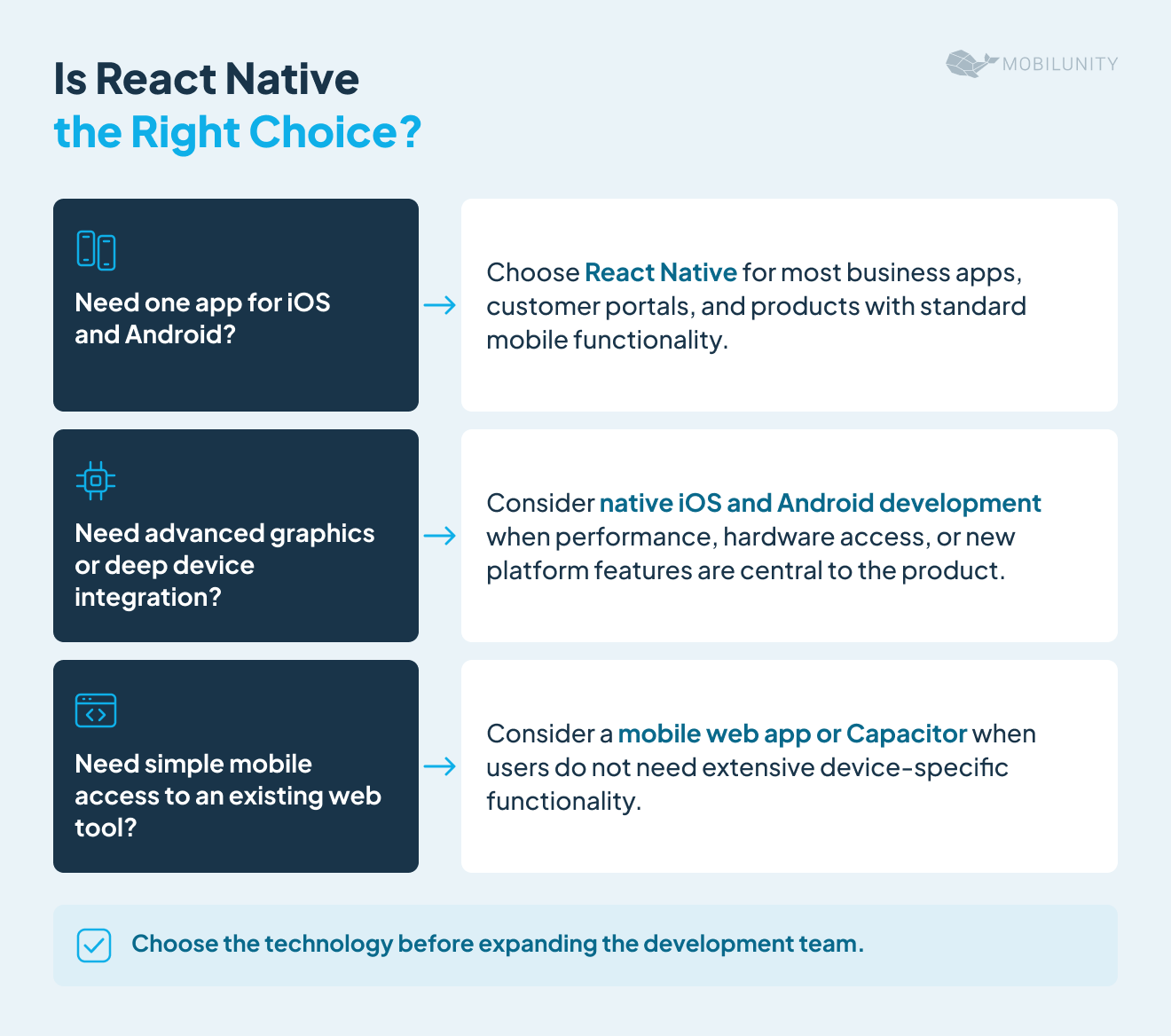
Native developers work directly with Apple’s and Google’s tools and APIs. They don’t have to depend on React Native libraries to access platform-specific features.
Native development may be a better choice if your app needs:
Native development is also worth considering when your app is central to your business.
Separate iOS and Android codebases give developers more direct control over performance and platform-specific behavior. For some products, that control justifies the cost of maintaining two development teams.
React Native isn’t the only way to build iOS and Android apps with shared code.
Flutter, Kotlin Multiplatform, and other technologies offer different ways to reuse code and access native features.
The right choice depends on your existing technology stack, your developers’ experience, and what your app needs to do.
For a closer comparison, read our guide to cross-platform frameworks compared.
Some business applications don’t need a dedicated mobile app. Internal dashboards, employee portals, and simple business tools often work well in a mobile browser.
If you already have a web application, you may not need to build a separate mobile product. Tools like Capacitor can package your existing app for mobile devices and provide access to certain native features.
This can be a practical option when your users need mobile access but don’t rely heavily on device-specific functionality.
React Native can save development time by sharing code between iOS and Android. However, developers still need to handle native dependencies and platform-specific issues.
Before you hire React Native developers, make sure the framework can support your app’s requirements.
If your product relies heavily on device hardware, advanced performance, or platform-specific features, consider native development first.
It’s usually easier and cheaper to make that decision early than to switch technologies halfway through a project.
Founded in 2010 and based in Kyiv, Ukraine, Mobilunity connects businesses with React Native developers for new apps, upgrades, and maintenance.
Unlike React Native development agencies that take charge of entire projects, Mobilunity provides dedicated developers who join your team. Your company makes the technical decisions, sets priorities, and manages delivery.
You can hire dedicated React Native developers to support your existing engineers or build a separate mobile development team. Mobilunity handles recruitment and administrative tasks, while you oversee the developers’ work.
This arrangement works well for companies with a CTO, engineering manager, or technical lead. It also suits businesses that need React Native expertise without setting up their own recruitment operations.
Its Zenchef case study describes a partnership that started in 2016. The French restaurant reservation platform needed more developers but faced high employment costs and difficulties recruiting locally. Mobilunity helped Zenchef build a dedicated development team in Ukraine and provides ongoing HR support to retain its specialists.
Among top React Native development companies, Mobilunity offers a staffing-focused option rather than a managed delivery service.
The difference is important. Mobilunity finds and supports dedicated developers, while your team manages the project, makes technical decisions, and oversees delivery.
For companies exploring where to find app developers, Mobilunity offers React Native specialists who work directly with their internal teams. It’s a good fit when you need more development capacity but want to keep control of your app.

Disclaimer: All salaries and prices mentioned within the article are approximate numbers based on the research done by our in-house Marketing Research Team. Please use these numbers as a reference for comparison only. Feel free to use the contact form to inquire on the specific cost of the talent according to your vacancy requirements and chosen model of engagement.