
Can I Outsource an FDE Team and Build It Offshore?


Key takeaways:
Companies need engineers who can do more than develop software. They need specialists who understand customer requirements, solve integration problems, and turn technical capabilities into working solutions. Forward deployed engineers (FDEs) combine these skills in one role.
Current job postings show what employers expect. OpenAI requires 5+ years of relevant experience for its FDE roles, while Palantir advertises forward deployed engineering positions across several countries. Databricks also seeks engineers with experience in production software development, systems integration, and direct collaboration with enterprise customers.
This article examines forward deployed engineer hiring trends through November 2026. You’ll learn what FDEs do, which skills employers prioritize, and how to define your own hiring requirements.
What is a forward deployed software engineer, and how does this role differ from traditional software development? A forward deployed engineer (FDE) works directly with customers or business users to understand their technical needs, develop or adapt software, and support its implementation. The role combines software engineering with customer communication and problem-solving.
For example, a company buys an AI platform and needs to connect it to its internal databases. The FDE meets with the customer’s technical team to understand their systems and requirements. They then write integration code, configure the software, test the connection, and fix issues before deployment. They also share customer feedback with the product team, especially when implementation reveals missing features or technical limitations.
Unlike general software developers, who typically focus on building and maintaining a product, FDEs work on making that product function in specific customer environments. Their responsibilities also differ from technical support, which usually handles known issues, troubleshooting, and product guidance.
The forward deployed engineer definition may vary between employers, but the core responsibilities remain similar. When reviewing candidates, check whether their experience covers production coding, API integrations, customer discovery, and deployment ownership. These responsibilities matter more than the job title, especially when comparing engineers from consulting, implementation, and product development backgrounds.
Demand for forward deployed engineers appears to be growing in 2026. Companies need specialists who can turn software and AI products into working solutions for their customers.
The following 4 sources show how companies are recruiting FDEs, investing in deployment teams, and defining the skills these engineers need:
These findings provide useful context for understanding the FDE job market, but the number of advertised positions tells only part of the story. For employers, the priority is identifying the technical skills, customer-facing responsibilities, and deployment experience their projects require.
FDE forward deployed engineer job descriptions in 2026 show that employers expect more than strong programming skills. Companies such as OpenAI and Reveal Technology seek engineers who can work directly with customers, handle production deployments, and take responsibility for implementation results.
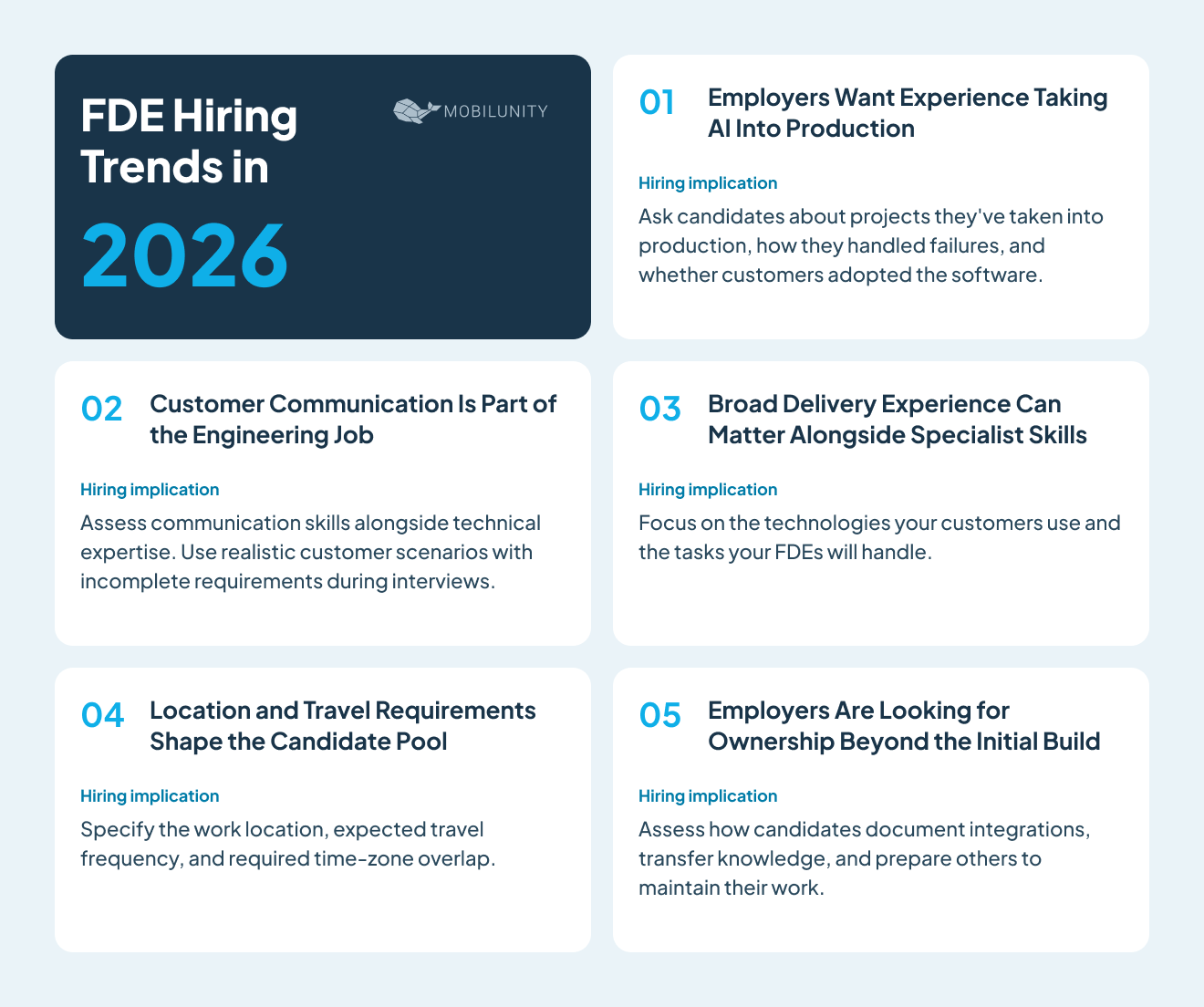
The following five trends highlight these expectations and explain how they should influence your hiring criteria.
OpenAI’s Forward Deployed Engineer vacancy in Seattle calls for engineers who can understand customer needs, design solutions, write code, and deploy software. The company also expects them to help customers adopt the technology and improve their workflows. A successful demo is only the starting point. Engineers must integrate software with existing systems, test it in real-world conditions, and fix problems that arise after deployment.
When interviewing candidates, ask about projects they’ve taken into production. How did they test the software, handle failures, and check whether customers actually used it?
FDE roles also exist outside AI. For example, Reveal Technology’s UK vacancy covers hardware integration, networking, and software deployment in operational environments.
What do forward deployed engineers do when working directly with customers? OpenAI expects FDEs to work closely with customers’ technical and business teams. Engineers need to understand what customers want to achieve, discuss technical requirements, and develop solutions that fit their systems.
Reveal Technology also looks for engineers who can explain technical decisions, understand user needs, and work with different stakeholders to resolve problems.
This means you should assess communication skills alongside technical expertise. Even an experienced developer may struggle with FDE work if they can’t ask the right questions or explain technical limitations to customers.
During interviews, give candidates a realistic customer scenario with incomplete requirements. See what questions they ask, how they approach the problem, and whether they can explain their solution to someone without a technical background.
Reveal Technology’s FDE vacancy lists Python, Go, C++, REST APIs, gRPC, cloud computing, and systems integration. OpenAI’s AI Infrastructure FDE role also requires experience with software development, debugging, testing, and deployment.
FDEs often work across several technical areas during a single customer project. For example, an engineer may need to develop an API integration, connect a database, configure authentication, and troubleshoot deployment issues.
When reviewing candidates, focus on the technologies your customers use and the tasks your FDEs will handle. You don’t need one engineer to cover every technical specialty. Complex security, infrastructure, or machine learning tasks may still require specialist support.
FDE positions vary in how much time engineers spend in the office, at customer sites, or working remotely. These requirements often depend on the product, customer needs, and the type of implementation work.
The forward deployed engineer role definition can also vary in terms of travel and on-site work. For example, OpenAI’s Seattle position requires three office days per week and up to 50% travel. Its Seoul vacancy has similar requirements. Reveal Technology’s UK position offers a hybrid arrangement but involves up to 20% international travel.
If you’re building a forward deployed engineering team, decide how much direct customer interaction each role requires. Some engineers may need to visit customer sites regularly, while others can handle integrations and technical support remotely.
Make these expectations clear in your job description. Specify the work location, expected travel frequency, and required time-zone overlap so candidates can assess whether the arrangement suits them.
What is the role of a forward deployed engineer after the initial implementation? OpenAI’s FDE description connects production deployment with adoption, customer feedback, and product improvements. Its FDE service description also emphasizes reusable solutions and transferring technical knowledge to customer teams.
Reveal Technology expects engineers to bring user feedback into product development and help turn prototypes into scalable products.
Hiring managers should also consider who will maintain the solution and support customers after deployment. Ask candidates how they document integrations, transfer knowledge, and prepare another engineer to maintain their work. Define who owns the code, documentation, and technical decisions after implementation.
This is especially important when external FDEs work on customer systems. Your internal team should understand how the solution works and be able to maintain it if an engineer leaves or the contract ends.
Start by answering a simple question: what does a forward deployed engineer do on your team? Identify the customer problems they’ll handle and the systems they’ll work with. This will help you focus on the skills the role requires rather than adding unnecessary qualifications.
The table below outlines what to look for in candidates and what your company needs to provide for them to do their job.
| Business Need | Evidence to Look for in a Candidate | Support Your Company Must Provide |
| Customer discovery | Experience gathering requirements asking technical questions, and defining project scope | Customer contacts, product documentation, and clear business goals |
| Software implementation | Examples of deployed integrations, production troubleshooting, and testing | Development environments, system access, and technical guidance |
| AI implementation | Experience with model APIs, evaluation, and production monitoring, if relevant | Approved AI tools, test data, and security requirements |
| Customer communication | Ability to explain technical decisions, discuss limitations, and handle unclear requests | Direct access to stakeholders and clear decision-making authority |
| Knowledge transfer | Documentation samples, handover experience, and maintainable code | Internal technical owner, code repositories, and handover procedures |
Match your requirements to the projects your FDEs will handle. For example, engineers who connect your SaaS product to customer CRMs need API and database experience, but may not need machine learning skills.
If your projects involve smaller integrations or standard deployments, there’s no reason to copy OpenAI’s job requirements. You risk overlooking qualified candidates because they lack skills your projects don’t require.
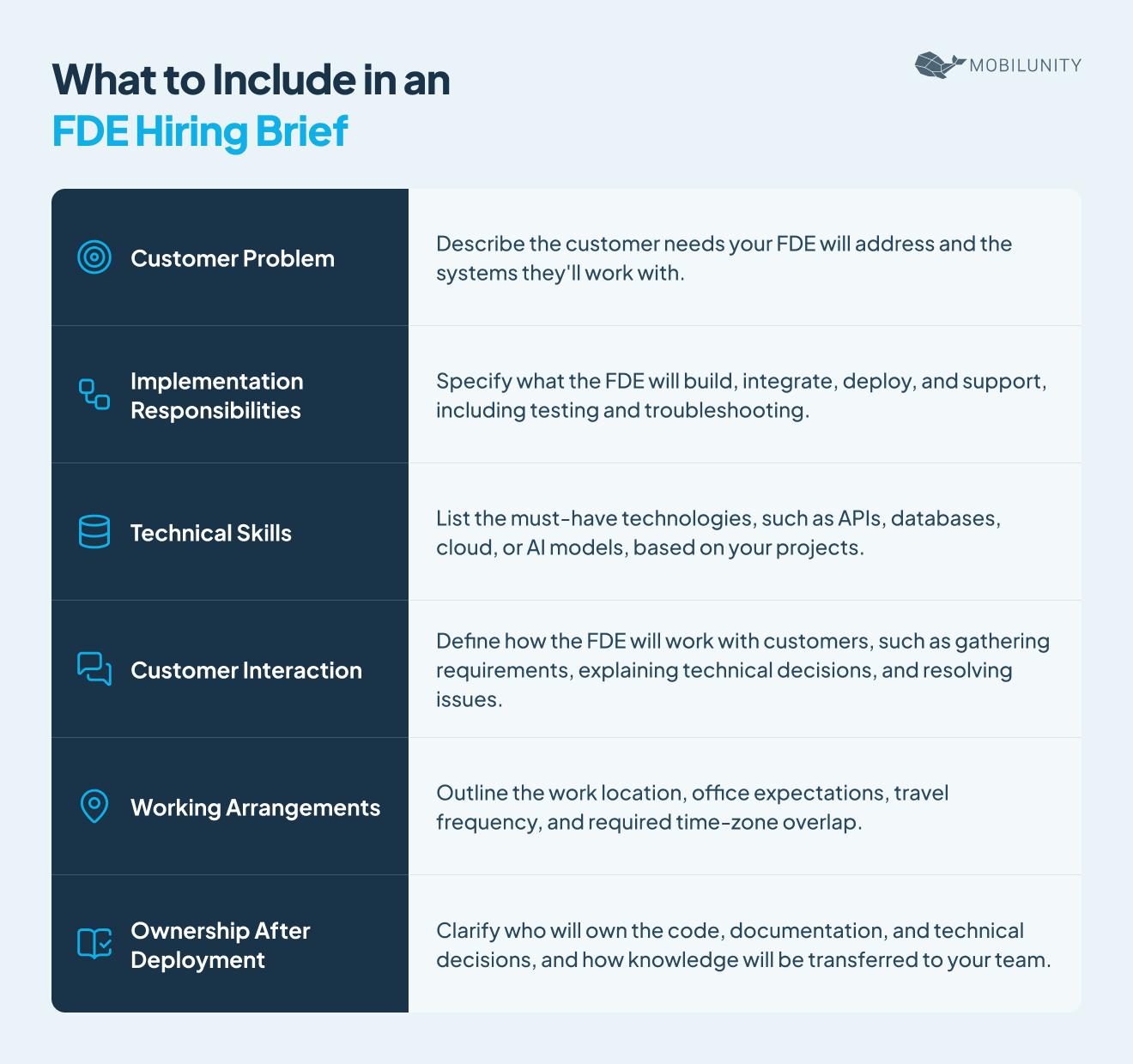
Before posting the vacancy, decide who will communicate with customers, approve technical decisions, and maintain the software after deployment. Make sure your job description reflects these responsibilities and that your team can provide the necessary support.
Your FDE may complete the implementation, but someone in your company needs to maintain the solution and handle problems afterward. This is particularly important when you use external forward deployed engineering services. It’s important to define forward deployed engineer responsibilities early, particularly where the engineer’s work ends and your internal team’s responsibilities begin.
The author of this Hyperadaptive article recommends keeping responsibility for customer implementations within your company. Otherwise, you risk losing important technical knowledge when the external engineer leaves.
Assign an internal product manager, engineering lead, or business owner to work with your FDE from the start. Make sure your team receives:
This doesn’t mean you need to create a new position or appoint a separate forward deployed engineer AI lead. An existing team member can take responsibility, provided they have the technical support and authority to make decisions.
The goal is to make sure your company can maintain the solution without depending on the engineer who originally built it.
At Mobilunity, we provide forward deployed engineers based your product, technical stack, and customer implementation needs. Our experience covers 16+ years in tech recruitment and more than 150 projects and clients from 30+ countries.
We start by discussing what forward deployed engineers are expected to handle on your project. These may include programming languages, API integrations, customer communication, location, and working-hour overlap. Based on these criteria, we identify forward deployed engineers for hire and evaluate their technical experience and communication skills. Across our recruitment operations, we report 2X faster talent acquisition compared to in-house recruitment.
Clients interview shortlisted candidates and decide who joins their team. Mobilunity can also assist with technical interviews when needed. We then coordinate onboarding and handle HR, payroll, and administrative tasks. The engineers work directly with the client, who sets daily priorities, oversees technical decisions, and manages customer projects.
We also help clients build dedicated software development teams or expand the existing ones. Our talent database includes 300+ pre-vetted AI engineers, and we’ve helped clients build or expand more than 20 dedicated AI teams. For projects that don’t require a full-time specialist, our FLEX model allows clients to work with skilled engineers part-time.
Our involvement doesn’t end when an engineer joins the team. We remain responsible for employment-related and administrative matters throughout the collaboration. Across our operations, Mobilunity reports a 94% employee retention rate and a 97% trial period success rate.
We can also discuss your technical requirements and team structure to see which collaboration model would work best for your project.

Disclaimer: All salaries and prices mentioned within the article are approximate numbers based on the research done by our in-house Marketing Research Team. Please use these numbers as a reference for comparison only. Feel free to use the contact form to inquire on the specific cost of the talent according to your vacancy requirements and chosen model of engagement.