

















 United States


 Latin America


 Eastern Europe












How to Hire Perl Developers: Skills, Interviews, Rates and Timelines
Most Perl work involves maintaining and extending existing systems rather than building new applications from scratch, so hiring usually calls for an experienced developer who can work safely in unfamiliar, legacy code.
Screen candidates for their ability to read and modify existing Perl, write tests for untested code, work with regular expressions and text-processing logic. They should be able to manage outdated dependencies without disrupting production. A practical code-review or debugging task is more useful than a CV alone for assessing these skills.
Hiring costs vary by seniority, location, and model: an in-house employee has salary and employment costs, while a dedicated team or freelancer can suit longer or defined project work. Hiring time depends on the role, candidate availability, and how quickly you interview and make decisions.
What a Perl Developer Actually Does on Your Project
Nobody hires for this work to build something brand new. The work belongs to one of five common types:
- Old web systems built before modern frameworks existed
- Science data pipelines, usually written once and rarely touched again
- Scripts that keep servers, backups, and deployments running
- Programs that process large volumes of log files and text
- Old finance or telecom systems
This kind of work shapes who is available to hire. People who know the language well have usually worked with it for many years, and few newcomers are learning it today.
Most candidates you meet will be experienced, and there is no large pool of beginners to hire at a lower price. Plan for a senior rate. A small pool does not mean an empty one, but the search takes longer, and the person you find will usually know your kind of system well.
If this hire is part of a bigger plan to build a remote team rather than fill one seat, it also helps to read about offshore development destinations before you commit to a region.
Decide What You Are Hiring Before You Write the Job Ad
Before you write a Perl developer job description, decide which of three situations you are in. Each one calls for a different kind of person, and years of experience with the language will not tell you who fits which.
If you only need the system to keep running, look for someone who has maintained old code for years. They should be able to fix a bug or make a small change without breaking what already works.
If you plan to move off the language, you need a different profile: a strong developer who understands the old system well enough to explain it, and who can also write in the language you are moving to. A legacy web application, for example, might move to PHP, so you might need to cross-search Perl and PHP developers for a better match.
Looking for a similar specialist in a different stack? Our guide to hire developers by technology covers other legacy and niche languages the same way.
If you plan to keep the system and add new features, look for someone who is comfortable working inside old code and extending it carefully. They should add the feature without rewriting everything around it.
Once you know your situation, write the ad to match. A generic ad attracts generalists. One that names the real system and the real problem, such as no tests, a stalled migration, or one person who holds all the knowledge, attracts people who have solved that problem before.
The Five Skills to Test For, and How to Test Each
A good Perl developer screening process should reveal how someone works with a system they did not design. Syntax questions are easy to prepare for. More useful tests involve incomplete information, old dependencies, unexpected behavior, and changes that could break something important. You do not need to be a Perl expert to run the first screening round, especially for simple IT staff augmentation. Give candidates a small piece of realistic material and ask them to explain their reasoning as they work.
Reading Someone Else’s Twenty-Year-Old Script
This is the most important skill on this list, and no other stack really tests for it the same way. Give the candidate a real, messy script (anonymized, if it is yours) and ask them to explain out loud what it does and why parts of it might be written the way they are. Good candidates describe the big picture first, then point to the one part that matters most. Weak candidates start critiquing the formatting before they understand the logic.
Ten-minute check: do they ask questions about the system, or start rewriting it in their head?
Regular Expressions at Production Scale
Anyone can write a pattern that matches a test string in an interview. What actually matters on the job is whether a candidate can find the bug in a pattern someone else wrote years ago, with no notes attached and real data flowing through it.
Ten-minute check: give them one input that should fail the pattern, ask them to predict the result, then check it together and see if their reasoning holds up.
Dependency Archaeology on CPAN
An outside library last touched in 2009 will eventually break, and someone on your team has to decide what to do about it: fix it, create an independent copy, or replace it. This decision comes up far more often in this stack than in most modern ones, since so much of the ecosystem is old.
Ten-minute check: show a real, abandoned library’s bug list and ask the candidate to pick a path forward, not write a fix.
Modern Practices Versus Decades-Old Habits
Good code today turns on safety checks by default, and a strong candidate should have a real opinion on how they structure new code, even if the answer is “it depends on the codebase.” This matters because plenty of candidates learned the language before these habits became standard, and never updated.
Ten-minute check: show a snippet missing those safety checks and ask what could silently go wrong before they add them back in.
Testing Legacy Code That Has None
The real task is never “write tests first.” It is “add a safety net to code you do not fully understand yet, then change it without breaking the parts you never touched.” Ask a candidate to describe their order of operations, not to recite testing theory in the abstract.
Ten-minute check: ask what single test they would write first, if they only had time for one before a risky change.
Six Interview Questions, and What a Good Answer Sounds Like
Once the technical screen is complete, the interview should move beyond language knowledge. Ask Perl developer interview questions that reveal how the candidate has actually worked with old systems, production incidents, unclear requirements, technical debt, and other people who depend on their work.
1. Tell me about the oldest or most difficult system you have had to maintain.
What to expect: A strong candidate should be able to describe the system, why it was difficult, what their responsibility was, and how they reduced risk while working on it. Listen for concrete details, not a list of technologies.
Weak-answer signal: They describe the language or framework but cannot explain the business problem, system constraints, or their own contribution.
2. Tell me about a change you decided not to make.
What to expect: Good developers understand that leaving something alone can sometimes be a deliberate engineering decision. Look for an explanation involving risk, cost, dependencies, business priorities, or insufficient evidence.
Weak-answer signal: Every problem becomes an opportunity for a rewrite or refactoring exercise.
3. What do you do when the documentation says one thing but the application behaves differently?
What to expect: A thoughtful answer should involve checking the running system, looking at logs or historical changes, talking to people who know the application, and documenting what is eventually confirmed.
Weak-answer signal: They automatically trust either the documentation or the code without investigating the discrepancy.
4. Tell me about a production incident where your first assumption was wrong.
What to expect: The candidate should be comfortable describing what they initially believed, what evidence disproved it, how they changed direction, and what they did afterward.
Weak-answer signal: They cannot remember a situation where their initial diagnosis changed, or they frame every incident as somebody else’s mistake.
5. How do you decide whether technical debt is worth fixing?
What to expect: Look for factors such as how often the problematic area changes, how much risk it creates, whether it slows delivery, whether it affects reliability or security, and what the business gets in return for the work.
Weak-answer signal: They treat all technical debt as equally urgent or argue that it should always be removed.
6. What would you want to know before taking ownership of a Perl system you have never seen?
What to expect: A strong answer may cover deployment, dependencies, runtime versions, databases, integrations, monitoring, backups, test coverage, documentation, known incidents, access, and who currently understands the system.
Weak-answer signal: They focus entirely on the source code and ignore the operational environment around it.
The goal is not to find candidates who give the “right” answer to every question. You are looking for evidence that they can investigate unfamiliar systems, communicate uncertainty, make trade-offs, and take responsibility for changes that affect production.
A 90-Minute Screening Task You Can Send Today
You do not need to read code to send a useful take-home task. Give the candidate a real, anonymized legacy script of 150 to 250 lines. It should have no tests and one small, hidden bug.
Ask for three things:
- a plain-English explanation of what it does
- one test that locks in the current, correct behavior
- a fix for the bug.
Use this marking guide to review the result without any Perl expertise:
| Area | What to Check |
| Explanation | The plain-English description is actually correct, not just confident-sounding |
| Testing | The test locks in behavior before the fix, not after it |
| Fix | The fix is small and targeted, not a quiet rewrite of everything around it |
| Communication | The explanation would make sense to you, a non-engineer, without extra help |
Use a real anonymized script, not actual client code. Tell the candidate up front what license the task is under, and that they keep their own work. Most candidates finish well under the 90 minutes given, and how they use the extra time tells you something too.
What It Costs: Rates by Region and the Real In-house Comparison
Cost here does not drop for junior hires, because there are almost no juniors to hire. You are paying for a rare skill: years of experience reading old code written in outdated language. Junior developers with this skill do exist, but they are rare, and few companies want to train a beginner on a system the business depends on.
Most searches therefore start at the middle level, and that is where pricing starts too. In practice, there is no cheap entry tier to bring your average cost down.
Perl Developer Monthly Gross Rates vs. Mobilunity Dedicated Model
Ukraine’s rates bundle compensation with recruitment, operational support, and infrastructure.
Perl Developer Monthly Rates in Ukraine
| Seniority | UA Gross Salary Rate (Monthly) | Monthly Cost with Mobilunity |
| Middle | $2,800 – $4,500 | $4,250 – $6,000 |
| Senior | $4,500 – $6,000 | $5,950 – $7,500 |
As per Mobilunity in-house tech recruiting team research done in September 2026
Global Regional Salary Benchmarks
For companies building in-house teams across key markets where nearshore and offshore clients operate, the gross monthly salary of Perl developers reflects the shortage of specialists in the local market.
Estimated Monthly Perl Developer Gross Salary Ranges by Region
| Region / Key Markets | Middle Perl Developer | Senior Perl Developer |
| North America (US) | $8,500 – $11,500 | $12,000 – $16,000+ |
| Western Europe (DE, FR, UK) | $4,800 – $6,800 | $7,000 – $10,200 |
| Eastern Europe | $2,800 – $4,500 | $4,500 – $6,000 |
Sources: Glassdoor US | Indeed Jobs | ZipRecruiter | DOU.ua. All figures checked September 2026.
What an In-House Perl Developer Really Costs
Base salary represents only a portion of total in-house costs. Mandatory employer payroll taxes, mandatory benefits, ongoing recruitment overhead, and bench time push the real employment load 20% to 45% higher than gross pay.
The table below highlights the estimated annual in-house costs across some of the key markets: US, UK, Germany, Switzerland, France.
Estimated Annual In-House Perl Developer Cost
| Country | Avg. Annual Gross Salary | Employer Taxes & Social Contributions | Estimated Benefits & Overhead | Recruitment & Bench Allowance | Total Estimated Annual In-House Cost |
| United States | $128,000 | $9,800 | $18,500 | $11,000 | $167,300 |
| Switzerland | $142,000 | $9,200 | $11,500 | $12,000 | $174,700 |
| United Kingdom | $78,000 | $10,500 | $4,800 | $6,500 | $99,800 |
| Germany | $74,000 | $15,600 | $3,200 | $6,000 | $98,800 |
| France | $68,000 | $24,800 | $2,100 | $5,500 | $100,400 |
Sources: IRS Publication 15 Employer Tax Guide | BLS Employer Costs Report | BMAS Social Insurance Guide | URSSAF Employer Rates Table | Swiss BSV Pension Portal | GOV.UK Employer Rates. Checked September 2026.
Salary is just the baseline cost of hiring a Perl developer. To see the true cost, you also have to account for taxes, benefits, and the time and effort it takes to recruit and keep them. When you add those up, a managed team is often much cheaper and easier than hiring in-house.
Dedicated Team vs Freelancer vs In-house Hire
Deciding how to hire Perl developers comes down to whether you want to spend months on job boards or get matched with proven talent in weeks.
In-house hiring is the slowest path, and it depends the most on your own network. A public job ad rarely brings in enough strong candidates on its own, so plan for weeks of searching before your first real interview.
Freelance is a genuinely good option here, more so than for most tech stacks. A lot of this work is small and self-contained: fix the bug, patch the pipeline, add one feature, done. If your need is a short list of clear tasks rather than ongoing ownership, a freelancer is often cheaper and faster, and that is true even though it argues against hiring a full team.
A dedicated team earns its cost when one person holds most of the system’s knowledge, and losing that person would genuinely hurt your business. Mobilunity’s own numbers show why this can work: 97% of consultants pass their trial period, and 94% of placed developers are still with their client a year later. Results vary by project, but that kind of track record is hard to get from a single freelance hire. Whichever way you hire Perl developer, budget real time for onboarding at a senior rate, since nobody moves fast on a system with no documentation.
| Dedicated Team | Freelancer | In-house Hire | |
| Cost structure | Monthly provider rate | Hourly or project fee | Salary plus employment overhead |
| Ramp time | Faster, from an existing bench | Often fast for scoped tasks | Slow: weeks to months to hire |
| Retention | Backed by a bench, not one person | Depends on freelancer availability | Concentrated in one person |
| IP and continuity | Defined in the service agreement | Must be addressed in the contract | Typically covered by the employment agreement |
| Management overhead | Partner handles day-to-day sourcing | Client manages scope and handover | Client manages both employment and delivery |
You can also compare this against a full dedicated development team if your workload needs more than one specialist. The right choice depends less on your budget and more on where the risk sits: in a system, in one person, or in a short list of one-off tasks.
Red Flags in a Perl CV and in the First Call
An impressive resume shows what a candidate is capable of on paper, but it can easily mask a lack of real-world fit, poor soft skills, or exaggerated achievements. None of these warning signs should automatically disqualify someone on the spot. Instead, treat them as map markers for your interview: areas where you need to ask targeted, probing questions to uncover the truth behind the text.
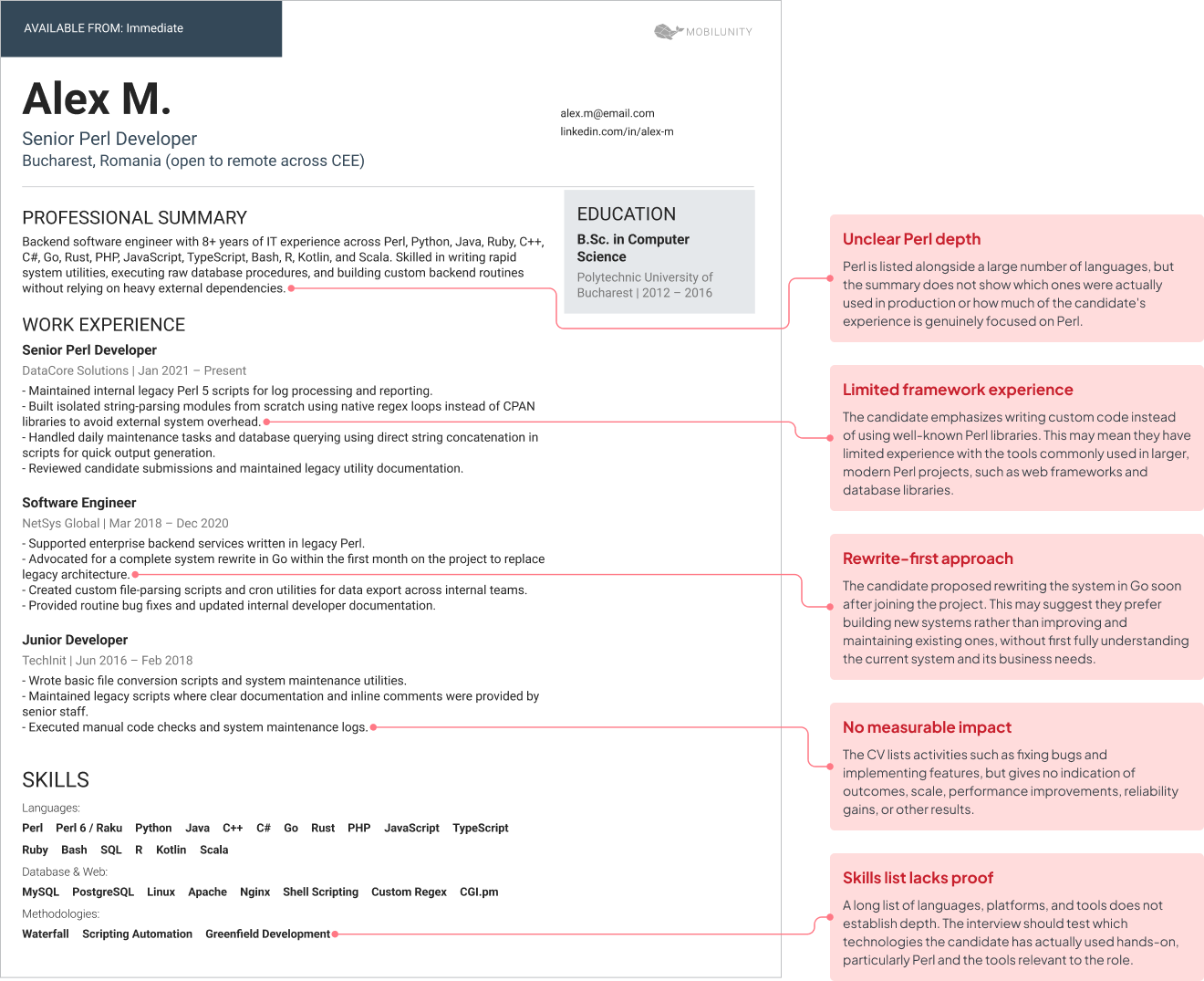
- Listed among fifteen or twenty other languages, with no real project named. This usually means passing familiarity, not real hands-on work.
- Cannot describe what an unfamiliar script does without asking for documentation first. This usually means they have only worked with their own code.
- Suggests a full rewrite on the first call, before asking what the system does. This usually means they want new work, not maintenance.
- No safety checks anywhere in their own sample code. This usually means old habits that were never updated.
- Has never used an outside code library beyond the basics. This usually means limited exposure to real, working production systems.
One flag alone rarely means much. Two or three together are worth digging into before you send the take-home task or book a final round.
How Long It Takes, Brief to First CV
Keep in mind that the pool is small, middle and senior, and mostly not looking for a new job.
Week 1: Requirements go out and sourcing begins. Most clients see their first CVs by around day five.
Week 2: Interviews run on your schedule. A good match moves straight to an offer.
Week 3 and later: If early candidates don’t pan out, the search keeps going based on what you tell us about why they weren’t right.
Two things can speed this up. First, consider a strong systems engineer willing to learn the language on the job, which opens up a much bigger pool. Second, consider a part-time or contract role, which many available candidates prefer. The first week after a hire usually goes to walking the new person through the parts of the system with no documentation, not writing new code.