Top-Rated Platform Engineering Services, Compared


Key takeaways:
To build an offshore platform engineering team, start with a specific problem your developers face, such as waiting two days for a test environment. Choose a team model based on how much of the work you want to manage internally, and name someone in your company to set priorities. Hire engineers who have solved similar problems, agree on working hours that overlap with your developers’, and give the new team the access it needs. Have one development team try the first improvement and use its feedback and results to decide whether to expand it.
It’s a team that builds and maintains shared capabilities your product developers use to release software: environment provisioning, deployment workflows, service templates and observability. The CNCF Platforms White Paper describes a platform as capabilities shaped around the needs of its users, and it says platform engineering teams should treat that platform like a product.
A simple example shows the idea. A developer needs a new service and picks an approved template. The repository arrives with a deployment pipeline and baseline monitoring already set up, instead of several tickets to different teams.
So what does a platform engineering team do day-to-day? Its engineers ask application developers where they lose time, work with DevOps and SRE specialists on pipelines and reliability, and agree on access and controls with security. Adoption is the test that matters, because a tool helps only when developers actually use it.
An offshore team is worth considering if at least one of these describes your company:
Your side of the deal matters just as much. You’ll need a technical leader who sets direction, regular access to the developers the platform serves, and time for code reviews. Someone also needs the authority to put shared work ahead of team-specific requests.
Location is the other factor. Offshore and nearshore describe distance from you. A nearshore platform engineering team works from a nearby region with closer hours, for example Eastern Europe for a German company or Latin America for a US one. Closer hours help when engineers need daily conversations with developers.
4 models cover most setups. They differ in who employs the engineers and who decides what they work on each week.
| Model | Who employs the engineers | Who manages daily work | Fits when |
| In-house team | Your company recruits, employs and manages them | Your company | You want internal employment and long-term ownership |
| Dedicated offshore team | A partner recruits, employs and supports them | Your company | You have a platform lead and need capacity or rare skills |
| Managed external team | The provider | The provider, within the agreed scope and service levels | You want to hand over agreed delivery or operations |
| Hybrid team | A mix of your employees and partner engineers | Internal leaders, with written ownership of priorities and technical decisions | You want to keep key decisions inside while adding people |
Choose by management capacity first. If someone on your side can run the backlog every week, a dedicated or hybrid model keeps control with you. If no one can, a managed team fits better, provided the agreement spells out scope, service levels and decision rights. For a closer look at that trade-off, compare IT staff augmentation vs outsourcing.
Continuity is the second filter. A platform engineering team builds knowledge about why each pipeline and template works the way it does, so models where engineers stay with you for years lose less of it.
Location fits into this choice rather than replacing it. A nearshore platform engineering team can work inside a dedicated or hybrid model, and only the time zone changes, not who owns the priorities.
A small starting structure is enough for a first project. Treat the split below as an illustration: the right size depends on the scope, the capabilities you already have and how many development teams the platform supports.
| Responsibility | Who could own it |
| Platform priorities and developer feedback | An internal engineering leader or designated platform product owner |
| Architecture and technical direction | A senior platform engineer or technical lead |
| Shared workflows and automation | Platform engineers |
| Security requirements and access reviews | Platform engineers working with your security owners |
| Platform reliability and support | Named platform or operations owners under an agreed support arrangement |
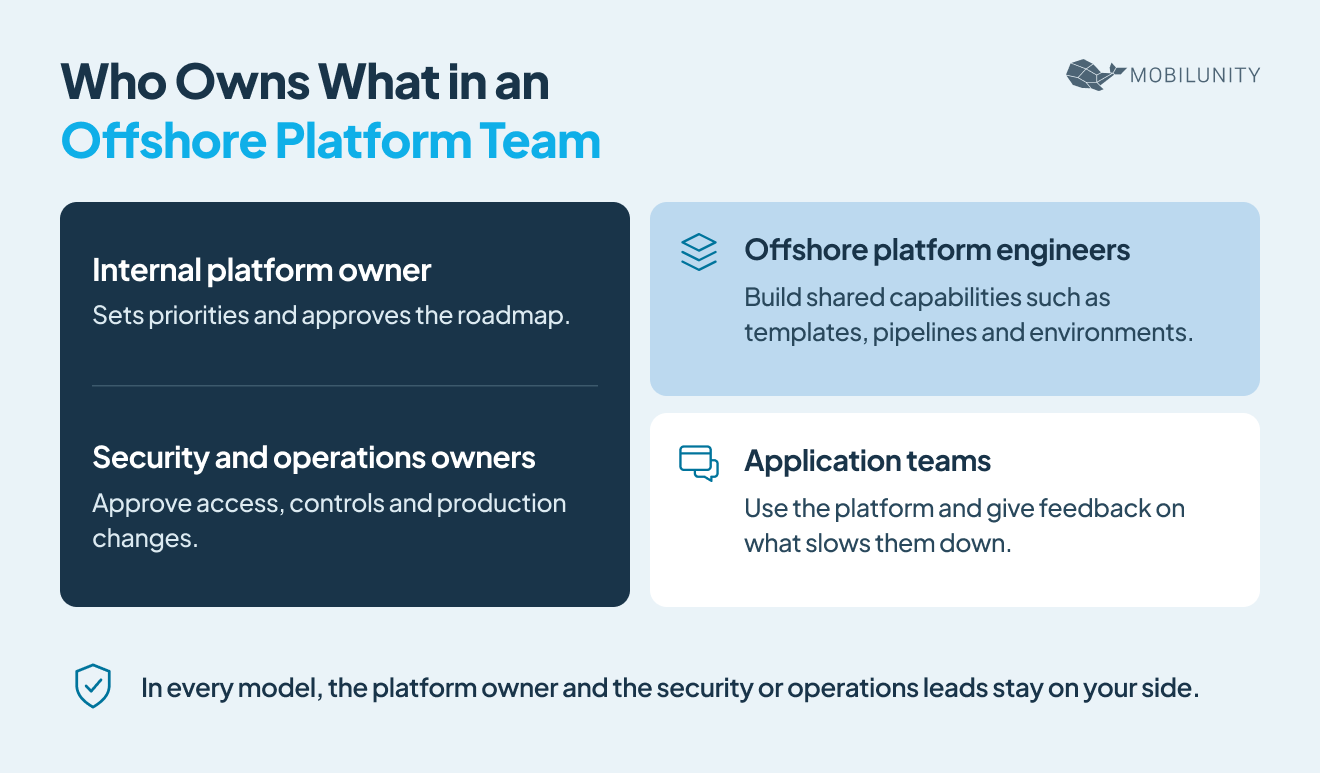
One person often covers several of these rows at the start. A senior platform engineer may set the architecture and still write most of the automation. An engineering manager may act as product owner until the work justifies a separate role.
Clear platform engineering team responsibilities also mean clear limits. Application teams keep ownership of their code, service-specific settings and product decisions, and they decide when to adopt a new template.
Before the team takes over production, agree on incident escalation, who writes and updates the documentation, and which hours support covers. Writing this down in week 1 saves an argument during the first outage.
The steps below take you from a single developer problem to a tested result. Each one is small, so you can adjust the plan before costs grow.
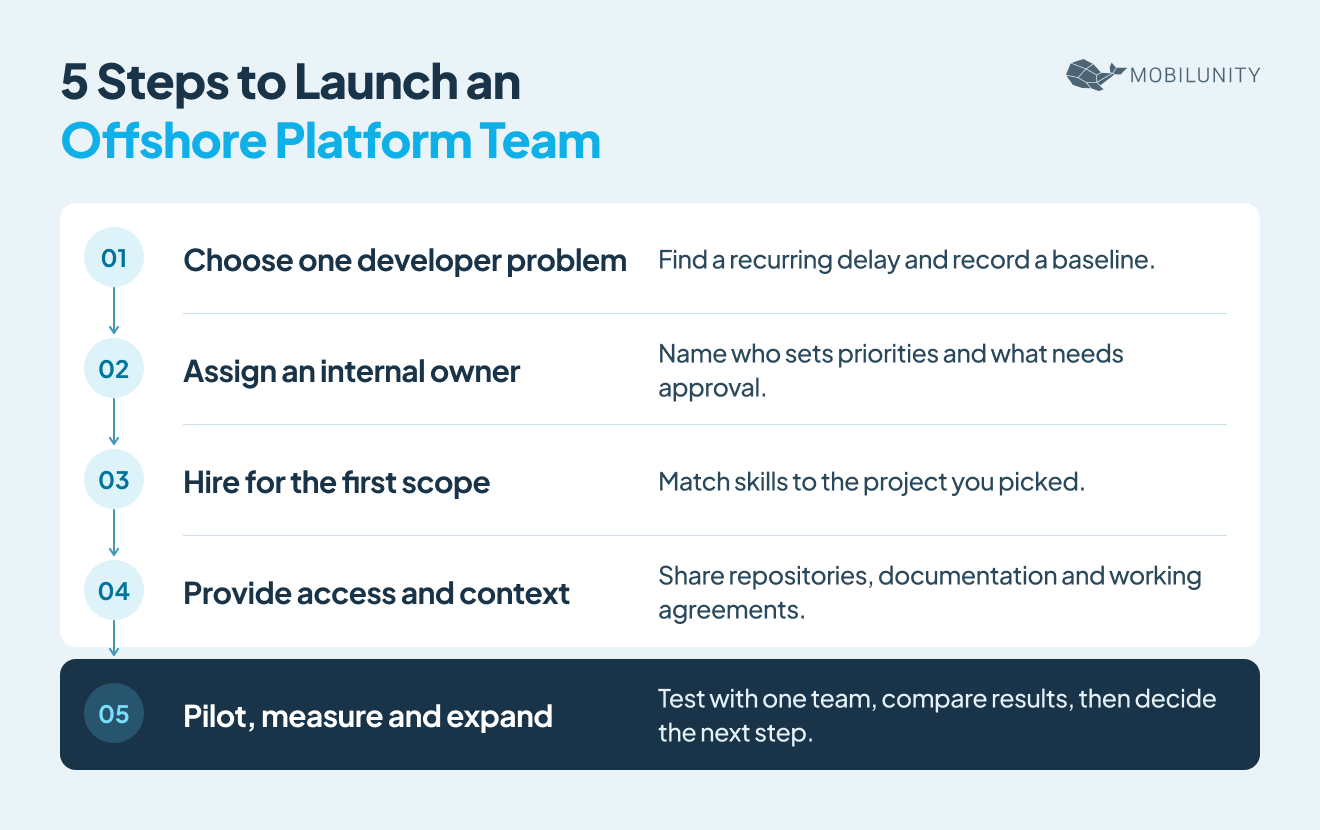
Start with interviews or a review of how work moves from commit to production. Look for a recurring problem, such as test environments that take days to provision or deployment pipelines that differ from team to team.
Then write down the first users, the scope, the current baseline and the improvement you expect, for example, cutting environment setup from 2 days to under an hour. Keep the project small enough to validate within a few weeks.
Name the person who prioritizes the backlog and settles disputed decisions. Then define what offshore engineers can change on their own, such as pipeline templates in a sandbox, and what needs approval, such as production network rules.
Agree in writing who owns infrastructure, security, releases and production support. Building a platform engineering team with these limits in place early avoids weeks of back-and-forth later.
Match skills to the project you picked. Standardizing deployments, for example, calls for CI/CD, infrastructure as code and experience working with developers who are used to their own scripts.
In interviews, ask what each candidate personally built on previous platforms, how they rolled it out, and whether developers adopted it. Someone who can describe adoption numbers or user feedback gives you a better signal than a long list of tools.
Give the team architecture documentation, repositories, infrastructure access, your security requirements and introductions to the developers they’ll serve. A checklist for onboarding a distributed team keeps this step consistent from one hire to the next.
Scope access to each engineer’s tasks, so a new hire working on pipelines doesn’t get admin rights to production databases on day 1. Then agree on shared working hours, written decisions, review practices and escalation contacts.
These habits are the core of managing remote teams, and they weigh more in platform work because every product team depends on what the platform engineers change.
Launch with one development team or one service. Collect feedback every week and compare the results with the baseline you recorded in the first step.
After the pilot, decide whether to improve the current capability, extend it to more teams or add a new one. Whichever path you take, an offshore platform engineering team should document its work and share knowledge as it goes, so nothing depends on one person.
Salaries or provider fees are only part of what a platform engineering team costs. Plan the budget around these groups:
Scope, seniority, weekly capacity and expected production coverage move the total most. When you compare offers, check what each engagement includes, and keep capacity for maintaining the platform after launch, since it needs upkeep like any product.
Tie a few measures to the problem you chose in the first step. These 4 work for most first projects:
Record a baseline before the pilot, then review usage and outcomes together. Say the team rolls out a new deployment tool to 5 teams. If 2 of them keep their old scripts and support requests stay flat, the rollout is finished but developers have gained little.
The benefits of platform engineering teams show up in these numbers over months, not days, so review them every quarter with the same teams.
Mobilunity provides platform engineering and DevOps consultancy tailored to your infrastructure, technical requirements, and project priorities. We assess engineers for relevant experience and can arrange a technical evaluation before assigning them to your project. They can help standardize deployment pipelines, automate test environment setup, or build shared tools for your development teams.
With our dedicated development team services, you define the requirements, priorities, and acceptance criteria. Our engineers work alongside your engineering team and adapt to how it collaborates, from technical reviews to project handoffs.
Mobilunity has 16+ years of experience in tech recruitment and a network of 5,000+ pre-vetted specialists. We share engineer profiles within 3-5 business days and typically assemble a dedicated team in 3 to 6 weeks. Our client partnerships average 4.2 years.
For a defined task, such as reviewing a deployment pipeline, Mobilunity can assign a FLEX consultant on a part-time basis, subject to availability and the agreed scope.

Disclaimer: All salaries and prices mentioned within the article are approximate numbers based on the research done by our in-house Marketing Research Team. Please use these numbers as a reference for comparison only. Feel free to use the contact form to inquire on the specific cost of the talent according to your vacancy requirements and chosen model of engagement.