
IT Recruitment Lithuania: Market Overview and Hiring Guide


Key takeaways:
The main distinction is who directs the work and oversees day-to-day execution. For context, a senior software developer in the US costs about $131,000-$160,000. Staff augmentation fits companies that already manage engineering work but need more capacity or specific skills. Managed services fit when you want a provider to manage a defined function and meet agreed service levels.
With staff augmentation, external engineers join your team, while your managers set priorities and direct their work. With managed services, you agree on the scope and expected results, while the provider decides how to deliver them. The right model depends on how much day-to-day control and delivery responsibility you want to keep in-house.
With staff augmentation, you’re adding engineers to a team you already manage. For example, two React developers join your sprints, take tickets from your backlog, and report to your tech lead. You decide what they work on, set priorities, and remain responsible for delivery. The provider employs the developers and handles the administrative side. This is the basic structure behind IT staff augmentation services.
With a managed service, the provider takes on more responsibility for the work. You agree on the scope and service-level agreement (SLA), rather than managing individual engineers. For example, a vendor may maintain a live product with a four-hour response time for production incidents and one monthly release. The provider manages the work and tracks performance against the agreed service levels.
Consulting is a separate model. Companies may bring in consultants for either specialized expertise or additional capacity. The second case is closer to staff augmentation, where external engineers expand a team you already manage.
The types of staff augmentation vary by project length, required skills, and how closely developers work with your team. The right option depends on the role and the support your team needs.
The main difference between IT staff augmentation vs managed services comes down to control and responsibility. With staff augmentation, you direct the engineers and manage their work. With managed services, the provider handles an agreed function and takes responsibility for the results.
The managed services vs staff augmentation decision comes down to control, delivery responsibility, cost structure, and what your team can manage internally.
| Factor | Staff Augmentation | Managed Services |
| Who directs the work | Your tech lead or engineering manager sets priorities and directs daily work | The provider decides how to organize and run the work within the agreed scope |
| Who owns the outcome | You remain responsible for delivery, deadlines, and the final result | The provider is responsible for delivering the agreed service and meeting the SLA |
| How it is billed | Usually per engineer per month or based on time worked | Usually a monthly fee for a defined scope and agreed services |
| Budget predictability | Costs generally rise or fall with team size and engagement length | The core fee is predictable when scope remains stable; ask how changes and work outside scope are priced |
| Time to start | Can start once suitable engineers are selected and onboarded | Usually requires scope definition, SLA agreement, and transition planning before service begins |
| What you need in-house | A tech lead or engineering manager with enough time to direct the external engineers | A service owner who can define requirements, review SLA performance, and manage the provider relationship |
| Where the knowledge lives | Engineers work inside your processes, but you still need documentation and knowledge sharing | Knowledge may sit with the provider, so ask what documentation and handover processes the contract requires |
| Who owns the IP | Depends on the contract. Ask how code, documentation, and other work products are assigned to your company | Depends on the contract. Confirm ownership of code, documentation, configurations, and other deliverables |
| Notice and exit | Check the notice period and what happens to access, documentation, and knowledge when engineers leave | Check termination terms, transition support, data return, documentation, and any exit fees before signing |
| Replacement when someone leaves | Confirm the replacement process, timeline, and whether additional fees apply | Staffing continuity is normally the provider’s responsibility, but confirm how the SLA covers key-person changes |
| Best for | Product teams that can manage delivery but need additional engineers or specific technical skills | Defined functions with measurable service levels that you want an external provider to run |
The key difference is how much responsibility stays with your team. With staff augmentation, you direct the engineers and remain responsible for delivery. With managed services, the provider takes responsibility for an agreed function and its results. Contract terms around knowledge transfer, replacements, and exit become especially important when the engagement changes or ends.
Consider a team that needs the equivalent of three senior software engineers for 12 months. Costs vary depending on whether you hire in-house, augment your team, or outsource a defined function.
For an in-house baseline, the BLS reported a median annual wage of $135,980 for US software developers in May 2025. Wages account for 70.0% of private-industry compensation, according to BLS Employer Costs for Employee Compensation data.
Dividing $135,980 by 0.70 gives an estimated loaded cost of about $194,000 per developer. For three developers, that’s roughly $583,000 a year before recruiting fees and management time.
With staff augmentation, the calculation is more direct: Mobilunity’s average rate is $6,000 per senior engineer per month (as of September 2026). For a team of three senior engineers, this comes to about $216,000 per year. Your own engineering managers still direct the developers and remain responsible for delivery.
A managed service requires a different comparison. You pay for an agreed scope and service-level agreement (SLA). Compare that fee with the cost of running the total cost of delivering the service, not the salary of one engineer. Depending on the scope, that may cover engineers, on-call coverage, tooling, and service management.
| Model | 12-Month Cost | What the Cost Covers |
| In-house team | About $583,000 | Three loaded US developer costs, before recruiting fees and management time |
| Staff augmentation | ~$216,000 | Three senior engineers provided by Mobilunity (estimate based on Mobilunity’s average monthly cost of $6,000 per senior engineer, as of September 2026) |
| Managed service | ~$624,000 | Illustrative three-FTE-equivalent capacity at Clutch’s reported $100-149/hour MSP range; actual pricing depends on scope, SLA, coverage, tooling, and change requests. |
The lowest monthly rate isn’t automatically the least expensive option. If your tech lead has little time to direct augmented engineers, that management requirement adds a real internal cost.
Both models can give you access to external engineering talent, but they divide control and responsibility differently. The better fit depends on what your team can manage internally and what you expect from the provider.
Staff augmentation gives you direct control over priorities and day-to-day engineering work. It also lets you add developers or specific technical skills without going through a full in-house hiring process.
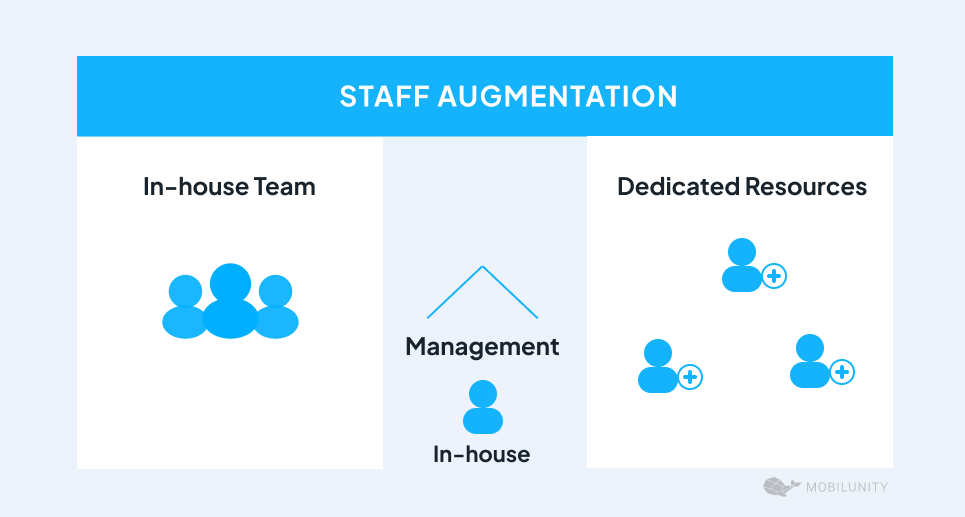
The trade-off is the management effort your team must provide. You onboard the engineers, assign their work, and bring them into your development process. Your company also remains responsible for delivery.
| Pros | Cons |
| Direct control over engineering priorities and daily work | Your team needs time to manage the engineers |
| Faster access to additional developers or specific skills | You handle project onboarding and knowledge transfer |
| External engineers work within your existing processes | Your company remains responsible for delivery |
With managed services, you agree on the scope, fee, and SLA, while the provider handles day-to-day delivery. This reduces the management work required from your engineering team.
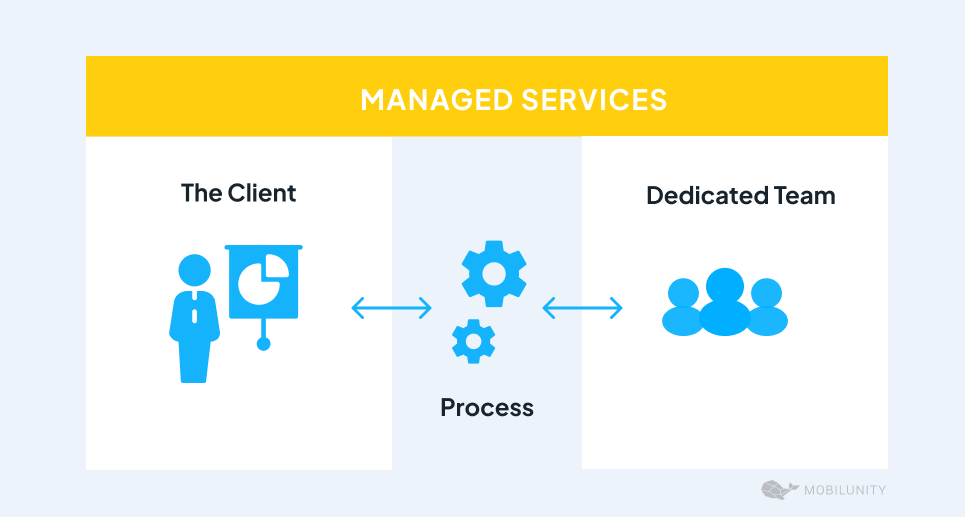
A defined monthly fee can also make costs easier to plan when the scope stays stable. However, you have less control over how the provider organizes the work. Requests outside the agreed scope may also come with additional charges.
| Pros | Cons |
| More predictable costs when the scope stays stable | Less control over daily engineering decisions |
| Provider is responsible for meeting agreed service levels | Changes outside the scope may cost extra |
| Less day-to-day oversight from your internal team | Important product knowledge may stay with the provider |
The SLA should define exactly what the provider must deliver. Broad terms such as “high-level monitoring” can leave key responsibilities unclear. Specify response times, coverage, responsibilities, reporting requirements, and service targets in the agreement.
For software companies, managed services usually cover a specific part of development or production operations. A managed services provider takes responsibility for that area under an agreed SLA rather than supplying individual engineers. In practice, software teams typically use this model across the five areas below.
Managed software development covers a defined development scope, such as ongoing product development or a specific product area. The SLA should define response times, delivery targets, and what the provider reports each month about releases, progress, and service performance.
Application maintenance and support covers production issues, bug fixes, updates, and ongoing application health. The SLA should define response times, resolution targets, and what the provider reports each month.
Managed QA puts an agreed part of the testing process in the provider’s hands. The SLA should cover response times for critical issues, testing or release targets, and monthly reporting on defects and test results.
Managed DevOps and cloud operations may cover deployments, infrastructure, monitoring, backups, and incident response. The SLA should define response times and recovery targets. Monthly reports should show relevant metrics for uptime, incidents, deployments, and infrastructure.
Managed security operations may include security monitoring, vulnerability management, and incident response. The SLA should set response times by severity, remediation targets, and monthly reporting requirements for vulnerabilities and incidents.
The SLA will vary by service, but it should clearly define what the provider is responsible for and how you will measure performance. Before signing, check what the provider will deliver, how you’ll track results, and what happens if they miss agreed targets.
The right model depends on your management capacity, how predictable the work is, and where you want responsibility to sit.
Choose staff augmentation when:
Staff augmentation gives you access to external specialists while your team keeps control over priorities, technical decisions, and delivery. Strong staff augmentation best practices, such as shared documentation and regular code reviews, also help keep knowledge within your team.
Choose managed services when:
With managed services, you give the provider more control over how the work is organized and delivered. This can reduce your team’s management workload, but it usually costs more and gives you less visibility into day-to-day decisions and internal findings.
The two models don’t have to be mutually exclusive. You might augment your product team with developers while a managed provider handles cloud operations or application support. This mixed approach can give you direct control where you need it and transfer responsibility where you don’t.
You don’t always need to choose one model for the entire engineering function. Some companies use staff augmentation and managed services alongside each other when different parts of the work require different levels of control.
For example, augmented engineers can work with your product team on the roadmap and new releases. A managed service can then handle maintenance, production support, or cloud operations for what the team ships.
A hybrid setup can also change as your needs evolve. You may start with augmented engineers while requirements are still changing, then move stable and measurable work into a managed service.
Before switching models or providers, check the contract terms that determine how much time and cost the transition will require:
| Contract Term | What to Check |
| Notice period | How much notice must you give before ending or changing the engagement? |
| Knowledge transfer | What runbooks, architecture notes, access lists, and other documentation must the provider hand over? |
| Transition overlap | Can the current and incoming teams work together during the handover? |
| IP assignment | Does your company retain clear ownership of code, documentation, and other deliverables? |
| Hiring the engineers | Can you hire people from the provider’s team directly, and does a conversion fee apply? |
The choice may also extend to outsourcing, where the provider takes on more responsibility for delivering the work. Our staff augmentation vs outsourcing comparison explains how the two approaches differ.
Team structure creates another decision. The dedicated vs extended team comparison can help you decide how closely external engineers should work with your internal team.
Whichever model you choose, think about the exit terms from the start. Clear handover requirements can make it easier to switch providers or move the work in-house without losing knowledge or disrupting the project.
Founded in 2010 and headquartered in Kyiv, Mobilunity focuses on staff augmentation and dedicated teams. The company has hired more than 1,000 tech professionals for client projects. It also holds a 4.8 rating on Clutch as of September 2026.
At Mobilunity, 97% of our consultants successfully complete their trial period. Over the past 12 months, we have maintained a 94% retention rate for placed developers across client projects, although results vary by client and project. Each client also works with a recruiter, resource manager, and account manager throughout the engagement.
The model gives clients direct control over engineering work. Mobilunity recruits and employs the developers, while your team sets priorities, assigns work, and remains responsible for delivery. You can add individual specialists or build a dedicated development team around your technical requirements.
Camptocamp offers one example of this model in practice. Mobilunity built a dedicated ERP team that works on its Odoo-based software and collaborates directly with the company’s Swiss team.
Mobilunity focuses on staff augmentation and dedicated teams rather than SLA-based managed services. If you want a provider to take responsibility for a defined function under an SLA, a managed services model may suit that requirement better.
Among the services Mobilunity offers are:
Together, these services give clients several ways to add technical expertise without building every role in-house. The right option depends on whether you need individual specialists, a long-term team, or support for a specific technical function.

Disclaimer: All salaries and prices mentioned within the article are approximate numbers based on the research done by our in-house Marketing Research Team. Please use these numbers as a reference for comparison only. Feel free to use the contact form to inquire on the specific cost of the talent according to your vacancy requirements and chosen model of engagement.