
Hire Developers in Hungary


Key takeaways:
Java powers scalable, platform-independent software across web, mobile, enterprise and cloud, and Oracle’s own figures put it on over 3 billion devices. That reach has a deadline attached: Premier Support for Java 17 ended in September 2026, so teams now need to move to Java 21 (supported to September 2028) or Java 25 (to September 2030). Most businesses hire Java development companies for that work, and for a fixed-scope project that’s the right call.
Other managers need something different: developers who join their own team, with the right Java and Spring experience, to cut costs and speed up delivery, with first CVs usually within 5 business days. That is where a provider like Mobilunity fits. We find and vet Java developers, handle HR and admin, and place them in your team, so you keep control of the work and the upgrade plan stays yours.
Java work usually comes in three engagement shapes, each solving a different problem. Staff augmentation adds capacity to a team you already run. A dedicated team owns a product over months or years. The third shape, project outsourcing, hands a bounded piece of work, such as a migration to a vendor who delivers it and leaves. This is what most people mean by Java development outsourcing.
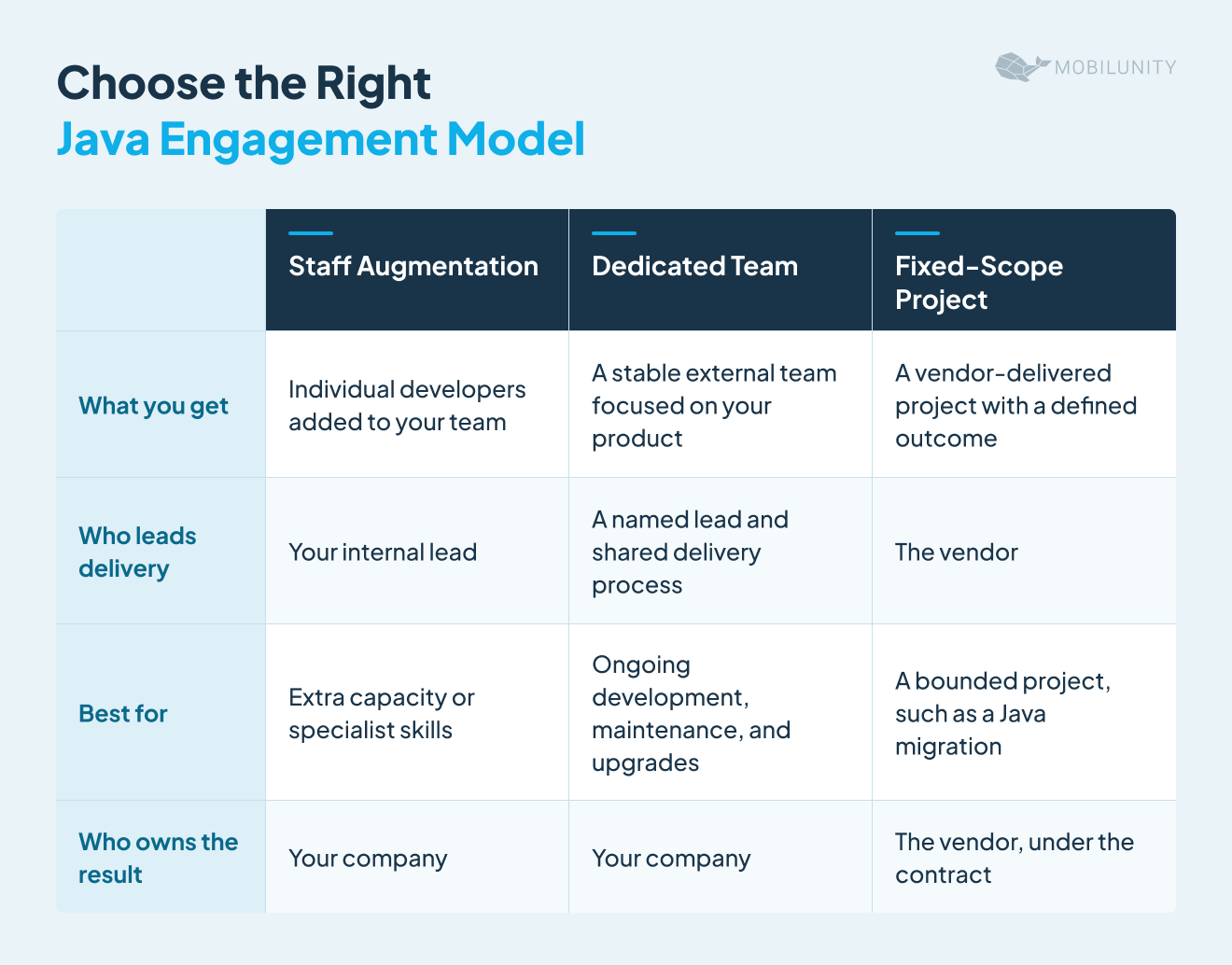
Which shape does an upgrade need? Usually a small dedicated team of developers with a named lead because the work is a project with an end date. Someone has to own the dependency list, the test results and the cutover.
If you are still deciding between shapes, read about IT staff augmentation and dedicated development teams.
Whichever shape you choose, you want Java specialists, not generalists. The difference is narrow and checkable: JVM tuning, the module system introduced in Java 9, Spring version experience, and build-tool migration between Maven and Gradle.
Java outsourcing companies vary widely on these points, so the eight checks later on this page are built to expose the gaps. They work whether you hire from a firm or hire developers through a provider.
The best fit also depends on company size. Large companies use offshore Java developers to maintain costly in-house systems and meet scaling demands, for example by optimizing infrastructure for microservices and real-time data or integrating Java applications with ERP and CRM systems.
Mid-sized businesses and startups use them for a different reason: to grow without heavy upfront investment. The typical work is cloud integration to cut infrastructure costs, fast iterative development, and data processing.
In both cases, location matters. Eastern Europe has a deep Java talent pool, and a provider that has already vetted candidates shortens a search that takes longer locally, especially for specialized roles.
Before you compare quotes, agree on what each quote covers. Java dev services usually include the items below.
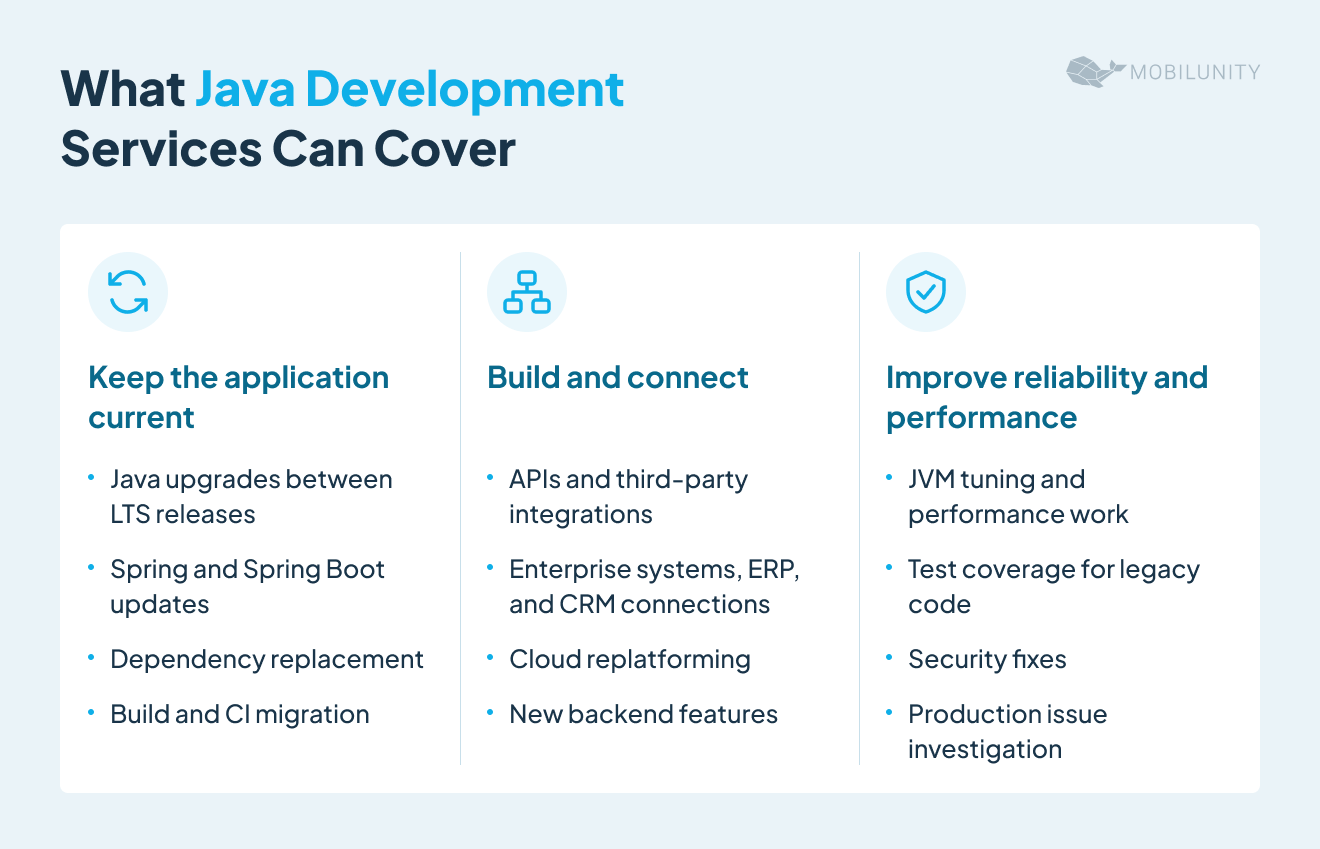
Spring Boot deserves a closer look, because outdated versions are the most common reason a Java upgrade gets blocked. Newer Java releases need newer Spring, and newer Spring changes configuration and APIs, so the two have to move together. If that is your situation, start with our page on Spring Boot developers.
Just as important is what a quote leaves out. Front-end work and database administration are usually excluded, and so is anything a vendor labels consulting without naming a deliverable. Push on that last one: a line for “consulting” with no output attached is a quote for hours, not for a result.
So where do we fit in this menu? We are not a Java development company. We source and vet developers with Spring, JVM tuning and cloud replatforming experience, and they work in your team under your process.
That makes the choice simple. If you want a vendor to own the outcome of a fixed-scope project, hire a firm. If you want developers who fit the work, we can supply them.
Five factors set what a Java developer costs, and they stack on top of each other.
To see the Ukrainian side, start with the bands below. They show developers’ gross monthly salaries and the monthly cost of working with them through Mobilunity.
| Seniority | Gross monthly salary | Monthly developer cost |
| Junior | $1,200 to $2,200 | $2,650 to $3,700 |
| Middle | $2,200 to $4,200 | $3,650 to $5,700 |
| Senior | $4,200 to $5,700 | $5,650 to $7,200 |
*As per Mobilunity in-house tech recruiting team research done in September 2026
Now the in-house side. The BLS Occupational Outlook Handbook puts the median US software developer wage at $135,980 (May 2025). The BLS Employer Costs for Employee Compensation release puts benefits at 30% of private-industry employer costs.
Benefits are 30% of employer cost, so the loaded cost is $135,980 / 0.70, about $194,000 a year or roughly $16,200 a month. Recruitment and management time come on top. The table below puts the three ways of getting Java developers side by side.
| Engagement shape | Typical monthly cost per developer | Who carries employment risk |
| US in-house hire | About $16,200, loaded | You |
| Dedicated Ukrainian developer | $2,650 to $7,200, by seniority | The provider handles employment and admin; you manage the work |
| Fixed-scope project with a Java firm | Priced by scope, no standard band | The vendor, under the contract |
Price is not the only number to watch, though. The cheapest quote often costs the most on an upgrade, because a botched migration is discovered in production, usually under load, and the fix costs more than the saving.
For salary data by country, see our guide to Java developer salaries.
The integration question is no longer about offices. Stack Overflow’s 2025 survey reports that 45% of US respondents work fully remote, the highest among the top-reporting countries. Distributed is the normal case, so the real argument is about overlap hours: how many you get and what has to happen inside them.
That makes overlap the thing to plan. Three things must belong inside it: the daily standup, code review, and any decision that blocks someone. Everything else can run asynchronously.
For a sense of scale, Kyiv is 2 hours ahead of London and 7 ahead of New York for most of the year. That gives London a near-full shared day and New York a shared morning.
Good overlap also makes integration pay off in four ways.
If your overlap is only two hours, schedule them deliberately. Put the standup first, reserve the second hour for reviews, and write down blocking decisions at the end of your day so the other side can act on them before you wake up.
This is the part of the page that decides your budget. The dates below come from Oracle’s Java SE support roadmap.
| Release | General availability | Premier Support ends | Extended Support ends |
| Java 8 (LTS) | March 2014 | March 2022 | December 2030 |
| Java 17 (LTS) | September 2021 | September 2026 | See Oracle’s roadmap |
| Java 21 (LTS) | September 2023 | September 2028 | See Oracle’s roadmap |
| Java 25 (LTS) | September 2025 | September 2030 | See Oracle’s roadmap |
When Premier Support ends, you stop getting new fixes on the terms most teams assume they have. That leaves two options: a commercial conversation with Oracle, or a move to another vendor’s build of the same release. Either is a cost you did not budget for.
Upgrade cost depends on how far you are traveling. Going from 17 to 21 is usually two to six weeks and mostly dependency work. Going from 11 to 21 adds the module system. Going from 8 to 21 is a project, because it crosses both. The OpenJDK 25 project page lists what is in the newest LTS release, which is worth reading before you scope.
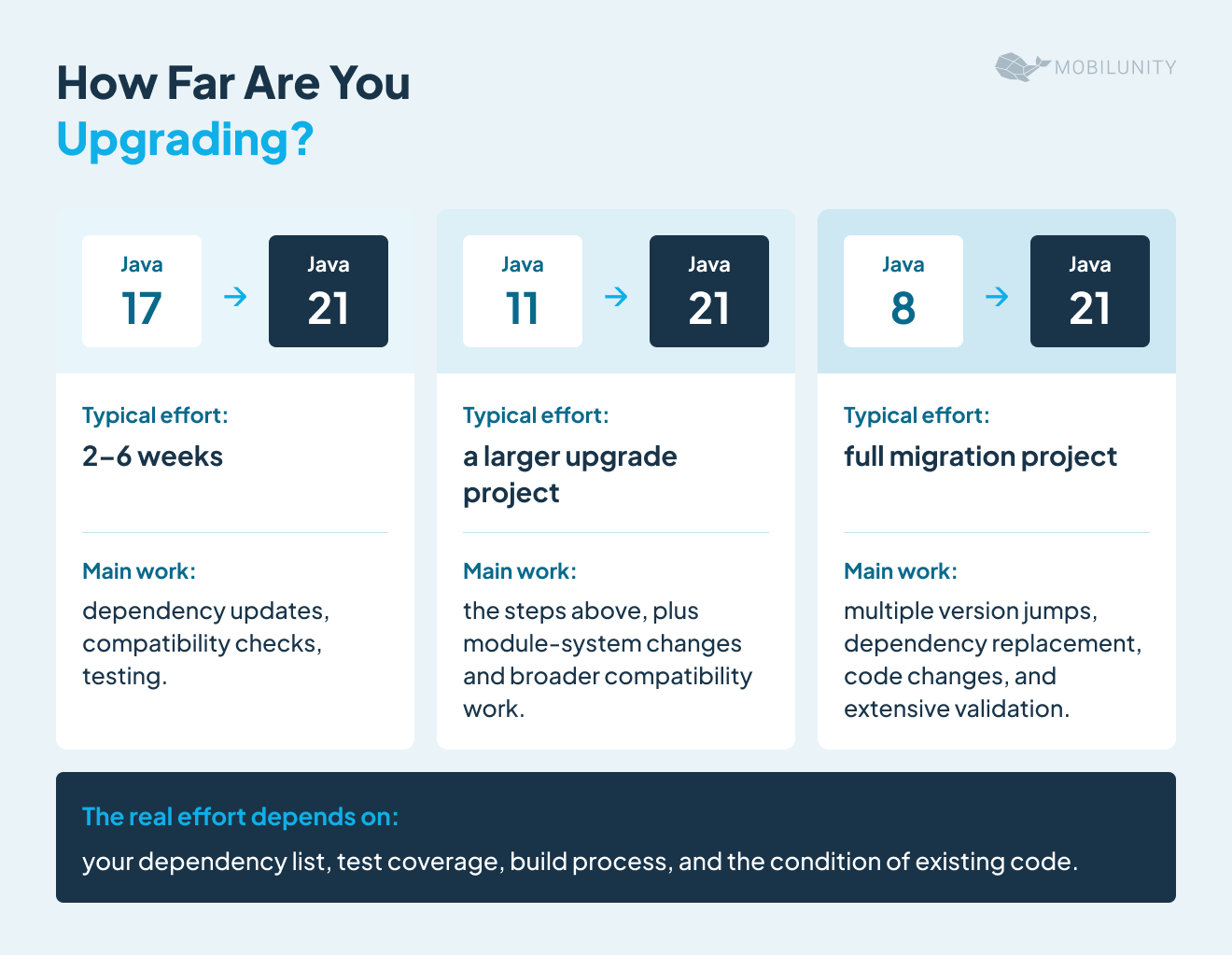
The decision rule follows from this: upgrade to the LTS with the longest runway you can reach, not to the next one. Moving from 17 to 21 in 2026 buys you two years, and moving from 17 to 25 buys four.
You probably can’t judge Java work yourself, and you don’t need to. Every check below is built so a non-technical manager can run it, whether you are talking to a firm or to individual developers.
To read the answers, start with the second check. A good answer names versions and a specific failure, such as a library that broke on the module system, while a vague answer about smooth migrations is a bad one.
Behind the checks sit the skill areas a strong Java engineer covers: core Java and JVM internals, web and API work (REST, SOAP, Kafka, microservices), databases (SQL, NoSQL, JPA), cloud and CI/CD, testing with JUnit, TestNG and Mockito, and security. How much of each you need depends on your project’s domain, complexity and stack.
The fourth check is where upgrades most often go wrong, because unresolved dependencies are where Java upgrades actually stall. Run the same list on Java consulting companies and you will see the pattern: strong ones answer with specifics, weak ones with adjectives. For skills detail, see our breakdown of Java developer skills.
The clearest red flag is anyone who quotes an upgrade without asking for your dependency list, because they are pricing a guess.
Once you know the shape, you need the right mix of roles. Java projects are often large and multifaceted, so they need a team of specialists who cover both technical and business goals. These are the key roles.
How many of each you need depends on project size, as the table shows.
| Role | What they do | Small project | Mid-sized project | Large project |
| Java developers | Write the core code in Spring, Hibernate and similar frameworks | 1 to 3 | 4 to 7 | 8 or more |
| Java architects | Design scalable solutions that match business goals | None | 1 | 2 |
| Front-end developers | Turn UI and UX designs into working interfaces | 1 | 2 | 3 or more |
| UI/UX designers | Keep the product intuitive and clean | 1 | 1 to 2 | 2 or more |
| QA specialists | Test the software and confirm the components integrate | 1 | 2 | 3 or more |
| Project managers or Scrum masters | Manage resources, delivery and communication | Part-time | 1 | 1 to 2 |
| DevOps engineers | Run deployment pipelines and CI/CD | None | 1 | 2 or more |
| Database administrators | Manage, optimize and secure the databases | None | None | 1 |
Your upgrade, though, needs a much smaller setup than any column above. A full dedicated team is oversized for 6 weeks of work, so a lead plus one or two developers fits better. If you need 2 developers rather than a development company, you can hire Java developers directly instead.
Mobilunity is a Kyiv-based provider of dedicated developers, founded in 2010. Mobilunity sources and vets Java developers, and they work as your team under your process. If you are shortlisting top Java development companies, treat this as the other route: developers instead of a delivery team.
97% of developers placed with clients successfully complete their probation period, and 94% of developers assigned to client projects have remained with those projects over the past 12 months. First CVs usually arrive within 5 business days (often even sooner), and the full process takes of setting up a team 3 to 6 weeks.
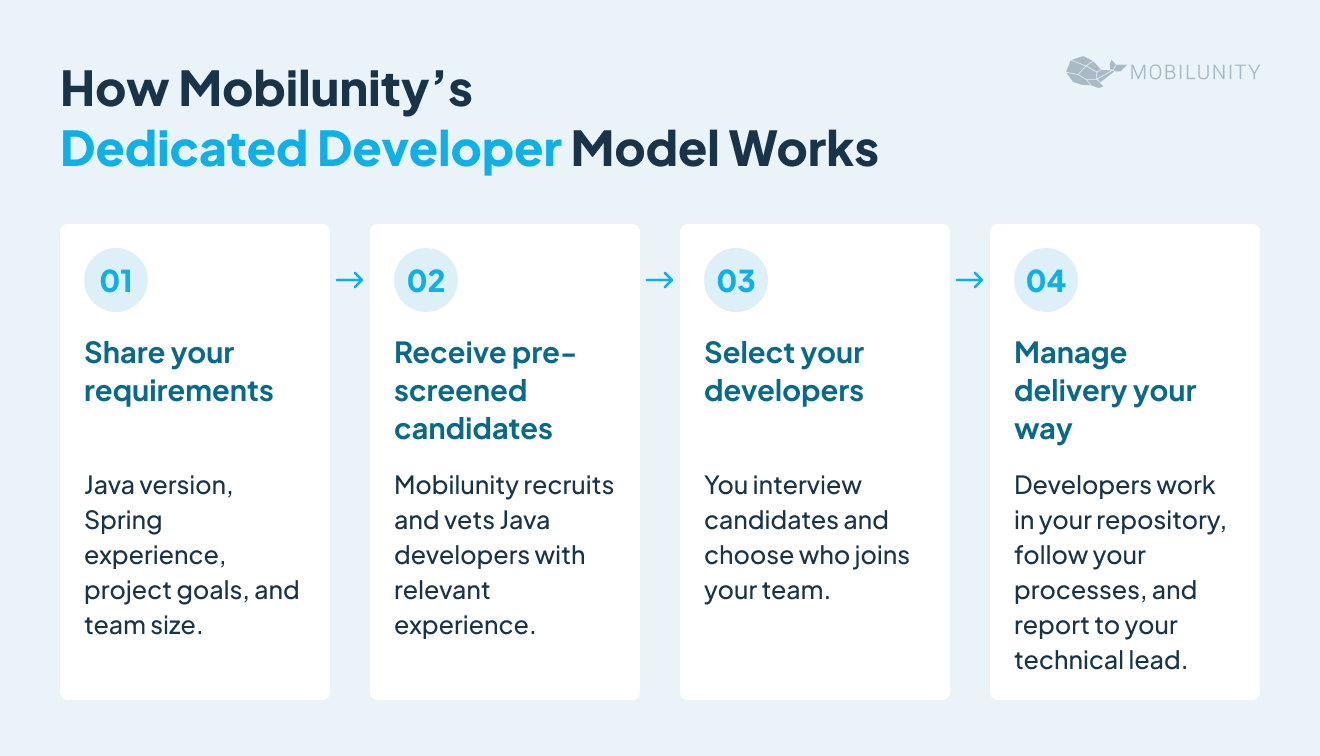
How does this model look in practice? Camptocamp, a Swiss provider of geospatial, infrastructure and business solutions, added a dedicated team from Ukraine and kept growing it. The setup matches the arrangement described above: developers who work as part of the client’s team while we handle recruiting and HR. The Camptocamp case study has the details.
Mobilunity is the wrong choice if you want a fixed-price Java 8 to 21 migration quoted before anyone has seen the dependency list. No one can price that honestly, and a project firm is the better fit.

Disclaimer: All salaries and prices mentioned within the article are approximate numbers based on the research done by our in-house Marketing Research Team. Please use these numbers as a reference for comparison only. Feel free to use the contact form to inquire on the specific cost of the talent according to your vacancy requirements and chosen model of engagement.