Hire Developers in Hungary


Key takeaways:
Keeping an existing PHP application running requires regular maintenance. This includes fixing security issues, updating the software it runs on, replacing outdated components, and adding features without interrupting the service people already use. PHP development services can cover these tasks, a larger application upgrade, or new development as your business needs change. The right scope depends on the application’s current condition and your team’s available skills.
The PHP version your application uses is one of the first things to check. According to PHP’s official support calendar, PHP 8.2 stops receiving security fixes on December 31, 2026, while PHP 8.1 is already out of support. Running an unsupported version can leave known security issues unaddressed, and upgrading may take extra work if other parts of the application are outdated too. Before comparing quotes, decide whether you need a company to manage a project from start to finish or a provider that can supply developers to work alongside your existing team.
Think of PHP development as a set of tasks that starts with keeping your application secure and running reliably. Before adding new features, a development team should check whether the software is up to date and fix any problems that could make future work more expensive. A typical scope of work follows this order:
When hiring a team, ask who will be responsible for each task before signing a contract. You should also expect the proposal to explain what needs attention first and why. A clear list of tasks is more useful than a long proposal that doesn’t explain what the team will actually do.
Some services may fall outside the scope of PHP development. These can include visual design, server and other infrastructure management, and front-end work beyond the templates used to display application content. If you need these services, clarify that at the start so you can compare the full cost rather than deal with unexpected charges later.
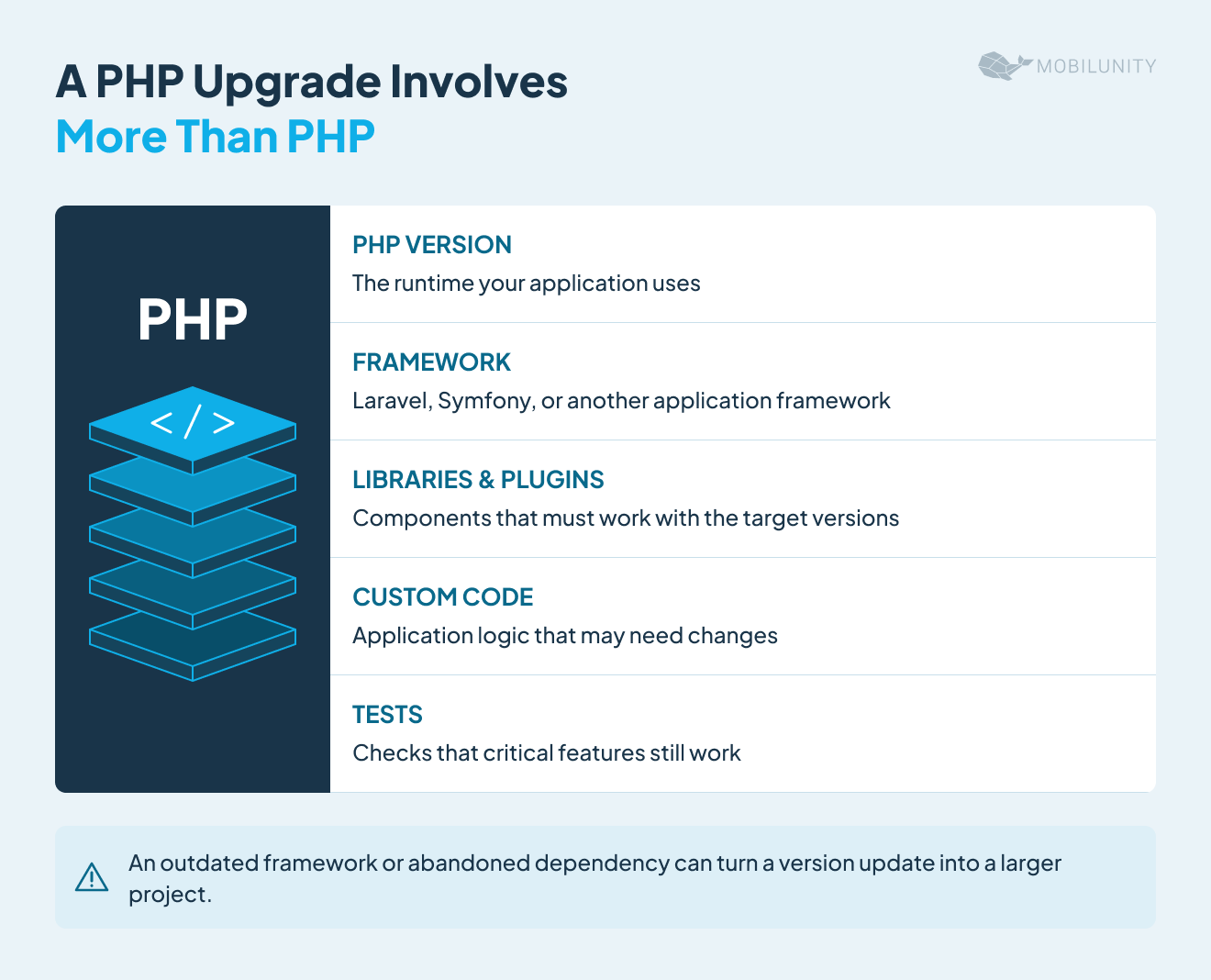
The order of work affects both the timeline and the budget. For example, adding a feature may take longer if the application relies on outdated software that needs updating first. Ask the provider to identify any required upgrades, name the PHP version the application will move to, and explain which components may need replacing. If the proposal covers new features but leaves these questions unanswered, you may receive a separate maintenance estimate later.
You can outsource PHP development by handing over the whole project, or by adding developers to your own team. A PHP development agency typically takes the first route: it scopes, builds, and delivers the work itself. Another option is to work with a provider that supplies PHP developers who join your existing team and follow your manager’s or technical lead’s direction. The right arrangement depends on whether you need a team to manage a project or additional people to help your own team deliver it.
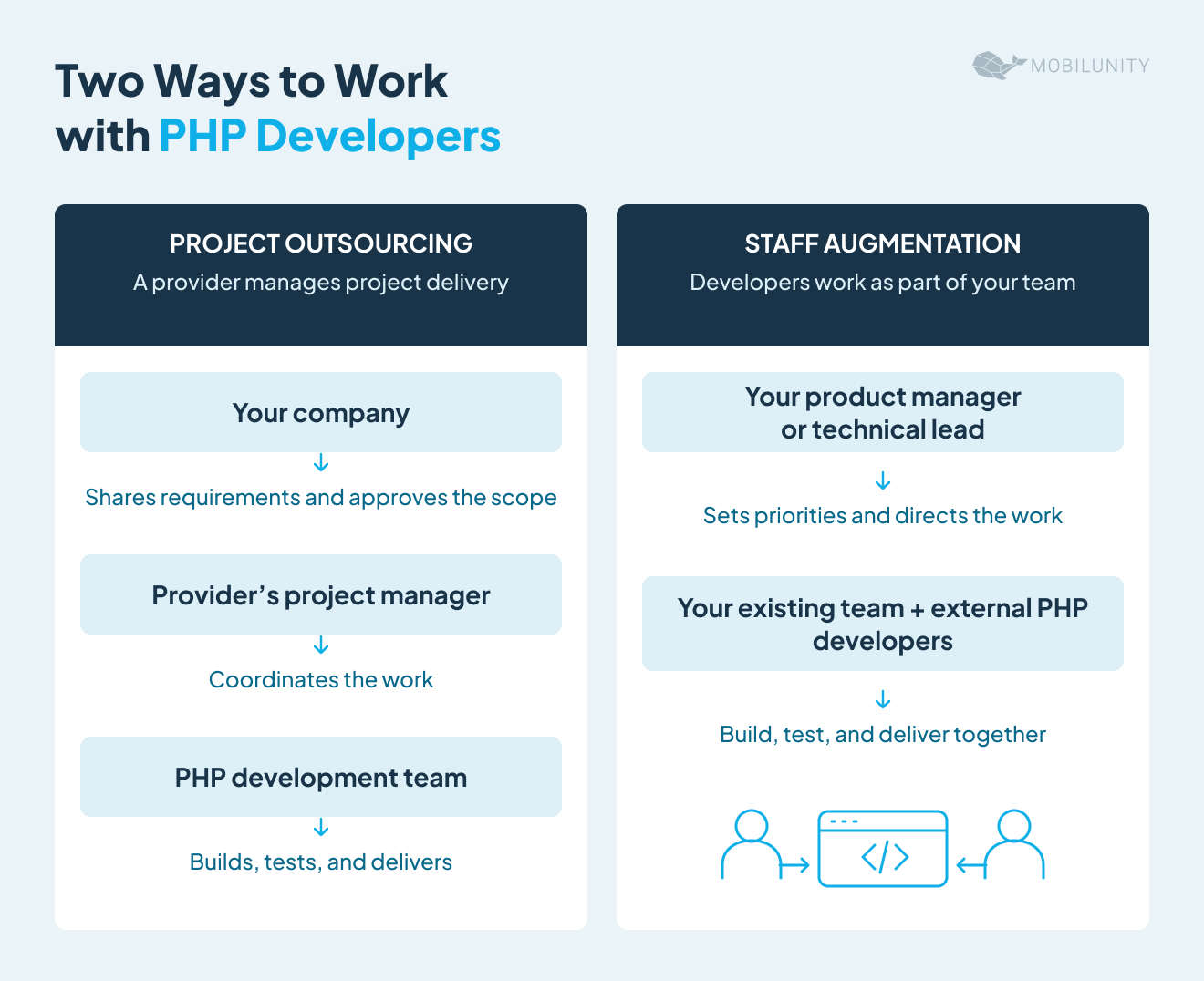
Mobilunity follows the second model. It helps clients find PHP developers who work within the client’s team, using its existing codebase and following its development priorities. The specific PHP services and tasks available through this arrangement should be confirmed before you agree on the scope. See our PHP work for more information.
Most PHP applications are one of three kinds, and each needs different work. Knowing which kind you have helps you ask a team the right questions.
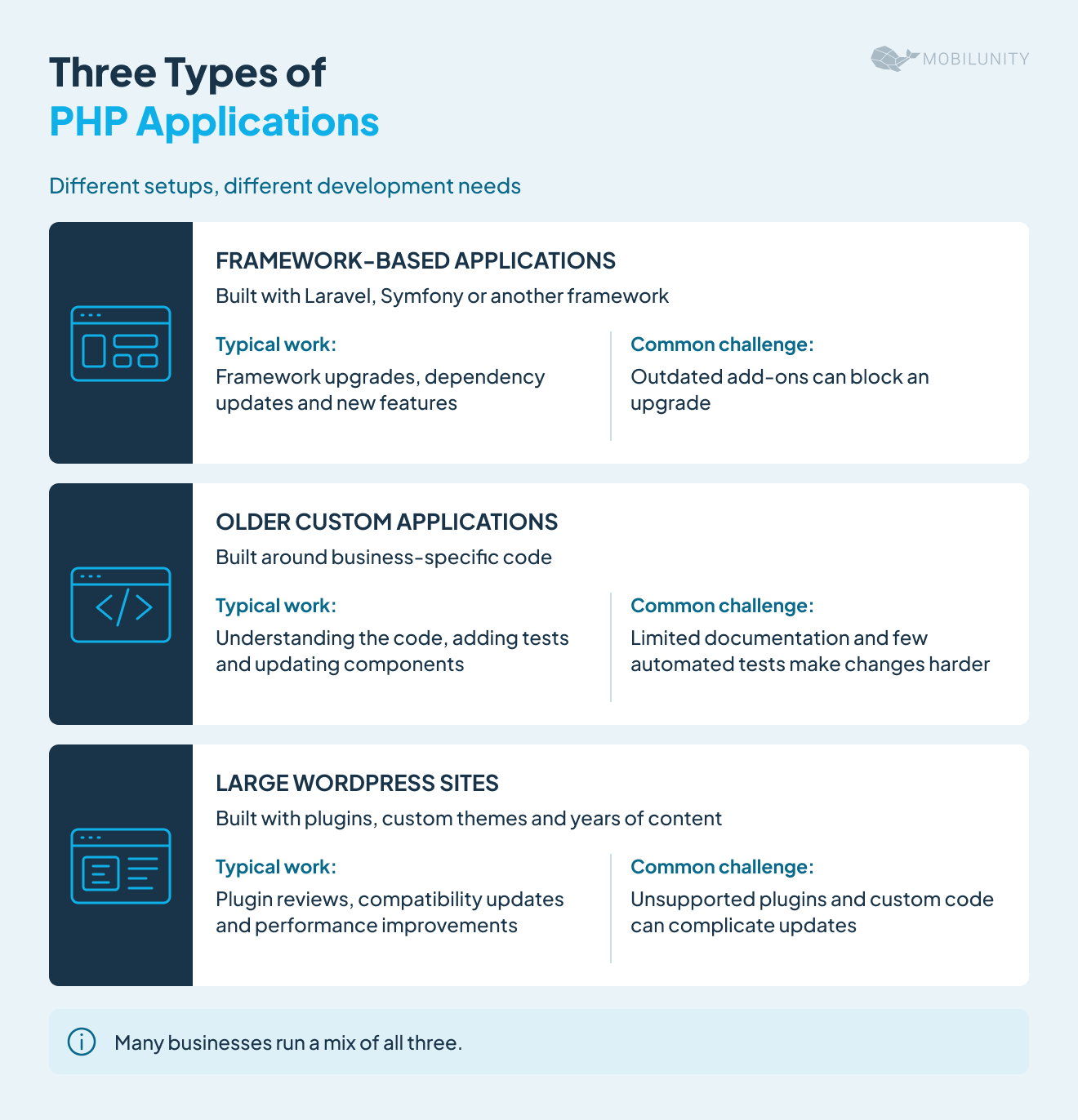
Applications built on a modern framework (a ready-made toolkit such as Laravel) are the newest and the easiest to staff. Work moves to the toolkit’s current version, keeping add-ons updated and adding features. The usual risk is an add-on whose maker stopped updating it, so ask for an upgrade plan that names the target version and any add-ons that block it. The same logic applies to other widely used toolkits, and our guide to CakePHP developers goes into one of them in depth.
Older custom applications were written from scratch before toolkits were common. They often generate the most revenue, have the fewest people who understand them, and usually have no automated checks to catch mistakes. The first job is adding those checks, not rewriting the application, so ask for a plan for them before you ask for an estimate.
Large WordPress sites that have outgrown their setup are the third kind: dozens of plugins, a custom design, and years of content. The work involves reviewing the plugins, confirming they run on the current version, and speeding up the site. Ask for a list showing which plugins still receive updates.
Mixed setups are common. A company may run a toolkit-based application next to an older custom one and a WordPress site for marketing, each on a different version, so the review should cover all three, not only the one that prompted the call.
Whichever kind you have, the first step is the same: a written list of the PHP version, the toolkit version, and every add-on in use. That list turns a vague quote into a dated plan.
Here’s the honest picture of PHP in 2026: it isn’t where most new projects start, and it still runs a lot of revenue. Both halves matter. If you’re weighing languages for a new product, PHP compared with Python covers that question. This guide assumes you already have the application and need it kept alive.
Start with the number you’re comparing against. Indeed’s salary data puts the average base salary for a PHP developer in the US at $84,475 a year (updated 11 October 2026). Indeed shows a range from $55,454 to $128,685, so the average is a midpoint, not a quote.
That works out to roughly $7,040 a month, and it’s only the base salary. Benefits, recruiting, equipment, and management time come on top, along with the months a new hire needs to learn a legacy codebase.
An hourly rate becomes a monthly cost once you know the hours, so ask any provider for the monthly total at the seniority you need, with maintenance and new development priced separately. Maintenance usually runs as a steady monthly engagement, while an upgrade has a start, an end, and a scope. The table shows both.
| Engagement shape | Maintenance or build | How it runs |
| Part-time developer | Maintenance | Steady monthly engagement |
| Dedicated developer, mid-level | Maintenance | Steady monthly engagement |
| Dedicated developer, senior | Upgrade or build | Fixed start and end |
| Loaded US in-house hire | Either | Salary plus benefits, about $16,200 a month |
A part-time developer suits a small application that needs patching a few days a month. A dedicated developer suits steady maintenance across a larger codebase.
A senior developer suits an upgrade, where decisions about dependencies and framework versions need experience, and the engagement ends when the upgrade ships. The in-house row is the comparison, not a recommendation: it shows what the same capacity costs when you employ it yourself.
Cheap quotes deserve a second look, because you usually get what you pay for. Three things make a cheap quote expensive later: an upgrade left out of the scope, a developer who needs weeks to learn your code, and a notice period that locks you in while you find out. A low quote usually leaves out the upgrade work, so the difference comes back later as extra hours.
For what developers earn in different countries, PHP developer salaries holds the full breakdown, so this page doesn’t repeat it.
The easiest way to compare the three options is by how much of the workday you share with the team, then by location. Say everyone works 9 to 6 in their own city. Kyiv is 2 hours ahead of London for most of the year, so a London team and a Kyiv team are both at their desks for seven hours a day. Kyiv is 7 hours ahead of New York, so a New York team shares just two.
For a London company, Kyiv is effectively nearshore. You can run a standup, review a pull request in the afternoon, and ask a question without waiting for tomorrow. PHP development outsourcing to a nearby time zone suits upgrade projects, where developers and your own staff need to settle many small decisions about dependencies.
For a New York company, the same team is offshore, and you plan around handoffs: a morning call, written tickets, work ready for review when you start the next day. Offshore PHP developers on a staggered schedule suit maintenance well because patching and dependency work rarely need real-time conversation.
The two setups also differ in how a day is organized. With 7 shared hours, questions get answered within the same afternoon, and a blocked developer loses minutes. With 2 shared hours, a blocked developer can lose a day, so written tickets with the version, the error, and the steps to reproduce it carry the whole engagement.
Ask any provider to confirm in writing which hours its developers will be online in your time zone. A promise of “flexible hours” doesn’t tell you whether anyone is there when a release breaks.
In-house is the third model, and the realistic comparison is narrower than it looks. The Stack Overflow 2025 survey reports that 45% of US respondents work fully remotely, the highest of the top-reporting countries. For a US company, that makes the choice remote against remote, not office against remote.
In-house wins when the application is the product and nobody else understands it. In that case, you’re paying for continuity and for people who stay through every change of business direction. For everything else, overlap hours and handoff quality matter more than the postal address.
The php.net’s supported versions page sets the rule: two years of active support, then two more years of critical security fixes only, then end of life. Security fixes are patches for weak spots that attackers can use. While a version is supported, those patches keep coming. After end of life they stop, and any weakness found in your version stays open.
The first two years of active support also cover ordinary bug fixes. The second two years cover security only. An application on a version in its security-only years stays safe but gets no improvements, and it has a hard end date.
Run the table below against the version your application uses today.
| Branch | Released | Security fixes end |
| 8.1 | [verify on php.net] | 31 December 2025 (end of life) |
| 8.2 | 8 December 2022 | 31 December 2026 |
| 8.3 | 23 November 2023 | 31 December 2027 |
| 8.4 | 21 November 2024 | 31 December 2028 |
| 8.5 | 20 November 2025 | 31 December 2029 |
The table is practical to use before you sign any contract. Ask which version you’re on before you ask for a price, and treat a developer that doesn’t ask the same question as quoting blind. The version decides whether you need a small upgrade or a staged migration through several releases.
Version support isn’t what stalls most upgrades. Abandoned dependencies and framework versions pinned to old releases do. A library that hasn’t shipped a release in three years can block the whole move, so scope those first and price the upgrade after you have the list.
Treat the last day of security support as the day the work must be finished, not the day it starts. A realistic upgrade includes an inventory, a dependency review, a test pass on a copy of the application and a release window, and each of those takes calendar time.
The 8.2 deadline is 31 December 2026, so an application still on it enters the new year without security fixes. Moving to 8.3 shifts that date to 31 December 2027, and 8.4 or 8.5 shift it further. Each step needs the same dependency check, so planning the upgrade now beats starting when the date arrives.
If you’re on 8.1 already, you’re past the date, and the upgrade is overdue rather than upcoming. Tell any firm that in the first message, because it changes the order of work: security exposure first, then everything else.
Most companies hiring a provider can’t judge the code themselves, and you can’t interview a developer well unless you are one. The practical test is previous work and a real task. The six checks below need no technical knowledge, only the answers. Write them down, send them to developers, and compare the replies side by side.
The first check carries the most weight. Give them something close to a real problem your own company has run into. A failing test, a small upgrade of one module, or a slow query from your production logs all work. How they ask questions about it tells you more than a portfolio.
The version question shows whether a developer tracks support dates, since a team that ran its last three projects on versions that were already out of support probably won’t flag yours. The dependency question matters because that’s where every upgrade stalls, and a good answer names a specific approach, such as replacing the library, forking it, or wrapping it.
Your codebase probably has few or no tests, so check four is about what happens in that case. A sensible answer writes tests around the riskiest paths before touching them, so a change that breaks something shows up the same day. References matter for the same reason: call two clients of your size and ask what went wrong, and how the firm handled it.
The last check is the red flag. A fixed price for an upgrade quoted before anyone has seen the dependency list is a guess, and you’ll pay for it later.
What you need from a developer service provider depends less on your industry than on your size:
An offshore team suits a large corporation’s long horizon because continuity is cheaper than rebuilding knowledge every year, and it should report progress across the estate, application by application. The risk for a smaller company is that one person holds all the knowledge, so ask for documentation, a second developer who can step in, and a plan for what happens if the first one leaves.
At every size, the first deliverable should be the same: a written inventory of versions and dependencies, so you know what you own before anyone changes it.
One business should skip a service provider entirely. A single small application with no roadmap is usually a job for a part-time contractor, not a team. If you want people rather than a service provider, read how to hire PHP developers directly.
Choosing between PHP development companies starts with deciding how you want to work. Some take responsibility for delivering a whole project, while others help you add developers to your own team. Mobilunity is a provider, not a development company, and it works the second way: it recruits and vets developers who work under your direction, with your priorities guiding their day-to-day work.
That fits companies that already have someone running the product and need extra engineering capacity, such as a team keeping an application patched and upgraded. If you want a provider to manage the whole project on its own, for example, a fixed-price rewrite of a legacy system, a development company is the better fit.
Founded in 2010 and based in Kyiv, Mobilunity offers several ways to add developers to your team. A dedicated development team suits ongoing work, and staff augmentation fills a specific skill gap.
For smaller jobs, Mobilunity FLEX provides part-time developers. This suits steady maintenance, such as patching and dependency updates, for an application that doesn’t need a full-time developer.
Mobilunity works with clients in fintech, e-commerce, SaaS, media, education, insurance and logistics, among other industries. Its recent PHP openings include Laravel, Symfony and WordPress roles. Each client has a dedicated account manager, developers pass quality checks before they’re introduced, and you can access a technical interview service when you want an expert’s view on a candidate.
The Camptocamp case study shows what the model delivers over time: a dedicated ERP team of Ukrainian developers that started in 2017 and has grown alongside the Swiss company. The result is a long-running, mutually beneficial relationship, with a team that already knows the client’s systems.
Mobilunity typically presents an initial shortlist within 5 business days of starting a search. Its approach rests on 3 Rs, Recruitment, Relationship and Retention, which cover how candidates are selected, how the collaboration runs, and how developers stay on your project.
No list of top PHP development companies can tell you which provider suits your application. The right match depends on your framework, your PHP version, and how your team works day to day, so compare providers on those points before you decide.

Disclaimer: All salaries and prices mentioned within the article are approximate numbers based on the research done by our in-house Marketing Research Team. Please use these numbers as a reference for comparison only. Feel free to use the contact form to inquire on the specific cost of the talent according to your vacancy requirements and chosen model of engagement.