
IT Recruitment Lithuania: Market Overview and Hiring Guide


Hungary has become a reliable and practical choice for companies wanting to outsource some of their IT or software development tasks. The local market provides a mix of skilled engineers, fair rates, and benefits that come with operating within the EU’s legal and data protection rules. This is all without the pressure or hype that often surrounds larger outsourcing centers.
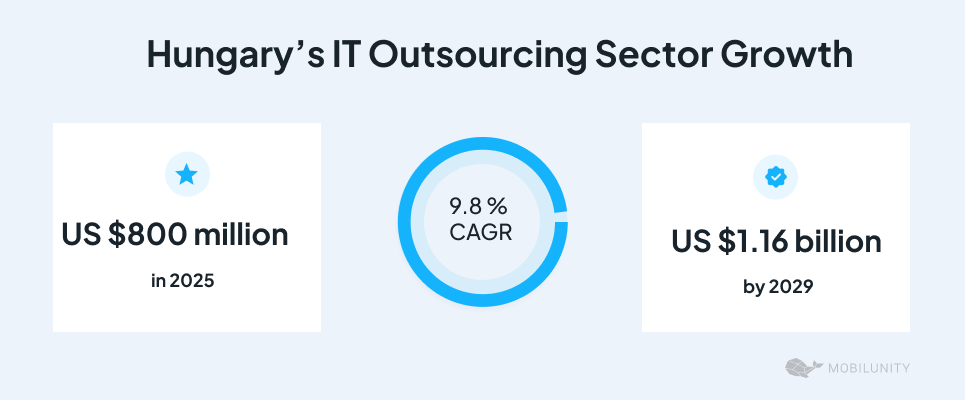
Industry data shows steady growth. The IT outsourcing sector in Hungary is expected to reach around US $800 million by the end of 2025, indicating a consistent upward trend. The overall IT services market is also forecasted to grow in the coming years, suggesting that international interest in Hungarian talent is strong.
In this article, we will explore what Hungary outsourcing really offers: the talent pool, pricing, industry specifics, legal aspects. We’ll also identify what companies should consider when selecting a partner.
Hungary is located in the heart of Central Europe, making it an easy choice for companies that want to grow their tech teams without going too far from home. A quick flight from major Western European cities and small time differences mean that working with Hungarian teams feels natural. It’s almost like collaborating across the hallway instead of across a whole continent.
Being part of the European Union adds more comfort for businesses. EU rules, like GDPR, help protect sensitive data and intellectual property. The country also maintains a generally stable political and legal environment, providing predictable conditions for foreign companies looking to establish outsourcing relationships.
Hungary’s membership in the Schengen Area further eases mobility and makes travel easier for workshops, meetings, or onboarding visits. This simplifies cross-border collaboration and reduces bureaucracy compared to some other regions. Altogether, these factors show Hungary as a practical, accessible, and reliable place to find tech talent. It is a place where international teams can work together efficiently and with confidence.
Hungary’s ICT and software development sector has been steadily growing and plays an important role in the country’s economy. Analysts estimate that the domestic ICT sector, which includes software and related services, contributes about 6% of GDP. The market for ICT services in Hungary is expected to grow to USD 60.4 billion by 2030. Growth is driven by increasing demand for software development, cloud services, and digital transformation projects from both local and international clients.
While Budapest is the largest tech hub, the sector is now spreading to other cities, providing various talent pools and cost options hungary it outsourcing. Some main hubs include:
Hungary’s IT landscape is supported by both active domestic companies and international players investing in the country. Local and each offshore company in Hungary contribute to market maturity and provide opportunities for collaboration. Together, they help position Hungary as a reliable outsourcing destination.
Well-known local companies with global impact:
As for big international players, EPAM Systems, for example, operates multiple delivery centers in Budapest, Debrecen, and Szeged, while Ericsson maintains an Engineering Service Delivery Hub within the country. IBM has also established service centers in Hungary, contributing to the local technology and outsourcing market. Financial services giant Morgan Stanley runs operations here as well.
This mix of local tech innovators and confirmed international investors creates a diverse ecosystem that can support both enterprise-level outsourcing and specialized software development projects. Hungary’s growing talent pool, along with regional hubs outside Budapest, makes the country a practical and flexible choice for companies looking to expand or outsource IT operations in Central Europe.
Hungary’s IT sector is fueled by a stable and well-trained talent pool, supported by both universities and specialized programming schools. As of 2021, the country employed around 180,00 ICT professionals, and approximately 4,000 new graduates enter the job market annually, ensuring a continuous supply of junior and mid-level developers.
Hungary boasts a number of universities and programming academies that consistently produce technically skilled graduates:
These institutions teach the basics of programming and expose students to real-world projects, internships, and collaborations with tech companies. They help graduates enter the job market with hands-on experience.
Hungarian developers cover a wide range of modern technologies, making them suitable for a variety of projects:
This range of skills ensures that Hungary can support projects ranging from enterprise software and SaaS solutions to mobile applications, cloud platforms and AI-powered applications.
Hungarian IT professionals are also well-prepared for international collaboration. According to the EF English Proficiency Index, Hungary is in the “high proficiency” category, meaning that developers can clearly communicate with Western clients, document code, and collaborate in distributed teams.
In addition to language skills, Hungarian developers are noted for their problem-solving abilities and adaptability. Their adherence to Western work practices makes international collaboration with any offshore company Hungary smoother and more productive.
Hungary’s IT market offers a variety of outsourcing models, enabling companies to choose the approach that best fits their needs. You can scale a team or complete a defined project. Moreover, there is an option of delegating ongoing IT operations.
Staff augmentation allows companies to expand their internal teams with dedicated Hungarian developers. The client manages the team directly, while the developers are employed locally by a partner company. This model is ideal for:
Hungary’s growing regional tech hubs make it easy to build a custom team with diverse skill sets quickly.
For clearly defined projects, project-based outsourcing gives companies a single point of responsibility. Hungarian software providers can handle the project from planning to deployment, which is well-suited for:
Project-based engagements are particularly popular with startups and medium-sized enterprises that want predictable costs and timelines without building permanent teams.
Some businesses prefer to entrust entire IT operations or product development to a local partner. Managed services cover everything from development and testing to infrastructure management and maintenance. Companies choose this model when they want:
Hungarian firms offering managed services typically provide structured processes, reporting, and quality standards aligned with international expectations. The client focuses on business strategy rather than day-to-day technical operations.
Hungary offers a distinct combination of quality, cost-effectiveness, and regional convenience, making it an increasingly popular choice for IT outsourcing. Unlike many typical outsourcing destinations, Hungary combines Central European accessibility, skilled talent, and regulatory stability. It creates an environment where companies can confidently scale development.
When you need to hire developers in Eastern Europe, Hungary strikes a balance between cost and quality. Average hourly rates for software developers typically range from $25 to $50 per hour, depending on experience and technology. It is significantly lower than rates in Western Europe or the United States, where similar developers can cost between $70 and $120 per hour.
This cost advantage allows companies to scale teams without overspending. It is especially profitable for mid-sized projects or specialized development tasks.
Hungarian developers are known for their strong technical expertise and disciplined approach to software engineering. Universities and programming schools emphasize thorough training in algorithms and modern programming methods. Many local IT service providers have implemented ISO, CMMI, or Agile-based workflows. They aim to ensure predictable delivery, code quality, and adherence to best practices.
Hungary is located in the Central European Time Zone (CET/CEST), which provides excellent alignment with most European working hours. This facilitates real-time collaboration and faster decision-making compared to teams located in Asia or the Americas. For US-based companies, the overlap is less, but still manageable for key communications.
Hungarian IT professionals are often praised for their work discipline and clear communication. You can be sure of the seamless integration of teams with Western clients. The country’s shared European business culture means that approaches to deadlines and collaboration are familiar to many clients. It reduces friction and misunderstandings.
As a member of the EU, Hungary has a stable legal framework. IT vendors are fully compliant with EU requirements, including the GDPR on data protection. This reduces legal and operational risks for companies handling sensitive customer data. Projects meet internationally recognized standards for privacy, intellectual property protection, and cybersecurity.
When you start considering software outsourcing, the first question that almost always comes to mind is: “How much will it cost?” Nearshoring Hungary, along with its neighbours such as Poland, Romania, and Ukraine, offers excellent conditions: rates are more affordable than in Western Europe or the US, but the professionals are qualified and reliable.
But it’s not just an hourly rate. The final cost depends on who you hire (junior, mid-level, or senior developers), how complex your project is, and what type of outsourcing you choose. Understanding these nuances in advance helps you plan realistically and avoid hidden surprises in the future.
To give you a clearer picture, here’s a snapshot of typical hourly rates in USD for developers at different experience levels. These numbers come from public salary data and industry surveys, so think of them as guidelines rather than fixed prices. Actual vendor quotes may vary depending on city, company, or project specifics.
| Country | Junior | Mid-Level | Senior / Experienced |
| Hungary | $25–35 | $35–55 | $50–75 |
| Poland | $30–40 | $45–65 | $60–90 |
| Romania | $28–38 | $40–60 | $60–85 |
| Ukraine | $20–30 | $30–50 | $45–65 |
Well, to hire developers in Hungary is not the absolute ‘low price’, but it strikes a balance: the rates are lower than Western Europe, yet you get a stable EU environment and high-quality talent.
The base rate is just one piece of the puzzle. Other factors can significantly affect the total cost of outsourcing:
Ultimately, a well-planned outsourcing strategy can deliver both cost-effectiveness and high-quality results, making Hungary a smart option for companies looking for skilled technology professionals.
When outsourcing IT to Hungary, understanding the legal and regulatory framework is just as important as evaluating costs or talent. Proper compliance ensures your intellectual property is protected and your data is secure. You have to make sure your agreements with developers or vendors are enforceable.
Hungary enforces IP rights under EU law, covering patents, copyrights, trademarks, and trade secrets. For outsourcing, ensuring proper IP assignment and confidentiality in contracts is essential.
Key points to remember:
Courts and arbitration bodies in Hungary generally uphold these agreements, providing reliable protection for your software and proprietary knowledge.
As an EU member, Hungary follows GDPR, which governs the processing of personal data. Vendors handling user or client data must comply with these regulations.
Critical considerations:
Following GDPR protects your users and also shields your company from potential fines and legal issues.
Hungary’s employment laws provide structure for hiring full-time employees, engaging contractors, or using dedicated outsourcing teams. Choosing the right model affects compliance, payroll, and management.
Important points:
By understanding these options and drafting proper contracts, companies can securely manage teams while benefiting from Hungary’s talent pool.
Hungary offers a skilled IT workforce and a stable outsourcing environment, but like any market, it comes with some practical issues. Being aware of these and planning ahead helps you avoid delays, unexpected costs, and talent gaps.
| Challenge | Impact | How to Mitigate |
| Competition for Local Talent | High demand in Budapest and major tech hubs can drive up rates and slow down hiring slower. | Offer competitive packages, flexible benefits, and long-term career opportunities. |
| Developer Turnover | Even skilled developers may move between companies, affecting project continuity. | Maintain good communication, clear career paths, and engaging projects; consider retention bonuses. |
| Remote Team Communication & Management | Misaligned expectations, time-zone differences, or unclear workflows can slow development. | Use project management tools, regular check-ins, and transparent reporting; set clear responsibilities. |
| Skill Gaps in Niche Technologies | Certain specialized technologies (AI, DevOps, cybersecurity) may have limited local availability. | Plan ahead and consider multi-city sourcing or dedicated training programs. |
Facing challenges in outsourcing is normal, but with careful planning and the right partner, Hungary’s IT talent can be a reliable extension of your team.
When planning to outsource software development, many companies look to Eastern Europe because it combines technical expertise, cost efficiency, and proximity to Western markets. Hungary, Poland, Romania, and Ukraine all offer strong IT talent, but there are differences that can influence which country is the best fit for a particular project.
| Criteria | Hungary | Poland | Romania | Ukraine |
| Tech Talent Specialization | Strong in Java, .NET, Python, React; growing AI & cloud expertise | Broad talent pool, strong in Java, PHP, .NET | Focus on software development & mobile apps; emerging AI | Large pool in web & mobile; growing cloud & AI expertise |
| Quality of Education & Talent Pipeline | 10+ top tech universities; ~8,000 IT graduates/year; strong coding schools | 20+ universities; large STEM graduate output | Several universities; Cluj & Bucharest hubs | Large graduate output, especially Kyiv & Lviv; variable program quality |
| English & Cultural Alignment | High proficiency; Western-style work culture | High proficiency; Western-oriented | Medium-high; generally good | Medium-high; generally good |
| Infrastructure & Connectivity | Reliable internet; major tech hubs; strong remote collaboration | Excellent connectivity; Warsaw & Krakow hubs | Good connectivity; Bucharest, Cluj hubs | Variable connectivity; strong in major cities |
| Turnover & Talent Retention | Moderate; competitive packages help retain talent | Moderate | Moderate-high | Moderate-high |
| Cost Predictability & Hidden Costs | Transparent; manageable overhead | Slightly higher; transparent | Moderate; variable | Lower base rates; management overhead can increase total cost |
| Innovation & R&D Presence | Strong R&D centers (IBM, Microsoft, EPAM, Ericsson) | Growing R&D ecosystem | Emerging R&D hubs | Large R&D potential; some international centers |
Hungary is often the best fit if your company:
Hungary quietly delivers results that matter without making the headlines for tech outsourcing. Companies are building teams that contribute directly to products and innovation.
For example, Genesys expanded its Budapest R&D center in 2023, growing to nearly 200 engineers. The team contributes to the company’s cloud-based customer experience platform, delivering:
Ericsson launched its 6G lab in Budapest in 2025. Hungarian engineers are actively developing next-generation mobile network software and cloud integration solutions. The team’s work contributes directly to global Ericsson R&D outputs, including network simulations, early 6G protocol testing, and proof-of-concept deployments.
Hungarian developers work across a wide range of technology stacks, including Java, .NET, Python, React, DevOps, and cloud solutions. Their contributions are measurable. They work on product functionality and support global R&D pipelines to deliver complex software solutions.
For companies evaluating Hungary, the bottom line is clear. The country provides a skilled, adaptable workforce capable of achieving meaningful results on large-scale software platforms, simulations, or specialized product modules. Teams are equipped to work efficiently and deliver results that directly impact products and services.
Starting an IT outsourcing project in Hungary can seem straightforward, but thoughtful planning ensures better results and smoother collaboration. Hungarian teams are highly skilled and adaptable, but like any international partnership, success depends on clarity, preparation, and alignment. Follow the simple steps for successful IT recruitment in Hungary.
Step 1. Define your needs
Indicate the tasks, technologies, and skills required and decide whether you need dedicated teams, short-term specialists, or managed services.
Step 2. Choose a reliable partner
Look for companies with relevant experience, a proven track record of international clients, and clear communication. Recommendations or case studies will help you assess their capabilities.
Step 3. Establish agreements and legal details
Cover intellectual property protection, non-disclosure agreements, project milestones, pricing.. Clear agreements reduce misunderstandings and legal risks.
Step 4. Engage the team
Share project specifications, tools, and communication procedures. Use project management tools, define review cycles, and assign points of contact to ensure everyone is on the same page.
Taking these steps ensures that your Hungarian team is quickly integrated and delivers results effectively, giving your project a solid foundation from day one.
Finding a vendor that fits your team and project needs can make all the difference in a successful collaboration. Here is what you should consider when selecting one:
At Mobilunity, we offer several ways for you to work with our talented developers in Eastern Europe, making it easy to match the team to your project’s needs. We handle HR, accounting, and support tasks so you can focus on managing your project and getting results.
You get full-time developers working exclusively on your project. We take care of HR, payroll, and helpdesk support. You stay in control of workflows and priorities. This is our most popular option for clients who want a fully integrated remote team.
Part-Time Developers – Mobilunity FLEX
This model allows you to manage part-time developers while we handle all administrative work. It’s a convenient way to access high-quality developers without committing to full-time staff.
Our recruiting-as-a-service offering helps you find top-tier developers locally in Hungary. We use our network and expertise to hire the right candidates quickly, reducing the time and effort needed for talent acquisition.

Hungary combines strong technical talent with competitive costs and a stable business environment. Cities like Budapest, Szeged, and Debrecen host thriving tech communities where developers tackle projects ranging from complex software platforms to specialized simulations.
Partnering with Mobilunity gives you direct access to these skilled teams while we take care of administrative and HR tasks. By collaborating with us, you can scale your projects efficiently, without the hassle of managing local hiring or infrastructure.

Disclaimer: All salaries and prices mentioned within the article are approximate numbers based on the research done by our in-house Marketing Research Team. Please use these numbers as a reference for comparison only. Feel free to use the contact form to inquire on the specific cost of the talent according to your vacancy requirements and chosen model of engagement.