



Hire Developers in Hungary


When businesses have limited resources, are growing too swiftly, or don’t have access to the right skills and experience, technical support can quickly become a major issue. Technical support is important to every business because it involves customers’ problems, resolving issues, improving products and services, and building a stronger relationship with customers. This is why businesses that struggle with offering good technical support should look into outsourcing. Outsourcing technical support gives customers access to quick and simple resolutions across multiple channels.
Outsourced tech support is the practice of hiring an outside vendor to do a business’ technical support, answering customer questions, and troubleshooting problems with a business’ product or service. In recent years, technical support outsourcing has seen extraordinary growth. In fact, the technical support outsourcing market is expected to grow by $11 billion during 2020-2024. This is mainly due to access to highly skilled support agents in regions with desirable salary brackets.
However, many businesses don’t quite understand the practice of technical support outsourcing and may get confused between tech support and a help desk. It is important for effective tech support outsourcing to understand exactly what is involved and the difference between the two departments, as well as the benefits of related services like outstaffing technical interview solutions.
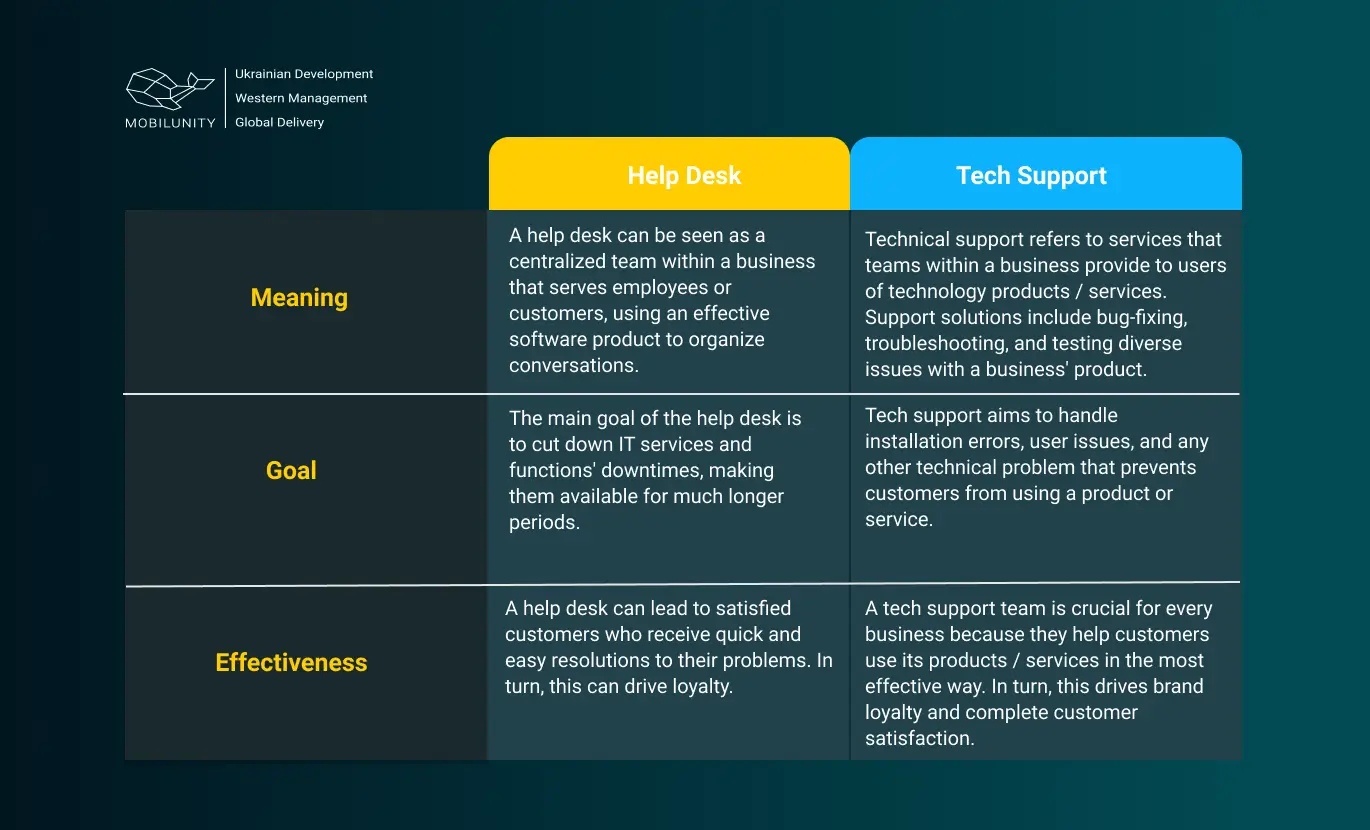
To understand the difference between a help desk vs technical support, it is essential to have a good definition of both.
In a business, both the help desk and technical support teams have a distinct role. While technical support aims to resolve the technical issues of customers, often with the help of other IT support teams, such as application support developer experts, a help desk is more focused on addressing customer queries and enhancing the customer experience. But these teams often work hand in hand. The global technical support outsourcing market increasingly focuses on grabbing business opportunities from the helpdesk segment as it is expected to account for the largest market share by 2022.
Both of these teams are very important within a business. And therefore, if a company does not have access to the right resources, it should opt to outsource these functions. Looking for experienced accounting software developer or RoR developer to manage your app? Contact us and hire programmers here and now!
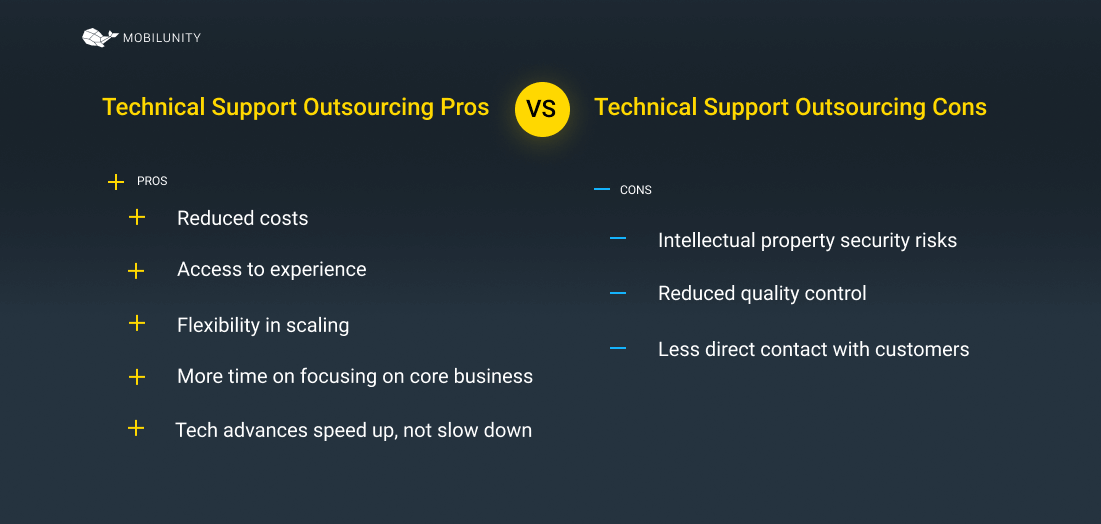
While tech and software support outsourcing comes with a lot of benefits, it doesn’t come without drawbacks. Let’s explore some problems businesses could face when outsourcing their tech support team:
Because a third-party company is working with important data, businesses and their customers can be left vulnerable to security risks and data breaches.
When businesses outsource, the tech support is no longer handled in-house and they have virtually no control over the quality of service provided. Businesses are also not responsible for onboarding new agents. This means they have no idea if they’re properly trained for the job or not.
Communicating through a third party gives businesses the opportunity to get immediate feedback from their customers. This can remove them from the customer relationship and can even lead to a loss of trust from customers.
Even though there are some drawbacks to making use of an outsourcing tech support solution, most of them are easy to overcome. The key is to work with a reputable outsourced partner and to communicate goals and objectives early on in the partnership.
It is very useful for businesses to understand both the pros and cons of outsourcing technical support. Here are some of the benefits involved:
When a business hires multiple in-house IT experts to provide support, they have to pay the overhead for the space and equipment they need to do their job. This can add up to thousands of dollars a year. When they outsource their technical support, they don’t have to pay nearly as much. They won’t need the additional office space or equipment. They also won’t need to run up a large bill on salaries every year. Instead, they only pay for the support that fits their specific needs. In fact, the entire market is driven by the increasing need for cost-effective solutions.
Technical support can be a delicate activity. Employees of outsource tech support companies have typically gone through expert training to cope with it and have accumulated major experience of handling different situations across diverse industries. As a result, businesses get access to experienced workers that bring skill and knowledge to their operations.
Outsourcing IT technical support allows businesses to grow or scale down their teams when necessary. In this way, they can grow their business at any time without having to worry about finding the right talent or resources.
Most businesses don’t focus on IT support but instead, work on aspects like product innovation. So, outsourcing their technical support makes sense. Outsourcing technical support allows them to focus on their primary product and on what they do best. Outsourcing support also allows business agents to deal with daily technical concerns and customer interactions instead.
A full-service outsourced tech support company typically uses state-of-the-art technology to work as effectively as possible, through their preferred channels, in the shortest amount of time.
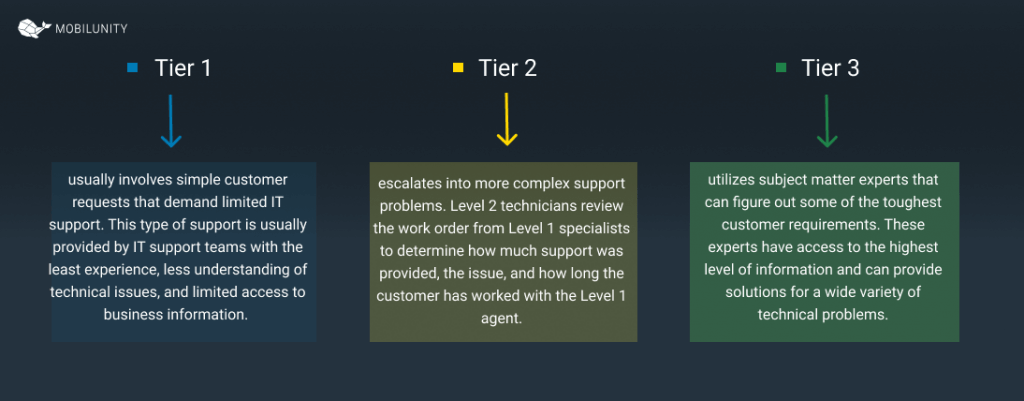
Breaking technical support into three levels allows businesses to apply the best team or specialist. The three levels can be broken down as follows:
Level 1 usually involves simple customer requests that demand limited IT support. This type of support is usually provided by IT support teams with the least experience, less understanding of technical issues, and limited access to business information.
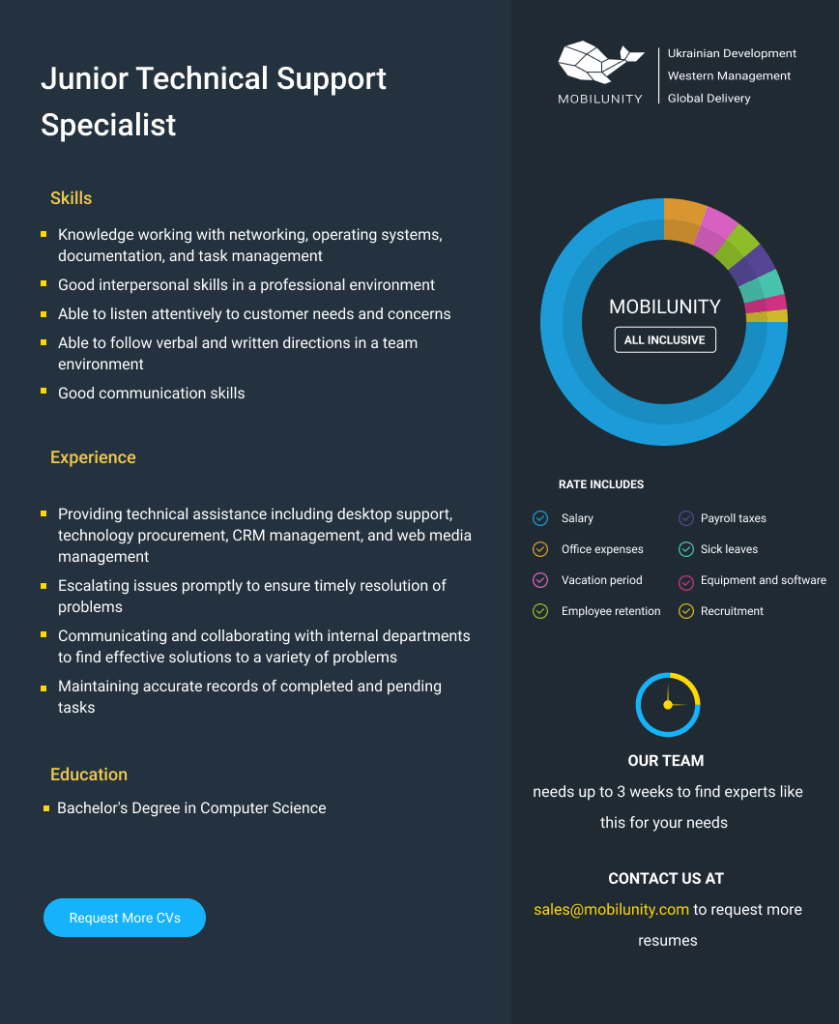
When businesses want to create a Level 1 support team, they should pick junior level technical support specialists who can:
Level 2 escalates into more complex support problems. Level 2 technicians review the work order from Level 1 specialists to determine how much support was provided, the issue, and how long the customer has worked with the Level 1 agent.
Level 2 technicians then communicate with the customer for an in-depth analysis of the query before providing a solution. If a solution is not immediately available, the query may move to Level 3 support.
Level 3 utilizes subject matter experts that can figure out some of the toughest customer requirements. This level of support typically requires experts in different subject matters. These experts have access to the highest level of information and can provide solutions for a wide variety of technical problems.
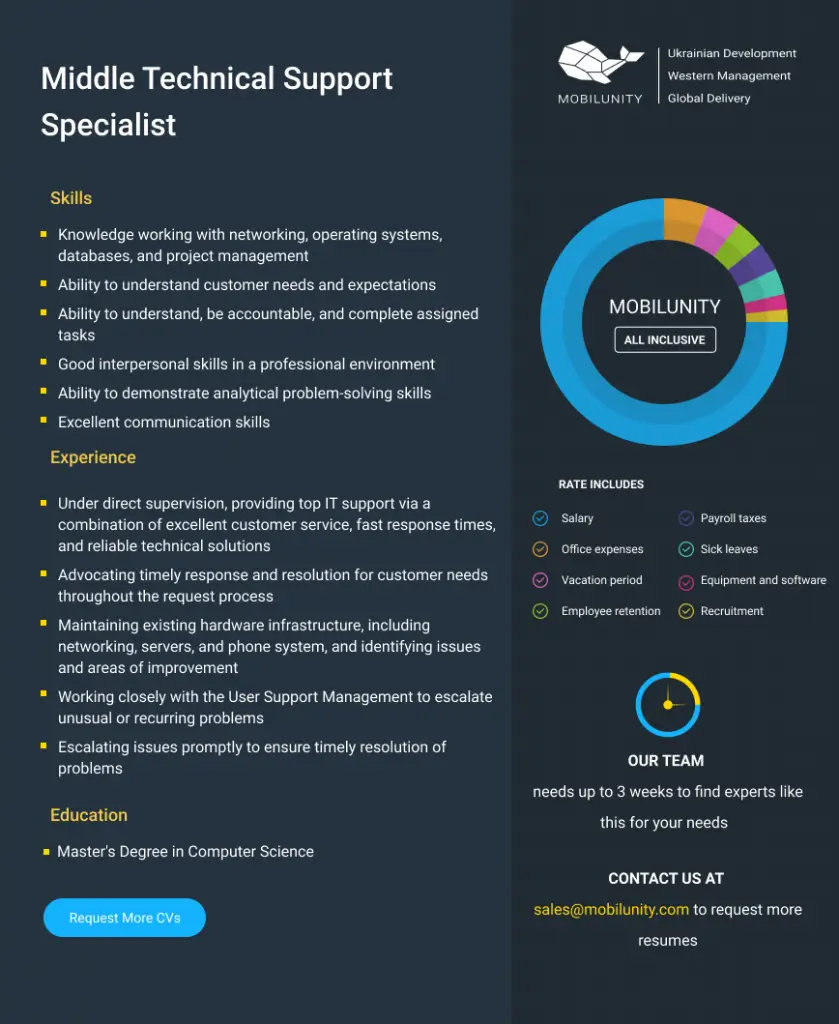
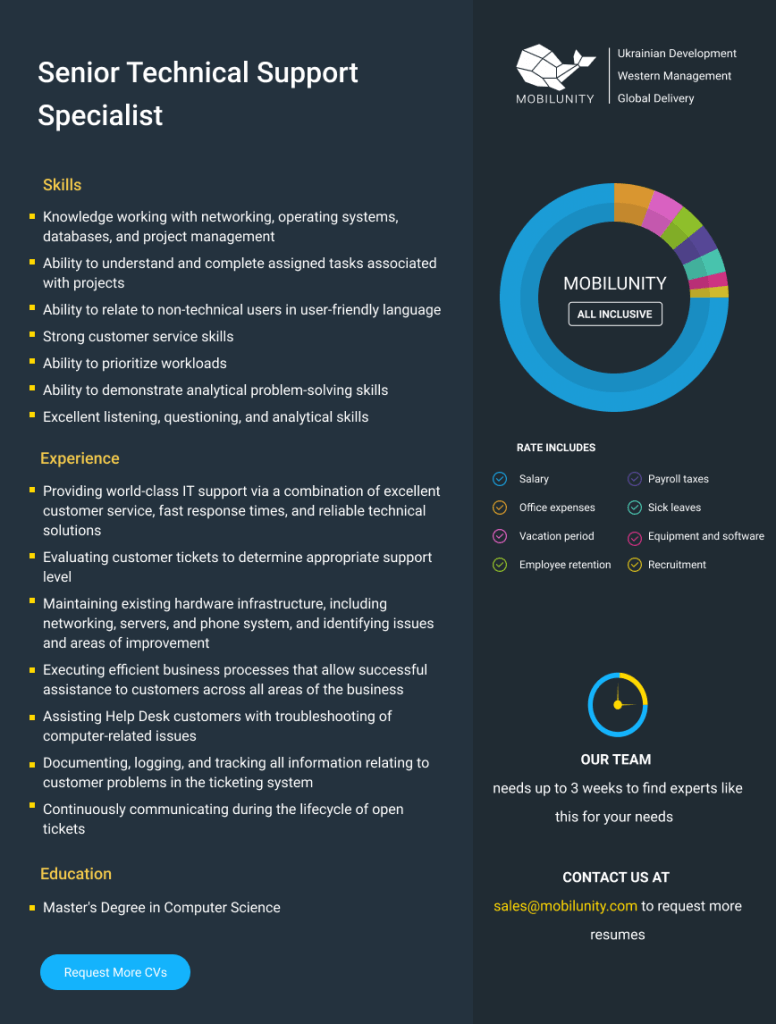
The type of expert businesses require may vary depending on the product and service they provide, the size of their business, and the number of clients they have. Here are examples of resumes for the different levels of specialists:
The right outsourcing partner depends on the complexity of your support needs, expected ticket volume, preferred time zones, and whether you need a dedicated team or a fully managed service. Here are 4 companies to consider:
Mobilunity is a global tech-talent and dedicated-team provider with 16 years of experience. The company works with more than 100 clients across 30+ countries and has a team of 300 consultants.
Mobilunity builds fully dedicated teams that clients manage directly, allowing them to retain control over day-to-day processes, priorities, and communication. Its services include dedicated teams, flexible on-demand specialists, consultancy, and recruitment.
For technical support outsourcing, Mobilunity can be a suitable partner for businesses that need experienced specialists, including product investigation, issue resolution, application support, and escalation management. It is particularly relevant for companies looking to extend an in-house technical team rather than outsource their entire customer-support operation.
Mobilunity’s approach is based on three areas: building strong client relationships, recruiting specialists according to each role’s requirements, and supporting long-term talent retention. This model helps businesses assemble and maintain stable technical teams while Mobilunity handles recruitment, onboarding, HR, payroll, and back-office support.
Source: vamasters.com
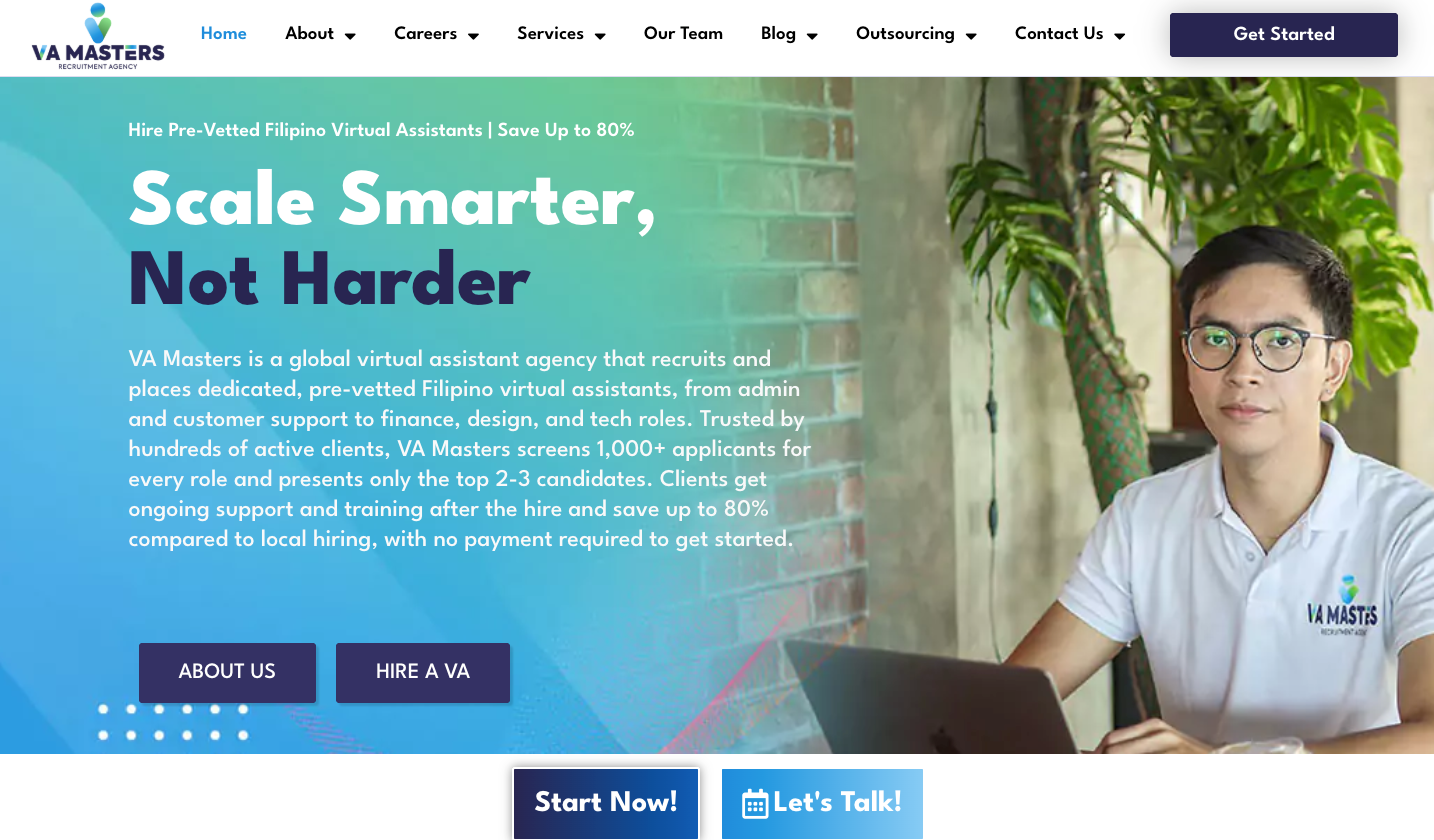
Not every support function has to go to a software development vendor. For Level 1 work such as handling tickets, answering calls and chats, collecting customer data, and basic troubleshooting, many companies now hire dedicated virtual assistants from the Philippines instead. VA MASTERS is a virtual assistant agency that recruits Filipino virtual assistants for businesses in the US, UK, Canada, Australia, and Europe, and has placed 1,000+ VAs to date.
Each role goes through a six-stage screening process, from 1,000+ applicants down to the top 2-3 candidates, including a custom skills test built around the actual support tasks. Technical support virtual assistants typically cost $8.50 to $16 per hour, which can mean up to 80% savings compared to local hiring, and there is no setup fee to get started. Many teams use a VA MASTERS virtual assistant as their first line of support and keep Level 2 and Level 3 engineering in-house or with a development partner.
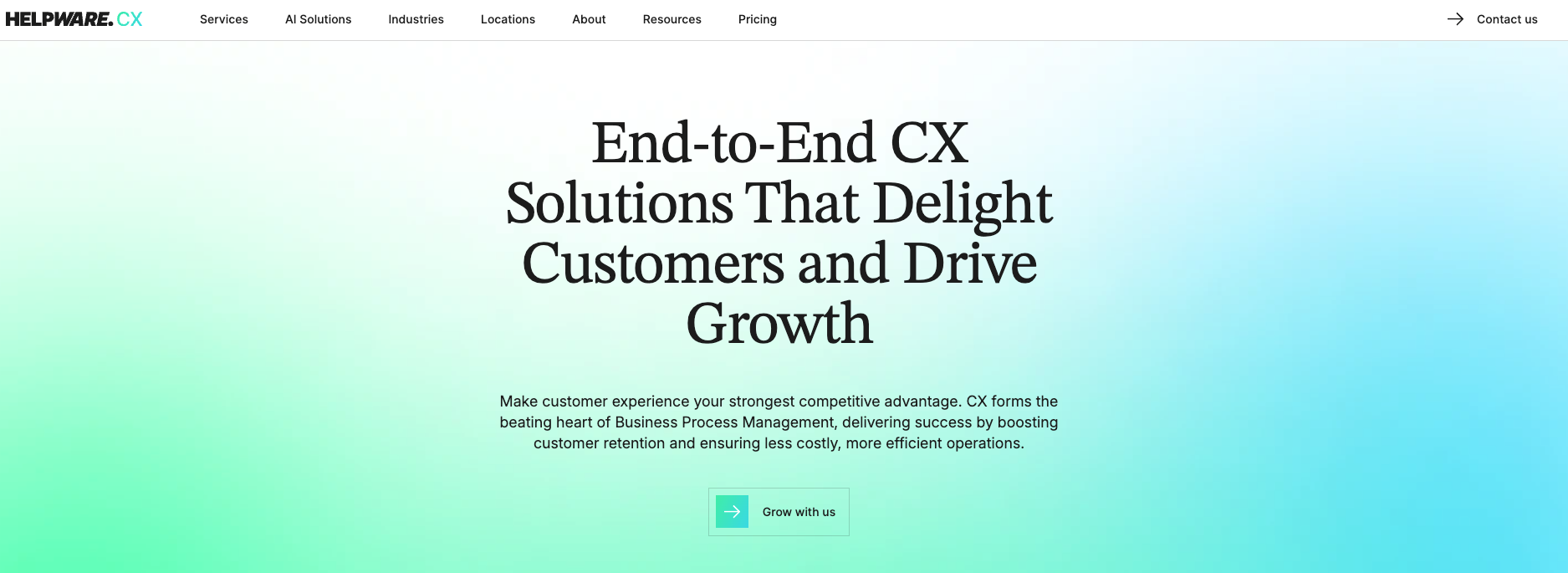
Source: helpware.com
Helpware is a customer experience outsourcing provider offering multi-tier technical support for businesses across industries. Its services include omnichannel support, product troubleshooting, SaaS and application support, technical help desk services, and coordination with engineering teams.
Helpware can be a good option for businesses that need a managed support operation covering several levels of complexity. The company combines trained support specialists with automation, ticket prioritization, diagnostics, and knowledge management processes to help resolve routine requests and more complex technical issues.
With global coverage and 24/7 support capabilities, Helpware may suit companies that need to scale technical support across time zones while maintaining consistent service levels.
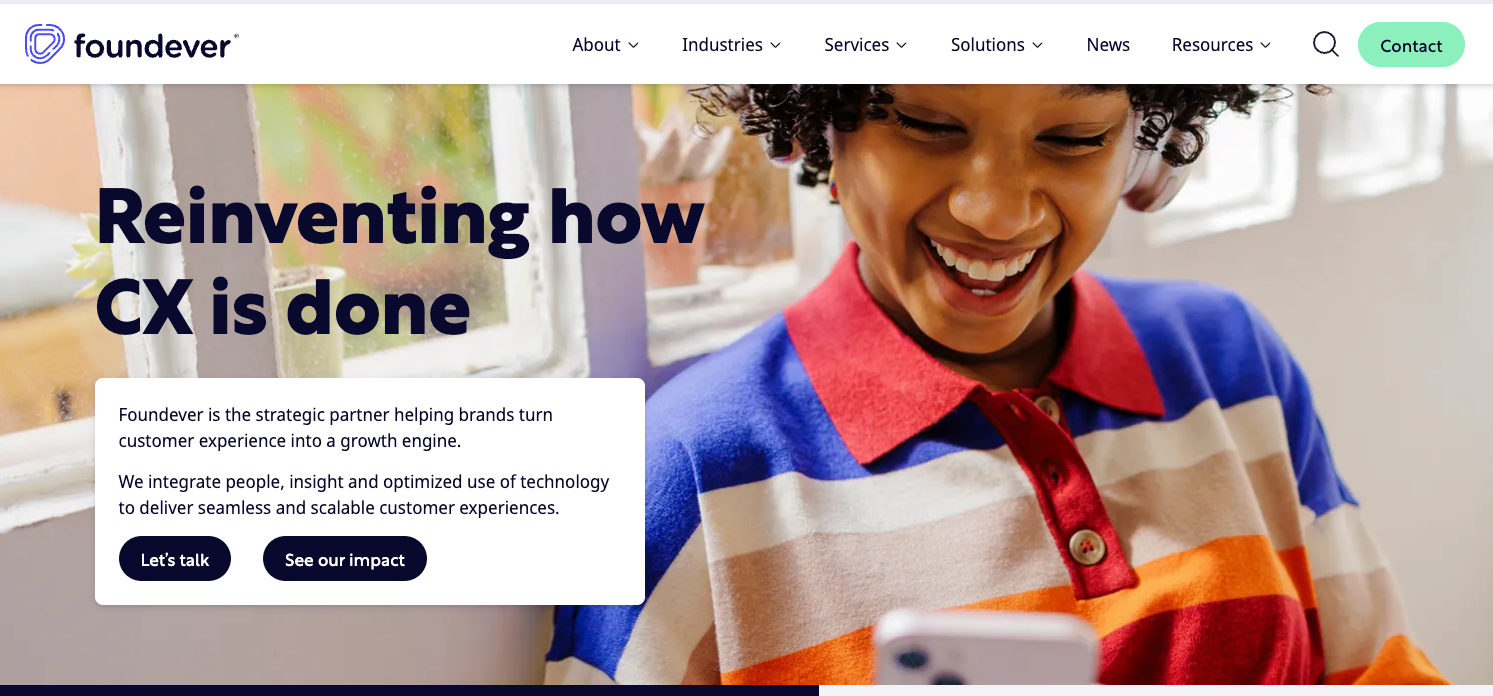
Source: foundever.com
Foundever provides global, multilingual technical support and IT service desk solutions. Its services are designed to help organizations deliver end-user support while improving efficiency through process automation, knowledge management, and self-service options.
Foundever can be suitable for larger businesses that need a scalable, managed technical-support partner across multiple markets. Its model combines trained multilingual agents with dedicated operational resources, such as program managers, knowledge engineers, and best-practice analysts.
This option may be especially relevant for organizations looking to provide consistent technical support across regions and languages while reducing the operational burden on their internal teams.
There are a few important questions to ask when wanting to make use of tech support outsourcing. Here, we take a look at some of the most frequently asked questions and answer them effortlessly.

Disclaimer: All salaries and prices mentioned within the article are approximate numbers based on the research done by our in-house Marketing Research Team. Please use these numbers as a reference for comparison only. Feel free to use the contact form to inquire on the specific cost of the talent according to your vacancy requirements and chosen model of engagement.