
IT Recruitment Lithuania: Market Overview and Hiring Guide


The benefits of staff augmentation are vast. This approach enables businesses to address the specialized skills gap, launch products more quickly, and manage expenses effectively without overburdening the HR team. At the same time, staff augmentation is far from a magic pill. You may encounter challenges when integrating specialists into existing teams and transferring knowledge.
How does it differ from traditional hiring? Essentially, these are different tools for different tasks: traditional hiring forms the long-term “foundation” of a team, while staff augmentation allows businesses to quickly strengthen that foundation with the necessary expertise when it is most needed. There’s also a distinct line between managed services vs staff augmentation.
In this article, we will look at the pros and cons of staff augmentation, risks of this approach, outline the cases in which it works best, and more.
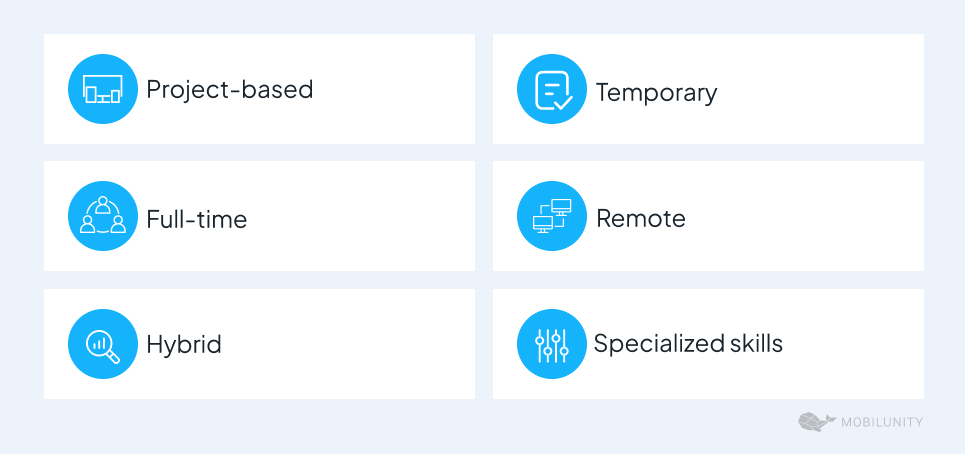
IT staff augmentation services can be adapted to various business needs, from rapid response to short-term peaks in the workload to long-term building of highly skilled teams. Here’s how it can be categorized by type:
All types have their distinct advantages, so businesses can choose the approach that best suits their goals. Before we get into the benefits of staff augmentation, we will look at how it works and what makes this model so effective in practice.
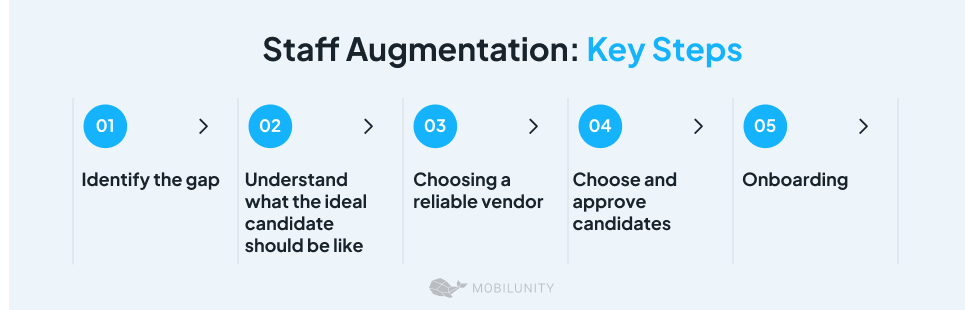
The process is actually quite simple: understand what skills or roles you’re missing, choose a reliable partner out of the top staff augmentation companies, get to know the candidates, and in just a few days or weeks, the new specialist can fully join the team. Below is a brief, clear, and user-friendly overview of how staff augmentation works step by step.
1. Identify the gap.
The first step is to determine precisely what the team is missing: what roles need to be filled, what skills they need to possess, and how many people are required to fulfill these needs. For example, you may need an iOS developer with SwiftUI experience to launch the application on time, because all other devs are busy building features. Or maybe you don’t have a specialist with this expertise at all.
2. Understand what the ideal candidate should be like.
Here, you describe everything: what they will do, what technologies they will use, what hours they will work, who they will interact with, and what results are expected. For example, you may be looking at offshore talent, so it would be ideal to have at least 4 hours of overlap with the core team during working hours and for them to participate in daily stand-ups.
3. Choosing a reliable vendor.
Now, look for a partner to help find the right specialists, that is reliable, fast, proven, and has good reviews. The vendor will take on all the heavy lifting, like searching, vetting, and legal nuances.
4. Choose and approve candidates.
The interview here is more of a friendly check: do they have the necessary skills, do they fit in with the work style, will they be comfortable interacting with the team? The goal is to find a person who not only “knows how” but also really fits in your company.
5. Onboarding.
A little excitement, a lot of information, and a quick dive into the project. It’s necessary to make a welcome call, introduce new workers to the team, and give as many details about the project as possible.
No months-long hiring cycles, no heavy HR overhead, and no fear of locking yourself into an expensive, long-term commitment. That’s why this model is gaining massive momentum across tech companies worldwide. Here are some of the top benefits of IT staff augmentation:
Want a highly skilled expert without inflating your headcount or dealing with the full cost of a permanent employee? That’s exactly what staff augmentation delivers. You don’t pay for lengthy recruitment cycles, benefits, taxes, or office infrastructure. You pay only for the expertise you need, and only for the time you actually use it. Nothing wasted.
The ManpowerGroup 2024 Global Talent Shortage report revealed that 74% of employers struggle to fill roles. But with staff augmentation, you can get specialized talent in a matter of weeks, not months. Staff augmentation companies have databases of pre-vetted talent that’s easier to reach. This accelerates development, reduces time-to-market, and dramatically lowers the pressure on team leads and project managers.
Today you need two backend developers, next month you’ll need QA engineers, and later you’ll scale down again? Staff augmentation lets you adjust your team as easily as you scale cloud resources: up when you need more power, down when you don’t. It’s a great model for companies with fluctuating workloads, seasonal spikes, or complex multi-stage projects where the team needs change constantly.
If permanent hiring is a “blind investment,” staff augmentation allows you to first work with a specialist on a real project. The company can see the quality of the code, the speed of work, the communication style, and compatibility with the team. Only then can it decide on long-term cooperation. This significantly reduces risks.
Searching, screening, verifying, contracts, payments, taxes, all of this falls on the provider. The team gets a ready-to-work specialist without internal bureaucracy. HR and managers can focus on their core tasks rather than endless interviews.
An excellent specialist may be located in another country, and this is no longer a problem. Staff augmentation removes geographical restrictions, expands the funnel, and allows you to choose from the best specialists in the world. Often at a more favorable price, due to differences in economies and cost of living.
Imagine a startup suddenly receives investment or enters a new market. You need to grow your team not “one by one,” but as a whole: frontend, backend, QA, DevOps. Thanks to staff augmentation, you can add several specialists at once and speed up development without losing quality.
External specialists often bring new approaches, best practices from other projects, non-standard solutions, and knowledge of tools that the team does not yet possess. This improves not only the product itself, but also the development of internal specialists.
The bottom line? Staff augmentation isn’t just “renting developers.” It’s a modern, efficient talent strategy that helps companies move faster, build smarter, and stay fully focused on delivering great products without drowning in hiring stress.
Staff augmentation is not suitable for everyone, but there are several typical situations where this model brings maximum value to companies:
1. Companies that need specialized skills that are not available within their team.
There are tasks where the internal team is strong but lacks narrow expertise, such as AI/ML models, cloud migration, cybersecurity, DevOps/Kubernetes clusters, and mobile development for a specific platform. Instead of hiring a full-time specialist for a temporary or infrequent need, the company brings in an external expert. This speeds up the work and avoids unnecessary costs.
2. Teams with tight deadlines or accelerated schedules.
If a project is urgent and internal resources are limited, staff augmentation allows you to quickly add several developers to a sprint, increase the pace of releases, and enter the market on time without sacrificing quality. This is the ideal solution for companies that frequently launch new products or develop complex systems where speed is critical.
3. Startups or small businesses that want to grow without risks.
Staff augmentation is particularly well-suited here because it provides access to senior expertise without hiring expensive full-timers, flexibility in scaling the team as needed, and the ability to dramatically accelerate MVP or new module release. This is the most cost-effective way to quickly build a strong team.
4. Departments that want to focus on key tasks.
Internal teams can focus on what brings the most value to the business, like innovation, strategic planning, and product development. External specialists take on technical implementation, support for individual components, monotonous or one-off tasks, and work on specific subprojects. This reduces the workload on the team and improves productivity.
| Challenge | Recommendations on how to cope |
| Gaps in communication and collaboration. Different time zones, cultural differences, and different approaches to work can complicate synchronization. | – Establish clear communication rules and tools. – Schedule regular sync-ups during overlapping work hours. – Appoint an internal coordinator or mentor. – Encourage transparent, asynchronous communication. |
| Delays in onboarding additional staff. New specialists may take longer to get up to speed with processes because they are unfamiliar with the product, the team, or internal standards. | – Prepare a structured onboarding plan. – Provide access, documentation, and code examples from day one. – Conduct a welcome call and introduce the team. – Introduce a “first task” practice for a quick start. |
| Relying on external resources for critical tasks. If an external specialist leaves the project, the company may lose context or momentum. | – Ensure there’s documentation of all decisions and changes. – Introduce a knowledge transfer process. – Involve internal specialists in key parts of the project. – Plan for overlap during offboarding. |
| Risks related to the quality of performance. Not all external specialists are equally qualified; there is a risk of getting the “wrong” specialist. | – Work only with trusted providers. – Conduct your own technical interview. – Give a test assignment or a short trial period. – Set clear KPIs and regular performance reviews. |
| Security and data access issues. External professionals need to be given working access, which creates security risks. | – Use the principle of “least privilege.” – Sign NDAs and IP agreements before starting work. – Use separate environments for work (dev/stage). – Restrict access by time or role. |
Staff augmentation is particularly effective when the following are required, like speed, flexibility, rare expertise, and budget optimization. But how can you ensure you get the most value our of this model? Here are a few considerations:
With the advantages of It staff augmentation, it’s becoming one of the most practical and flexible ways to strengthen IT teams in modern business. At the same time, this model has its challenges, but with the right approach, transparent processes, a reliable partner, and thoughtful integration, any risks can be turned into controllable and manageable ones.
As a result, staff augmentation gives companies what they often lack: speed, flexibility, and access to specialized skills when they are really needed. For businesses looking to scale, accelerate development, and maintain control over their products, it’s a strategic advantage.

Disclaimer: All salaries and prices mentioned within the article are approximate numbers based on the research done by our in-house Marketing Research Team. Please use these numbers as a reference for comparison only. Feel free to use the contact form to inquire on the specific cost of the talent according to your vacancy requirements and chosen model of engagement.