
Hire Developers in Hungary


When a company’s internal IT team can’t handle everything, perhaps due to limited skills, a need for extra help quickly, or a desire for more flexibility, you generally have two options. You can bring in external specialists temporarily or give the entire project or function to an outside provider.
Many companies choose the second option; recent data shows that the global IT outsourcing market is expected to reach about USD 588 billion by he end of 2025. According to a 2024 survey by Deloitte, 80% of executives in organizations that use third-party vendors plan to maintain or increase their outsourcing investments. About half of these organizations already outsource back-office tasks and key functions like R&D or sales support.
On the other hand, many businesses opt for staff augmentation because it allows them to integrate skilled IT professionals directly into their in-house team. This method helps maintain control and flexibility without fully committing to outsourcing. The choice between augmentation and outsourcing is ultimately a strategic decision based on what you need: control, speed, flexibility, or full delegation.
In this article, we will look at what each model really means. We will also consider their real-world advantages and disadvantages to help you determine which one is the best fit for your business.
IT staff augmentation is a flexible hiring approach that lets companies expand their internal teams with external IT specialists for a specific timeframe or project. Instead of handing over complete responsibility to a vendor, businesses keep direct control while accessing skills that may be lacking internally or temporarily in high demand.
These professionals work within your existing framework, align with your tools and processes, and follow your internal managers’ guidance. The vendor handles recruitment, contracts, and payroll, while you focus on execution and delivery.
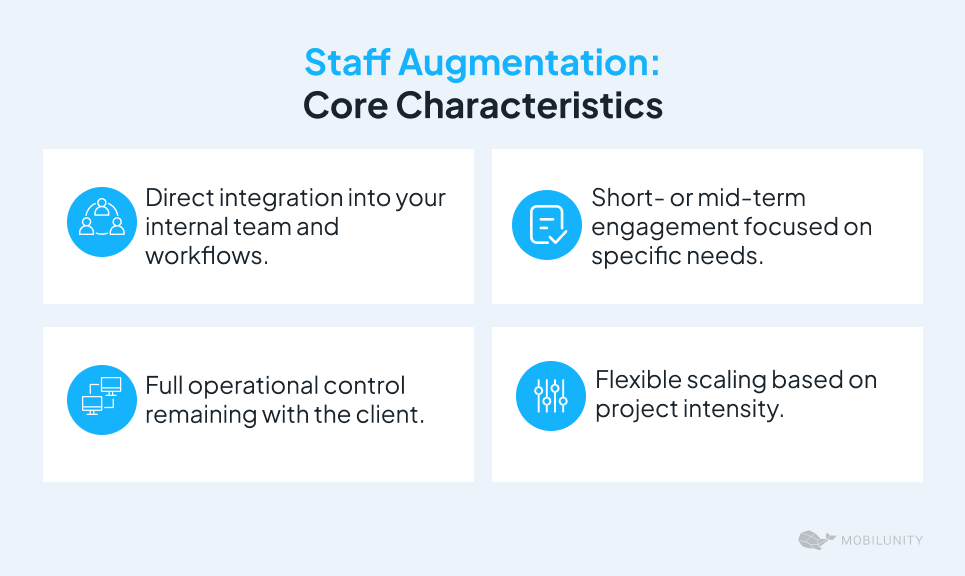
Staff augmentation is especially appealing for businesses that need speed without losing control. Instead of starting the hiring process from scratch, teams can plug in skilled professionals who can contribute almost immediately.
Key benefits include:
Beyond operational benefits, this model also supports business continuity. When internal capacity is stretched, projects keep moving, deadlines remain manageable, and internal teams can avoid burnout.
While this model offers freedom and flexibility, it also puts more responsibility on the client side. The success of augmented staff depends on their skills and on how well your organization manages and integrates them.
Some challenges to consider include:
Also, keep in mind that there is a difference between managed services and staff augmentation. With staff augmentation, you add specialists directly to your team. They work under your guidance, follow your processes, and fit smoothly into your workflow. Managed services, however, take a more hands-off approach. The provider supplies the talent and also oversees the execution, project management, and everyday operations.
IT outsourcing is a way for a company to hand over certain IT tasks, services, or entire projects to an external provider. This provider takes charge of planning, executing, and delivering results. Rather than expanding their internal team, the business relies on the vendor’s infrastructure, processes, and abilities, treating them as a separate extension of the company.
In this arrangement, the outsourcing partner manages everything, from allocating resources and organizing workflows to ensuring quality and meeting deadlines. The client focuses on setting goals, approving milestones, and monitoring results, while the provider handles daily coordination.
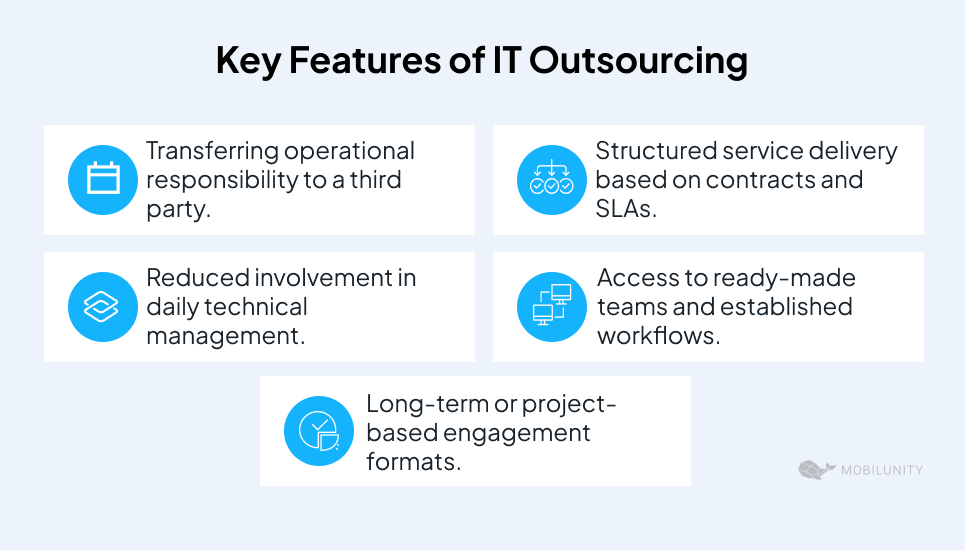
One of the main reasons companies choose outsourcing is to improve efficiency. By delegating tasks to a specialized provider, businesses allow their internal teams to focus on strategic priorities, product development, and core operations.
Key benefits include:
In addition to financial advantages, outsourcing also brings operational stability. Tasks are managed by teams whose main focus is delivery. In this case, internal staff can shift their energy toward innovation and long-term planning instead of routine tasks.
Even with its efficiency, outsourcing also comes with risks that companies need to carefully consider. Since many operational controls pass to the vendor, businesses might feel less connected to daily progress and technical decisions.
Some possible drawbacks include:
Staff augmentation vs project outsourcing help businesses access external IT talent, but they address different needs. Unlike outsourcing staff augmentation model boosts your in-house team by adding specialists who work under your management. Outsourcing transfers responsibility to an external provider who handles the work independently.
The main difference appears in daily operations. With augmentation, you remain closely involved in decisions and workflows. With outsourcing, your role focuses more on overseeing results than managing people.
Key differences at a glance:
| Criteria | Staff Augmentation | Outsourcing |
| Main Goal | Strengthen your existing team by filling skill gaps or increasing capacity for specific tasks or periods. | Delegate an entire function, project, or process to an external company for complete execution. |
| Control and Management | You retain full operational control. The augmented specialists follow your workflows, standards, tools, and internal leadership. | Management responsibility is shifted to the vendor, who defines processes, supervises the team, and controls execution. |
| Cost Structure | Typically based on hourly or monthly rates per specialist. Costs adjust according to workload and team size changes. | Often structured as fixed-price or long-term contracts with predefined deliverables and service levels. |
| Skill and Expertise | You selectively bring in niche experts to complement your existing knowledge base without permanent hiring. | You rely on the vendor’s collective expertise and established internal processes to handle the defined scope. |
| Integration and Collaboration | Deep integration with your internal team: shared communication channels, daily syncs, and cultural alignment. | Limited integration: collaboration usually occurs at milestone or reporting levels rather than daily operations. |
| Involvement Level | High involvement from your side — you guide priorities, decisions, and execution flow. | Lower involvement — your focus shifts to monitoring outcomes rather than managing daily tasks. |
| Flexibility and Scalability | Highly flexible — specialists can be added or reduced quickly as demands change. | Less flexible — scaling usually requires contract revisions and renegotiation of scope or resources. |
| Onboarding | Faster onboarding since specialists adapt to your processes and tools while joining existing team structures. | Longer onboarding focused on aligning expectations, deliverables, and communication frameworks. |
There’s no one-size-fits-all answer to whether staff augmentation or outsourcing is the right choice. It depends on how your business operates and what your project needs.
Staff augmentation is often used when a company has a strong internal team but requires additional expertise or capacity for specific tasks. For instance, if your product is growing quickly and your developers are overwhelmed, hiring 2 to 3 backend specialists for six months helps maintain your workflow, tools, and leadership structure while adding more support. This also applies when you need a specialized skill, like DevOps, AI, or cybersecurity, that your current team doesn’t have, but you don’t want to make a permanent hire.
Outsourcing, however, is best when a business wants to step back completely from execution. Consider launching a new mobile app while your core team focuses on the main platform. Instead of managing additional developers, you can assign the project to an external provider who oversees the team, deadlines, and delivery. You only need to approve milestones and review results, rather than coordinating daily tasks.
Consider this while choosing:
Large, multi-layered projects that need regular adjustments benefit from staff augmentation. Smaller or well-defined projects usually fit better with outsourcing.
If you need predictable costs and fixed deliverables, outsourcing provides clearer financial planning. When flexibility is more important (for example, if the project scope might change) staff augmentation offers better control over spending.
When speed is essential and you need professionals brought on quickly, staff augmentation allows for rapid scaling. Outsourcing can take longer to set up but is effective when timelines are stable and long-term.
If you want to be directly involved in decisions, technical choices, and priorities, augmentation keeps that power in-house. If you’re comfortable handing over execution entirely, outsourcing frees your team from operational oversight.
A strong internal team that needs support will benefit from augmentation. If your internal expertise is limited or already stretched thin, outsourcing can provide a ready-made solution with minimal internal management.
In practice, when choosing between outsourcing vs staff augmentation, the smartest decisions are made when the model supports the project and the way your team prefers to work.
Staff augmentation provides an effective way to access the right expertise when you need it. Here are five practical reasons why businesses choose this approach to keep projects on track, maintain quality, and move quickly without overwhelming their internal team.
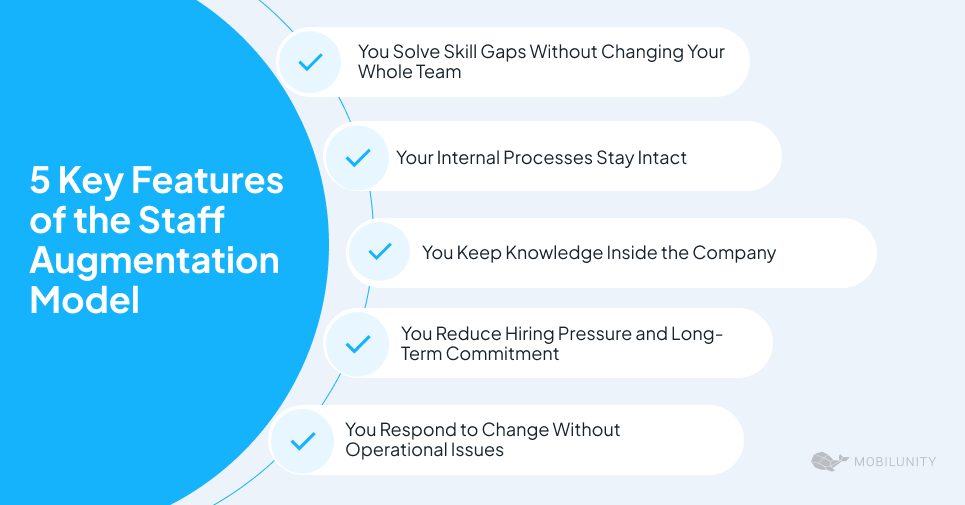
Instead of restructuring roles or redistributing work internally, staff augmentation lets you bring in specialists exactly where your project needs them. This could be a QA engineer for a release cycle, a DevOps expert for infrastructure setup, or a UI designer for a product refresh. Once the task is complete, your team can return to its usual workflow.
With staff augmentation, you don’t need to adjust to someone else’s workflows or project management style. The specialists fit with your tools, communication standards, and decision-making process. This keeps execution consistent and avoids the tension that often comes with outside delivery methods.
One of the biggest benefits is knowledge retention. Augmented specialists actively contribute to your internal environment, documentation, and team learning. Instead of project knowledge leaving with a vendor, it stays within your organization.
When you need expertise quickly, traditional hiring can slow you down. Staff augmentation skips the long hiring process, probation periods, and permanent employment risks while still ensuring you collaborate with experienced professionals.
Projects rarely stay the same. Requirements shift, priorities change, and timelines tighten. Staff augmentation allows you to react to these changes almost instantly, adding, replacing, or rebalancing specialists without disrupting the project’s structure.
In short, choosing staff augmentation is about giving your projects momentum, making smarter decisions, and staying ahead of challenges as they arise.
When searching for IT talent, focus on three key areas: make sure candidates are technically skilled and experienced, confirm that they can fit well with your team and workflows, and collaborate with a partner who manages administrative tasks so your internal team can concentrate on delivery. Flexibility, clear communication, and quick onboarding are vital to prevent delays or conflicts.
Mobilunity helps businesses find skilled professionals quickly, providing them IT staff augmentation service. We integrate those professionals smoothly into projects and allow teams to grow without the usual recruitment challenges. Our flexible approach makes sure you get the expertise you need, right when you need it.
Pre-vetted specialists: You can connect with experienced IT professionals ready to join your team without lengthy screening.
Seamless team integration: Mobilunity’s experts fit into your processes, tools, and culture, working as a natural part of your team.
Fast onboarding: Teams can start contributing in just a few weeks, keeping projects on track.
Administrative support: Mobilunity manages contracts, payroll, benefits, and compliance, allowing your internal resources to focus on other tasks.
Flexible scaling: You can add or reduce specialists as necessary, whether it’s one expert or an entire dedicated team.
Proven track record: Mobilunity has effectively supported clients across various industries, from startups to large enterprises.
Mobilunity focuses on flexibility and offers several collaboration options:
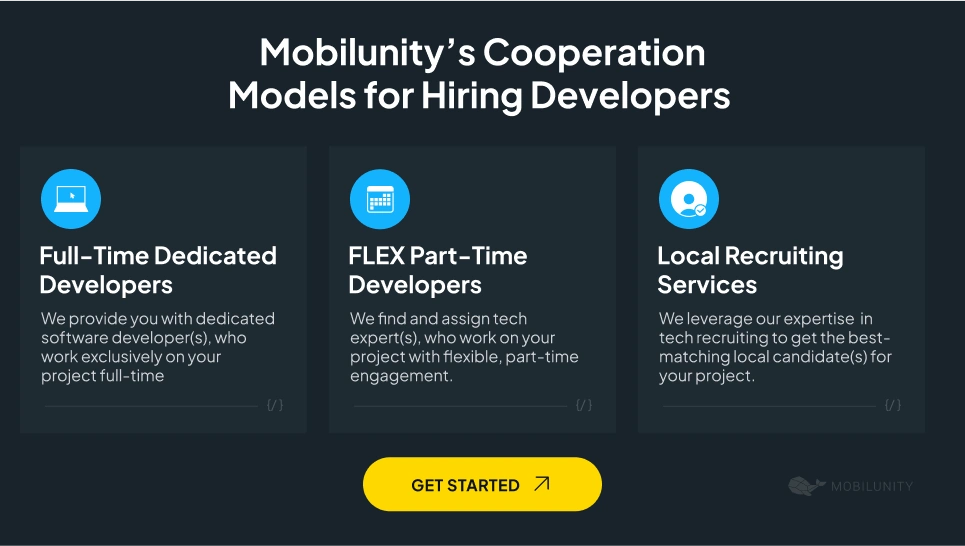
By merging speed, reliability, and integration, Mobilunity helps businesses quickly scale IT teams while minimizing risk and maintaining control over projects.
Choosing between staff augmentation and outsourcing is about matching your team structure with how your business operates and the goals you want to reach. The right approach can turn a bottleneck into progress. It can help you deliver projects faster, maintain quality, and adapt to change without disorder.
In the end, the best strategy is in understanding what your team needs, how much control you want to keep, and where outside expertise can have the most impact. With flexible IT staffing models, skilled talent, and partners who understand your workflow, expanding your capabilities can focus more on opportunity and less on risk.

Disclaimer: All salaries and prices mentioned within the article are approximate numbers based on the research done by our in-house Marketing Research Team. Please use these numbers as a reference for comparison only. Feel free to use the contact form to inquire on the specific cost of the talent according to your vacancy requirements and chosen model of engagement.