












IT Recruitment Lithuania: Market Overview and Hiring Guide


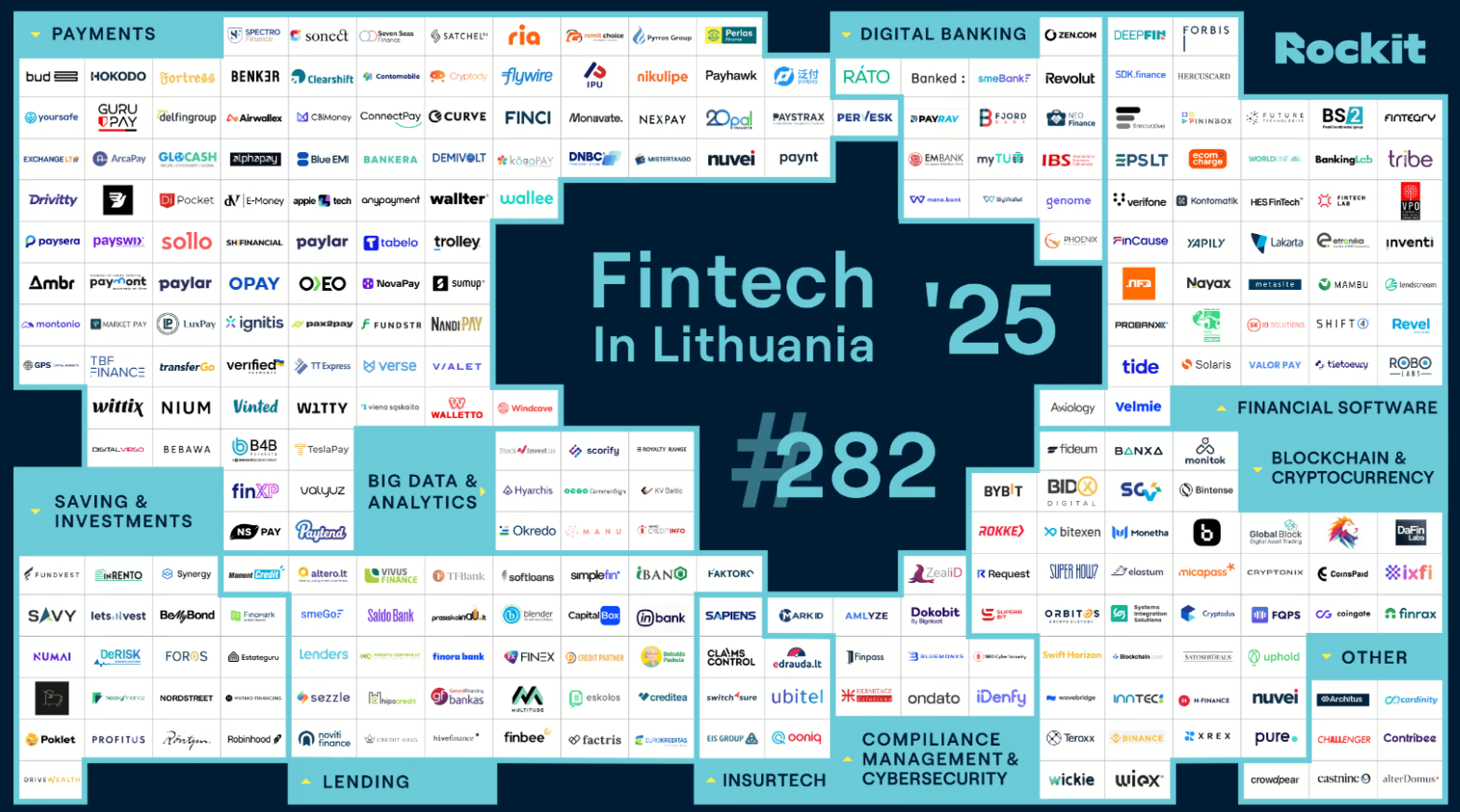
Businesses looking to hire developers in Eastern Europe should consider Lithuania an appealing option. This country is a tech hub with thousands of tech experts, a robust digital infrastructure, and a vibrant tech ecosystem. It has strong cybersecurity, fintech, blockchain, AI, and IoT ICT subsectors.
In this article, we’ll explore why it’s beneficial to hire dedicated developers in Lithuania, check its top tech hubs, learn about popular technologies, and discuss the salaries of local software engineers. We’ll also tell you about nearshoring cooperation formats and share some tips on finding a reliable tech talent provider.
Let’s start with a brief overview of the Lithuanian ICT sector.
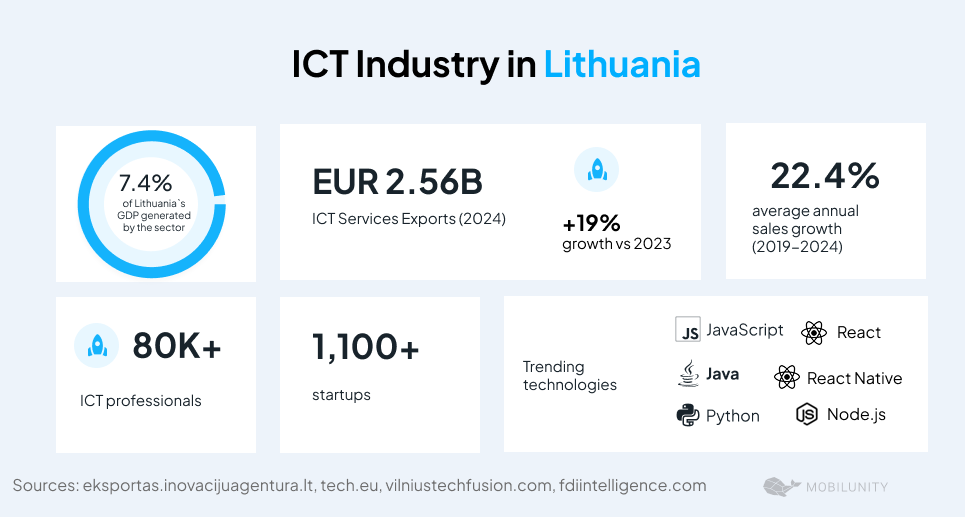
Lithuania’s ICT industry is a major pillar of the economy, accounting for 7.4% of national GDP and exporting services worth EUR 2.56B in 2024, a 19% increase from the previous year. With around 80,000 ICT professionals, 4,000 IT companies, and more than 1,100 startups, the sector continues to expand rapidly. Technologies like Python, JavaScript, Java, React, React Native, and Node.js dominate the market, showcasing a developing, innovation-driven tech landscape.
With such a dynamic and fast-growing technology sector, Lithuania offers an environment where businesses can hire skilled developers quickly and confidently. Below are the key advantages that make the country an appealing nearshore destination.
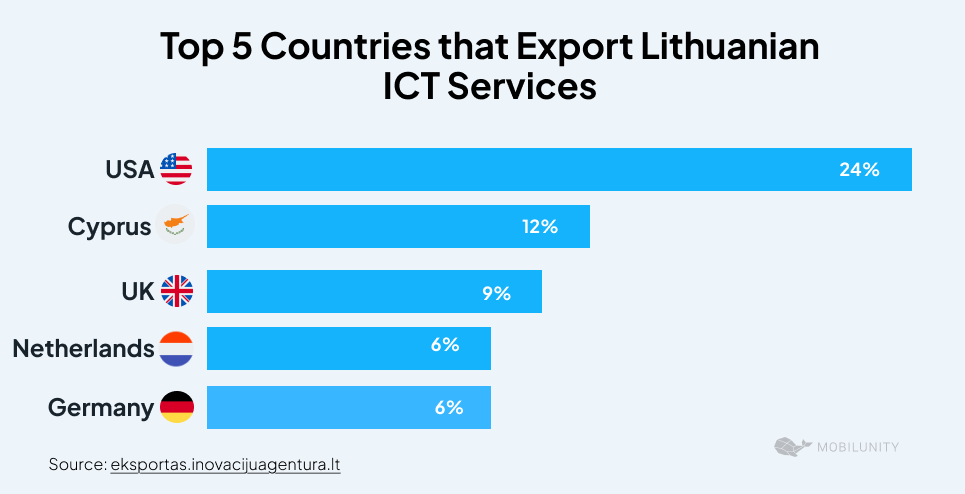
Lithuania’s tech sector exports ICT services to leading global markets, highlighting an evolved engineering culture and creating strong conditions for companies seeking reliable, scalable development talent.
Here are the key advantages businesses get when they hire contractors in Lithuania.
Lithuania ranks 22nd among 39 European countries by monthly net salary, which is nearly half that of Germany, the Netherlands, the UK, Austria, and other Western European countries. We’ll explore software engineers’ salaries in more detail later; however, businesses hiring developers Lithuania can save 30-50% of costs while keeping the engineering quality high.
Over the last 10 years, Lithuania’s ICT talent pool has grown impressively at an average annual rate of 14%. The country was the 1st in the EU for the number of young specialists (age up to 34) joining the ICT sector. The national reskilling/upskilling program is expected to add 20,000 professionals in IT, life sciences, automation, business process digitization, and engineering.
Companies based in Northern and Western Europe can leverage the closely aligned working schedule of Lithuania. They can run stand-ups and sprints and initiate ad-hoc discussions during business hours, avoiding the delays of offshore collaboration. Such a development rhythm feels like working with an in-house team.
Lithuania has one of the most rapidly expanding tech ecosystems in Central and Eastern Europe. The country got into the top 20 startup ecosystems (ranking 19th of 118 countries) with 7.5% annual infrastructure growth. Its tech companies have raised around EUR 600M in 2024.
Lithuania is a Moderate Innovator according to the European Innovation Scoreboard 2025 (#33 globally) and has EUR 724M allocated in the Recovery and Resilience Plan to advance the country’s digital transformation.
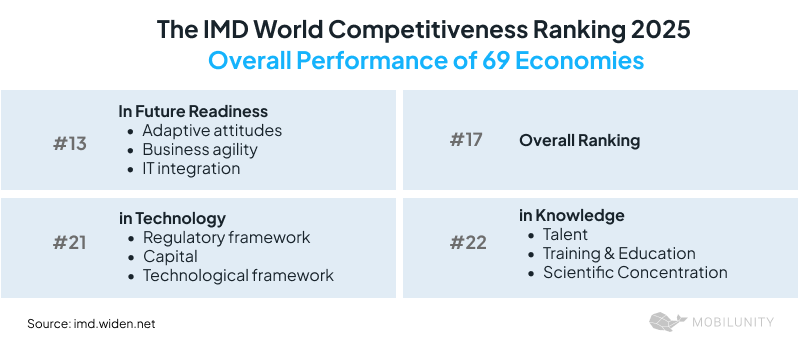
Lithuania has maintained political stability and implemented reforms, supporting its evolving tech and innovation ecosystem. Here are some highlights of the BTI Transformation Index that analyzes and compares transformation processes towards democracy and an inclusive market economy worldwide.
| #3: Lithuania’s BTI Transformation Index (out of 137 countries) | ||
| #5 Economic Transformation Factors: – Level of Socioeconomic Development – Organization of the Market and Competition – Monetary and Fiscal Stability – Private Property – Welfare Regime | #3 Governance Index Factors: – Level of Difficulty – Steering Capability – Resource Efficiency – Consensus-Building – International Cooperation | #4 Political Transformation Factors: – Stateness – Political Participation – Rule of Law – Stability of Democratic Institutions – Political and Social Integration |
Most Lithuanian developers speak English fluently, as the country ranks #33 in English proficiency among 123 countries and regions. Their communication is direct and structured, and they’re comfortable with agile processes, collaborative decision-making, and accountability. This makes working with Lithuanian teams smooth, predictable, and culturally compatible for European companies.
Access a world of talent and boost your team by recruiting expert developers from around the globe. Gain from a range of unique viewpoints and skills to propel innovation and development in your technology initiatives.
Lithuania’s tech talent is concentrated in several rapidly developing hubs, each contributing unique strengths to the country’s digital landscape. Below, we explore what sets these cities apart and why they matter for companies hiring remote developers.
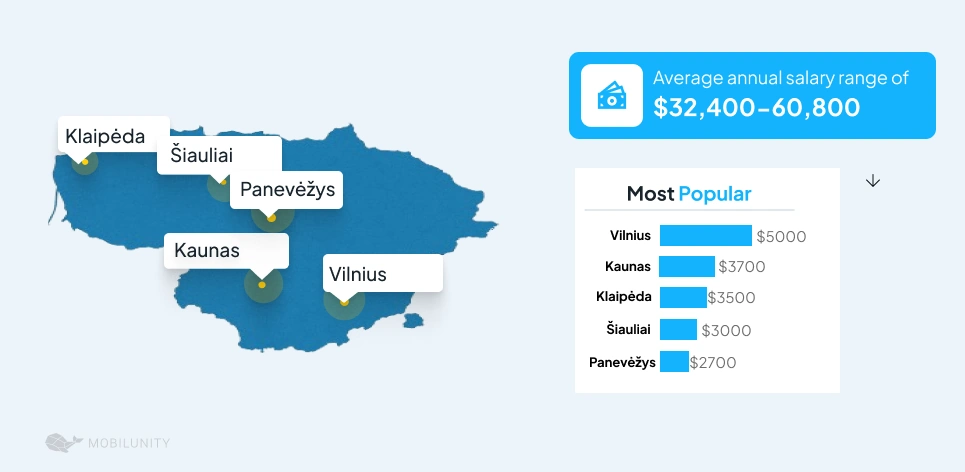
Lithuania’s capital and largest tech center ranks #69 of 1,450+ cities in the Startup Ecosystem Report 2025. The fastest-growing Lithuanian city boasts a growth rate of 22%. With renowned universities, modern infrastructure, and a thriving fintech scene, this hub attracts global companies. Vilnius ranks #3 in Europe and #10 globally for cybersecurity and provides access to senior developers across Python, JavaScript, Java, and cloud technologies.
Lithuania’s second major tech hub is supported by Kaunas University of Technology, which hosts the country’s first academic incubator, KTU Startup Space. With the Startup Ecosystem Index of 196, the city is home to fast-growing IT service companies and manufacturing-tech R&D, creating steady demand for tech specialists. Kaunas offers reasonable salaries and a stable pipeline of well-trained graduates.
This is a coastal tech hub with a growing digital services sector supported by Klaipėda University and several vocational IT programs. The city ranks #963 globally for its startup ecosystem and #69 globally for its automotive industry. It attracts companies in logistics, maritime tech, and automation due to its port-driven economy. Klaipėda provides a mix of affordable operating costs and a developing pool of high-quality tech talent.
It’s a hub that offers companies a cost-efficient location for building remote development teams, supported by local universities and practical IT programs. While smaller than major hubs, the city provides steady access to motivated entry- and mid-level talent. So Šiauliai is suitable for businesses looking to scale sustainably without capital-city overhead.
This is an emerging regional hub where companies can build remote teams at lower operating costs than Lithuania’s major cities. Panevéžys has technical colleges and vocational programs supplying entry-level tech talent. So the city appeals to businesses seeking stable, long-term support roles or gradually expanding engineering teams in a quieter, cost-efficient environment.
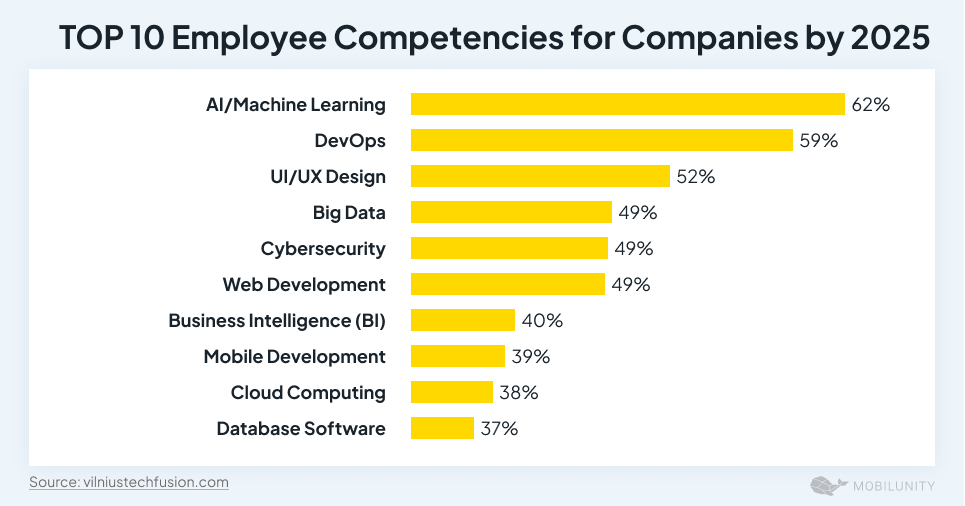
Lithuania’s tech workforce has strong engineering skills and proficiency in modern stacks. Below are the in-demand expertise companies look for when hiring Lithuanian developers. They reflect the country’s growing focus on high-quality, scalable product development.
Strongest ICT subsectors in Lithuania
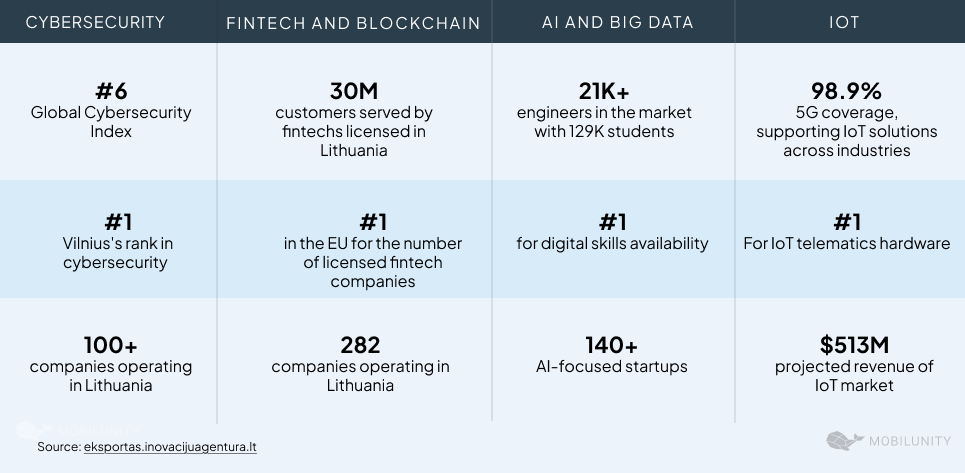
Lithuania has a growing pool of developers skilled in practical AI and machine learning applications, including data processing, model training, and automation tasks. Businesses hiring here benefit from specialists who can support analytics-driven products, enhance existing systems with intelligent features, and collaborate effectively within modern data-focused teams.
You can hire Lithuanian DevOps engineers with experience in modern automation practices, cloud infrastructure management, and continuous integration workflows. You gain access to specialists who help streamline deployments, improve system reliability, and support scalable product architectures. Their familiarity with common cloud platforms and tools makes integration with distributed teams straightforward and efficient.
Lithuanian UI/UX designers bring a mix of usability thinking and clean, modern visual aesthetics. When hiring here, you gain professionals who can translate product requirements into intuitive interfaces, run user testing, and collaborate closely with engineers. Their design approach supports clear user journeys, straightforward navigation, and consistent product experiences across web and mobile.
Lithuanian Big Data specialists are skilled in handling large-scale data processing, structuring datasets, and supporting analytics-driven product features. Businesses hiring in this field contract professionals who design reliable data pipelines and refine data quality. Big Data experts collaborate with engineering teams to enable informed decision-making and deeper product insights.
Lithuanian cybersecurity professionals are equipped to strengthen systems through threat detection, vulnerability assessment, and security monitoring. Founders and CTOs hiring here engage specialists who support secure product development and reinforce compliance standards. Remote cybersecurity experts collaborate with on-site engineering teams to reduce risks, protect sensitive data, and maintain resilient digital environments.
Lithuanian web developers are experienced in building modern, reliable applications for both startups and established companies. You onboard engineers who write clean, maintainable code and collaborate effectively with designers and backend teams. They are familiar with modern frameworks and development practices that support scalable, user-friendly web products with predictable delivery.
Lithuanian BI specialists help companies turn raw data into clear, actionable insights. Businesses get professionals who can build dashboards, support reporting needs, and work closely with stakeholders to clarify metrics. Their analytical approach enhances decision-making and helps teams monitor performance across products, operations, and customer behavior.
App developers Lithuania are skilled in delivering reliable iOS and Android applications, focusing on performance, usability, and maintainable architecture. Companies hiring here gain engineers who collaborate closely with product teams and adapt quickly to evolving requirements. Lithuanian programmers support long-term app development with consistent code quality and attention to user experience.
Cloud specialists based in Lithuania help companies design, deploy, and maintain scalable infrastructure across major cloud platforms. When hiring here, you engage engineers who improve system reliability, automate deployments, and optimize resource usage. Their experience with modern cloud environments supports secure, cost-efficient architectures that grow smoothly with product and user demands.
Lithuanian database specialists are skilled in designing, optimizing, and maintaining reliable data storage systems. These professionals ensure data integrity, improve query performance, and support high availability. Their work strengthens application stability and provides a solid foundation for analytics, reporting, and long-term product scalability.
The salaries of core tech specialists in Lithuania will help you understand how much it will cost to hire or grow your team. Estimated costs will help you plan budgets, compare locations, and decide whether hiring in Lithuania is affordable and realistic for your company’s long-term product goals.
| Tech Role | Annual Salary Range (Junior-to Senior) |
| Backend Developer | $23,700 – $64,900 |
| Frontend Developer | $20,700 – $55,500 |
| DevOps Engineer | $23,800 – $80,200 |
| IT Project Manager | $24,400 – $62,400 |
| Data Scientist | $26,800 – $68,000 |
| IT Product Manager | $23,500 – $70,400 |
| Team Leader | $37,900 – $84,000 |
Source: manoalga.lt
These figures show that you can get skilled talent in Lithuania at rates considerably lower than in Western Europe. This country gives companies a cost-efficient way to scale backend, frontend, DevOps, data, or leadership positions.
With an understanding of compensation ranges, the next step is choosing the right format for collaboration with your Lithuanian developers.
Nearshoring is the umbrella term for both outsourcing software development and IT staffing. Here, we’ll focus on the second model, which assumes hiring Lithuanian developers through a talent acquisition partner.
Tech staffing typically falls into two formats:
The dedicated team model provides you with full-time developers who work solely on your product. They integrate into your processes, tools, and communication flow. You manage developers’ tasks and priorities as if they were internal employees. The staffing partner handles recruitment, HR, legal compliance, and ongoing developer support.
This setup is ideal for long-term development, stable collaboration, and companies that need reliable engineering capacity without expanding local teams.
Staff augmentation lets you add individual remote developers to your existing team to fill skill gaps or increase capacity without long hiring cycles. These engineers work under your direction, follow your processes, and collaborate with your in-house employees as full team members.
The staffing partner handles sourcing, contracts, and HR, while you stay focused on delivery. This format is ideal for short-term needs, niche expertise, or gradual team expansion.
These core nearshore staffing models will work when, for instance, you need to build a dedicated development team in Lithuania, hire developers in Latvia part-time, or engage a Ukrainian developer hourly.
However, you’ll need to find a company that can source high-quality specialists, communicate clearly, handle back-office tasks, and ensure developer retention.
Choosing a reliable tech staffing provider in Lithuania requires evaluating more than just rates. The questions below will help you assess transparency, developer quality, communication, and long-term stability before committing to a partnership.
With this framework in mind, you’ll have a clearer picture of your potential partners’ reliability and long-term focus.
For 15+ years, we’ve been refining Mobilunity’s recruiting, retention, and relationships approaches to deliver stable, long-term engineering teams. The points below highlight why businesses worldwide rely on us as a trusted partner for acquiring remote development talent.
Mobilunity’s screening focuses on technical accuracy and cultural fit, resulting in a 93% probation pass rate. You meet only developers aligned with your stack, workflow, and expectations, ensuring smooth integration and faster productivity from the start.
We keep you informed at every stage with clear timelines, candidate details, and proactive communication. Without hidden steps or unclear processes, you get full visibility into how your team is sourced, supported, and managed throughout the partnership.
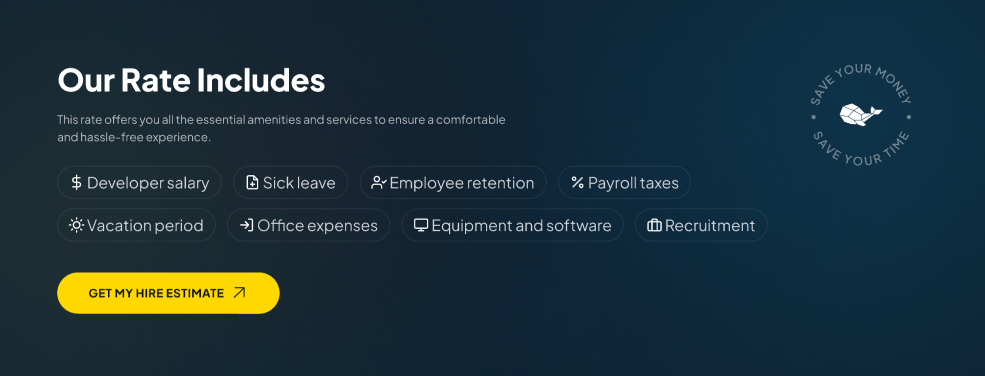
Mobilunity handles contracts, HR, payroll, compliance, and GDPR-aligned documentation, freeing up your time from administrative tasks. You focus on development, while we handle employment formalities, legal matters, and day-to-day support for your remote team.
We maintain long-term motivation through personalized HR care, structured feedback cycles, and continuous engagement programs. This results in developers staying an average of 3 years or more, contributing to your product stability and deeper knowledge retention.
With an average partnership length of 4.2 years, Mobilunity consistently delivers dependable collaboration, steady performance, and predictable results. Clients stay because teams remain stable, communication is clear, and engineering quality holds up over time.
Mobilunity delivers long-term stability and effective communication and provides developers who truly fit your needs. We create a partnership you can rely on as your product and team continue to grow.
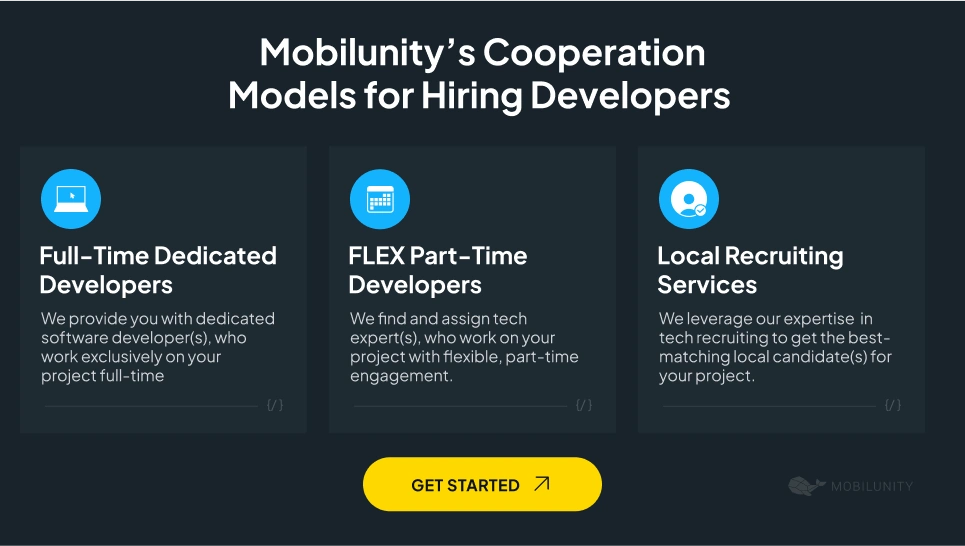
Mobilunity assembles long-term, full-time engineering teams that work just like your in-house staff. You manage the roadmap and daily tasks, while Mobilunity handles hiring, HR, payroll, IT helpdesk support, and talent retention. This model suits companies needing stable, scalable development capacity without the overhead of running internal recruitment and administration.
FLEX, on-demand developers give you quick access to part-time or short-term specialists when you need extra support or niche skills. Mobilunity supplies pre-vetted experts who integrate into your workflow, helping you handle peak workloads or urgent tasks without long-term commitments or complex hiring processes.
Mobilunity’s RaaS model provides full-cycle recruitment for companies that want to hire employees in Lithuania. Our team sources, screens, and presents candidates based on your requirements, reducing time-to-hire and ensuring technical fit. You gain in-house employees, while Mobilunity manages IT Recruitment in Lithuania efficiently and transparently.
When you decide to hire in Lithuania, you get a balance of strong engineering talent, competitive costs, and smooth collaboration supported by EU standards. With a growing tech ecosystem and a culture of reliable communication, Lithuania provides a favorable environment for building long-term remote teams.
Whether you choose dedicated developers, on-demand collaboration, or full-cycle recruitment, the key is selecting a partner who understands your product goals and can deliver stable, motivated talent. With the right setup, Lithuanian teams can support your growth for years to come.

Disclaimer: All salaries and prices mentioned within the article are approximate numbers based on the research done by our in-house Marketing Research Team. Please use these numbers as a reference for comparison only. Feel free to use the contact form to inquire on the specific cost of the talent according to your vacancy requirements and chosen model of engagement.