


















 United States


 Latin America


 Eastern Europe













How to Hire Rust Developers: Skills, Interviews, Rates and Timelines
The main difficulty is finding relevant candidates, not sorting through a large applicant pool. Rust specialists are less common than JavaScript, Java, or C# developers, but a precise job description can produce fewer unsuitable applications and reduce wasted interview time.
Start with the system you need to build, replace, or extend. A C++ migration requires different experience from an embedded product, WebAssembly component, or networking service. Once the role is clear, test ownership and borrowing, async runtime decisions, unsafe code, cross-compilation, and error handling across FFI boundaries. A structured interview and a focused 90-minute task usually reveal more than language certifications or an arbitrary number of Rust years.
The full timeline to hire Rust developer depends on candidate availability, interview stages, notice periods, contracting, and onboarding. Remote hiring and openness to strong systems engineers who learned Rust more recently can widen the pool and shorten the search.
What a Rust Developer Actually Does on Your Project
The work usually falls into five project types: replacing a performance-sensitive C++ service, moving browser computation into WebAssembly, writing embedded firmware, building blockchain infrastructure, or maintaining networking software. The 2024 State of Rust Survey also found strong use in backends, networking, cloud technology, and embedded systems.
Crypto roles are unusually visible and can lift advertised pay. A crypto figure is a poor benchmark for industrial IoT or internal networking, so compare industry and employment model first.
Rust is often wrong for a standard desktop app, routine CRUD product, or short-lived prototype. Check libraries, team knowledge, and targets first. If the architecture is open, Rust compared with Python can frame the tradeoffs.
Rust can sit inside a C++, Python, or Node system. Its FFI handoff needs explicit data layout, ownership, and error behavior.
Decide What You Are Hiring Before You Write the Job Ad
Look for a strong systems engineer who can work effectively in Rust, not a badge or an arbitrary number of Rust years. Many capable candidates learned the language after shipping production software in C++, Go, or another systems environment.
Your Rust developer job description should name the first problem they will own and the environment around it. If early technical discovery changes the role, for example by revealing that the project is a C++ migration rather than a greenfield service, recalibrate the requirements before you hire developers by technology.
State whether the role is fully remote, the required overlap hours, and whether the work involves crypto. If your budget is outside crypto ranges, say so early and describe the engineering problem clearly. Candidates who want the problem may still engage, while candidates focused on token or trading compensation can opt out before the offer stage.
For a greenfield service, prioritize architecture judgment, deployment, and runtime choices. For a C++ migration, C++ depth and safe boundary design matter more than five years in Rust. For a polyglot team, look for clear interfaces and effective cross-language review.
A migration may need a C++ engineer learning Rust, while an established business application may be better served when you hire a C# developer.
The Five Skills to Test For, and How to Test Each
You do not need to ask for textbook definitions. Ask for a recent production example, what failed, and how the candidate verified the fix. A technical reviewer can validate the details after a non-technical interviewer records the evidence.
Ownership, Borrowing, and Lifetimes
The candidate describes a specific lifetime or aliasing problem and explains how a clearer data model or API resolved it. Repeated .clone() calls are not presented as the default fix.
10-minute check: Ask for a borrow-checker fight they lost. Have them identify who should own the data, which references must remain valid, and what they redesigned after the first approach failed.
Async and Runtime Choice
The candidate connects Tokio, async-std, smol, or the choice to avoid async with the workload, ecosystem support, cancellation behavior, blocking work, operational complexity, or binary size. They can name at least one cost of the decision.
10-minute check: Give them a service that handles many network connections but also performs blocking file work. Ask which runtime they would choose, how they would isolate the blocking work, and what would become harder after that choice.
Unsafe Discipline
Unsafe is limited to a justified case such as FFI, hardware access, or a measured low-level optimization. The candidate describes a private boundary, documented safety assumptions, tests, and review rather than using unsafe to silence the compiler.
10-minute check: Ask about the last unsafe block they wrote. Have them state the invariant that makes it safe, how callers are prevented from breaking that invariant, and which test or review step would catch a mistake.
Cross-Compilation and Target Triples
The candidate can name a target triple they shipped and separate compiler-target issues from native libraries, toolchains, packaging, and runtime behavior. They explain how they reproduced and verified the failure on the target environment.
10-minute check: Present a project that builds on x86-64 Linux but fails for ARM Linux or WebAssembly. Ask for the first checks they would run and what evidence would distinguish a Rust target problem from a missing system dependency.
Error Handling Across the FFI Boundary
The candidate defines a stable error representation, explicit allocation and deallocation rules, and controlled panic behavior at the C, Python, or Node boundary. They do not pass Rust-specific types across an ABI without a contract.
10-minute check: Ask them to sketch how a Rust function would return data and an error to C or Python. Listen for who owns the memory, how the caller releases it, and how the boundary prevents a panic from crossing unexpectedly.
These checks also clarify how much independent ownership the role needs. If one specialist will own a component inside a wider team, a dedicated development team structure can provide continuity while your technical lead keeps architecture control.
Teams with complex data pipelines may also need adjacent experience from Scala developers.
Seven Interview Questions, and What a Good Answer Sounds Like
Use the same questions for every shortlisted candidate and request one concrete example per answer. The structure below lets a non-technical interviewer capture evidence for an engineer to review.
1. Describe a borrow-checker fight you lost
What to expect: A specific ownership problem and a change to the data model or API.
Weak-answer signal: The candidate only defines borrowing or says .clone() solved every case.
2. When did you last reach for unsafe, and how did you contain it?
What to expect: A justified use, private boundary, safety assumptions, tests, and review.
Weak-answer signal: unsafe was a shortcut to silence the compiler, with no containment or verification.
3. Tokio, async-std or smol, and what did that choice cost you?
What to expect: A workload-based decision and one accepted drawback.
Weak-answer signal: A favorite runtime is named without a project constraint or tradeoff.
4. Walk me through a C++ or Go component you replaced with Rust
What to expect: What improved, what became harder, and how both were measured.
Weak-answer signal: They cannot name a migration or integration cost.
5. What is in your Cargo.toml that you would defend in review?
What to expect: Reasons for key dependencies, feature flags, and update controls.
Weak-answer signal: They add crates by default and cannot explain maintenance or review.
6. How do you return an error across an FFI boundary into C or Python?
What to expect: A stable error, explicit memory ownership, and controlled panic behavior.
Weak-answer signal: Rust types are passed across the boundary without an ABI or ownership plan.
7. When is Rust the wrong choice for a project?
What to expect: A decision based on ecosystem, delivery, team, hiring, or runtime constraints.
Weak-answer signal: The candidate recommends Rust for every system and cannot describe a failed fit.
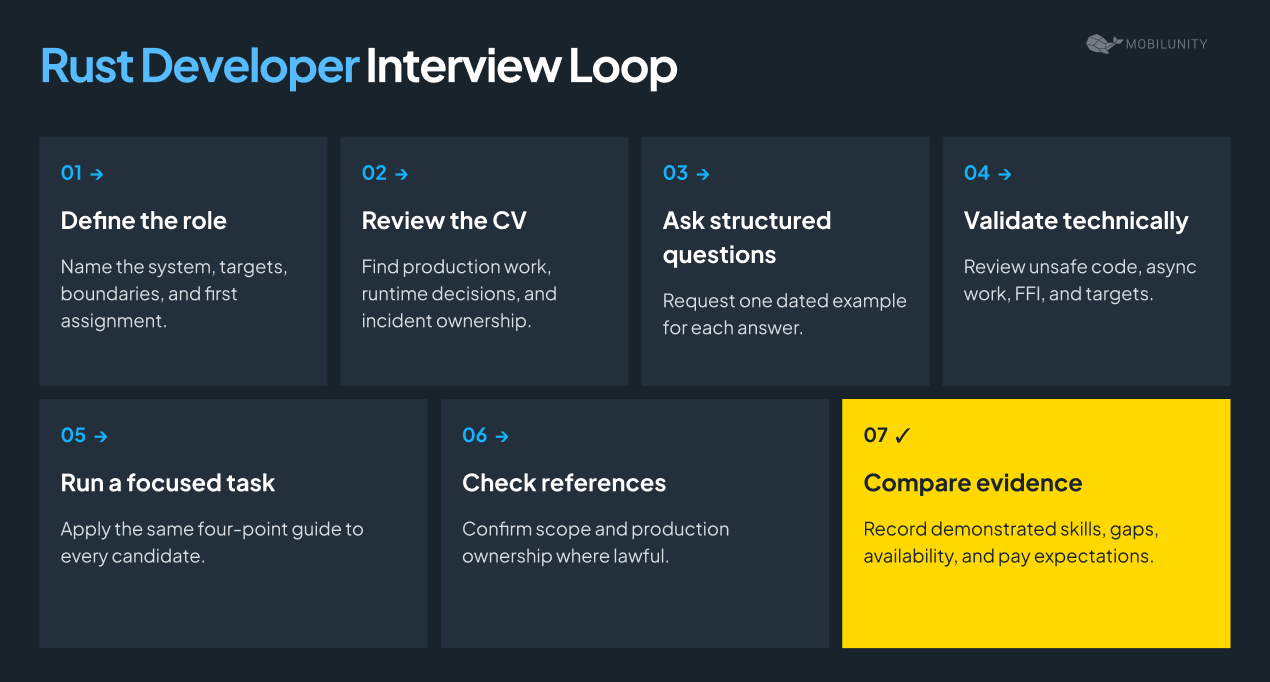
The loop should expose uncertainty rather than reward polished vocabulary. If several applicants fail at the same point, review the brief before blaming the market.
A 90-Minute Screening Task You Can Send Today
Provide a small log or CSV parser that already builds. Include one deliberate lifetime problem and one unnecessary .clone(). Ask the candidate to fix both, justify each change in two sentences, and add one property test that covers generated input rather than a single hand-written example.
State that the starter repository uses the MIT license and that the candidate keeps their work. Do not ask for account setup, deployment, or unrelated features. A technical reviewer can award one point for each result:
- The project compiles with no new unsafe code.
- The clone is removed through borrowing rather than Rc<RefCell<…>> by default.
- Tests cover empty input and malformed rows.
- The explanation makes sense to a reader who does not write Rust.
The task measures judgment, testing, and communication within a controlled scope. It should not become free product work or an endurance test.
What It Costs: Rates by Region and the Real In-house Comparison
Rust developer salary figures vary sharply because public samples mix employment, contracting, crypto, and different locations. The table below shows Ukraine-based monthly data for Ukrainian Rust developers, based on research by Mobilunity’s in-house technical recruitment team in September 2026:
| Seniority | Gross Monthly Compensation | Rust Developer Monthly Cost with Mobilunity |
| Junior | $1,400–$2,800 | $2,850–$4,300 |
| Middle | $2,800–$5,200 | $4,250–$6,700 |
| Senior | $5,500–7,000 | $6,950–$8,500 |
As per Mobilunity in-house tech recruiting team research done in September 2026
Public samples are small, not equivalent quotes. Remote work widens the pool, while industry, on-call duties, and cross-platform experience move the number.
| Country | Published Rust Salary Benchmark, per year | Measure Checked September 2026 |
| United States | $116,000–$192,000 | Total pay range; $148K median |
| United Kingdom | $45,097–$82,237 | Total pay range; $59K median |
| Germany | $88,722–$104,646 | Berlin total pay range; $101K median |
| France | $37,536–$64,835 | Base pay range; $54K average |
| Canada | $45,869–$67,040 | Base pay range; $55K average |
| Netherlands | $68,244–$81,888 | Base pay; $68K average, one reported salary |
Source: Glassdoor
As of September 2026
For a U.S. in-house comparison, start with Glassdoor’s $90,000–$143,000 annual base-pay range and show the additions separately. The table uses current national benchmarks, not a promise about one employer.
| U.S. In-house Cost Line | Planning Amount | Basis Checked September 2026 |
| Base salary | $90,000–$143,000 | Glassdoor Rust developer base pay |
| Employer Social Security and Medicare | About $6,885–$10,940 | 7.65% employer share, subject to the Social Security wage base, from the IRS |
| Benefits and paid leave | Budget separately | Benefits were 30.0% of private-industry employer compensation in June 2026, according to the BLS |
| Recruiting | $5,475 average nonexecutive cost per hire | SHRM 2025 benchmark |
| Vacancy and bench time | Company-specific | Apply the role’s monthly cost for each unfilled or non-billable month |
Do not add the BLS percentage directly to salary because it is not software-specific. Use your benefits plan, state taxes, equipment, and recruiting data for approval.
Dedicated Team vs Freelancer vs In-house Hire
Companies that hire Rust developers for continuing delivery may use an IT staff augmentation dedicated model instead of opening a local entity. In practice, they hire dedicated Rust developers for ongoing work, while an employee fits a permanent core role and a freelancer fits a bounded assignment.
A freelancer can be right for an FFI review, performance investigation, or defined prototype. A contract rate is not a salary because it may fund taxes, insurance, unpaid time, equipment, and gaps between assignments. Compare guaranteed cash when crypto-linked compensation appears.
A dedicated development team offers continuity, but every provider has a smaller Rust bench than its mainstream bench. Ask for the available count, production experience, and sourcing time, including from Mobilunity.
| Factor | In-house Employee | Freelancer | Dedicated Developer or Team |
| Best fit | Permanent core capability | Bounded review or short project | Ongoing product work and team extension |
| Cost | Salary, benefits, recruiting, equipment | Hourly or project fee | Recurring monthly client cost |
| Ramp time | Often three to six months for a scarce senior profile | Often short if scope is narrow | Shortlist and interviews, subject to actual availability |
| Retention | Managed directly by the employer | Depends on future bookings | Supported by provider and engagement model |
| IP | Employment agreement and policy | Contract terms | Contract terms and provider process |
| Management | Full HR and technical management | Scope and contract management | Client leads delivery; provider supports HR operations |
Every model still needs reviews, documentation, and a second person who understands critical boundaries. Verify the commercial and IP terms.
Red Flags in a Rust CV and in the First Call
A red flag prompts a follow-up, not automatic rejection. Give each candidate the same chance to provide a production example.
- Rust appears only in tutorials or toy repositories, suggesting little production exposure.
- No borrow-checker conflict can be described, suggesting limited ownership work.
- .clone() or Rc<RefCell<…>> is the first response to ownership trouble.
- unsafe has no boundary, safety comment, test, or review story.
- Memory safety is used to argue that tests matter less.
- Every migration is a clean success, with no integration or operating cost.
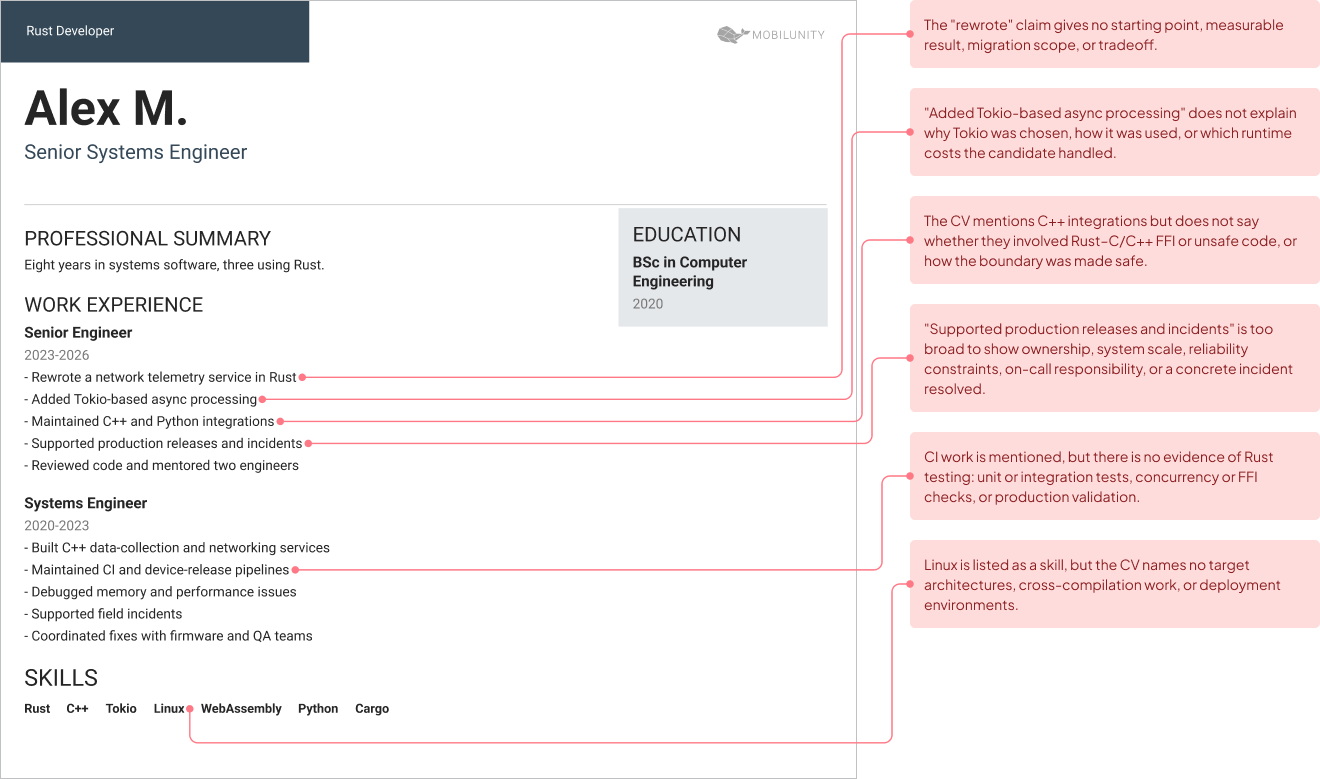
This may still be a strong candidate. The notes turn vague claims into consistent first-call questions.
How Long It Takes, Brief to First CV
Rust usually takes longer to staff than a mainstream stack because experienced candidates have fewer reasons to move and many roles require systems knowledge beyond the language. At Mobilunity, clients receive the first matching CV within five business days in most searches, often sooner. The full timeline still depends on interviews, candidate notice, contracting, and access setup.
Week one covers the brief, technical calibration, sourcing, and early profiles. Interviews and the screening task can follow in week two, with contracting and onboarding after selection. The two choices that move the date most are accepting a strong systems engineer who is newer to Rust and making the role fully remote.
Before the start date, prepare repository access, build instructions, target environments, a named reviewer, and a small first ticket. A test, parser fix, or documented boundary change is a better first commit than a broad rewrite. Mobilunity’s consultant trial-period success rate is 97%; retention across client projects over the past 12 months is 94%, although retention varies by client and project.