






























How to Hire Ruby on Rails Developers: Skills, Interviews, Rates and Timelines
Hiring Ruby on Rails developers in 2026 means finding people who can safely work in established products, not just write new code with AI tools. Look for evidence of production judgment: diagnosing issues, reviewing generated code, and modifying applications with real users, data, and business rules.
Start with the work you need: a new MVP, an upgrade to a newer Rails version, or continued development on a live product. Then check five practical areas: database behavior, upgrades, background jobs, testing, and judgment around Rails conventions. A non-technical manager can ask for specific examples while an engineer or hiring partner validates the deeper details.
If you need a quick answer on how to hire Ruby on Rails developers, first define the project type and Rails version, then verify recent production work in database performance, upgrades, background jobs, testing, and Rails conventions. Use consistent interview questions and a focused 90-minute task instead of relying on tool lists. At our company, we can share the first matching CV within five business days, often sooner.
The Rails Developer You Need Depends on the Project
Most commercial Rails work happens in existing systems. A developer may support a SaaS product launched between 2010 and 2020, maintain a marketplace, extend an internal business application, build a rapid MVP, or upgrade an application that has fallen several major versions behind.
Each project needs a different profile. An MVP calls for someone who can make sensible choices quickly. A mature product needs a developer who can trace production issues and change business rules without disrupting users. An upgrade requires experience with dependencies, database changes, failing tests, and behavior that changed between Rails versions.
Candidate CVs increasingly mention AI coding assistants. Ask what the tool was used for, how the output was reviewed, and whether it helped solve a production problem. Recent maintenance examples still tell you more than a list of current tools. Our guide to offshore Rails development gives more context on the work distributed Rails teams handle.
Decide What You Are Hiring Before You Write the Job Ad
A useful job ad names the application, Rails version, and first problems the developer will own. Three common project scenarios are a greenfield MVP, an upgrade of a Rails 4 or Rails 5 application, and team extension on a live product. Each leads to a different shortlist and budget.
When transitioning a project or hiring for polyglot roles, assessing experience from Python developers who have moved to Ruby can show how quickly a candidate adapts to Rails patterns.
A Ruby on Rails developer job description should include the Ruby and Rails versions, database, hosting environment, background-job system, test suite, and the expected overlap hours. A Ruby developer job description can be broader, but it should still name Rails when the role supports a Rails application.
High applicant volume does not guarantee relevant experience. Ask which Rails version the candidate last shipped to production. A gap of several major versions can add training time even when the person knows Ruby well.
If you plan to hire Ruby on Rails developer for an existing product, name the current version and upgrade expectations in the job posting. Teams that hire without this context often spend the first interview establishing whether the candidate’s experience is relevant.
If the role is still unclear, the broader process used to hire developers by technology can help turn a business need into a technical profile.
The Five Skills to Test For, and How to Test Each
You do not need to grade code during the first call. Ask for one real example in each area and note what the candidate observed, changed, and measured. A technical reviewer can then confirm the details.
For distributed roles and offshore Rails development, the following checks clarify the independence expected in staff augmentation. The more ownership the developer has, the more important production examples become
ActiveRecord and N+1 Queries
The candidate describes the user-visible symptom, how query logs or monitoring exposed the pattern, what changed, and the measured reduction in query count or response time.
10-minute check: Give them an orders page that loads customer data one record at a time. Ask how they would prove the problem exists, choose between includes, preload, or another approach, and verify the result.
Rails Upgrades
The candidate names the starting and target versions, deprecations, blocked dependencies, failed behavior, and the tests, staged releases, or monitoring used to reduce risk.
10-minute check: Ask how they would begin moving a Rails 5 application toward a supported version. Listen for a test baseline, dependency review, incremental upgrade path, and a rollback or release plan.
Background Jobs
The candidate describes a production retry or duplicate delivery and explains how idempotency, a database constraint, or another safeguard prevented duplicate payments, emails, or records.
10-minute check: Present a payment or email job that receives the same payload twice. Ask how they would make it safe to repeat and which test would prove the protection works.
Automated Testing
The candidate profiles the suite, identifies the slowest groups, improves database setup or browser coverage, fixes unstable examples, and reports a measured change in runtime or reliability.
10-minute check: Say that a test suite grew from 20 to 60 minutes. Ask what data they would collect before deleting tests or adding parallel execution, and how they would confirm that the change preserves coverage.
Metaprogramming and Monkey Patching
The candidate explains the narrow constraint that required a monkey patch, how it was isolated, tested, documented, and reviewed, and how the team planned to remove it.
10-minute check: Ask them to contain a temporary patch for a gem. Listen for a small boundary, regression tests, version pinning or monitoring for an upstream fix, and a clear removal condition.
For distributed roles, these checks also clarify the independence expected in Rails staff augmentation. The more ownership the developer has, the more important production examples become.
Six Interview Questions, and What a Good Answer Sounds Like
Ask each candidate for your dedicated development team a specific project and record the answer for a technical colleague. If the explanation becomes difficult to follow, ask what users experienced before and after the change.
1. Walk me through a Rails major-version upgrade you led. What broke?
What to expect: They name the versions, dependency or behavior changes, testing approach, and release plan.
Weak-answer signal: They cannot name a broken dependency, a failed test, a deprecation, or a production check.
2. Describe an N+1 query you found in production and how you spotted it
What to expect: They connect a slow page or API to query logs or monitoring data, then explain the fix and the measurement.
Weak-answer signal: They define N+1 correctly but provide no example or verification.
3. What happens if one of your background jobs runs twice?
What to expect: They explain the duplicate effect and how the operation stays safe to repeat.
Weak-answer signal: They assume the queue guarantees exactly-once execution.
4. When did you last monkey-patch something, and would you do it again?
What to expect: They describe the reason, risks, tests, documentation, and removal plan.
Weak-answer signal: They use monkey-patching as a default shortcut or ignore its effects during upgrades.
5. How do you keep a 20-minute test suite from becoming a 60-minute one?
What to expect: They profile the suite, target the slowest groups, and measure the result.
Weak-answer signal: They suggest deleting tests or adding parallelism without finding the cause.
6. When is Rails the wrong choice?
What to expect: They consider the existing system, team, performance needs, deployment environment, and product constraints.
Weak-answer signal: They claim Rails fits every project or reject it for all new work without considering the application.
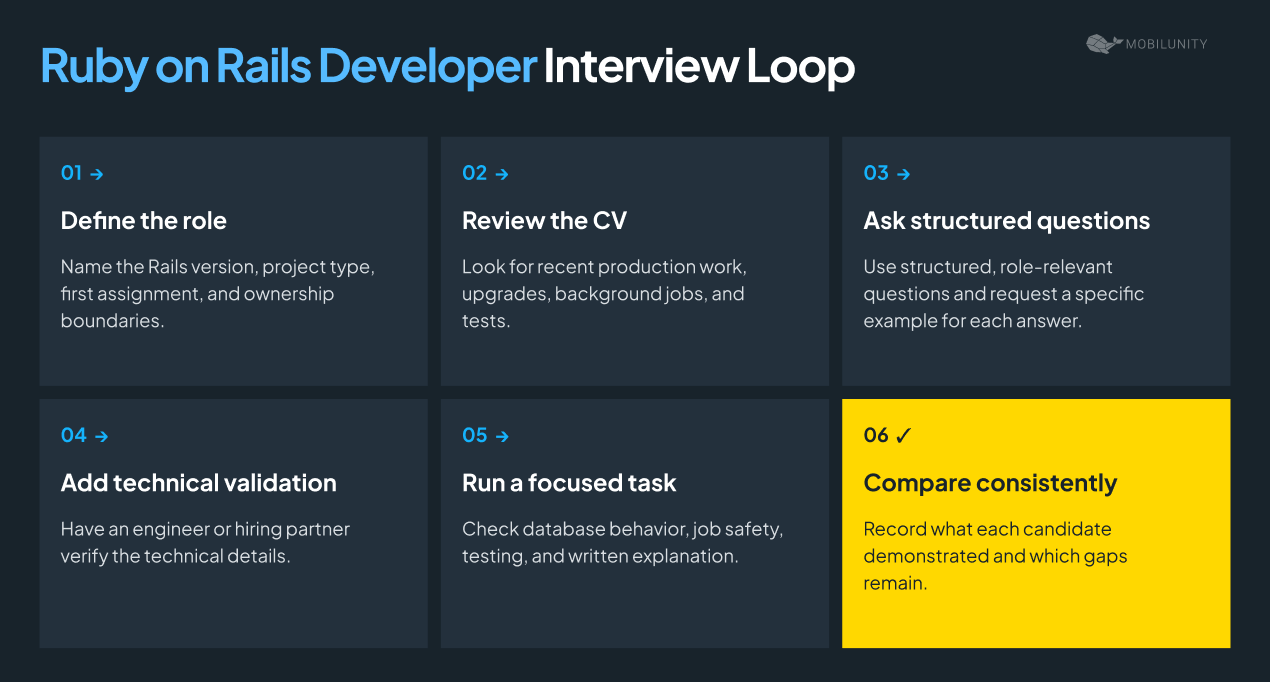
The interview loop should reduce uncertainty about the role. If several candidates fail for the same reason, check whether the brief or sourcing criteria need to change.
A 90-Minute Screening Task You Can Send Today
Prepare a small Rails application with an index action that produces an N+1 query and a background job that creates a duplicate record when it runs twice. The repository should already install and run locally.
Ask the candidate to fix both problems, add one automated test for the double-run case, and explain each fix in two sentences. State the repository license and confirm that the candidate keeps ownership of their work.
The technical reviewer can award one point for each outcome:
- The N+1 is removed, and the lower query count is demonstrated.
- The background job is safe to run twice.
- The test covers duplicate execution.
- The explanation is clear to a non-engineer.
The reviewer should also note whether the candidate stayed within scope and explained tradeoffs. Account setup or a broken starter repository should not become hidden parts of the test.
What It Costs: Rates by Region and the Real In-house Comparison
Ruby on Rails developer cost depends on seniority, location, Rails version, upgrade experience, and hiring model. Gross salary, freelance rate, and monthly cost measure different things, so compare each figure with its inclusions.
The Ukraine ranges below are based on Mobilunity in-house recruitment team research data gathered on September 2026.
| Seniority | Ukraine Gross Monthly Compensation | Monthly Cost with Mobilunity |
| Junior | $1,100-$2,400 | $2,550-$3,900 |
| Middle | $2,400-$4,400 | $3,850-$5,900 |
| Senior | $4,400-$5,900 | $5,850-$7,400 |
Source: Mobilunity in-house tech recruitment team data, September 2026
Public benchmarks help with country-level planning, but they are not quotes for identical roles. The table adds an estimate of the listed employer payroll charge to the published annual salary benchmark. Local thresholds, contribution caps, contract type, region, and benefit rules can change the result.
| Country | Published Annual Ruby on Rails Salary Benchmark | Estimated Employer Payroll Charges | Estimated Salary and Payroll Cost |
| United States | $121,478 | $9,293 (7.65%) | $130,771 |
| United Kingdom | $61,799 | $8,275 (15% above $6,627) | $70,075 |
| Spain | $46,616 | $14,287 (30.65%) | $60,904 |
| Austria | $63,670 | $13,357 (20.98%) | $77,024 |
| Japan | $57,181 | $8,577 (about 15%) | $65,758 |
| Israel | $85,725 | $5,585 (progressive rates) | $91,310 |
Source: Indeed, IRS, HMRC, Glassdoor, Morgan McKinley.
Data reflects market information gathered in September 2026
Rails work often carries a seniority premium because established products and upgrades require production judgment. For an in-house comparison, add employer taxes, benefits, recruiting, equipment, training, and the cost of an unfilled role. For a freelancer or dedicated developer, confirm hours, paid time off, replacement terms, operational support, and management responsibilities.
Recheck every benchmark before publication and before approving a hiring budget. The current version, upgrade scope, cloud responsibility, and industry knowledge can move a quote outside a general range.
Dedicated Team vs Freelancer vs In-house Hire
When companies hire Ruby on Rails developers, the model should reflect the amount of product context the work requires. In-house hiring gives the company direct responsibility for employment. Freelancers suit bounded work. Companies often hire dedicated Ruby developers when an application needs continuing attention and retained knowledge.
A freelancer may be the best choice for an isolated integration or short review. A major upgrade is harder to separate because it can affect dependencies, tests, deployment, and behavior across the product.
A dedicated development team can retain context while the client controls priorities and technical decisions. At Mobilunity, our consultant trial-period success rate is 97%, and retention across client projects over the past 12 months is 94%. Retention varies by client and project, so these are company results rather than a guarantee.
| Factor | In-house Employee | Freelancer | Dedicated Developer or Team |
| Best fit | Permanent role | Defined, bounded work | Ongoing product maintenance and delivery |
| Cost | Salary plus employer costs | Hourly or project fee | Recurring cost |
| Ramp time | Recruiting, notice, onboarding | Often short for a narrow task | Candidate selection and onboarding |
| Continuity | Managed by the employer | Depends on availability | Supported by the provider and engagement model |
| IP | Employment agreement and policy | Contract terms | Contract terms and provider process |
| Management | Full HR and technical management | Scope and contract management | Client leads delivery; provider supports HR operations |
Every model still needs a product owner or engineering lead. IT staff augmentation can add capacity, but it does not replace internal product direction.
Red Flags in a Ruby on Rails CV and in the First Call
Treat each red flag as a reason to ask a follow-up question, not as an automatic rejection. Give every candidate the same chance to provide a dated production example.
- The last shipped version is Rails 5, and no later upgrade appears. Ask how the candidate has closed the version gap.
- They cannot describe an N+1 they found. Their database knowledge may be theoretical.
- The CV contains only portfolio projects. Ask whether they have supported a live system with real users and data.
- Background jobs are treated as fire-and-forget. Ask what happens after a retry or duplicate execution.
- No tests appear. Ask how changes were checked before release.
- A rewrite is proposed before the upgrade problem is understood. Ask what evidence makes replacement safer.
Alt text: Annotated anonymized Ruby on Rails developer CV highlighting missing version, upgrade, database, background-job, and testing evidence.
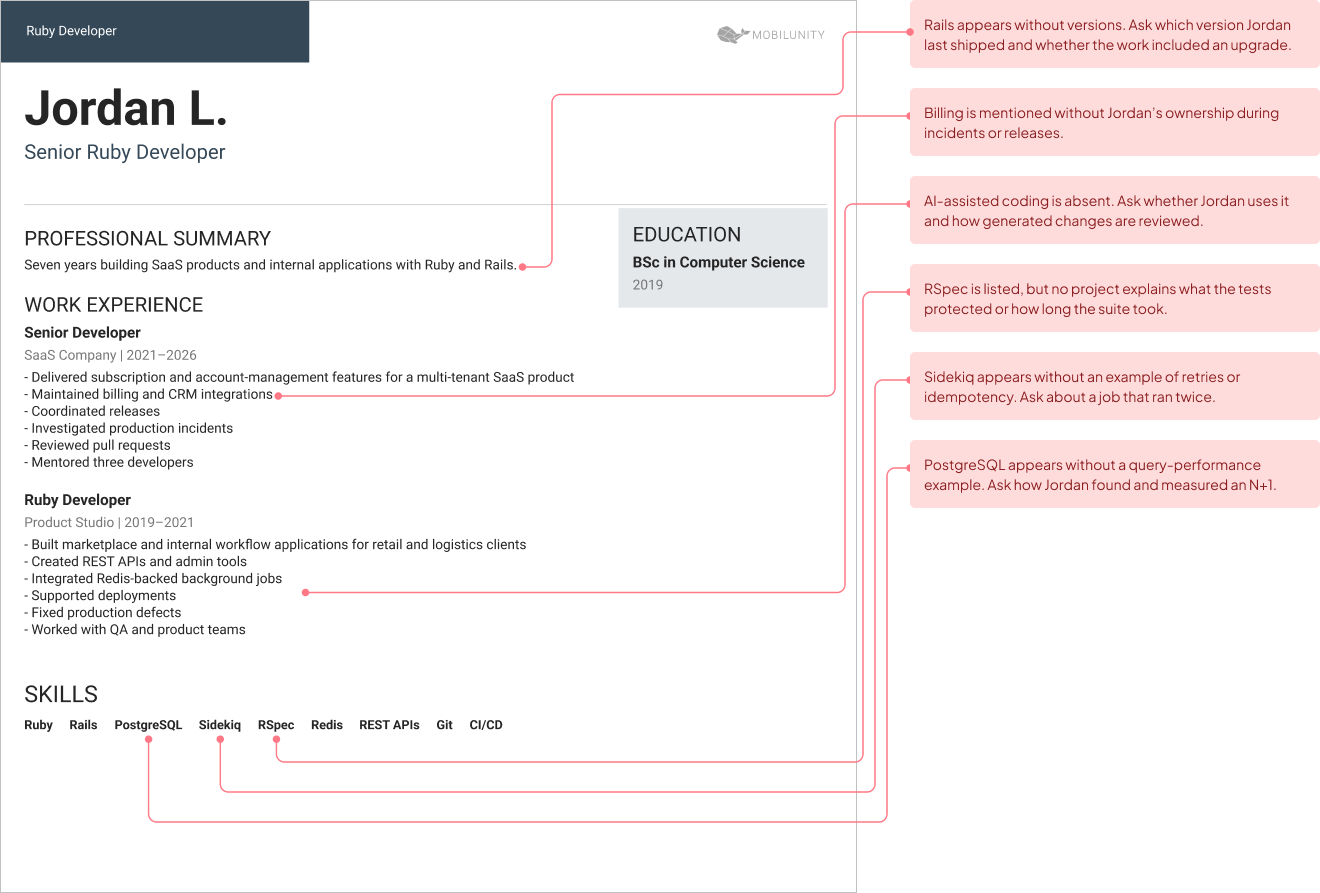
This CV may still belong to a strong candidate. The annotations show what the first call should clarify before the technical interview.
How Long It Takes, Brief to First CV
Rails searches can quickly produce many applicants, but quality screening takes longer than collecting CVs. Plan around the time needed to verify recent production ownership, especially for an older application.
At Mobilunity, we provide the first matching CV within five business days in most searches, often sooner. Week one covers the brief, version requirements, sourcing, and early profiles. Interviews, technical validation, contracting, availability, and onboarding follow.
The Rails version and mandatory upgrade experience have the greatest effect on the shortlist. Before the start date, prepare repository access, setup instructions, credentials, and a small first ticket. A bug fix, test, or query improvement is a better first commit than a broad refactor.