
Hire Developers in Hungary

Key takeaways:
The simplest way to choose between Angular development companies is to pick the one where developers have already moved an app like yours to the current major version, v22. These engineers already know the upgrade path, which is what most companies are actually looking for.
Angular’s popularity is partly due to its continual upgrades and enhancements. Offshore Angular developers get access to the latest features and security improvements because of the framework’s predictable release cycle, which includes major updates typically every six months.
An Angular development company should prove 3 things on the first call: the versions its Angular developers have shipped, that they will work inside your repository, and who owns the code and the knowledge if you leave. The framework publishes its support dates, so you can check each claim against a calendar.
Whether you need individual engineers, a full team, or vetted specialists matched to your specific needs, you’re in the right place.
Angular work covers new builds, feature development and keeping existing apps up to date. The main service areas are:
Support work is the other half of the business. It covers bug fixes, dependency updates, performance tuning and the upgrades that keep an app inside the support window, and it’s often priced as an ongoing monthly team rather than a fixed project.
One distinction matters before you shortlist anyone. Angular means version 2 and above, while AngularJS is version 1.x, a separate framework with its own older hiring pool.
Moving off version 1.x to Angular is a migration, not an upgrade. If you search for an Angular JS development company, check which of the two the provider actually staffs.
Quotes for this work look alike at first glance and differ in what they leave out. Ask for the scope as line items, and compare them against these 7.
Two of these items are where quotes drift. Upgrades are priced by version distance, so a quote that doesn’t name your starting and ending versions isn’t a quote. Testing is the other: if the provider’s number assumes your tests exist and pass, find out how much of your code they actually cover before you accept it.
Three things usually fall outside the quote and surface late: design, backend work, and build-pipeline pieces that aren’t Angular’s own, such as CI servers or hosting.
If your app depends on a backend that has to change, you’re buying a second scope. For work that reaches into the wider stack, our guide to offshore JavaScript development covers it.
How this work is delivered matters as much as what is included in the quote. With a dedicated team or staff augmentation model, your internal lead sets priorities, manages the work, and approves the results. Mobilunity provides dedicated development teams, staff augmentation, and part-time Angular developers for companies that want this level of control.
Offshore Angular JS programmers earn different salaries depending on their location and experience. Understanding global salary rates for Angular developers helps you plan your budget and find the right talent.
These bands come from our in-house tech recruiting team’s September 2026 research and cover developers based in Ukraine only. The first column is gross developer pay, and the second is the monthly cost of that developer through the company.
| Seniority | Gross salary per month* | Monthly cost with Mobilunity* |
| Junior | $1,000–$2,200 | $2,450–$3,700 |
| Middle | $2,200–$4,200 | $3,650–$5,700 |
| Senior | $4,200–$5,700 | $5,650–$7,200 |
*According to research conducted by Mobilunity’s in-house technical recruiting team in September 2026.
The table below shows estimated monthly developer salaries in other regions, based on Glassdoor and Indeed research. These are salary benchmarks rather than all-in hiring or provider costs:
| Region | Median pay per month | Range per month |
| United States | About $11,250 | $9,000–$14,100 |
| Poland | About $2,800 | $2,000–$3,700 |
| Hungary | About $2,650 | $1,800–$3,500 |
| Bulgaria | About $2,400 | $1,800–$3,600 |
| Romania | About $1,850 | $1,150–$2,550 |
| Mexico | About $1,750 | $1,300–$2,150 |
*All rates are as of October 2026
These figures show developer salaries, not the full cost of hiring or engaging a developer through a provider. Salary is only one part of the budget: employers may also cover recruitment, payroll administration, equipment, paid leave, benefits, taxes, legal compliance, and the cost of replacing a developer if needed. For that reason, do not compare the salary figures below directly with Mobilunity’s monthly rates, which reflect the broader cost of providing and supporting a developer. More detailed country-by-country pay is covered in our Angular developer salaries guide.
An upgrade is priced differently, by how far behind the app is. Treat these as planning ranges for a small team, because a real figure depends on your test coverage and how much of your code uses removed APIs.
| Majors behind | Typical effort | How to plan it |
| 1 to 2 | 2 to 4 weeks | A sprint |
| 3 to 4 | 6 to 10 weeks | One planned stretch of work |
| 5 or more | Varies | A project with its own plan |
These ranges describe the shape of the cost and aren’t our pricing, so ask any firm, us included, for a figure on your own app.
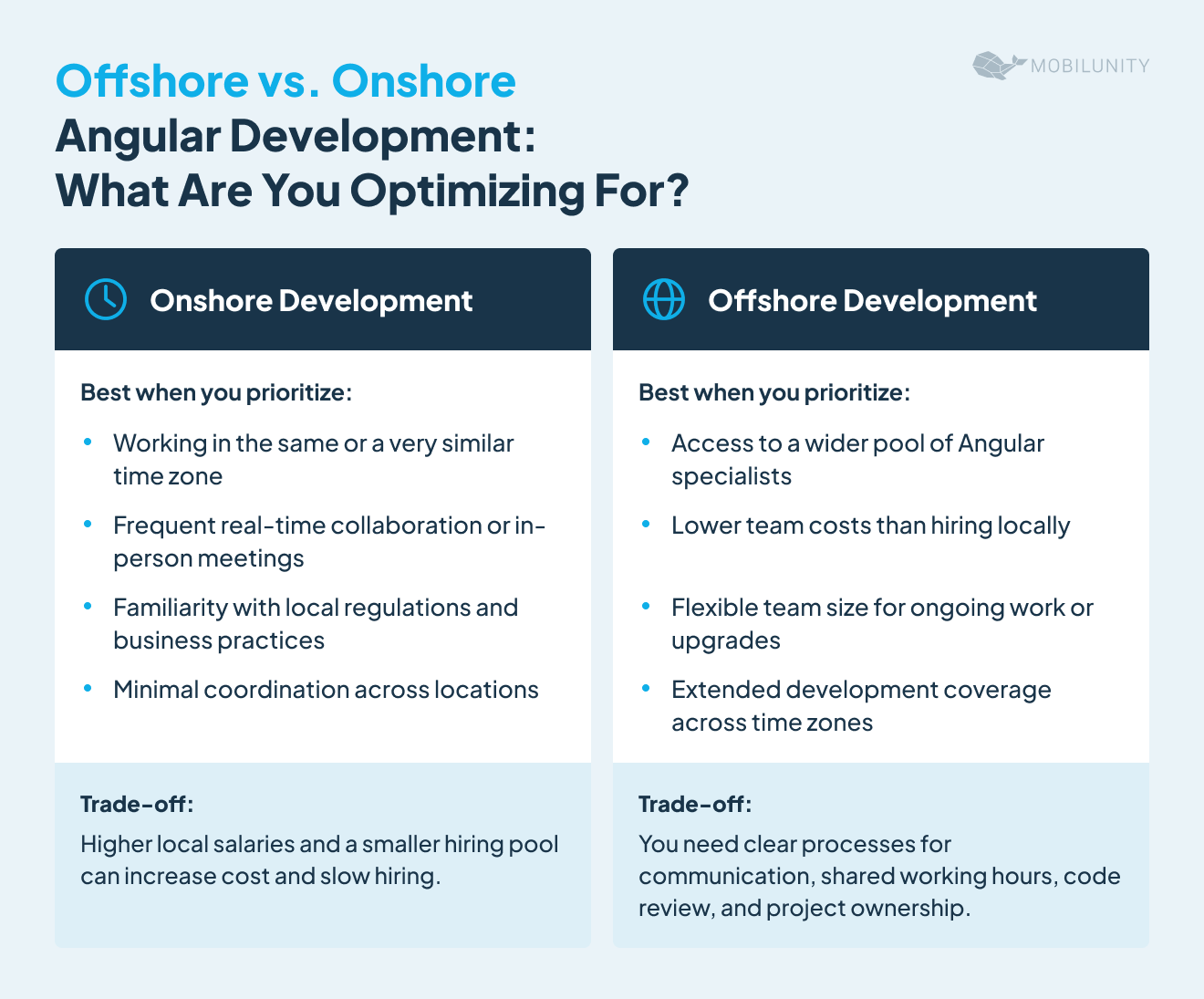
Onshore development happens in the client’s country. Offshore Angular development means delegating the work to a team in another country. The right choice depends on 6 factors, as shown in the table below:
| Criteria | Onshore | Offshore |
| Cost | Local salaries and overhead set the price. | Lower local costs in the team’s country can make it cheaper. |
| Time zone | A shared time zone makes meetings and handoffs simple. | Meeting schedules and working hours need deliberate coordination. |
| Communication | Shared language and culture usually make it easier. | Language and cultural differences take extra effort to manage. |
| Talent pool | The local pool may be limited and miss some skills. | A global pool offers skills that aren’t available locally. |
| Project management | Proximity and in-person meetings make it simpler. | Distance adds management time and effort. |
| Regulatory compliance | Familiar local labor law makes compliance easier. | Meeting local rules across borders is harder to guarantee. |
Remote work is already normal on the client’s side: in the Stack Overflow Developer Survey 2025, 45% of US respondents said they work fully remotely, the highest of the top-reporting countries. The survey measures where developers sit, not where the work should go, so treat it as context rather than a verdict.
Angular’s release schedule is public, and it’s the most useful page to read before you talk to any firm. A typical major gets 12 months of active support, then 12 months of long-term support (LTS).
The dates for v20 and v21 follow the older six-month cadence, and the page marks every date as approximate and subject to change.
| Version | Status | Released | Active support ends | LTS ends |
| v22 | Active | Jun 3, 2026 | June 2027 | June 2028 |
| v21 | LTS | Nov 19, 2025 | Jun 3, 2026 | June 2027 |
| v20 | LTS | May 28, 2025 | Nov 19, 2025 | Nov 28, 2026 |
Read the last column first: it’s the date your version stops getting patches. A v20 app has until the end of November, a v21 app has until mid-2027, and v22 runs to mid-2028.
In practice, LTS is a security posture. The page says LTS releases get only critical fixes and security patches, which means newly found vulnerabilities and regressions caused by third-party changes such as a new browser version. New features and most bug fixes are not provided.
Any app on v19 or older is already out of support, so it no longer receives updates from Angular, security patches included.
You also can’t jump straight to the latest version. An app has to move up one major version at a time, so an app on v15 needs seven separate upgrades to reach v22.
That’s why upgrade cost depends on how many versions you’re behind, not on how big the app is. Each step can require code changes and a fresh round of testing, and an app with few automated tests means you have to check each step by hand.
The timing is also changing. New major versions arrived every six months until v22, and Angular now plans one every 12 months, with v23 expected around June 2027.
If the bill makes you question the framework itself, our article on migrating Angular to React covers that decision, and this page assumes you’re staying.
Your real constraint is the support calendar: a fixed number of weeks to get from your current version to one Angular still patches, with a team that has to learn your code first.
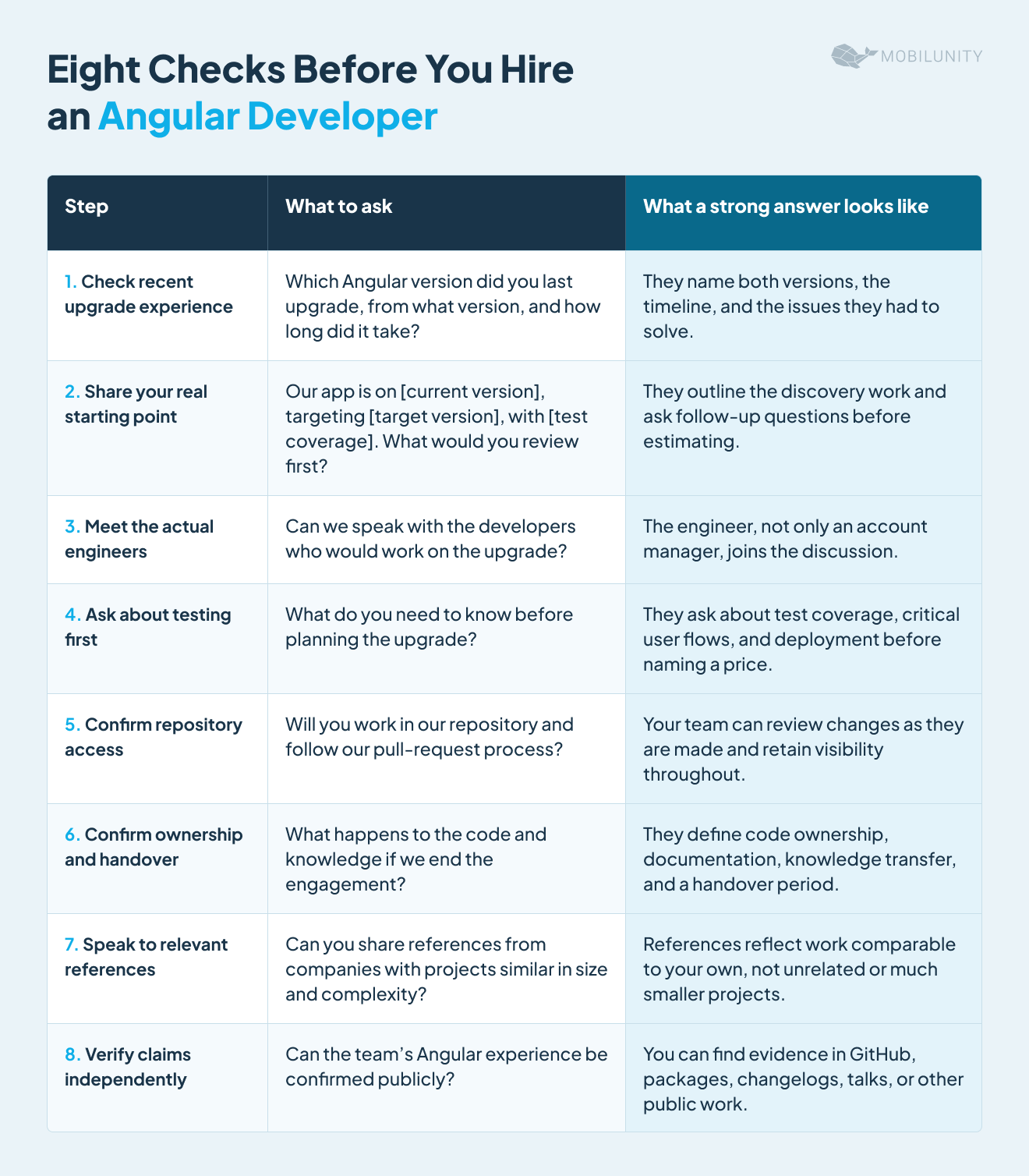
These 8 checks test whether developers can do that, and each comes with what a good answer sounds like.
Start with the first two checks, since they cost you nothing: ask which version the developer last upgraded, then hand them your own upgrade. An engineer that can’t answer clearly is easy to rule out, which usually leaves a short list. If you also want to see what your own engineers should be doing during the work, our guide to what an Angular developer does lays out the role.
The same checks apply to Angular consulting companies as to development providers: ask who will do the work, not who will advise on it.
You can customize the team to the unique requirements of your project, with both full-time and part-time models. The flexibility suits smaller projects, improving resource allocation for efficient, cost-effective delivery, even when roles like DevOps or project management aren’t needed full-time.
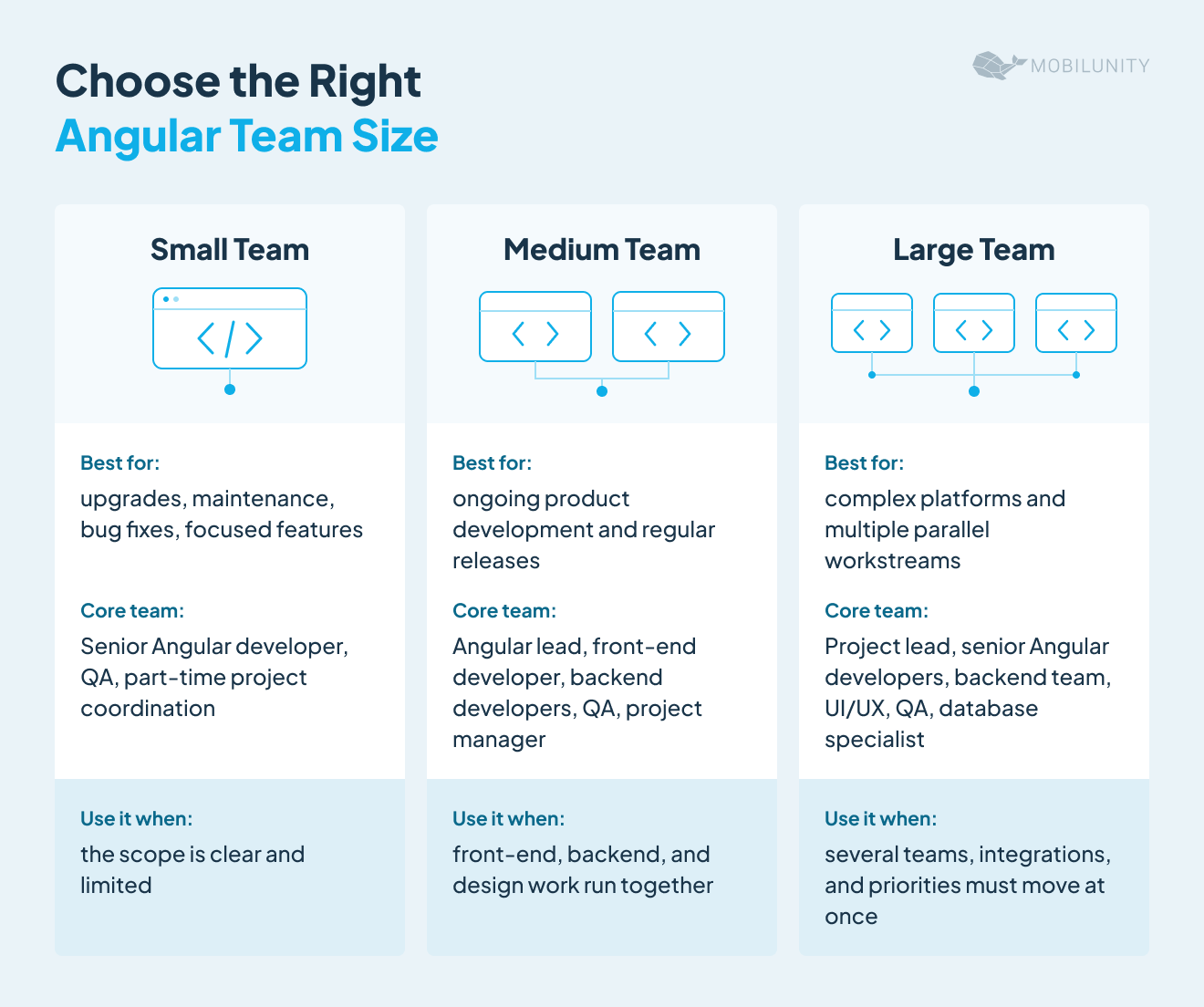
Ideal for simplified tasks, this small team increases productivity and communication.
This configuration suits projects of modest complexity, balancing thorough development with design.
For large-scale projects that need in-depth knowledge of both development and design, this structure works well.
Combining an outside team with in-house engineers pays off in 4 ways:
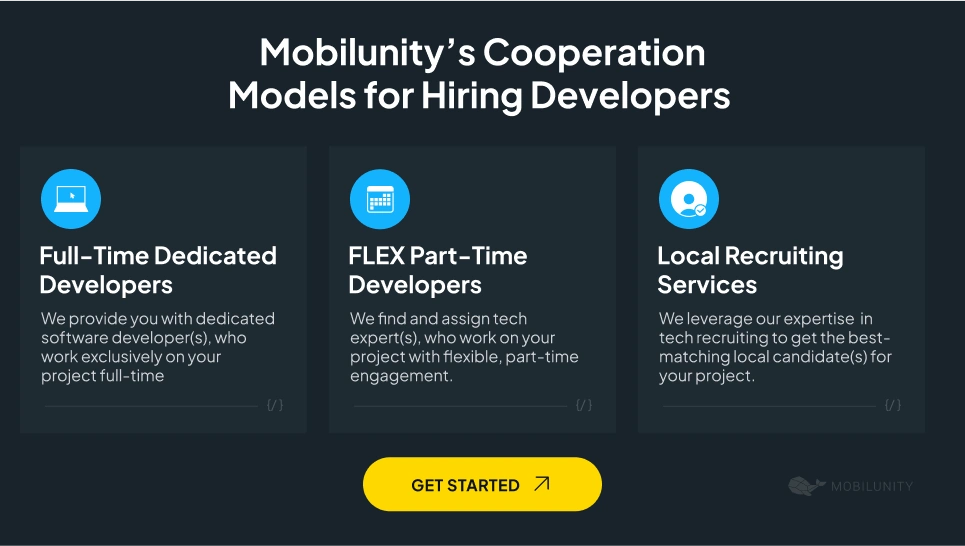
Two models cover most projects: dedicated teams for major projects, and part-time developers for short-term work, one-off upgrades, and support.
A full dedicated team is oversized for a six-week upgrade, and the QA specialist matters more than the designer there, because each major version needs the full test suite run again. One or two developers who have done the same upgrade before, working inside your repository, is closer to the right size.
If you need individuals rather than a development team provider, you can hire Angular developers directly, or look at a full Angular development team.
Founded in 2010, Mobilunity helps businesses build dedicated dev teams in Ukraine and beyond. We provide Angular developers who join our clients’ teams, work under their technical direction, and contribute to ongoing product development. We also handle recruitment, onboarding, HR, accounting, IT helpdesk, and retention, so our clients can focus on their products while we take care of the team’s operational needs.
According to Clutch, we have a 4.7 rating (as of September 2026) with hourly rates of $25–$49 and a minimum project size of $10,000. Our Angular hiring process combines candidate screening with technical assessments to help clients find developers who match their requirements. Notably, 40% of interviewed candidates receive offers, and 97% pass probation.
Our experience includes projects across different industries and technology stacks. In 2017, we helped 42Matters, a Swiss app intelligence and analytics company, expand its development team with specialists experienced in Angular, React, and Node.js. The collaboration helped improve the speed and quality of its development cycles.
You can also explore our experience through the Camptocamp case study. Camptocamp is a Swiss provider of geospatial, infrastructure, and business solutions that needed technical support. We helped the company build a dedicated team in Ukraine, including Angular developers and ERP specialists. The partnership has continued since 2017, allowing Camptocamp to expand its development capacity and maintain continuity across projects.
Our dedicated development team model suits businesses that need ongoing engineering support and want to grow their teams over time. If you need an Angular architect for just 2 weeks, with no plans for further collaboration, a dedicated team may be more than your project requires.

Disclaimer: All salaries and prices mentioned within the article are approximate numbers based on the research done by our in-house Marketing Research Team. Please use these numbers as a reference for comparison only. Feel free to use the contact form to inquire on the specific cost of the talent according to your vacancy requirements and chosen model of engagement.
Client Testimonial
Mobilunity provides an excellent and efficient tech talent service. All my staffing requests, even for niche technologies, were fulfilled in a 2 to 4-week time period, with top-notch candidates. Besides that, I like the caring environment that the Mobilunity team provides for the developers and ensures that everybody is able to work without distractions.
I strongly recommend Mobilunity as a tech talent partner!

Waldemar Biller
Head of Technology








Fulltime dedicated teams, FLEX on-demand model, consultancy, recruitment, EOR