Hire Developers in Hungary

Key takeaways:
Python development companies typically deliver software projects, while dedicated staffing providers supply developers who work as part of your team. Both can help you build backend applications, data pipelines, or machine learning systems. The difference is who manages the work and takes responsibility for delivery.
Before choosing a provider, decide whether you need backend developers, data engineers, or machine learning specialists. These roles require different skills and come at different costs. If you’re maintaining an existing application, check its Python version. According to the Python Developer’s Guide, Python 3.9 is no longer supported, and 3.10 reaches end of life in October 2026.
When comparing Python development companies and tech staffing providers, look at their technical experience, pricing, and contract terms. If you have an internal technical lead, dedicated offshore developers may be a better fit. If you need someone to manage the entire project, consider a company that offers managed development services.
Offshore Python developers work remotely from another country on Python-based projects. They build web applications and APIs, automate business tasks, and develop data processing or machine learning systems.
Hiring offshore gives you access to developers outside your local market without setting up an office abroad. You can hire one specialist or build a dedicated team, depending on the work you need done.
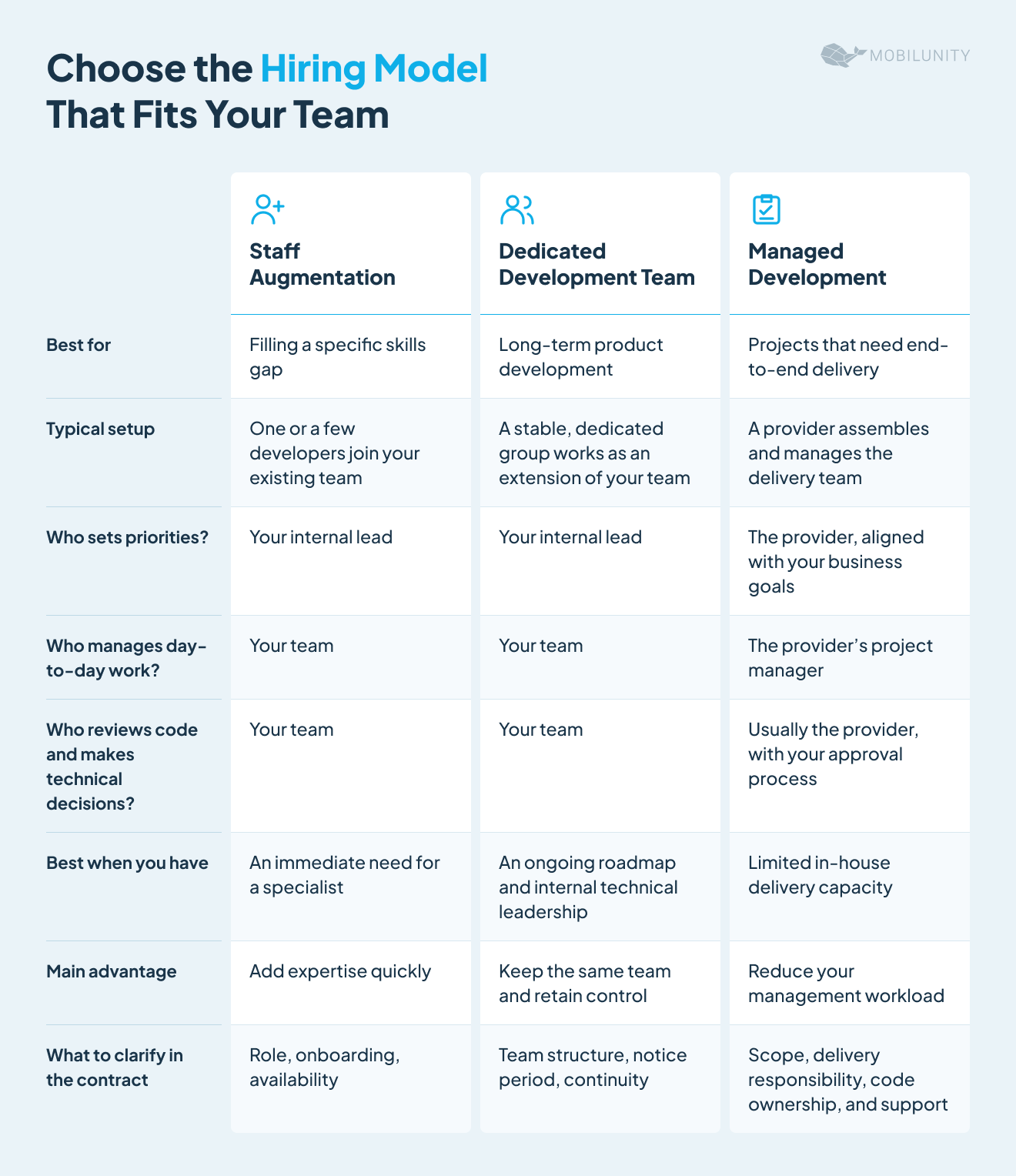
Your hiring model depends on whether you can manage developers internally or need a provider to handle the project.
With staff augmentation, offshore Python developers join your existing team and report to your technical lead. They follow your workflows and work alongside your employees.
If you need several developers for ongoing work, you can hire a dedicated offshore team. This model suits long-term product development, maintenance, and regular feature releases.
Alternatively, a Python development agency can manage the entire project. The agency assigns developers, coordinates their work, and takes responsibility for delivering the agreed results.
Offshore developers use tools like Slack, Jira, and GitHub to communicate and manage their work. Regular meetings, clear requirements, and shared workflows help them stay connected with your team.
Remote development is already common. According to the Stack Overflow Developer Survey 2025, 45% of US respondents work fully remotely, the highest percentage among the countries surveyed.
Before choosing a hiring model, decide who will assign tasks, manage developers, and review their code. If you can handle these responsibilities internally, staff augmentation or a dedicated team may suit you better than managed development services.
Backend developers, data engineers, and machine learning (ML) engineers all use Python, but their work requires different skills.
Before contacting a Python development agency, define what you need to build or improve. This will help you find specialists with relevant experience, ask the right interview questions, and compare rates.
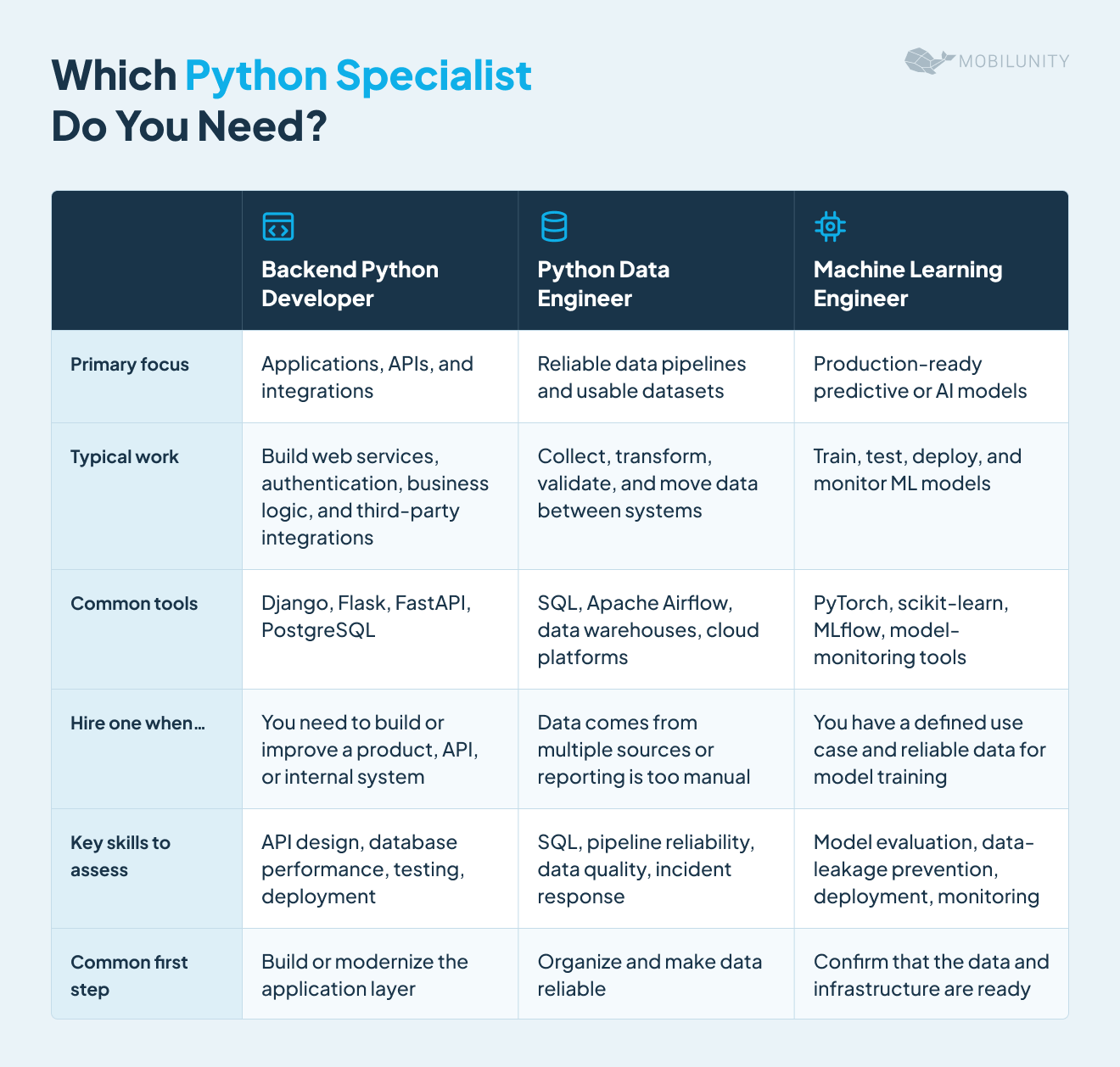
Backend Python developers build and maintain the systems behind web and mobile applications. They develop APIs, manage databases, handle authentication, and connect applications with external services.
They often use Django or FastAPI, depending on the project. Read our guide to Python frameworks to compare your options.
Hire backend developers to build SaaS products, add features to existing applications, or integrate different systems. Look for experience in API development, database performance, testing, and deployment.
If you’re evaluating Python compared with Node.js, consider your application’s requirements and your team’s experience. Both work well for backend development, so the choice depends on your existing technology and the developers available.
Python data engineers build systems that collect, process, and move data between applications. They work with databases, data warehouses, and tools like Apache Airflow to automate data pipelines.
Hire data engineers when your data comes from several sources or your team spends too much time preparing reports manually. They make sure your systems deliver accurate, usable data.
Look for experience with SQL, data pipelines, quality checks, and troubleshooting failed workflows. Experience building backend APIs isn’t enough for this role.
Machine learning (ML) engineers build, train, test, and deploy ML models. They use tools like PyTorch and scikit-learn and monitor how models perform in production.
Hire ML engineers when you have a specific problem to solve and reliable data to train models. Check their experience with model evaluation, data leakage prevention, and performance monitoring.
Some companies need data engineers before they need ML specialists. If your data is incomplete or poorly organized, you’ll need to fix those problems before model development can begin.
These specialists have different skills and rates, so you should evaluate them differently. Test backend developers on API design, data engineers on pipeline reliability, and ML engineers on model development and deployment.
A provider should understand your project before recommending developers. If it offers all three types without asking about your application, data, or goals, that’s a warning sign.
For more examples of what Python is used for, read our guide.
Offshore Python developers work on backend applications, data systems, and machine learning projects. The type of work determines which specialists you need and what skills to look for.
Backend Python developers build new applications and maintain existing ones. They develop APIs, connect software systems, and manage the logic behind your application’s features.
Their main tasks include:
These tasks require backend development skills rather than data science or machine learning expertise. If you have an existing application, ask developers to review its code and dependencies before estimating the project.
Python developers can automate routine tasks like processing files, transferring data, and generating reports. This saves employees time and reduces errors from manual work.
Backend developers can automate tasks that connect business applications through APIs. For large datasets, complex data processing, or scheduled pipelines, you’ll usually need a data engineer.
Data engineers bring information from different systems together and prepare it for reporting and analysis. They often work with data stored in databases, cloud platforms, and business applications.
You can hire them to:
These tasks require SQL, workflow automation, and cloud data experience. A Python developer who writes data processing scripts may lack the skills to manage a production data platform.
Machine learning engineers build systems that predict outcomes, classify data, or automate decisions. They develop, test, deploy, and monitor ML models.
Their work includes preparing training data, evaluating models, and connecting them to existing applications. They also monitor model accuracy after deployment.
Before hiring ML engineers, make sure you have enough reliable data for your project. If your data is incomplete or poorly organized, hire a data engineer first.
Offshore Python developers can maintain existing software, update dependencies, fix performance issues, and improve automated tests. They can also replace outdated integrations.
Choose a specialist based on your system. Backend developers maintain applications and APIs, data engineers support pipelines, and ML engineers manage deployed models.
For more on Python pros and cons, read our guide. Your hiring decision should depend on your project’s technical needs.
Before you outsource Python development, clarify what your contract includes. A staffing provider supplies developers who work under your management, while a development company may take responsibility for project delivery.
Make sure you agree on maintenance, production support, and access to sensitive data. These requirements affect which specialists you hire, what you’ll pay, and who handles each task.
Your project scope may cover several types of work, depending on the specialists you hire.
Backend developers typically handle application work, while data engineers manage pipelines and ML engineers support model deployment.
Not every task comes with a standard development or staffing contract. Check what’s included before agreeing on the price.
For example, data labeling may require specialists other than Python developers. You may also need separate experts for cloud infrastructure, network security, or company-wide DevOps work.
If developers need access to real customer data, agree on permissions, security measures, and data protection requirements first.
Support hours also need to be clear. A developer hired for regular working hours won’t necessarily be available at night, on weekends, or during production emergencies.
Mobilunity provides Python staff augmentation and helps companies hire dedicated developers. Instead of managing entire software projects, Mobilunity recruits specialists who work directly with your team.
You can hire offshore Python developers for backend development, maintenance, data engineering, or machine learning projects. This staffing model gives you control over development while Mobilunity handles recruitment and staffing support.

Python developer rates vary by experience, location, and specialization. Backend developers, data engineers, and machine learning specialists have different skills, so their rates may differ.
When comparing prices, check whether you’re paying for one developer, a dedicated team, or a complete project. Also ask about minimum contract length and how much notice you need to end the agreement.
According to Glassdoor, senior software developers in the US earn $115,000-$171,000 annually in base salary, with median total pay of $180,000, as of October 2026.
The cost of hiring also includes employer-paid benefits. The US Bureau of Labor Statistics reports that benefits account for 30% of private-sector employer compensation costs. Based on Glassdoor’s base salary range, a senior developer could cost approximately $164,000-$244,000 annually, including benefits.
These figures provide a benchmark for comparing US employment costs with offshore Python staffing. Actual expenses depend on experience, location, and the benefits offered.
Offshore Python developer rates depend on the type of work. Backend developers, data engineers, and ML engineers may charge different rates because their skills and responsibilities differ.
Based on research by our internal tech recruitment team in September 2026, Mobilunity’s gross monthly rates range from $3,850 to $5,900 for mid-level Python developers and $5,850 to $7,400 for senior specialists. Rates for specific roles may vary.
Check whether the monthly rate includes recruitment, employment costs, equipment, paid leave, and developer replacement. If these services cost extra, your final bill may be higher than expected.
Also ask about notice periods. A lower rate may not save you money if you must pay for several months after ending the contract.
To compare providers fairly, estimate the total cost for your project. Use the same team size, developer experience, working hours, and contract terms.
Python releases a new version about once a year. Older versions eventually stop receiving security updates, which can put your application at risk. If you use an outdated version, your developers should check for security issues and plan an upgrade.
The Python Developer’s Guide provides the official support schedule. The table below shows the status of major Python versions as of October 2026.
Python versions first receive regular bug fixes, followed by security updates only. Once a version reaches its end of life, it no longer receives official security fixes.
| Python Version | Status in October 2026 | End-of-Life Date |
| Python 3.9 | End of life | October 31, 2025 |
| Python 3.10 | Security fixes only; approaching end of life | October 2026 |
| Python 3.11 | Security fixes only | October 2027 |
| Python 3.12 | Security fixes only | October 2028 |
| Python 3.13 | Security fixes only; released October 7, 2024 | October 2029 |
| Python 3.14 | Active bug-fix support; released October 7, 2025 | October 2030 |
The dates follow Python’s published release schedule. Python 3.10 reaches end of life during October 2026, so its exact support status needs confirmation on publication day.
An application built five years ago may still use Python 3.9 or 3.10. Python 3.9 is no longer supported, and Python 3.10 reaches its end of life in October 2026. Upgrading these applications should be a priority.
A simple upgrade may only require a newer Python version, updated libraries, and testing. The work becomes more expensive if older libraries or deployment systems don’t support the new version.
For example, if your application uses an outdated C extension, developers may need to rewrite parts of the code or replace the library. This can take much longer than updating Python itself.
Before upgrading to Python 3.14, your team should also check compatibility with existing libraries and tools. You can find the changes in the official Python 3.14 release notes.
Ask potential developers which Python version your application uses and what might break during an upgrade.
Before estimating costs, they should review your libraries, deployment setup, and existing tests. This matters whether you’re hiring offshore developers or comparing Python consulting companies.
Be cautious if a provider gives you a price without reviewing your application. Ask for a compatibility check and a recommended Python version before agreeing to the work.
Hiring offshore Python developers lets you find talent outside your local market without opening an office abroad. You can recruit backend developers, data engineers, or machine learning specialists based on your project’s needs.
Offshore hiring also brings challenges with communication, team management, and technical support. Success depends on choosing the right developers and making sure they work well with your existing team.
Offshore hiring gives you access to more developers. If you can’t find local specialists with Django, Apache Airflow, or PyTorch experience, you can search in other countries.
You can also expand your team as your project grows. For example, you might hire two backend developers first and add a data engineer when you need automated reporting.
Offshore developers may cost less than US employees with similar experience. However, rates vary by skill level, specialization, and contract terms.
A dedicated team lets you keep the same developers across multiple releases. This is especially useful for complex applications that take time to understand.
Time zone differences can slow decisions when your developers and internal team have few overlapping hours. Agree on shared working hours and response expectations before development begins.
Communication problems often arise from unclear requirements rather than language differences alone. Give developers access to acceptance criteria, architecture documentation, and the people who can answer technical questions.
Code quality requires attention as well. Establish review standards, automated testing, and deployment permissions instead of assuming every developer follows your internal practices.
Production support deserves particular attention for data engineering projects. A pipeline that fails at 3 a.m. may interrupt reporting or downstream applications before the next workday begins.
When you hire Python developers, look for experience with projects similar to yours. Someone who builds Django APIs may lack experience with production data pipelines.
Ask which Python versions they used in their last three projects. If they worked with unsupported versions, find out how they managed security risks and upgrades.
For data engineers, ask how they handle a pipeline failure at 3 a.m. Who gets the alert, investigates the problem, and restores the pipeline? Check what monitoring tools they use and whether their contract covers overnight support.
Once developers join your team, give them access to your code, development tools, and documentation. Assign someone internally to explain priorities and review their work.
Start with a small, well-defined task, such as updating an API or improving a data pipeline. Check the results against your requirements before assigning more work.
Finally, make sure everyone knows who handles recruitment, technical decisions, and production support. Clear responsibilities will help your offshore developers work effectively with your team.9
Founded in 2010 and headquartered in Kyiv, Ukraine, Mobilunity recruits dedicated offshore Python developers for international clients. Its model suits companies that want developers working directly with their internal engineering teams.
Unlike Python software development companies that manage entire projects, Mobilunity focuses on recruiting and supporting dedicated specialists. Clients retain responsibility for technical direction, priorities, and development processes.
Mobilunity’s Clutch profile lists a 4.8/5 rating as of October 2026.
Its Python developer hiring service covers candidate sourcing, technical screening, and team assembly. Companies can assess candidates before selecting developers for their projects.
The Camptocamp case study describes Mobilunity’s experience assembling a dedicated ERP development team in Ukraine. Although the engagement isn’t presented as a Python-only project, it illustrates the company’s approach to long-term technical staffing.

Among top Python development companies, Mobilunity is worth considering if you need dedicated engineers rather than a provider responsible for complete project delivery.
Its main limitation follows from that model: you need internal technical leadership to assign work, review code, and manage delivery. Companies without those resources may prefer a managed development provider.

Disclaimer: All salaries and prices mentioned within the article are approximate numbers based on the research done by our in-house Marketing Research Team. Please use these numbers as a reference for comparison only. Feel free to use the contact form to inquire on the specific cost of the talent according to your vacancy requirements and chosen model of engagement.
Client Testimonial
Mobilunity provides an excellent and efficient tech talent service. All my staffing requests, even for niche technologies, were fulfilled in a 2 to 4-week time period, with top-notch candidates. Besides that, I like the caring environment that the Mobilunity team provides for the developers and ensures that everybody is able to work without distractions.
I strongly recommend Mobilunity as a tech talent partner!

Waldemar Biller
Head of Technology


Fulltime dedicated teams, FLEX on-demand model, consultancy, recruitment, EOR