

















































How to Hire Node.js Developers: Skills, Interviews, Rates and Timelines
Hiring a Node.js developer in 2026 starts with deciding whether you need a backend specialist or a full-stack JavaScript engineer. The right choice depends on your product, your existing team, and the work the new hire will own.
For projects focused on APIs, databases, and integrations, prioritize backend expertise, including testing and maintaining production systems. If the developer will also work on React or another JavaScript frontend, look for proven experience across both. Node.js experience alone does not establish full-stack expertise.
Before screening candidates, define the role’s responsibilities and the skills your team needs most. This will help you choose the right seniority, compare candidates consistently, and select a hiring model that fits your workload and budget.
Define the Node.js Role Before You Start Hiring
Before crafting the Node JS developer job description, decide whether you need a Node.js specialist or a full-stack JavaScript engineer. This choice affects which candidates you screen, what experience you prioritize, and what you test during the interview.
The right profile depends on the scope of the work. If the developer will contribute to both backend services and a JavaScript frontend, full-stack experience is valuable. If the role focuses on APIs and backend infrastructure, prioritize depth in Node.js. Define those responsibilities around your project’s needs.
A greenfield API needs a developer who can make backend decisions from the start. Look for experience with API design, authentication, databases, error handling, testing, observability, and deployment. If the API supports a JavaScript frontend, full-stack experience can be useful, but it shouldn’t replace strong backend skills.
Legacy maintenance requires a different profile. You need to hire NodeJS developers who can understand an unfamiliar production service, trace existing behavior, update dependencies, and make changes without breaking other systems. This also applies when replacing a Python or Ruby service with Node.js. Migration experience becomes especially useful because the developer must preserve existing behavior while moving functionality in stages.
For team extension, your ability to hire developers by technology should reflect the actual gaps in your existing team. Look for someone who can join an established codebase and work within the team’s architecture, coding standards, and review process. If they also need to contribute to a React or other JavaScript frontend, a full-stack JavaScript engineer is the stronger fit. If their work stays within APIs and backend services, a Node.js specialist may give you more relevant depth.
Real-time requirements add another layer to any of these project types. If you’re adding WebSockets to an existing product, prioritize experience with connection management, authentication, failures, and concurrent connections. Someone who has built chat, notifications, live dashboards, or collaborative features will usually bring more relevant experience than a developer whose work centers entirely on REST APIs.
The hiring market also changes where you should spend your effort. More applicants don’t necessarily mean more qualified applicants, especially when the pool includes JavaScript developers with very different levels of Node.js experience. Your screening process needs to distinguish between those who have simply worked with Node.js and those who have made architecture decisions, maintained production systems, handled migrations, or contributed effectively across the stack.
Five Node.js Skills to Check Before You Hire
A Node.js CV can tell you about a developer’s background, but it doesn’t always reveal whether they have the Node JS developer skills required to make sound decisions in production. This is especially important when screening full-stack developers, whose Node.js experience may vary considerably. The five areas below help you assess this more closely. Each outlines what to expect from an experienced developer and provides a practical 10-minute check.
1. Event Loop and Async Control Flow
What good looks like: The candidate understands how blocking work affects a Node.js application. They can describe situations where synchronous operations, CPU-heavy processing, or poorly managed asynchronous work delayed other requests.
For a senior developer, understanding how the event loop works isn’t enough. They should know how to identify event-loop problems through latency, CPU usage, profiling, or other production signals. They should also explain why they chose a particular fix, such as restructuring the operation, moving CPU-heavy work to worker threads, or separating it into another service.
10-minute check: Ask: “Tell me about a time the event loop became blocked. How did you identify the problem, and what did you change?”
If they haven’t encountered this exact situation, give them an example. An API normally responds in 100 milliseconds, but every request slows down when one endpoint processes a large file. Ask how they would investigate the slowdown.
A weaker candidate may immediately suggest adding servers or increasing resources without first identifying what is blocking the process.
2. Streams and Backpressure
What good looks like: Streams are one of the clearest ways to distinguish practical Node.js experience from basic framework knowledge. A developer who has worked with large files, uploads, downloads, exports, or data pipelines should understand why loading everything into memory can become a problem.
They should also understand backpressure. If one part of a pipeline produces data faster than the next part can process it, the application needs to control the flow. Otherwise, memory consumption can continue to grow.
10-minute check: Give them a scenario: “A Node.js service needs to process a 5 GB CSV file and send the transformed data to another service. How would you build it?”
Look for an approach that processes the file progressively rather than loading all 5 GB into memory. Then ask what happens if the receiving service processes data more slowly than your application reads the file.
A weaker candidate may suggest reading the entire file into memory or overlook the difference between reading and processing speeds.
3. Error Handling in Async Code
What good looks like: The candidate understands how errors move through asynchronous Node.js code and what happens when nobody handles them. They should be comfortable with rejected promises, async functions, and error-first callbacks in older codebases.
For production work, they should also think beyond catching the error. Listen for how they decide what to log, what response to return, whether an operation can safely retry, and whether the process can continue.
10-minute check: Show them a short promise chain where an operation throws and nobody handles the rejection. Ask: “What happens here, and how would you fix it?”
Then change the scenario. A database update succeeds, but the next asynchronous operation fails. Ask whether they would retry the whole operation and what risks that could create.
A weaker candidate may suggest adding try/catch without explaining where to handle the error or what should happen afterward.
4. Dependency and Supply-Chain Discipline
What good looks like: npm gives Node.js developers access to an enormous package ecosystem, but every added dependency introduces code your application now relies on. An experienced developer should therefore have a clear reason for what goes into package.json.
They should consider whether a package is actively maintained, what transitive dependencies it introduces, how updates are controlled, and whether the functionality justifies another dependency. They should also know how their team responds when a dependency receives a security advisory.
10-minute check: Give them a representative package.json and ask: “Which dependencies would you defend keeping, and which would you consider removing?”
Then ask what they would do if one of those packages received a security advisory. Listen for an investigation process rather than an automatic “update everything” response.
A weaker candidate may judge packages mainly by popularity or assume that installing the newest version resolves the risk.
5. TypeScript in a Node Codebase
What good looks like: The candidate should be able to explain why they use TypeScript, how strict they make it, and where its protection ends. For a senior role, simply knowing TypeScript syntax isn’t enough.
The important boundary is runtime data. TypeScript can define what an API response, request body, environment variable, or database result should contain, but those definitions don’t validate the actual data received at runtime. The developer should know where validation is necessary and where TypeScript alone is sufficient.
10-minute check: Ask: “Your TypeScript code expects an incoming API response to contain a numeric userId, but the service sends a string. What happens?”
Follow up by asking where they would validate external data and where they would rely on TypeScript. You can also ask which compiler settings they consider important and why.
A weaker candidate may assume that a TypeScript interface automatically validates incoming data.
Taken together, these checks show how a candidate approaches the parts of Node.js that become more important once a service reaches production. You don’t need every candidate to give the same solution. Look for someone who can explain what they would do, why they would do it, and what tradeoffs their decision creates.
Seven Node.js Interview Questions Worth Asking
An effective interview should help you understand whether a candidate has the expertise to handle your production problems, not just demonstrate theoretical knowledge. To assess this, you need to learn about the situations they faced and how they responded. The 7 Node JS developer interview questions below don’t require deep Node.js skills from you to evaluate the developers’ answers. Focus on the specifics: what happened, how they identified the cause, what they changed, and the reasoning behind their solution.
1. Tell Me About a Time You Blocked the Event Loop
What to expect: The candidate should describe how the problem appeared in production and how they traced it back to blocking work. Listen for symptoms such as slow requests, latency spikes, or an unresponsive service. A strong answer explains what they measured, what caused the problem, and what they changed.
Weak-answer signal: They explain what the event loop is but can’t describe how they would diagnose a blocked one.
2. When Did You Last Use a Stream Instead of Buffering, and Why?
What to expect: Look for a concrete case involving large files, uploads, downloads, data processing, or another workload where holding everything in memory would create problems. A senior developer should also discuss backpressure and what happens when data arrives faster than the next stage can process it. Node’s own documentation warns that ignoring backpressure can lead to high memory use.
Weak-answer signal: They focus on stream syntax but can’t explain why streaming was better for that workload.
3. What Is in Your package.json That You Would Defend in Review, and What Would You Remove?
What to expect: A good candidate doesn’t treat every npm dependency as harmless. They should be able to defend packages that solve meaningful problems and question dependencies that add little value. Listen for how they assess maintenance, security, transitive dependencies, update risk, and whether simple functionality needs an external package at all.
Weak-answer signal: They judge dependencies mainly by download counts or assume a package is safe because it is widely used.
4. How Do You Handle a Promise Rejection That Nobody Awaited?
What to expect: The candidate should recognize this as more than a local try/catch problem. Listen for how they prevent unhandled rejections, what they log, and what their process-level policy is when one still reaches the application boundary. Current Node.js documentation explains how unhandledRejection is emitted and how unhandled rejections can become uncaught exceptions under the default behavior.
Weak-answer signal: They haven’t considered what happens outside the immediate function or assume the application can always catch the error and continue safely.
5. Walk Me Through a Python or Ruby Service You Replaced With Node.js. What Got Better, and What Got Worse?
What to expect: Don’t require migration experience unless your project actually needs it. If it does, a strong candidate should discuss more than rewriting endpoints. Listen for how they preserved behavior, migrated traffic, tested compatibility, handled dependencies, and measured the result.
The strongest answers also acknowledge tradeoffs. A migration might simplify development for a JavaScript-heavy team while making CPU-intensive workloads less suitable for that service.
Weak-answer signal: They describe the migration as automatically better because the new service used Node.js.
6. Where Would You Not Use Node.js?
What to expect: This is partly an honesty test. A senior developer should recognize workloads where Node.js isn’t the natural choice, particularly CPU-intensive processing that would spend substantial time executing JavaScript rather than waiting for I/O. Even Toptal’s Node.js guide explicitly identifies CPU-intensive applications as an area where another technology may be required.
A good candidate may suggest isolating that workload in another service rather than replacing Node.js across the entire application.
Weak-answer signal: They claim Node.js is suitable for virtually every workload or choose technologies based mainly on personal preference.
7. How Do You Keep a Node.js Service Running When a Dependency Ships a Breaking Change?
What to expect: Look for a controlled update process rather than “don’t update dependencies.” The candidate should discuss version pinning or lockfiles, automated tests, staged upgrades, release notes, CI checks, monitoring after deployment, and a rollback plan. For an important dependency, they should also consider whether the application has become too tightly coupled to it.
Weak-answer signal: Their only strategy is to stay on the old version indefinitely or update immediately and fix whatever breaks afterward.
These questions aren’t about finding one textbook answer. A senior Node.js developer should explain what they would do, why they would do it, and what could go wrong. That distinction is especially useful when several candidates know the same frameworks but have very different levels of production experience.
A Practical 90-Minute Node.js Assessment
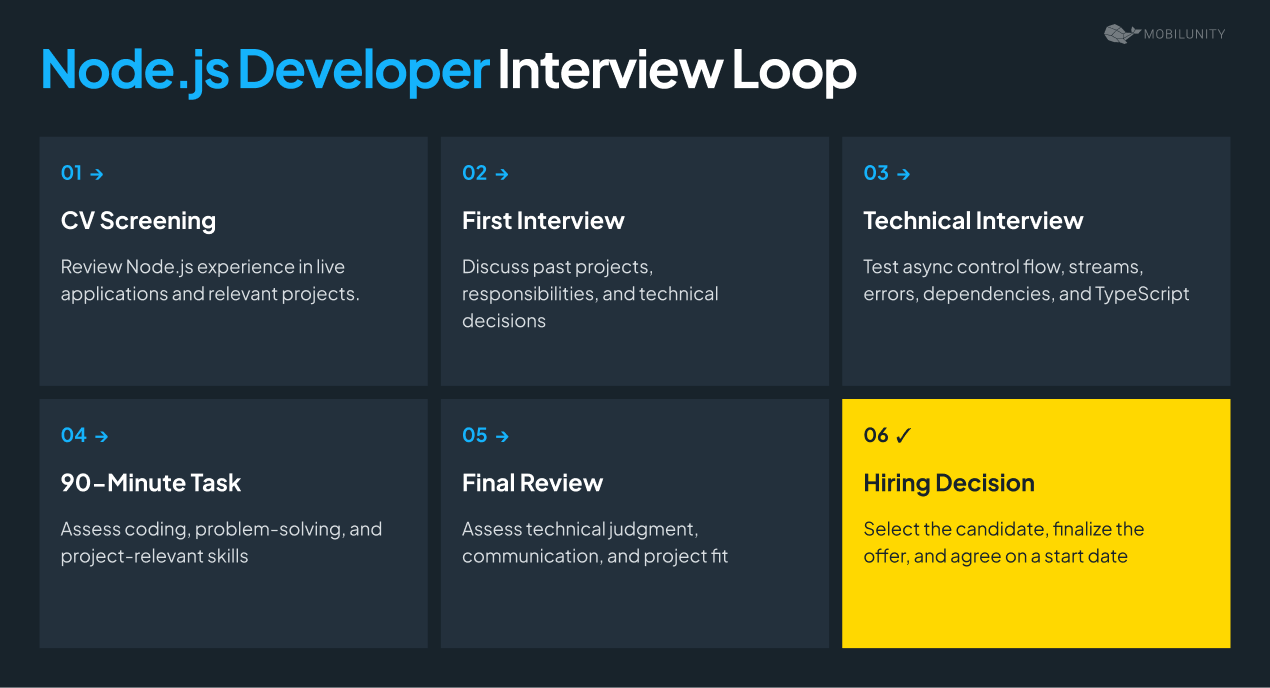
This task tests one of the clearest differences between basic and experienced Node.js development: how a developer handles large amounts of data. You don’t need to know Node.js or write any JavaScript to send the task or review the result.
Give the candidate a ready-to-run Node.js service that reads a large file into memory before calculating aggregated results. The starter project should include setup instructions and a sample data file.
Node.js screening task
Improve the supplied service so it can process large files without loading the entire file into memory.
Your task:
- Replace the current file-buffering approach with streaming
- Make sure the service handles backpressure correctly
- Add tests that cover an empty file and a malformed line
- Keep the existing output format unchanged
- In two sentences, explain how your changes affect memory use
Spend no more than 90 minutes. You don’t need to add features beyond those listed above.
Use this four-point guide to review the submission:
| Area | What You Can Check |
| Streaming | The service processes the file in smaller chunks instead of loading the whole file into memory |
| Backpressure | The solution controls data flow when processing can’t keep up with incoming data |
| Testing | The test coverage includes both an empty file and a malformed line |
| Explanation | The two-sentence explanation makes the memory difference clear to someone without a technical background |
Release the starter project under the MIT License and state this clearly in the repository. The candidate keeps ownership of the code they write for the task, and your company receives no rights to reuse their submission.
You can use this task as an initial screening step without assessing the code yourself. Review whether the candidate met the requirements and explained their approach clearly, then ask a technical reviewer to evaluate the implementation.
Node.js Developer Rates and In-House Costs
When you hire Node JS developer, the costs depend on their seniority, location, and the hiring model. Salary alone doesn’t give you a fair comparison. For an in-house employee, you also need to account for employer costs, benefits, recruitment, and any time you’re paying for before the developer becomes productive.
For comparison, Mobilunity’s rates below show gross monthly salaries and total monthly hiring costs for junior, middle, and senior Node.js developers in Ukraine, providing a benchmark for comparing seniority levels and planning your hiring budget.
Node.js Developer Gross Salary and Hiring Costs in Ukraine*
| Seniority | Gross Monthly Salary | Monthly Hiring Cost |
| Junior | $1,000 – $2,100 | $2,450 – $3,600 |
| Middle | $2,100 – $4,100 | $3,550 – $5,600 |
| Senior | $4,100 – $5,800 | $5,550 – $7,300 |
*All rates are as of September 2026
Calculating the Cost of an In-House Node.js Developer
Bringing a Node.js developer onto your payroll involves more than covering their annual salary. Depending on the country, your budget also needs to account for employer taxes, social contributions, and employee benefits. The table below provides estimated annual costs across eight markets, based on current salary data and country-specific employment costs. Actual expenses will vary by employer, location, and benefits package.
Estimated Annual In-House Node.js Developer Cost*
| Average Annual Gross Salary | Employer Taxes / Contributions | Estimated Benefits | Estimated Annual In-House Cost | |
| US | $103,300 | $7,900 | $16,800 | $128,000 |
| Canada | $57,300 | $4,300 | $4,000 | $65,600 |
| Germany | $56,700 | $11,900 | $2,300 | $70,900 |
| UK | $70,200 | $9,500 | $4,200 | $83,900 |
| Switzerland | $119,600 | $7,700 | $8,900 | $136,200 |
| Denmark | $81,100 | $1,200 | $7,100 | $89,400 |
| France | $46,200 | $16,800 | $1,100 | $64,100 |
| Spain | $44,000 | $13,500 | $800 | $58,300 |
Sources: salary.com | Glassdoor | stepstone.de | rubyonremote.com | tech-careers.dk | welovedevs.com | Indeed | ISR | canada.ca | tk.de | gov.uk | ahv-iv.ch | businessdenmark.virk.dk | mon-entreprise.urssaf.fr | seg-social.es | bls.gov | destatis.de | ons.gov.uk | bsv.admin.ch | OECD | urssaf.fr | ine.es
*All rates are as of September 2026
Employers may now have a larger pool of candidates to choose from. That additional choice, however, doesn’t necessarily translate into lower rates for experienced Node.js developers.
A larger candidate pool gives you more Node.js developers to choose from, but it doesn’t necessarily reduce rates for experienced talent. Sourcing candidates may take less time, while finding someone with the right technical background still requires careful screening. Prioritize proven production experience, sound technical judgment, and the ability to maintain and improve a live service over time.
To compare your options fairly, first define the work the developer will handle and the seniority you need. Then look beyond the monthly salary or hiring rate. Factor in employer costs, benefits, recruitment, and onboarding time to understand what each hiring model will actually cost you.
Dedicated Team, Freelancer, or In-House: Which Fits Your Project?
Node.js developers are relatively easy to find compared with specialists in languages such as Rust or Scala. The challenge is finding someone with the right production experience for your project. Your choice of hiring model should depend on how long you need the developer, who will maintain the service after launch, and how much responsibility you want to take on for employment and day-to-day management.
In-house hiring can be a good fit when Node.js is central to your product and you want someone to develop deep knowledge of your systems over time. When you hire Node.js developer in-house, that expertise stays within your company. Finding applicants is usually straightforward, but screening them takes more attention. Look for developers who have maintained production services, not only built smaller APIs or short-term projects.
The tradeoff is that your company takes on the full responsibility of employing the developer. This includes recruitment, technical screening, payroll, benefits, paid leave, equipment, and retention. Hiring can also take longer because you’re looking for someone to join the company permanently rather than cover a specific project.
Freelancers suit short-term projects where the scope, deliverables, and end point are clear from the start. You can hire a developer to build an API, integration, CLI, or small serverless service without creating a permanent position. This model gives you the technical support you need for a specific project without a long-term employment commitment.
This model is less suitable when your product requires ongoing support after launch. Someone needs to monitor performance, troubleshoot failures, update dependencies, address security issues, and understand previous technical decisions. A freelancer can handle this maintenance, but you should agree on their long-term availability and support responsibilities in advance.
A DDT (dedicated development team) can be a better fit when your Node.js product needs ongoing development and support. The advantage isn’t access to hard-to-find talent, but continuity without the responsibilities of direct employment. At Mobilunity, retention for placed developers was 94% across client projects over the past 12 months, though retention varies by client and project.
The provider recruits and employs the developers, who join your engineering processes and work to your priorities. The trial period gives you time to assess how well they fit your team – a stage that 97% of Mobilunity consultants successfully complete.
As an IT staff augmentation model, the DDT gives you ongoing engineering capacity while the developers remain employed by the provider. It suits growing API platforms, ongoing migrations, and products where Node.js developers work closely with frontend and infrastructure teams. For a small, one-time API project, however, a freelancer may be all you need to complete the work and hand it over.
| Dedicated Team | Freelancers | In-house Employees | |
| Cost structure | Monthly provider rate | Hourly or project fee | Salary plus employment overhead |
| Ramp time | Recruitment and onboarding required | Often faster for bounded work | Recruitment plus internal onboarding |
| Retention | Designed for ongoing collaboration | Depends on continued availability | Strong potential for long-term continuity |
| IP | Defined in service agreement | Must be covered in the contract | Typically covered by employment agreement |
| Management overhead | You manage delivery; provider handles employment | You manage scope, handover, and support arrangements | You manage both employment and delivery |
Choose the hiring model based on what you’ll need after the first release. A freelancer can be a good fit for a clearly defined, short-term project. An in-house developer gives you long-term internal ownership, while a dedicated team provides ongoing continuity without adding developers to your payroll.
Red Flags in a Node.js CV and in the First Call
A strong Node.js CV doesn’t always mean strong production skills. This distinction is especially useful when evaluating candidates for offshore Node.js development, where you may screen developers from a larger candidate pool. These 6 warning signs can help you spot areas that deserve a closer look before moving a candidate to the next stage.
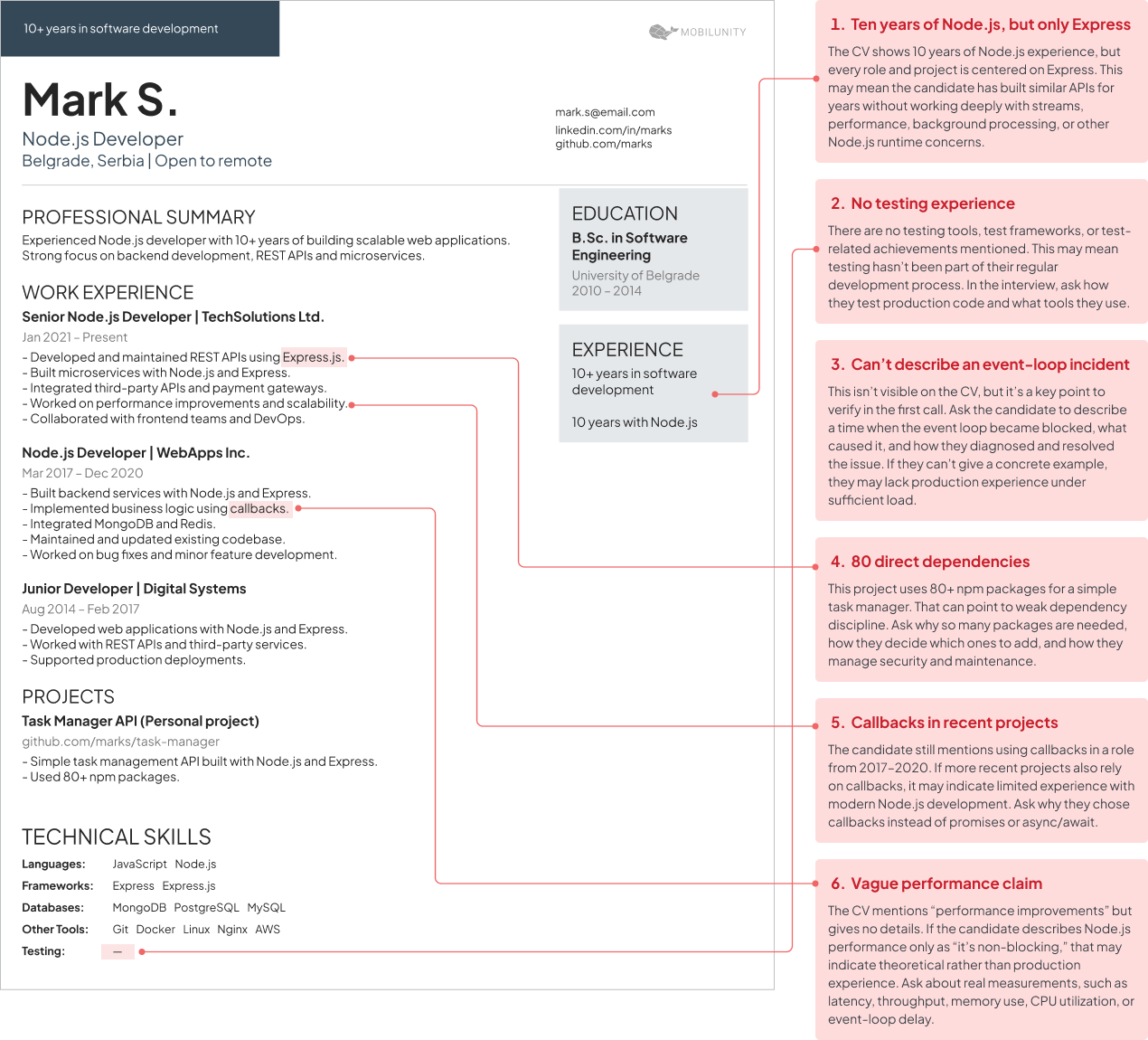
- Ten years of Node.js experience, but every project centers on Express. This may mean the candidate has spent years building similar APIs without working deeply with streams, performance, background processing, or other Node.js runtime concerns.
- They can’t describe a time the event loop became blocked. This may mean they haven’t operated Node.js services under enough load to diagnose event-loop problems in production.
- A small service has 80 direct dependencies in package.json. This can point to weak dependency discipline, especially if the candidate can’t explain why those packages are necessary or how they manage their security and maintenance.
- Recent projects still rely entirely on callbacks. This may indicate limited experience with current Node.js development if the candidate can’t explain why they chose callbacks instead of promises or async/await.
- Their portfolio contains no test files. This may mean testing hasn’t been part of their regular development process, particularly if they can’t explain how they test production code elsewhere.
- They describe Node.js performance only as “it’s non-blocking.” This may indicate theoretical rather than production experience if they can’t discuss measurements such as latency, throughput, memory use, CPU utilization, or event-loop delay.
A single red flag isn’t a reason to reject a candidate. Callbacks may make sense in an older project, and a complex service can have a long list of dependencies. Use these signals as starting points for follow-up questions instead. What you want to find out is whether the candidate has worked with Node.js in production and can explain the decisions they made.
From Hiring Brief to First Commit
Node.js is one of the faster stacks to staff because the candidate pool is relatively large. At Mobilunity, we present the first relevant CVs within 5 business days, and in most cases, even sooner. From there, the timeline depends on your interview process, requirements, and how quickly you make a hiring decision.
Week 1: You share the project requirements, and Mobilunity starts sourcing and screening candidates. You receive the first matching CVs within five business days, with many searches producing relevant candidates sooner.
Week 2: You interview the strongest candidates and run your technical assessment. A backend-focused Node.js role usually gives you a broader pool. Mandatory TypeScript experience can narrow the search, particularly if you need someone who has worked in a strictly typed production codebase.
Week 3: Once you select a developer, you move through the offer, contracting, and onboarding process. If the role also requires frontend work, finding the right match can take longer. A developer who can contribute confidently to both a Node.js backend and a React frontend needs a broader skill set than a backend specialist.
First commit: The developer gets access to the codebase, development environment, documentation, and relevant services. Your team introduces its deployment process, coding standards, monitoring setup, and code review practices before assigning the first task.
A well-documented project with a ready development environment can shorten the path from onboarding to the first commit. Missing documentation, access problems, or an environment that takes days to configure can delay productive work even after you’ve hired the right developer.