





























How to Hire C# Developers: Skills, Interviews, Rates and Timelines
Hiring the right C# developer comes down to 4 things: deciding what the role really needs, checking a short list of practical skills, comparing the full cost of each hiring option, and planning a realistic timeline. With Mobilunity, for example, you get the first closely matched CVs within 5 business days, and usually faster.
Years of experience alone do not show whether a C# developer is the right fit. Focus on everyday skills such as asynchronous programming, database queries, application-to-data tools, and testing. A short practical task can confirm these skills. When comparing hiring options, include salaries, taxes, recruitment fees, and paid leave. The final timeline depends on the required seniority and skills, candidate availability for interviews, and onboarding needs.
Where a C# Developer Fits Into Your Team
C# is Microsoft’s main programming language, and .NET is the platform it runs on. In practice they are 1 hire, not 2. Teams that set out to hire C Sharp developers and teams that search for .NET are looking at exactly the same people, so a shortlist drawn up for one is the shortlist for the other.
What that developer actually does depends on what you’re building, and 4 kinds of work come up again and again:
- Web services and APIs, usually built with ASP.NET Core. This is the part other systems talk to, and it is the most common reason companies hire.
- Internal business systems: reporting, invoicing, scheduling, the software a company runs on every day.
- Cloud work on Microsoft Azure, where the application lives and where the monthly bill comes from.
- Older desktop applications built with WinForms or WPF, which many companies still depend on and still need to maintain.
A fifth kind sits apart from the rest. Unity games also use C#, but a Unity developer writes gameplay code against a game engine, which shares very little with a web service. If you need both, treat them as 2 separate roles. The same applies in reverse: our page for .NET developers covers the server-side profile in more detail.
Your industry shapes the role as much as the technology does. In banking, insurance and healthcare, the work is defined by audit trails, data residency and release approvals rather than by features, and our write-up on .NET in regulated industries explains what those constraints do to a delivery schedule.
Decide What You Are Hiring Before You Write the Job Ad
Before you write a C# developer job description, decide what an engineer will actually spend their time on. The most useful question is not how many years of C# somebody has, but whether they have solved the kind of problem you are about to hand them.
The experience you need depends on the shape of the project. For a new service, look for somebody who can set up the structure and make sensible choices from the start. For an existing system, you want somebody comfortable working inside code other people wrote, without breaking what already works.
Older desktop applications need a different kind of experience. Look for a developer who is comfortable maintaining legacy code, understanding unfamiliar systems, and making careful updates without disrupting existing functionality.
Large enterprise platforms are worth a separate thought. The profile you need there often looks closer to the one on our Java developers guide than to a startup backend hire, because the work is more about stability and integration than about speed.
It also helps to separate what you require from what you would simply like. Most hiring managers want a C# developer who also knows SQL and a little frontend work. SQL is worth requiring, because almost every serious performance problem ends up in the database. The rest can usually be learned on the job by somebody who already thinks clearly.
If you are still deciding which role to fill, explore our guide to hire developers by technology to compare the skills and expertise your project needs.
The Five Skills to Test For, and How to Test Each
The skills below are the ones that separate a developer who will be productive in your codebase from one who has mostly read about it. Each check takes about 10 minutes and needs no code from you. The goal is not to grade the answer technically, but to hear whether the candidate is describing something that really happened.
Asynchronous Code
Modern applications handle many requests at the same time, and the code that manages this is called asynchronous. When it’s written carelessly, the application freezes under load while the server itself looks completely idle. It’s the most common cause of production incidents in this stack.
10-minute check: Ask the candidate to describe a time an application hung or slowed down badly, and what caused it. A strong answer includes the symptom, how they found it and what they changed. Somebody who has never seen this probably hasn’t run a system under real load.
How the Code Asks for Data
Developers use a feature called LINQ to ask the database questions from inside C#. Written one way, the database does the work and returns 10 rows. Written another way, the application drags the whole table into memory first and sorts through it there, which works fine in testing and falls over once the data grows.
10-minute check: Ask for a query they had to rewrite, and what it was doing wrong. You’re listening for somebody who noticed the difference and can explain it simply. An answer that stays on readability, without mentioning how much data was moving, misses the point.
What the Data Tool Does Behind the Scenes
Most teams use Entity Framework, a tool that writes database instructions on the developer’s behalf. It’s convenient until a screen takes 20 seconds to load and nobody knows why, because nobody has looked at what the tool is actually sending.
10-minute check: Ask how they check what their tools generate. Naming a log, a profiler or simply reading the output is enough; you don’t need to grade the method. A developer who has never looked is telling you the tool is a black box to them.
SQL
SQL is the language databases speak. Even when a tool writes it for them, someone who can read and write it directly solves the serious performance problems. This is the skill most worth requiring outright.
10-minute check: Ask what the slowest thing they ever fixed was, and what made it slow. You’re listening for a specific story with a before and an after, not a general statement that performance matters. A backend CV with no SQL on it anywhere deserves a direct question.
Testing
Tests are small programs that check the main program still works after a change. What matters isn’t how many tests exist, but whether they cover the things that would hurt your business if they broke.
10-minute check: Ask which parts of their last project they covered with tests and which they deliberately left alone. A thoughtful answer explains the trade-off. An answer built around a coverage percentage is a policy, and policies don’t catch problems.
Weight these by what the project needs. A new service leans on the first 2, an existing system leans on the data skills and SQL, and everything benefits from the last one. You don’t need to judge the technical detail yourself, only whether the answers contain real experience.
One more thing is worth listening for across all 5 checks, and it isn’t technical at all. You’ll rely on this person to tell you why something is late, why a shortcut is risky, or why an estimate moved. If you understand their explanations now, without asking for a translation, you’ll understand them every week once they join.
Six Interview Questions, and What a Good Answer Sounds Like
Technical knowledge on its own doesn’t tell you how somebody will behave on your project. These C# developer interview questions look at how candidates handle pressure, mistakes and trade-offs. Each one comes with what a strong answer covers and which answers are worth a second look, so you can run the conversation without writing any code yourself.
1. An application you built started freezing under load. How did you find the cause?
What to expect: They describe the symptom, how they investigated, and what they changed. Strong candidates mention checking how the application was handling many requests at once.
Weak-answer signal: They describe the theory of asynchronous code without giving an example of anything actually breaking.
2. Tell me about a screen or report that was too slow. What did you do about it?
What to expect: They explain what was slow, how they measured it, and what the fix was. The best answers involve looking at what the database was doing rather than guessing.
Weak-answer signal: They talk about clean code and readability without mentioning how long anything took before or after.
3. How do you check what your data tools are doing behind the scenes?
What to expect: They describe reading the queries their tools generate, using logs or a profiler. You do not need to grade the method, only to hear that they look.
Weak-answer signal: They’ve never looked, or they assume the tool always does the sensible thing.
4. Tell me about a project outcome in numbers rather than technologies.
What to expect: Hours saved, errors removed, cost avoided, or a page that went from 10 seconds to 2. Ask one follow-up about how you measured the number.
Weak-answer signal: A percentage with no baseline, such as a 90% improvement, with no explanation of what was measured or how.
5. A security problem is reported in a tool you use, and no fix is available yet. What do you do?
What to expect: A sequence rather than a slogan: work out whether your application is actually exposed, limit the risk, then plan the replacement. Mentioning who they would tell is a good sign.
Weak-answer signal: They say they would update the tool, which is the one option the question already removed.
6. When is C# the wrong choice for a project?
What to expect: Fair answers include heavy scientific computing, very small devices, and quick throwaway scripts. The point is whether they can criticize their own toolkit.
Weak-answer signal: They can’t name a single case, which usually means they haven’t yet worked at the edges of the platform.
You don’t need C# expertise to judge these answers. Look for candidates who explain their thinking in plain language, who describe risks instead of promising that nothing will go wrong, and who can point to something specific that happened.
A 90-Minute Screening Task You Can Send Today
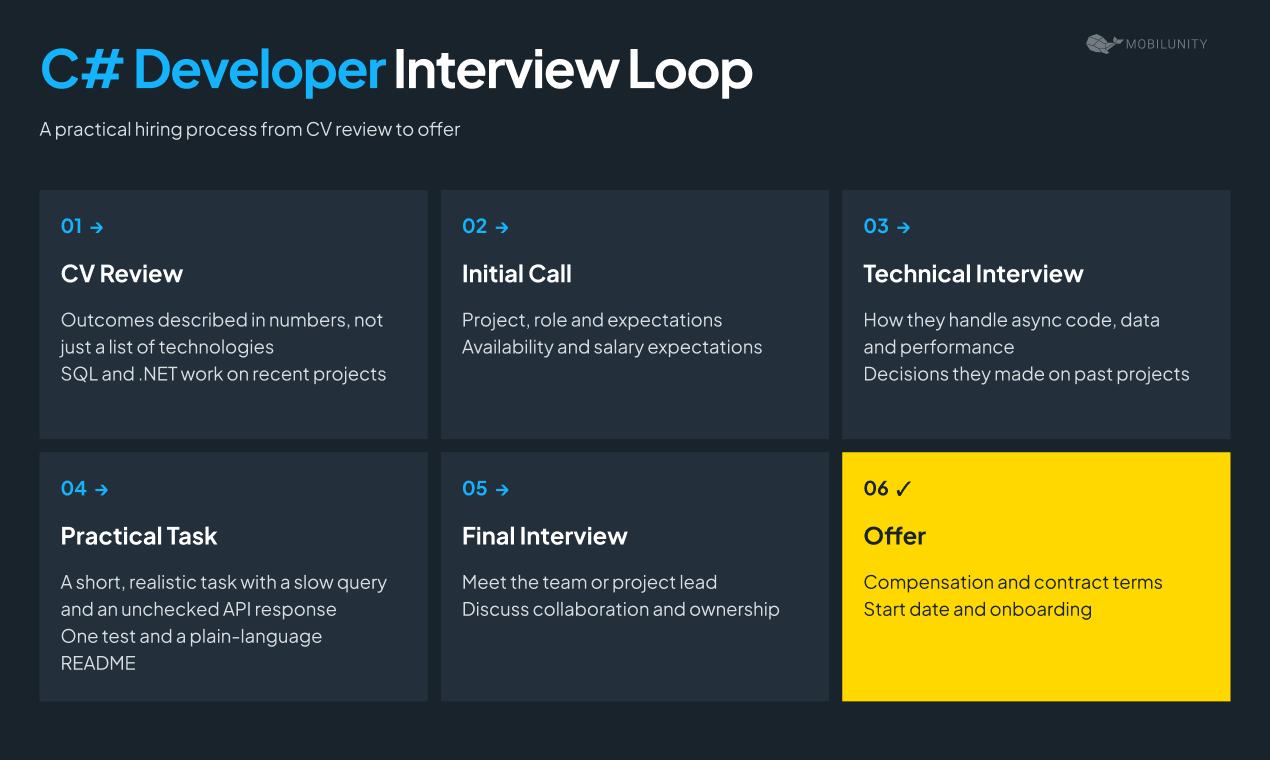
This one slots in between the first call and the technical interview, and it suits middle and senior candidates best. Hand over a small project that already runs, so the 90 minutes are spent on the problem instead of on configuration.
The task: a small service that reads a list of records from a database and returns them through an API. Plant 2 problems in it. The first is the one from the skills section, where the code drags the whole table into memory before filtering it. The second is an outside service whose answer the code trusts without checking, so one unexpected value brings it down.
Their job is to fix both, leave behind 1 test, and describe each change in 2 sentences that someone outside engineering can read.
Use the marking guide below. It lets you review the result without reading the code closely, because every line is about an outcome you can see or an explanation you can read.
| Area | What to check |
| Performance | The filtering now happens in the database, and the candidate can show you that it does |
| Safety | The data coming from the outside service is checked before it’s used |
| Configuration | Passwords, keys and connection details stay out of the code they send back |
| Testing | There’s at least 1 test, it fails against the original code, and the candidate explains what it protects |
| Explanation | The written notes make sense to you without a technical translation |
Put 2 promises in writing when you send it. The code they send back is theirs, released under a permissive license such as MIT, and none of it will reach your product. Where you pay candidates for screening time, quote the rate in the same message.
What It Costs: Rates by Region and the Real In-house Comparison
What a C# hire costs depends on three things: seniority, location, and the hiring model you choose. A senior engineer commands more than a junior developer almost everywhere, but the gap between markets can be just as significant. The same C# profile that costs six figures annually on an in-house payroll in the United States or Western Europe may be available at a lower monthly cost through a dedicated team model in Ukraine.
Salary is only the starting point. An in-house hire also adds payroll taxes, benefits, recruitment, equipment, onboarding, and replacement costs. A provider’s monthly fee usually combines these into one more predictable figure. The sections below compare salaries, total hiring costs, and key markets.
C# Developer Monthly Gross Salary Rates
Gross salary is the starting point for any comparison, and it moves more with seniority than with any single technology in the job ad. The table below shows current gross monthly salary ranges for C# developers in Ukraine, taken from data gathered by our Recruitment Team:
| Seniority | Monthly Gross Salary (USD)* |
| Junior | $1,000 – $2,000 |
| Middle | $2,000 – $4,200 |
| Senior | $4,200 – $5,700 |
| Team Lead | $5,700 – $6,800 |
*As per Mobilunity in-house tech recruiting team research done in September 2026
Salary and cost aren’t the same figure. An employee on your own payroll brings employer taxes, benefits, recruitment fees, paid leave, a laptop and the time it takes to settle them in. Through a provider, employment and administration are already inside the monthly fee, so the quoted number is much closer to the real one. The table below shows monthly costs with Mobilunity, based on research conducted by our in-house technical recruitment team in September 2026:
| Seniority | Monthly Cost With Mobilunity (USD)* |
| Junior | $2,450 – $3,500 |
| Middle | $3,450 – $5,700 |
| Senior | $5,650 – $7,200 |
| Team Lead | $7,150 – $8,300 |
*As per Mobilunity in-house tech recruiting team research done in September 2026
Location moves the number more than any other single factor. The table below compares median gross monthly salaries for developers in this stack across several hiring markets, so you can see where Ukraine sits against the alternatives.
| Market | Median Monthly Gross Salary (USD)* |
| Switzerland | $10,150 |
| United States | $10,020 |
| Canada | $6,960 |
| Germany | $6,890 |
| United Kingdom | $6,700 |
| Spain | $3,350 |
| France | $3,160 |
| Ukraine (middle to senior) | $2,000 – $5,700 |
Sources: talent.com salary data for .NET developers in each market, read on September 22, 2026 and converted at the European Central Bank reference rates of the same date.
*All rates are as of September 2026
What an In-house Developer Really Costs
The salary line in your budget is the smaller half of an in-house hire. On top of it sit compulsory payroll taxes, social contributions and whatever benefits package the local market expects. All of that shifts from country to country, so the same salary buys a very different total in Munich and in Madrid.
The United States shows the gap clearly. The median salary for software developers is $134,040 a year. On top of that, benefits run at 31.5% of total employer compensation costs for full-time private-sector staff, which works out at roughly 46 cents for every dollar of wages, or about $61,700 a year. Recruitment adds a one-off of close to $4,700 per hire, spent whether or not the person stays.
Add those lines together and a single in-house developer in the United States costs roughly $200,000 in the first year, or about $16,700 a month. In the United Kingdom the employer National Insurance rate alone is 15% of qualifying earnings for the 2026 to 2027 tax year, before pension and benefits are counted.
Sources: U.S. Bureau of Labor Statistics (Occupational Outlook Handbook and Employer Costs for Employee Compensation, June 2026), SHRM benchmarking data, and GOV.UK National Insurance rates. All figures are as of September 2026.
Compared with the monthly cost of a dedicated developer, the difference is easier to see. The point is not that one model is always cheaper. It is that a C# developer salary is only one part of the total cost of hiring them.
The true C# developer cost also includes employer taxes, benefits, recruitment, administration, and replacement costs if the role becomes vacant. Budget for the total cost of the hire, not the salary alone.
Dedicated Team vs Freelancer vs In-house Hire
The right way to hire C# developers depends on how long the work will last and how much of the management you want to carry yourself. The 3 models below suit different situations.
Hiring in-house makes sense when you want somebody who grows into the product, absorbs the business and is still around in 3 years. You work with and manage the developer directly. The trade-off is that recruitment, screening, employment costs, and day-to-day management are your responsibility, and you need to restart the hiring process whenever someone leaves.
Supply matters here too. Candidates for ASP.NET Core work are plentiful in most markets, so a web service role fills quickly. Desktop work with WinForms or WPF, and anything Unity, draws from a much smaller pool, and that shows up in both the timeline and the salary.
Freelancers suit work with a clear scope and an end date: an integration, a reporting feature, a migration nobody will need to extend. Agree up front on code ownership, documentation, bug fixes and handover. The model gets risky when the code has to be maintained later, because the person who understands it is no longer around.
Companies that hire dedicated C# developers are usually buying continuity on a system that will outlive the current roadmap. With the dedicated development team model, the developers work inside your processes while we handle employment and administration.
At Mobilunity, 97% of consultants successfully complete their trial period, and retention across client projects reached 94% over the past 12 months, though results vary by client and project.
| Dedicated Team | Freelancer | In-house Hire | |
| Cost structure | Monthly provider rate | Hourly or project fee | Salary plus employment overhead |
| Ramp time | Recruitment and onboarding handled for you | Often fastest for bounded work | Recruiting plus internal onboarding |
| Retention | Designed for ongoing engagement | Ends with the project | Yours to manage |
| IP | Defined in the service agreement | Must be addressed in the contract | Covered by the employment agreement |
| Management overhead | You manage delivery, we handle employment | You manage scope and handover | You manage employment and delivery |
Project length and ownership should decide this, not the headline rate. Choose a freelancer for short, self-contained work and an in-house developer when the knowledge needs to stay inside your company. IT staff augmentation and the dedicated team model both work when you need external developers inside your existing process.
Notice that the screening work above survives all 3 columns. Getting it wrong and having to hire a C# developer twice costs roughly the same whichever model you picked, and it dwarfs whatever you saved on the rate.
Red Flags in a C# CV and in the First Call
A CV never shows the whole picture. None of the signals below is a reason to reject somebody on its own. Each one simply tells you what to ask about on the first call.
- Technologies listed with no outcomes. The CV names languages, frameworks, and tools but never says what any of them were for. This usually means nobody ever asked the developer what the work achieved.
- Numbers with nothing behind them. A claim such as a 90% improvement, with no baseline, no unit and no explanation of how it was measured. Ask what was measured and the answer arrives quickly, or not at all.
- The pattern that freezes applications. Code samples full of .Result and .Wait(). These force the program to stop and wait where it wasn’t designed to, and they’re behind the classic freeze under load.
- Data tools used without curiosity. Entity Framework listed everywhere, with no sign the developer ever looked at what it sends to the database. It’s the single most common source of slow software in this stack.
- No SQL anywhere on a backend CV. Most serious performance problems end up in the database. A backend developer who has never mentioned it may have always had somebody else to hand those problems to.
- Unity experience only, for a server-side role. Unity uses the same language, but the work is games rather than web services. It isn’t a reason to reject anyone, it’s a reason to check which of the 2 jobs they’ve actually done.
Some things that look like warnings aren’t. A gap in the dates belongs to somebody’s life and says nothing about their work. A CV written in plain sentences instead of buzzwords usually belongs to a person who has had to explain their work to a non-engineer before, which is exactly what you want.
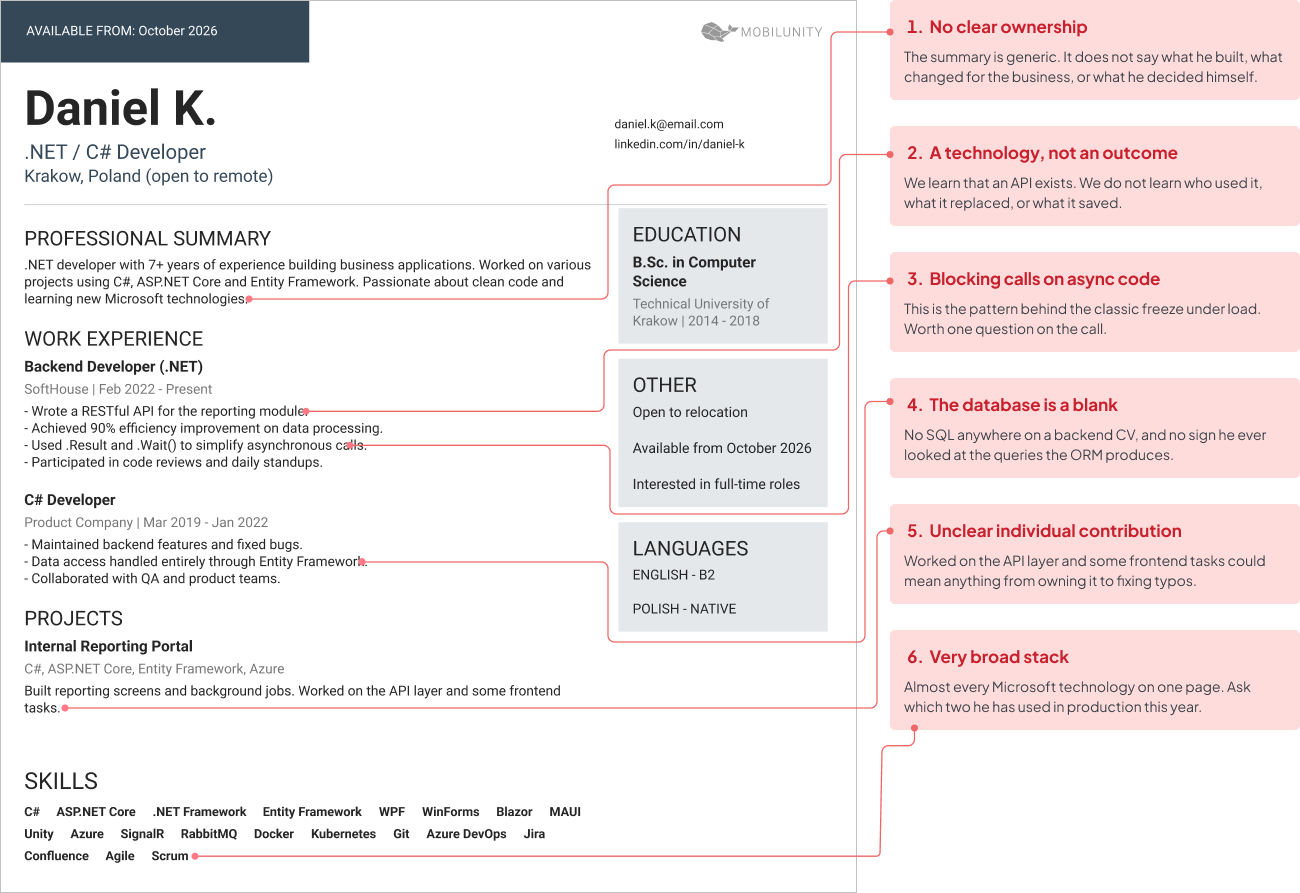
Use these signs to decide what to explore further, not to shorten the list before you’ve spoken to anyone.
How Long It Takes, Brief to First CV
Two things set the pace: how sharply the role is defined, and how quickly your own people can free up interview slots. For calibration, C# staffs at roughly the same speed as Java, and considerably faster than Rust or Scala, because the pool is deep in every market we recruit in.
Our own part of the schedule is 5 business days from brief to the first closely matched CVs, and frequently less.
Week 1: you brief us, we source and screen, and the first shortlist reaches your inbox.
Week 2: you meet the candidates. When one of them is clearly right, we take it through to an offer and start onboarding.
Week 3 onwards: if nobody in the first group fits, your feedback reshapes the search and we go again.
The timeline stretches on 2 requirements. A hard Azure requirement narrows the pool to people with real deployment history, and desktop work with WinForms or WPF narrows it further, since fewer developers keep those skills current. Your own interview availability affects the date more than either.
Once you’ve chosen somebody, onboarding starts with access to the code, the tools and the documentation. Your team then walks them through how you work, and the first small task usually lands inside that first week.