







 United States


 Latin America


 Eastern Europe






















How to Hire JavaScript Developers: Skills, Interviews, Rates and Timelines
Hiring a JavaScript developer starts with a routing decision, because almost nobody needs JavaScript on its own. Most roles turn out to be React, Vue or Angular work on the front end, Node.js on the server, or a full-stack role that covers both. Once you know which one you’re hiring, the rest follows: test the skills the project actually uses, compare the full cost of each hiring model, and plan around your own interview calendar. At Mobilunity, the first closely matched CVs reach you within 5 business days, and usually sooner.
Years of JavaScript on a CV predict very little on their own. What matters is how somebody handles the parts of the job that go wrong in production: data that arrives late or in the wrong order, pages that load slowly, and code that has to survive the next person who touches it. A short practical task tells you more about that than any list of frameworks.
Front End, Server Side or Both: What You Are Really Hiring For
JavaScript runs in 2 places: in the browser, where people see and click things, and on the server, where data is stored and decisions are made. Almost every role sits in one of those 2 worlds, and knowing which one saves you weeks of interviewing the wrong candidates.
Front-end work is what users touch: screens, forms, dashboards, everything that reacts when somebody clicks. It’s usually built with React, Vue or Angular, and these developers spend their time on how the interface behaves. If your project is already on React, our hiring guide for React developers describes the profile in detail.
Server-side work is the part nobody sees. It handles logins, payments, stored data and the connections to other systems, and in JavaScript it’s usually built with Node.js. When something has to stay up at 3 a.m., this is the person you need, and our guide for hiring Node.js developers covers what that role involves.
Some developers do both, which is what full-stack means. One person can take a feature from the database through to the screen, and that suits smaller teams where nobody wants a handover between 2 specialists. Our full-stack developers guide explains where that works and where it doesn’t.
Another 2 kinds of work come up often enough to mention. Build tooling and performance are the invisible job of keeping a site fast and a release process reliable. Legacy maintenance means keeping an older codebase alive while something newer is built beside it.
One thing to settle before you write anything down. In 2026 most JavaScript roles are really TypeScript roles. TypeScript is JavaScript with a safety layer that catches a class of mistakes before release, so treat it as baseline rather than a bonus.
Write the JavaScript Developer Job Description Around the Work
The most expensive mistake at this stage is confusing seniority with memory. A senior developer isn’t the person who can recite the difference between 2 similar built-in commands. That’s what documentation is for. Seniority shows up in judgment: knowing which problem to solve first, what to leave alone, and when a quick fix will cost you later.
It’s also worth dropping one habit that quietly shapes most shortlists. Many hiring managers screen on weekend projects and public code activity. However, this often measures how much free time someone has, not how well they can do the job.
A JavaScript developer job description works best when it describes the work rather than a wish list of technologies, because requirements in this field vary enormously between companies, roles and industries. Write it around the 2 or 3 things the person will do in month 1. If you are still deciding which role fits your project, explore the skills and roles available when you hire developers by technology.
Most searches come down to 1 of 3 situations. It might be a build from nothing, in which case you want somebody comfortable choosing the shape of things before anyone else arrives. You may be adding a person to an existing product, where the skill is working inside code other people wrote without breaking it.
Or you may be modernizing something old, which is its own job. Look for a developer who can understand legacy code, make careful updates, and improve the system without disrupting existing functionality. Our comparison of jQuery compared with JavaScript explains what changes between them.
Teams that try to cover all 3 situations with a single job ad usually end up covering none of them well. Pick the one that matches your backlog, and the ad, the screening call and the shortlist all get easier.
The Skills That Decide Whether a JavaScript Hire Works Out
The skills below come up most often in real JavaScript work, and they’re a starting point rather than a complete list. Each comes with a short explanation of why it matters and a question you can ask in about 10 minutes. You don’t need to grade the technical detail. Simply listen for whether the answer reflects real hands-on experience or repeats a prepared definition.
The Language Under the Framework
Frameworks like React and Vue change every few years. The language underneath them doesn’t. Developers who only know the framework tend to get stuck the moment a problem falls outside it, and those problems are exactly the ones that reach you.
What to ask: Ask about a bug where something in their code held on to the wrong value, and how long it took to find. A real answer has a story: what broke, how they tracked it down, and what they changed. A textbook definition means they revised for the interview.
TypeScript at the Edges
TypeScript checks that data looks the way the code expects, but only while the code is being written. The moment information arrives from somewhere else, from your own server or an outside service, those checks no longer apply, and that’s where applications break.
What to ask: Ask what they do when a field they expected to contain text arrives empty instead. Strong candidates describe checking the data as it comes in. Weaker ones only restate that TypeScript catches errors early, which is true and not the point.
Handling Things That Happen Out of Order
On the web, requests don’t come back in the order they were sent. Type a search quickly and an older, slower answer can land after a newer one and overwrite it. Users see the wrong results and nobody can reproduce it, which makes this one of the most frustrating bug categories.
What to ask: Ask them to describe a time the wrong data appeared on screen and what caused it. You’re listening for somebody who has met this problem and knows how to cancel or ignore the stale answer, rather than somebody who has only read about it.
Speed and Page Weight
Every feature a developer adds makes the page a little heavier, and heavier pages lose customers on slow connections. The question isn’t whether somebody cares about speed. It’s whether they’ve ever measured it.
What to ask: Ask what the biggest thing they removed from a project was, and how they knew it helped. You want a tool named and 2 numbers, before and after. “We made it faster, with nothing behind it,” isn’t an answer.
Testing
A test is a small piece of code whose only job is to shout when a change breaks something that used to work. Their number matters far less than their placement: do they sit around the parts of the product whose failure would show up on an invoice?
What to ask: Which corners of the last project did they decide not to cover, and what was the reasoning? A thoughtful answer explains the trade-off. An answer that leans on a coverage percentage is quoting a rule, and rules don’t find bugs.
Weight these by the role. Front-end work leans on the last 3, server-side work on the first 3, and a full-stack brief needs all of them at a reasonable level rather than one exceptional one.
JavaScript Developer Interview Questions and What Good Answers Sound Like
The questions below are a practical set rather than an exhaustive one, and each answer includes a note on what a good reply sounds like and what should make you ask more. None of them can be answered from a study guide, because each one asks what happened rather than what is true.
1. Tell me about a bug where your code held on to the wrong value. How long did it take to find?
What a good answer sounds like: A specific story: what users saw, how they tracked it down, what the fix was. Good candidates often say the fix was small and finding it wasn’t, which is exactly right.
What should make you ask more: A textbook explanation with nothing that actually broke attached to it.
2. Where does TypeScript stop protecting you, and what do you do about it?
What a good answer sounds like: They describe the moment data arrives from outside the application and explain how they check it before using it.
What should make you ask more: They repeat that TypeScript catches errors early and stop there, without mentioning anything arriving from elsewhere.
3. Tell me about a time the wrong information appeared on screen because answers came back out of order.
What a good answer sounds like: Ownership and a clear account of the cause. Everybody who has shipped enough has met this, and the useful signal is how calmly they describe it.
What should make you ask more: They say it can’t happen in their code, or they’ve never seen it, which usually means limited time on a live product.
4. What did you remove to make a page load faster, and how did you know it worked?
What a good answer sounds like: A tool they used to measure and 2 numbers, before and after. Ask which single item made the biggest difference.
What should make you ask more: A list of general techniques with no project, no measurement and no result attached.
5. What do you deliberately not test, and why?
What a good answer sounds like: A trade-off they can defend out loud, tied to a real codebase and real risk.
What should make you ask more: A coverage target, which is a policy rather than a judgment, or the claim that they test everything.
6. React, Vue, Node or all 3: what are you genuinely strongest at?
What a good answer sounds like: A clear ranking and an honest second place. This is the routing question, asked of the candidate, and it often saves an unnecessary second interview.
What should make you ask more: Comfortable with all of them, which usually means nobody has depended on them for any.
7. When is JavaScript the wrong choice for a project?
What a good answer sounds like: Fair answers include heavy number crunching, tight performance constraints and very small devices. The point is to see whether somebody can be honest about the limits of what they work with every day.
What should make you ask more: Nothing comes to mind at all, which generally means the work so far has stayed well inside what the language handles comfortably.
None of this requires you to read a line of code. The people worth shortlisting think out loud in language you follow, name the risks rather than promising there aren’t any, and anchor what they say in something that actually happened.
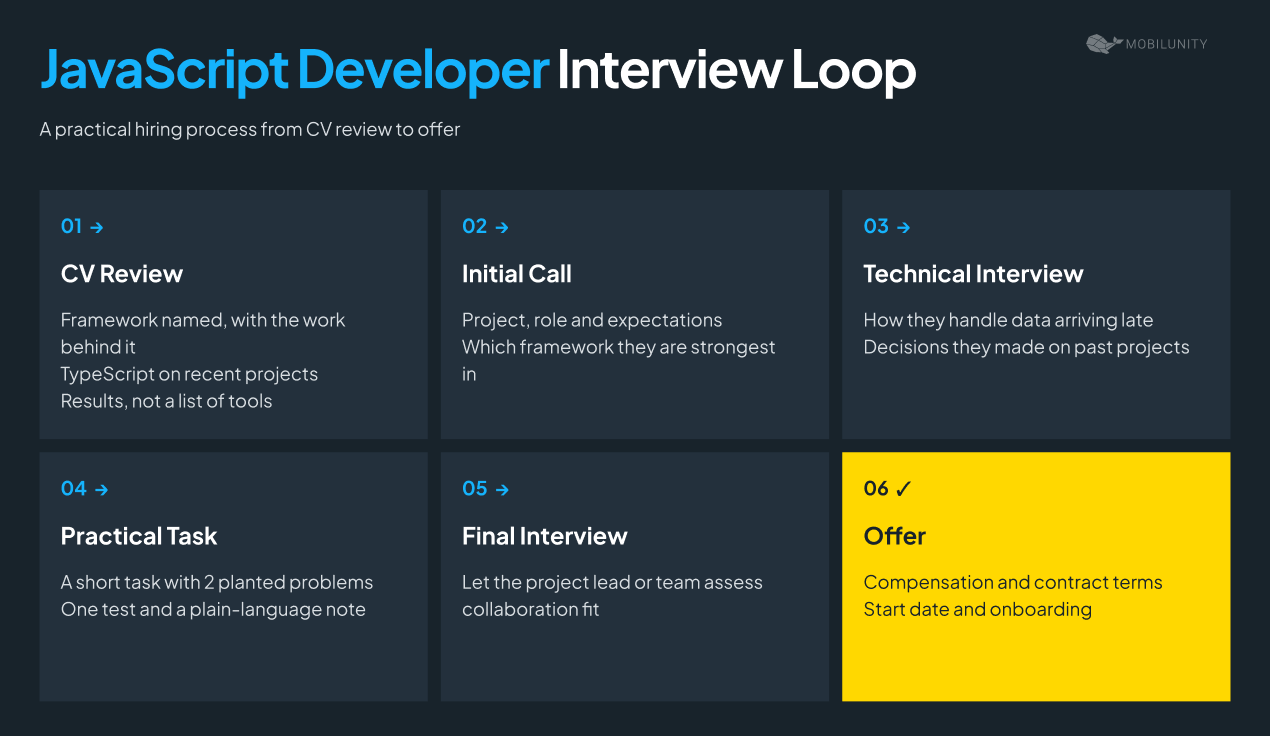
A 90-Minute Screening Task You Can Send Today
Send this task after a successful first call and before a longer technical interview. Give candidates a small project that already runs, so they can spend the full 90 minutes on the task instead of installing tools or fixing setup issues.
The task: Give the candidate a small search page that gets results from an API. The page should already work, but include two intentional problems:
- If a user searches twice quickly, an older, slower response can replace the newer results.
- The page trusts all data returned by the API, so one unexpected value can cause it to break.
Ask the candidate to fix both problems, add one test, and write a short explanation of each fix in plain language.
Use the checklist below to assess what you can see on screen and how clearly the candidate explains their work.
| Area | What to check |
| Search results | The latest search results remain visible, even if an earlier request finishes later. |
| API data | The page safely handles missing or unexpected data from the API. |
| Testing | The candidate adds at least one test and explains what it checks. |
| Explanation | The written explanation is clear to a non-technical reader. |
Make two points clear: the candidate keeps ownership of their submission, and you will use it only for evaluation – not in your product.
What a JavaScript Hire Costs, by Seniority and Market
The number comes out of 3 inputs: seniority, geography, and the employment arrangement you pick. The fourth factor is specialization, which is often overlooked. Developers with in-demand expertise, such as React or Node.js, usually cost more than general JavaScript developers. Ask for the specific skills your project needs instead of a broader profile.
JavaScript Developer Monthly Gross Salary Rates
A JavaScript developer salary in Ukraine is significantly lower than its Western European equivalent. Here are the monthly ranges we’re seeing across our own placements.
| Seniority | Monthly Gross Salary (USD)* |
| Junior | $1,000 – $1,800 |
| Middle | $1,800 – $3,500 |
*As per Mobilunity in-house technical recruiting team research done in September 2026. At senior level the market prices a framework specialist rather than a general JavaScript developer.
Salary is only the amount paid directly to the developer. Total cost includes the additional expenses of employing them, such as payroll taxes, benefits, recruitment fees, paid leave, equipment, and the cost of replacing them if they leave. With a provider, such as Mobilunity, employment and administrative costs are usually included in one monthly fee.
| Seniority | Monthly Cost With Mobilunity (USD)* |
| Junior | $2,450 – $3,300 |
| Middle | $3,250 – $5,000 |
*As per Mobilunity in-house tech recruiting team research done in September 2026
Nothing shifts the figure as much as geography does. Set the usual hiring markets side by side, convert averages to a monthly figure in dollars, and Ukraine’s position becomes easy to read.
| Market | Average Monthly Gross Salary (USD)* |
| Switzerland | $10,170 |
| United States | $10,020 |
| Germany | $6,930 |
| United Kingdom | $6,680 |
| Netherlands | $5,300 |
| France | $3,820 |
| Spain | $3,340 |
| Ukraine (junior to middle) | $1,000 – $3,500 |
Sources: talent.com average salary data for JavaScript developers in each market, read on September 22, 2026, divided by 12 and converted at the European Central Bank reference rates of the same date.
*All rates are as of September 2026.
What an In-house Developer Really Costs
Budget a salary, and you’ve budgeted the smaller half. Mandatory payroll taxes, social contributions, and the benefits local candidates expect all stack on top, and the proportions differ wildly by country. An identical salary produces a very different invoice in Zurich than it does in Valencia.
American numbers make the point easily. Software developers there have a median salary of $134,040 a year. Benefits account for 31.5% of what private-sector employers spend on full-time staff overall, nearly 46 cents on top of every wage dollar, which adds about $61,700 to this salary.
Then there’s filling the role at all, around $4,700 a hire, money you spend whether the person lasts a decade or a quarter. Stack the 3 lines up and year 1 for one US developer lands near $200,000. British employers start from a different place but not a cheaper one: National Insurance alone takes 15% of qualifying earnings in the 2026 to 2027 tax year, with pension and benefits still to come.
Sources: U.S. Bureau of Labor Statistics (Occupational Outlook Handbook and Employer Costs for Employee Compensation, June 2026), SHRM benchmarking data, and GOV.UK National Insurance rates. All figures are as of September 2026.
One cost that is easy to overlook is the time a role remains open after a developer leaves. While you search for and onboard a replacement, projects can slow down and other team members may need to cover the work. For a closer look at regional rates, see our breakdown of JavaScript developer costs in more detail.
Dedicated Team, Freelancer or In-house Hire
A pair of questions settle how to hire JavaScript developers: how long you expect the work to run, and how much day-to-day management you want on your own desk. Each of the arrangements below answers those differently.
In-house hiring gives you the widest choice of candidates, because JavaScript has the largest talent pool of any language we recruit for. That’s also the catch: the range in quality is enormous, and the screening is the real work. You get somebody who learns your product and stays with it, and you carry recruitment, employment costs, and management in return.
Freelancers are a good fit for clearly defined projects, such as a redesign, a single feature, or a one-time migration. Agree on code ownership, documentation, and handover before work begins. They are less suitable for work that will need ongoing support, especially if the original developer may not be available later.
Companies that hire dedicated JavaScript developers are usually buying continuity across a stack that changes quickly. With the dedicated development team model, developers work as part of your team and use your processes and tools, while Mobilunity handles contracts, payroll, and administration. At our company, 97% of consultants successfully complete their trial period, and retention across client projects reached 94% over the past 12 months, though results vary by client and project.
| Dedicated Team | Freelancer | In-house Hire | |
| Cost structure | Monthly provider rate | Hourly or project fee | Salary plus employment overhead |
| Ramp time | Recruitment and onboarding handled for you | Often fastest for bounded work | Recruiting plus internal onboarding |
| Retention | Designed for ongoing engagement | Ends with the project | Yours to manage |
| IP | Defined in the service agreement | Must be addressed in the contract | Covered by the employment agreement |
| Management overhead | You manage delivery, we handle employment | You manage scope and handover | You manage employment and delivery |
Decide on duration and ownership, not on whichever monthly figure looks smallest. Short and self-contained points to a freelancer. Knowledge that has to live inside your own walls points to an employee. IT staff augmentation and the dedicated model both cover the middle case, where we hire the developers and the process stays yours.
One point holds across all 3 columns. The screening described above doesn’t change, and the cost of getting it wrong and having to hire a JavaScript developer twice is far higher than any difference in monthly rate.
Red Flags in a JavaScript CV and in the First Call
No CV tells you enough on its own. Treat each signal below as a prompt for the screening call, not grounds for a no.
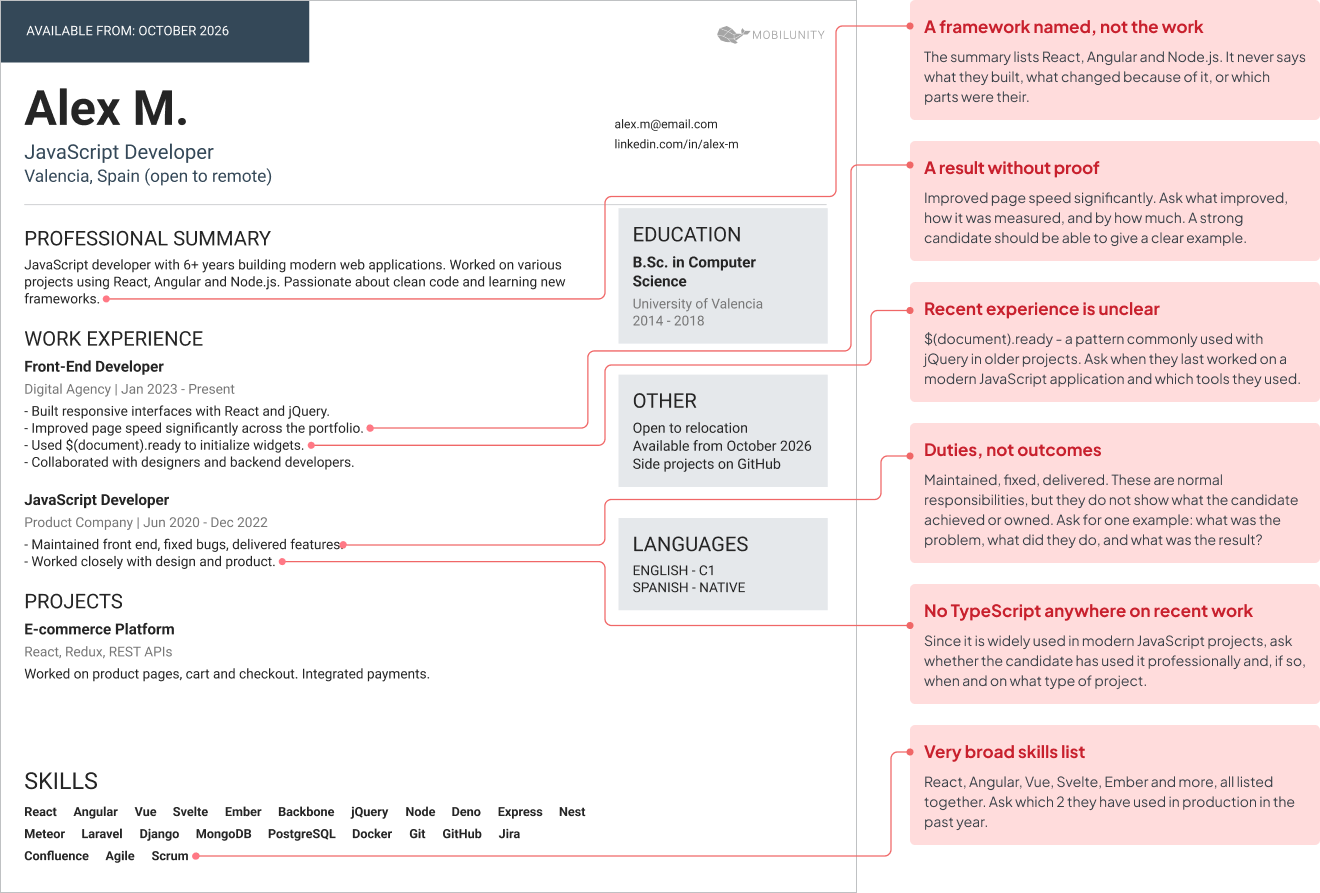
- A framework named, with no sign of the language under it. The CV says React or Vue on every line but never describes a problem solved rather than a tool used. This often means the framework is as far as the knowledge goes.
- No TypeScript anywhere on recent work. In 2026 most teams use it. Its absence from the last 2 or 3 roles usually means the candidate hasn’t worked on a modern codebase recently.
- No bug they ever caused. On the first call, the candidate can’t describe a mistake of their own. For a senior hire this usually points to limited responsibility rather than a flawless record.
- Speed claims with nothing behind them. Improved performance, with no measurement, no tool and no number. Put the question directly, and it either comes back straight away, or it doesn’t come back.
- Older habits presented as current practice. Patterns from the jQuery era described as today’s work. It’s worth asking when the candidate last worked on something built in the past few years.
- Every framework in existence on one page. React, Angular, Vue, Svelte, and 5 more, all listed together. Ask which 2 they’ve used in production in the past year and listen to how specific the answer gets.
A couple of things that look like warnings usually aren’t. A gap between roles is somebody’s life, and it predicts nothing about how they write software. Plain sentences where you expected buzzwords usually mean the candidate has already had to make their work understood outside engineering, and that’s a skill you’re paying for.
Pay attention to whether the candidate asks anything about your product before talking about themselves, and whether they can name the part of the stack they’re weakest at without becoming defensive. None of this is about location: strong developers work everywhere, and our guide to offshore JavaScript development covers how the same screening travels across time zones.
How Long It Takes, Brief to First CV
Two factors set the pace: how precisely the role is described, and how fast your calendar can absorb interviews. JavaScript fills faster than any other stack we recruit for, simply because the pool is so large. The constraint is screening, not finding people.
At Mobilunity, the first closely matched CVs reach you within 5 business days, and in most cases sooner.
Week 1: Share your requirements with us, and we begin sourcing and screening candidates. You receive the first shortlist.
Week 2: Interview the selected candidates. Once you choose the right person, we prepare the offer and start onboarding.
Week 3 and beyond: If no candidate from the first shortlist is the right fit, your feedback helps us refine the search and present new candidates.
Some requirements can extend the hiring timeline. A specific framework reduces the number of suitable candidates, and finding a developer with strong frontend and backend skills can take longer.
After you choose a developer, onboarding begins with access to the codebase, tools, and project documentation. The team then explains its workflow, coding standards, and review process before the developer starts their first task.