







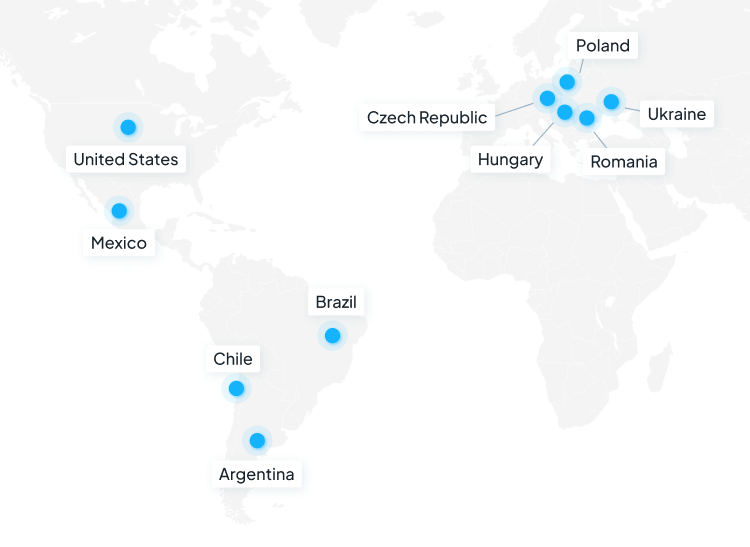

 United States


 Latin America


 Eastern Europe
 Ukraine




























How to Hire Python Developers: Skills, Interviews, Rates and Timelines
Start with the work, not the programming language. Backend development, data engineering, machine learning, and automation all use Python but require different experience. Once the role is clear, look for evidence that candidates have handled similar projects and can work with testing, dependencies, performance, and production code.
A short practical task can reveal more than a long list of technologies on a CV. The same applies to interviews: ask about real problems candidates have solved and the decisions they made.
Price the role by discipline and seniority, then compare the full cost of each hiring model, since a salary leaves out employer taxes, benefits, recruiting and the weeks a seat sits empty. Timing depends mostly on how narrow the skill set is and how quickly your team interviews: Mobilunity puts a list of vetted candidates in front of you within 5 business days, often sooner, while a complete hire takes longer once interviews, an offer and onboarding are counted.
What a Python Developer Actually Does on Your Project
A Python developer isn’t one profile. The language shows up in four kinds of work, and each one calls for a different person.
- Web and backend services in Django or FastAPI, the most common of the four.
- Data engineering with Pandas, Airflow and Spark, built around pipelines that have to survive growing data.
- ML and AI engineering with PyTorch or TensorFlow is in the highest demand for most tech startups.
- Automation and scripting: internal tools, scheduled jobs and file processing.
The 2025 Stack Overflow Developer Survey shows how big the pool is. It puts Python at 57.9% of all respondents and 54.8% of professional developers, up 7 percentage points from 2024, and reports a 5-point gain for FastAPI in the web framework results.
A pool that large is why applicants are plentiful and why they vary so much. For a fair look at where the language fits and where it doesn’t, read where Python fits and where it does not.
Pick one of the four before you write the ad. Every later decision, from the job post to the interview to the budget, follows from that choice.
Decide What You Are Hiring Before You Write the Job Ad
Your Python developer job description should name the project shape and discipline before listing a single framework.
A greenfield service needs someone who has made architecture decisions before and can explain them, usually a senior web engineer with production Django or FastAPI work. A data pipeline needs someone who has watched a job fail when the data grew and can say what they changed.
Adding ML to an existing product needs two people, in practice: an ML engineer who has shipped and monitored a model, and a backend developer who knows your codebase.
Let the work set the seniority, not a year count. A developer with 3 years on a production payments system can beat one with 8 years of internal scripts if your project needs the payments experience. Ask what they owned, what they changed and what happened after release.
Legacy maintenance and team extension follow the same logic. For the first, ask about a risky change the candidate made in someone else’s code. For the second, ask how they’ve worked inside an existing review process and release schedule.
In the ad itself, describe the product, the main responsibility and the experience needed to carry it. A posting that lists Django, Airflow, PyTorch and Kubernetes attracts people who have touched each one once.
Expect volume, and expect strong people in it. The language is popular enough that a good ad draws more applicants than you can interview, which makes your screening the bottleneck. If you’re comparing places to source candidates, our guide to sites to hire Python developers covers the options.
The screening bar is simpler than any framework checklist: would you trust this person to commit code on their own without damaging the codebase? Ask yourself that about every candidate, and browse the hire developers by technology guide if the role turns out to be a different stack.
The Six Skills to Test For, and How to Test Each
The Python developer skills worth testing are habits, not syntax. You can check each of the 6 below in about 10 minutes, and none needs you to write code. Listen for specifics: a named tool, a real project, a number. Pay attention to a decision the candidate would now reverse.
Keep a score sheet: 0 for no example, 1 for a general answer, 2 for a specific project with a decision and a result. Use the same sheet for every candidate, so you compare answers instead of impressions. On a senior role, 3 or more zeros is a clear signal to stop.
Which Python They Actually Are
Good looks like a recent, specific answer: “two years of FastAPI services and one Django migration.” Ask for the last project from requirement to production. Then ask “what did you write yourself?” every time you hear “we.” A candidate who claims all 4 disciplines equally usually owns none of them. Write down the discipline they name and hold every later answer against it.
Packaging and Environments
Good looks like a project that rebuilds on a clean machine using venv, Poetry or uv, a lockfile and, often, a Docker image.
In the Stack Overflow survey, Docker reached 71.1% of respondents, pip 40.9%, uv 9.5% and Poetry 9%, so the tool matters less than the outcome. The venv documentation covers the built-in option. Ask which they’d choose today for a new project and why, because the reasoning matters more than the name.
The check: “If I clone this repo onto a fresh laptop, what do I type?” A strong answer is a short sequence that ends in a passing test run. A weak one is a list of packages the candidate remembers installing by hand.
Performance and the GIL
In standard builds, the Global Interpreter Lock lets one thread execute bytecode at a time. Threads therefore help with waiting on the network or disk, but not with CPU-heavy work, where multiprocessing, async code or a C extension is the usual answer. Recent releases also offer an optional free-threaded build, described in the official free-threading guide, though most production code still runs on the standard one.
Good starts from a measurement, so listen for “I profiled it” before “I added workers.” The check: “When did you reach for multiprocessing, async or a C extension, and what did it buy you?” A good answer has a before and after number. For a web role, ask about a slow endpoint, and for a data role, a slow job. The story has the same shape either way.
Typing Discipline
Good means type hints and a checker such as mypy on public interfaces and important data structures, plus a clear line where the candidate stops.
Ask: “An API is documented as returning a list of orders and sometimes returns nothing. What breaks, and where do you catch it?”
A candidate who says they skip hints on new code should be able to name what replaces them, such as strict tests or schema checks. Strong candidates separate checking types before the code runs from validating real data while it runs. Pydantic is one common way to do the second.
Testing
Good looks like pytest with fixtures, tests for failure cases as well as the happy path, and a suite the team still runs. The pytest fixtures documentation explains the reuse pattern.
Ask what they would do about a suite that takes 20 minutes. A good answer starts by finding the slowest tests (pytest can list them with –durations), then trims setup and runs tests in parallel. Also ask about the last bug a test caught before release, since teams that test seriously have one ready.
Data-Specific Skills
For data roles only. If the role is web or scripting, skip this block and use the ten minutes for a second packaging or testing question. Good means the candidate understands memory behavior in Pandas and has made a job survive a bigger dataset.
Ask about a job that worked on a small file and fell over on a large one. Listen for chunked reads, tighter data types, earlier filtering, or moving work into a database, and for how they found the problem in the first place. Some candidates will mention Polars as an alternative.
Eight Interview Questions, and What a Good Answer Sounds Like
These Python developer interview questions work for a non-technical interviewer because they ask for stories, not definitions. For each one, listen for a real project, a specific tool and a trade-off. A memorized answer sounds like a textbook: correct, general and missing any detail about what went wrong.
1. Over the last two years, which kind of Python work did you do most: web services, data pipelines, ML or automation? What did you personally ship?
What to expect: One clear discipline, a recent project and a specific piece of work the candidate owned, such as an API, a nightly pipeline or a deployed model.
What a memorized answer sounds like: A list of all 4 disciplines with “we” in every sentence and no single thing the candidate built.
2. You’re starting a new service from an empty repository. Walk me through how you set it up.
What to expect: They cover the environment, dependency management, configuration, a test run and how a teammate would reproduce the setup on a clean machine.
What a memorized answer sounds like: “I install the packages I need and start coding,” with nothing about lockfiles, containers or onboarding the next developer.
3. An endpoint is slow under load. When did the GIL actually matter to you on a project like that?
What to expect: A real slowdown, a measurement, a clear split between waiting on the network and heavy computing, and a reasoned fix such as async code, processes or a C extension.
What a memorized answer sounds like: A textbook definition of the GIL, with no project where it changed a decision.
4. A teammate asks where to add type hints in a growing codebase. Where do you stop, and why?
What to expect: A reason tied to the code, such as hints at module boundaries and in shared data structures, plus an awareness that hints don’t validate real data at runtime.
What a memorized answer sounds like: An absolute rule, such as “everything or nothing,” with no exceptions and no reasoning.
5. A Pandas job that ran fine on a sample file crashes on the full dataset. What do you do? (Data roles)
What to expect: They start by finding the cause, then describe chunked reads, tighter data types, earlier filtering or moving work into a database.
What a memorized answer sounds like: “I’d optimize the code,” or the name of a single function, with no way of finding the bottleneck.
6. Tell me about a commit you would now describe as net negative.
What to expect: A real example, an honest account of what it broke and a specific habit that changed afterward. This is the section 3 bar, asked directly.
What a memorized answer sounds like: A claim that every decision worked out, or a story where a teammate or the client was to blame.
7. A dependency has a CVE and no patched version exists. What do you do?
What to expect: They check whether the vulnerable code path is reachable, consider mitigation or a replacement, document the risk and tell the right people.
What a memorized answer sounds like: “Upgrade it,” without noticing that no fixed version exists, or “ignore it” without assessing exposure.
8. When is Python the wrong choice for a project?
What to expect: Concrete cases, such as tight latency budgets, mobile apps or teams with no one who can maintain it, and the alternative they’d pick.
What a memorized answer sounds like: An answer that treats the language as the fix for everything.
You don’t need Python expertise to judge these answers. Follow every one with two probes: “What would you do differently?” and “What did that cost you?” A real answer produces a number, a name or an argument with a teammate, and a rehearsed one goes vague.
Ask the routing question first, because its answer tells you which of the other seven apply. Skip the Pandas question for web roles and the CVE question only if the role never touches production. Eight questions fit in a 45-minute call, with time left for the candidate’s own questions.
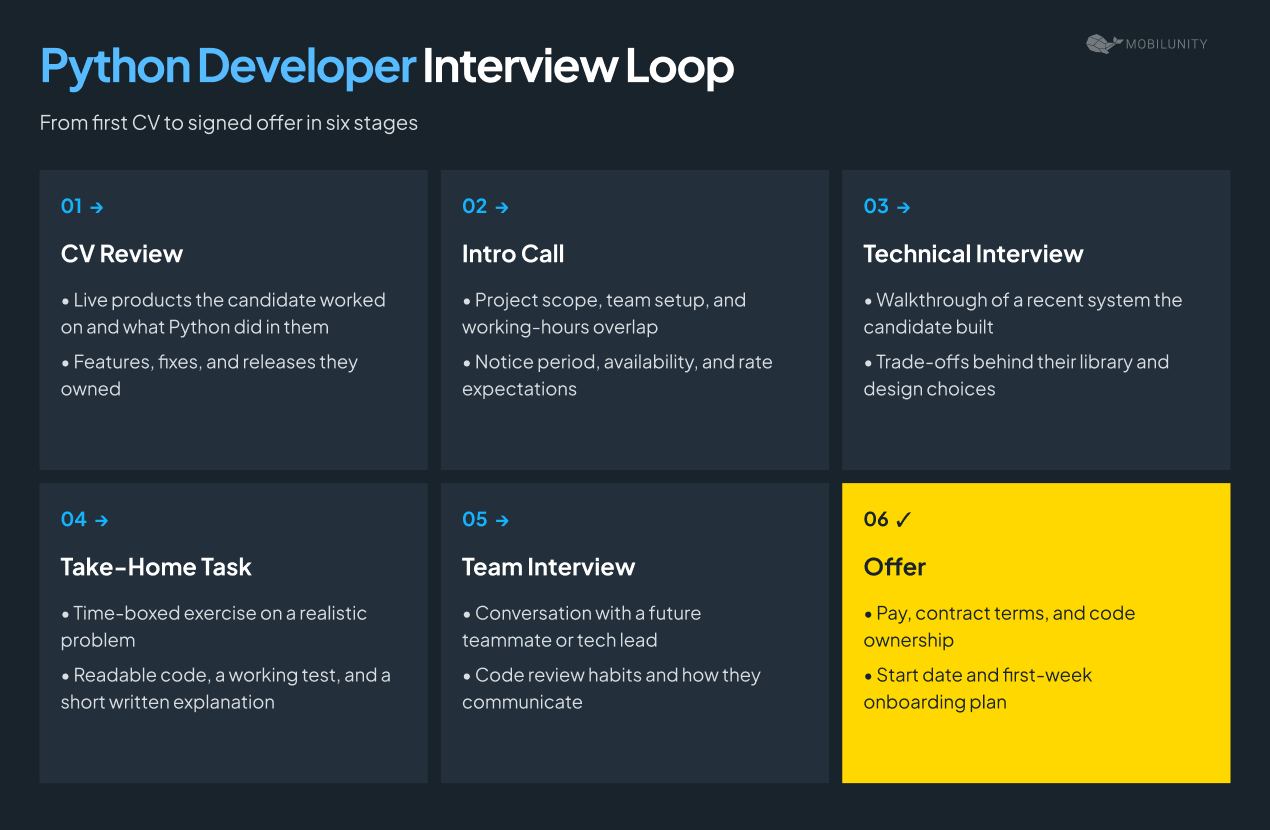
A 90-Minute Screening Task You Can Send Today
This task tests everyday engineering, and you can send it without reading code.
“Attached is a script that loads a large CSV (we suggest 1–2 GB) entirely into memory. It has no tests. In 90 minutes or less, change it so it processes the file without holding it all in memory, add one test, and write two sentences explaining the memory difference.
Include a short README with what you’d improve given more time and which AI tools you used. You keep the copyright to your work. We’ll read and run it only to evaluate your application, and we won’t publish or reuse it.”
Run the exercise yourself, or ask an engineer to, before you send it. If a reviewer can’t finish it in 90 minutes, shorten it. Send it after the first call, not before, so you don’t spend candidate time on a poor fit.
Mark each submission on four points:
- It streams or chunks the file rather than loading everything.
- Dependencies are declared so someone else can reproduce them.
- The test covers an empty file and a malformed row.
- The two-sentence explanation makes sense to a non-engineer.
Run the code first, then ask the candidate to talk you through their choices for 10 minutes. Put the license and the candidate’s ownership in the email itself, so nobody has to ask.
What It Costs: Rates by Region and the Real In-house Comparison
A Python developer salary figure means little until you say which of the four hires it describes, where the person lives and whether you pay a salary or a contract rate. For example, the typical Python developer hourly rate varies widely based on regional tech hubs, ranging from $25 to $50 in offshore markets to 85–135+ for mid-level engineers in North America.
Python Developer Monthly Gross Salary Benchmarks
Gross salary expectations for Python software engineers vary significantly based on geographic region, depth of specialization, and experience. While regional ranges give a clear market picture, baseline compensation can also fluctuate within specific tech hubs inside a single region.
The table below outlines estimated gross monthly salary ranges for Middle, Senior, and Lead Python Developers across major hiring regions.
Python Developer Monthly Salary Ranges by Region and Seniority*
| Region | Junior | Middle | Senior | Lead / Architect |
| Eastern Europe | $1,000 – $2,000 | $2,200 – $4,200 | $4,200 – $6,000 | $6,000 – $7,200 |
| Western Europe | $2,500 – $3,800 | $4,000 – $6,000 | $5,800 – $8,500 | $8,500 – $11,500 |
| Latin America | $1,000 – $2,000 | $2,400 – $4,000 | $4,000 – $6,200 | $6,000 – $8,500 |
| North America | $2,900 – $4,700 | $7,800 – $10,500 | $10,500 – $14,500 | $14,000 – $18,500+ |
Sources: Glassdoor | Levels.fyi | Stack Overflow | Indeed | Payscale
*Data updated as of September 2026
Understanding the Total Cost of Engagement Models
While raw salary benchmarks give you a baseline for compensation, your actual monthly invoice is based on the way to choose how to hire Python developers.
Direct in-house hiring: Base salary represents only a portion of your financial commitment. In-house employment adds mandatory payroll taxes, statutory social contributions, health insurance, paid leave, equipment provision, and ongoing HR overhead.
Dedicated team model: When hiring through a dedicated development partner, your fixed monthly rate covers developer compensation alongside end-to-end administrative management, recruitment costs, legal infrastructure, and operational support.
To illustrate how this works in practice, the table below provides actual monthly engagement pricing for Python talent:
Monthly Python Developer Cost with Mobilunity*
| Seniority Level | Monthly Hiring Cost (USD) |
| Junior | $2,550 – 3,900 |
| Middle | $3,850 – 5,900 |
| Senoir | $5,850 – 7,400 |
*As per Mobilunity in-house tech recruiting team research done in September 2026
The Real Cost of an In-House Python Developer
A developer’s base salary rarely matches what hits your bottom line. When building an in-house team, employers incur mandatory country-specific taxes, pension contributions, medical insurance, and employee benefits. Because statutory contributions and benefits practices vary wildly across jurisdictions, an identical base salary can result in vastly different total employment expenditures depending on where the developer is legally employed.
The table below breaks down the total estimated annual expense of maintaining an in-house Python developer across key international markets, comparing base compensation against mandatory employer additions.
Estimated Annual In-House Python Developer Cost*
| Market | Average Annual Gross Salary | Employer Taxes & Mandatory Contributions | Estimated Benefits & Perks | Estimated Total Annual In-House Cost |
| United States | $108,000 | $8,260 | $17,500 | $133,760 |
| Switzerland | $135,000 | $8,700 | $10,200 | $153,900 |
| Denmark | $75,500 | $1,250 | $6,600 | $83,350 |
| United Kingdom | $66,000 | $8,900 | $4,000 | $78,900 |
| Germany | $58,500 | $12,350 | $2,400 | $73,250 |
| France | $53,000 | $19,350 | $1,350 | $73,700 |
| Canada | $57,000 | $4,400 | $4,000 | $65,400 |
| Spain | $44,000 | $13,400 | $850 | $58,250 |
Sources: IRS | US Bureau of Labor Statistics | OECD Tax Database | Urssaf (France) | Seg-Social (Spain) | Federal Tax Administration (Switzerland) | StatCan
Data updated as of September 2026
In countries like France and Spain, statutory social security and payroll taxes can add 30% to 37% directly on top of the base salary. Conversely, markets like the US feature lower mandatory taxes but significantly higher private healthcare and fringe benefit expectations.
Offshoring or nearshoring through dedicated models allows companies to convert variable local tax burdens, equipment overhead, and recruitment costs into a predictable, fixed monthly line item. Choosing Python staff augmentation gives you full control over day-to-day development while taking the administrative hassle off your plate.
When deciding between direct hiring and vendor partnership models, base salary represents only the entry point. Evaluating time-to-hire, administrative bandwidth, local employment liabilities, and long-term retention support reveals the true cost efficiency of your engineering setup.
Dedicated Team vs Freelancer vs In-house Hire
You can hire Python developer in 3 ways, and each is the right answer for someone. The mistake is choosing the model before you know which of the four disciplines you need.
In-house works when the language is core to your product and you want someone to build context for years. The applicant pool is large, given the 57.9% survey share above, and it includes plenty of strong candidates. You own the search, payroll and replacement, plus every cost line in the previous section.
A freelancer is the right call for bounded work: a one-off data cleanup, an automation script, a prototype, an analysis with an end date. It’s the wrong call for anything you operate in production, because nobody owns it after the contract ends.
Write code ownership, documentation and handover into the agreement before work starts. For very short work, the arithmetic often favors a freelancer, because you pay only for the weeks you use.
A DDT (dedicated development team) fits ongoing work with a roadmap and your own product owner. If you want to hire dedicated Python developers through an agency, the honest pitch is discipline matching: someone screens for the right one of the four before you see a CV.
Mobilunity’s retention rate for placed developers was 94% over the past 12 months across client projects, and its consultant trial period success rate is 97%. Both vary by client and project.
A dedicated team is a poor fit for very short work. For a three-week script, the setup costs more than a freelancer’s fee, and no provider replaces technical leadership on your side. For a wider stack, the same trade-offs apply to IT staff augmentation.
| Factor | Dedicated team | Freelancer | In-house hire |
| Cost | Monthly provider fee | Hourly or project fee | Salary plus employer load |
| Ramp time | Days to first CV, then your interviews | Often days for defined work | Recruiting plus notice period |
| Retention | 94% for placed developers | Ends with the contract | Depends on your retention effort |
| IP | Set in the service agreement | Must be assigned in the contract | Covered by the employment agreement |
| Management overhead | You direct the work, the provider handles employment | You manage scope and handover | You manage everything |
Project length and how much engineering leadership you already have should decide it. If either is short, lean toward the freelancer. Before you commit to any model, ask the same three questions: who owns the code on day one, who is accountable when the person leaves, and what month six costs compared with month one.
Red Flags in a Python CV and in the First Call
Treat each flag below as a place to ask for detail. None is a reason to reject someone on its own, and the same flags apply whether you hire locally or through offshore Python development.
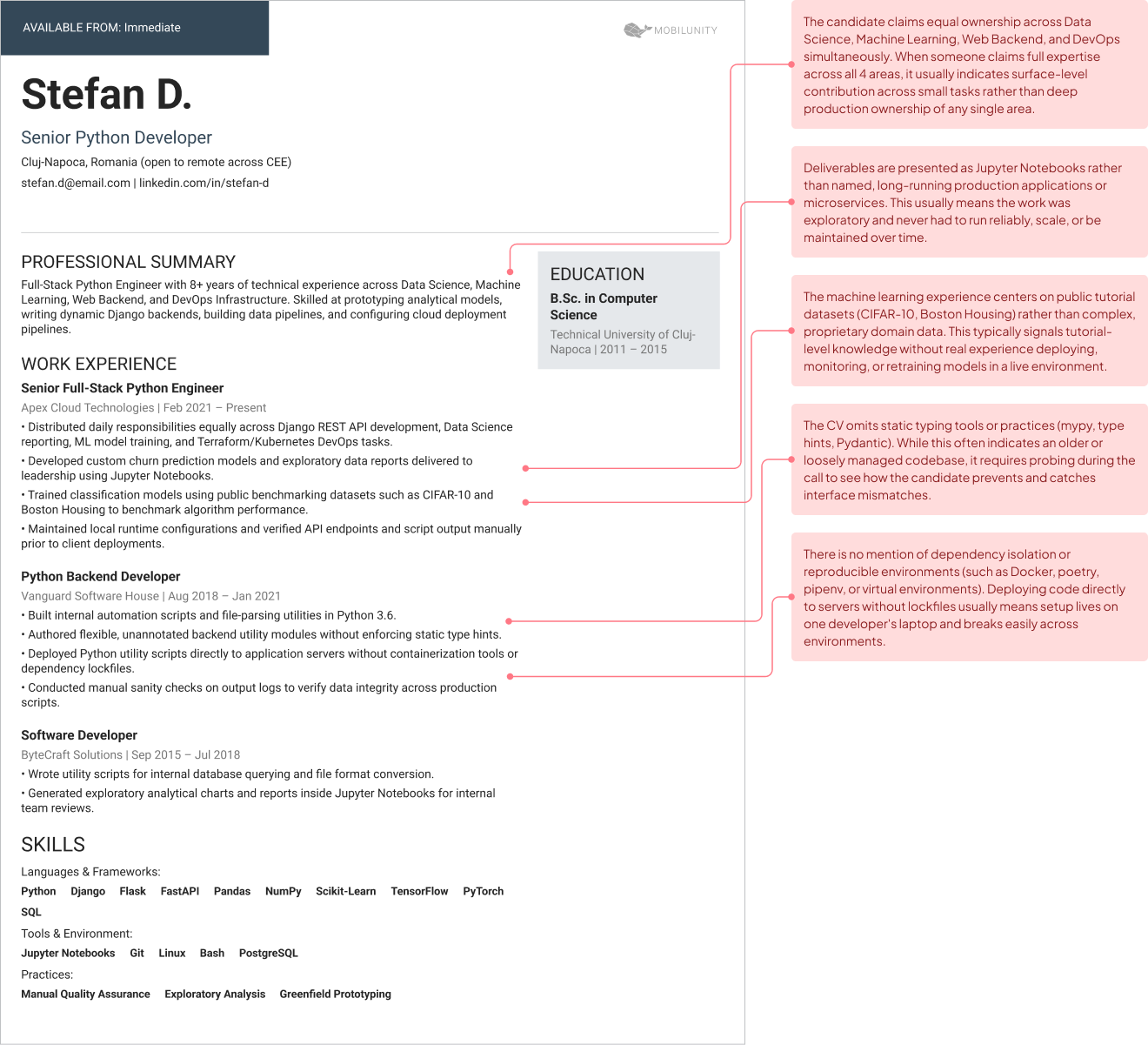
- A CV that claims all four disciplines equally, which usually means none was owned in production.
- Notebooks only, with no production system named, which usually means the work never had to keep running.
- No packaging story: no lockfile, container or environment, which usually means setup lives on one laptop.
- Type hints absent from recent work, which often just means an older codebase, so ask how the team catches interface mistakes.
- No tests and no explanation, which usually means changes are checked by hand.
- ML experience that is all tutorials on public datasets, which usually means no deployed or monitored model.
The first call has its own tells. Watch for a candidate who can’t name the project they’re proudest of and say why, who quotes the previous team’s results as their own, or who answers every question with a tool name instead of a decision. Any of these usually means the technical round will stay shallow too.
The goal is a CV whose claims match what the candidate can explain out loud. For more on what strong ones look like, see our notes on Python developer CVs.
How Long It Takes, Brief to First Commit
Time to first CV is the part you can plan around. Mobilunity’s median from brief to first CV is up to 5 business days, and in most cases it’s faster. Days one to five cover the brief, sourcing and the first shortlist. A brief that names the discipline, seniority, must-have tools and working hours shortens the search, and one that asks for a good developer doesn’t.
After that, the clock is mostly yours: how fast you interview, decide and agree a start date. Plan for interviews the following week and an offer soon after. Block two interview slots per week in advance, because a candidate left waiting eight days for a second round can accept another offer. These later steps are typical, not measured, and a candidate’s notice period can add more.
Discipline splits the expectation. Web and scripting profiles staff quickly. Genuine ML engineering takes longer, because fewer candidates have shipped and monitored a model in production. Decide within a day of the final interview, while the shortlist is fresh. Two things move the date most: which of the four you need, and whether you require domain data experience, such as healthcare or fintech datasets.
In the first week after the start date, aim for repository access, a local setup built from scratch and one small change merged, so the first commit lands in days.