


















































How to Hire Scala Developers: Skills, Interviews, Rates and Timelines
Most teams that ask us for a specialist in this language don’t strictly need one. What they need is a strong JVM engineer with real instincts for functional programming, and our first closely matched CVs reach clients within 5 business days whichever profile they pick. That flexibility is often what turns a lengthy search into a hire made within weeks.
Test 3 things and you’ll get the hire right. How the candidate thinks about immutability and side effects, which effect system their current codebase uses, and, if the role touches data, what they’ve actually made faster in Spark. Everything else can be learned on your project, and much of it will be. That is the short version of how to hire Scala developers without a 6-month search.
Defining Your Scala Hiring Need
Scala is known as a general-purpose language, but the jobs on offer are far narrower than that reputation suggests. In practice, most companies hiring for it are building or maintaining a data platform, so that is the work your candidates will have done.
The work comes in 4 kinds:
- Apache Spark and data engineering, which most openings are for. Spark is the software companies use to process very large amounts of data, and Scala is the language it was built in.
- Akka, or the free version of it called Pekko, is used to build services that have to keep answering quickly when a lot of people use them at once.
- Kafka pipelines, which carry a constant stream of data between systems that were never designed to talk to each other.
- Looking after platforms built between roughly 2015 and 2020, when a lot of companies chose Scala. This is quieter work, and there is a great deal of it.
Decide which of the 4 you need before you write the job description, because they call for different people. A data role wants somebody who has taken a report that took 6 hours to produce and got it down to one. A maintenance role wants patience with code written by people who left years ago. You will find both of those people among Java developers far more often than their job title suggests.
That points to the most useful decision you can make here. Interview experienced JVM engineers on how well they understand functional programming, and where they clearly do, hire them and let them pick up the language on the job. Scala was designed so someone who knows Java can write it almost like Java from day 1 and learn the rest gradually, and the courses and books for that are free and good.
We’ve had good results doing exactly that, usually for clients who came to us after months of searching. Somebody strong in a closely related language, plus a few months set aside for them to learn, gets you further than holding out for a perfect match. The same holds across offshore JVM development more generally.
There is one real exception. For the most senior roles, somebody’s deep knowledge of a particular library does change how the whole system gets built, and those roles are worth paying the premium for. Ask yourself whether this is one of them. If it isn’t, you have just made your candidate pool about 10 times bigger.
The Five Skills to Test For, and How to Test Each
These are the areas worth your interview time, in the order they usually decide whether a hire works out. Each one comes with what a good answer looks like and a check you can run in about 10 minutes without reading any code.
Functional programming judgment, not syntax
This is what transfers from Java or anywhere else on the JVM, and it’s the one thing nobody picks up in a fortnight. You want somebody who avoids changing data in place by default, and who can also say where they broke that rule because a deadline was closer than the ideal.
A 10-minute check: Ask where they decided the textbook approach wasn’t worth it, and what they did instead. A real answer names the trade-off and the project it happened on. A prepared one gives you definitions from a tutorial and no project at all.
Spark, if the role touches data
This is where most of the demand comes from, so most candidates will claim it. The signal is whether they understand how work gets divided across machines: how the data is split, why moving it between machines is slow, and what happens when 1 machine gets far more of it than the others.
A 10-minute check: Ask about a job they made faster, by how much, and what was slowing it down. You want 2 things in the reply: a number and a cause. If you get neither, keep asking until you do, because a general claim about efficiency tells you nothing.
The effect system in your codebase
ZIO, Cats Effect and plain Futures are 3 different ways of organizing work that happens later, and code written for one doesn’t read like code written for another. Of all the ways a Scala hire goes wrong, picking somebody fluent in a different one from yours is the costliest, because they spend their first months relearning rather than building.
A 10-minute check: Find out from your team which one your project uses, then ask the candidate which they’ve shipped with and what they’d have to relearn. Honest beats confident here.
Build tooling, specifically sbt
sbt is the tool that turns the code into something you can actually run, and it is famously awkward. Teams lose days to it. Somebody who has repaired a build when it stopped working is worth more to you than somebody who has only ever pressed the button.
A 10-minute check: Ask what they’ve repaired in sbt: a dependency conflict, a slow compile, a release step that kept failing. People who’ve done it can share specifics quickly.
Which major version they last shipped on
Version 2 and version 3 look alike and differ enough that moving between them is real project work. Plenty of production systems are still on 2.13 and will be for years.
A 10-minute check: Ask which one their last project ran on and what a migration would cost you. The estimate matters less than whether they’ve thought about it.
Don’t score all 5 equally. For a data role, the first 2 matter most. For a platform role, the middle 3 do. And if you still have almost no candidates after 2 weeks, the problem is where you’re looking rather than how you’re interviewing, so the next step is our list of sites to hire Scala developers.
If nobody internal can assess this, borrow an engineer from elsewhere in the business for the technical round, or bring in an external reviewer for an hour. Our index of hire developers by technology pages exists partly because that hour is the cheapest insurance in the process.
Six Interview Questions, and What a Good Answer Sounds Like
You can ask all 6 of these yourself, with no engineer in the room. Each one asks the candidate about something they have personally done, so nobody can prepare for them by reading up the night before.
1. Are you a Scala developer, or a JVM engineer who writes Scala?
What to expect: There’s no wrong answer, and that’s the point. The reply tells you whether you’re hiring someone who chose the language and follows its ecosystem, or someone who would move to a Java service next year without minding. Both are useful, and one is usually cheaper.
Weak-answer signal: They can’t say which one they are, or they answer with whatever they think the job ad wants to hear instead of describing what they’ve actually worked on.
2. Which effect system does your current codebase use, and what would you change about it?
What to expect: A specific name with an opinion attached. Engineers who have worked with one of these libraries always have a complaint about it.
Weak-answer signal: They can’t name the library their own project runs on, or they tell you the choices are all much the same, which usually means limited exposure to any of them.
3. Tell me about a Spark job you made faster. What was the bottleneck?
What to expect: A before and after number, a named cause, and what they changed. For a role with no data in it, swap this for the busiest service they’ve worked on and what broke first under load.
Weak-answer signal: A list of general techniques with no project, no measurement, and no result attached to any of them.
4. Was your last project on version 2 or version 3, and what would migrating cost?
What to expect: An answer that separates the easy part from the hard part, with a rough estimate of the work involved.
Weak-answer signal: They call the migration trivial, which nobody who has run one ever does, or they’re not sure which version their last project was on.
5. What have you fixed in sbt?
What to expect: A small, specific war story. It sorts people who have owned a build from people who have only used one, and it takes about 90 seconds.
Weak-answer signal: The build was always somebody else’s job. That’s fair for a junior hire and a warning sign for a senior one.
6. When is this the wrong language for a project?
What to expect: Fair answers include teams with no functional programming experience, simple web services where the compile times aren’t worth it, and anywhere local hiring is the binding constraint.
Weak-answer signal: They can’t think of a single case, which usually means they’re telling you what they think you want to hear rather than what they’ve seen.
These 3 patterns on a CV are worth a direct question rather than a rejection:
- A list of every library in the ecosystem with no indication of which ones were used in production, and when
- Years of experience that all predate 2020, which often means the last codebase was on version 2.12 and nothing has changed since
- Data work described without a single number: no volumes, no runtimes, no cost before and after
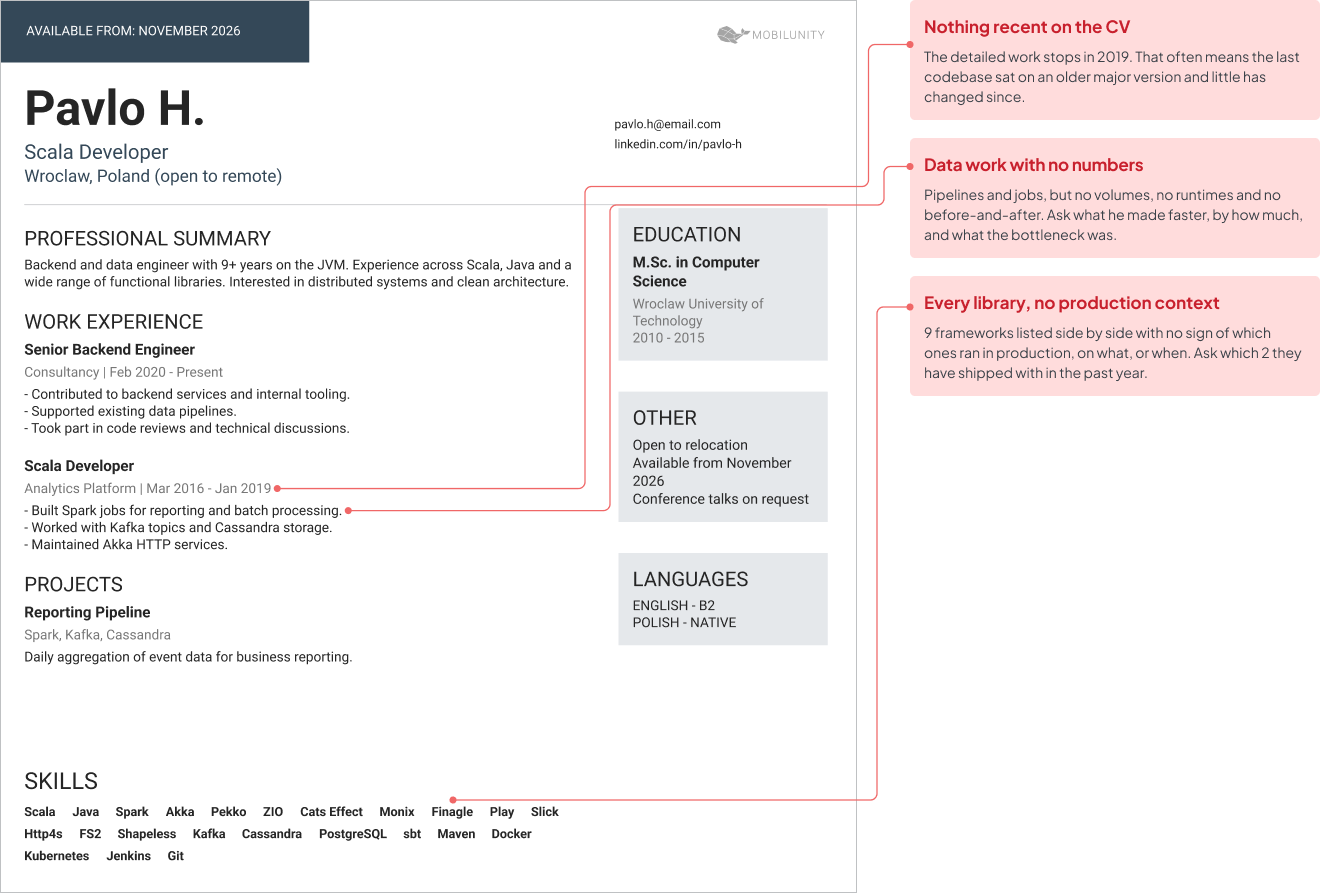
None of the 3 rules anybody out. Each tells you where to spend the first 10 minutes of the screening call.
What It Costs and How Long It Takes
The price gets pushed up from 2 directions at once. Few engineers have genuine experience with the more complex libraries, and those who do understand the value of that expertise when it comes to salary reviews.
At the same time, Scala roles are less common than Java roles. Engineers already in good Scala roles are therefore less likely to be actively looking to move. That leaves employers with a smaller pool of available candidates, which naturally slows hiring.
Start with gross salary, which is what the engineer receives before tax. A Scala developer salary in Ukraine looks like this across the 4 levels we place most often:
| Seniority | Monthly Gross Salary (USD) |
| Junior | $1,400 – $2,800 |
| Middle | $2,800 – $5,200 |
| Senior | $5,500 – $7,000 |
| Team Lead | $7,000 – $8,500 |
Source: Mobilunity in-house recruitment team data, September 2026.
Salary and cost are different numbers. Through a provider, recruitment, employment, payroll and administration are all covered by one monthly fee, so the full Scala developer cost per month looks like this:
| Seniority | Monthly Hiring Cost (USD) |
| Junior | $2,850 – $4,300 |
| Middle | $4,250 – $6,700 |
| Senior | $6,950 – $8,500 |
| Team Lead | $8,450 – $10,000 |
Source: Mobilunity in-house recruitment team data, September 2026.
Put an engineer on your own payroll instead, and a second line appears beside the salary: the employer load, meaning the contributions and benefits you’re required to pay on top. It varies enough between countries to change the answer.
| Market | Typical gross salary, software developers | Employer load on top of gross pay | Approximate yearly cost to the employer | Checked against |
| United States | $135,980 a year (median, May 2025) | About 46 cents per dollar of wages, since benefits are 31.5% of total compensation for full-time private-sector staff | About $198,600 | BLS Occupational Outlook Handbook; BLS Employer Costs for Employee Compensation, June 2026 |
| Sweden | SEK 55,900 a month (average, private sector, 2025) | 31.42% of gross pay in employer social contributions | About SEK 881,600 (about $89,000) | Statistics Sweden (SCB), 2025;, 2026 rates |
| United Kingdom | £56,914 a year (median, full-time, 2025) | 15% employer National Insurance above the £5,000 secondary threshold, before pension | About £64,700 (about $85,500) | ONS Annual Survey of Hours and Earnings, 2025;, 2026 to 2027 tax year |
| Poland | PLN 13,900 a month (median, October 2024) | About 20.5%: pension 9.76%, disability 6.5%, accident insurance from 1.67%, Labour Fund 2.45%, FGŚP 0.10% | About PLN 201,000 (about $52,100) | Statistics Poland (GUS), October 2024; ZUS, 2026 |
| Austria | €3,010 to €3,950 a month at entry level, paid 14 times a year (collective agreement minimum, 2025) | About 29.6% in Vienna: social insurance 20.98%, employee provision fund 1.53%, family fund 3.7%, chamber surcharge 0.36%, municipal tax 3% | About €54,600 to €71,700 at entry level (about $62,100 to $81,400) | AMS Berufslexikon, 2025;, 2026 rates |
| Finland | €5,020 a month (median, 2024) | About 19.3%: pension 17.10% on average, health insurance 1.91%, unemployment insurance 0.31%, plus accident insurance | About €71,900 (about $81,700) | Statistics Finland, 2024; Finnish Centre for Pensions, 2026 rates |
| Ukraine, through a provider | Inside the monthly fee above | Already inside the monthly fee above | $34,200 to $120,000, junior to team lead | Mobilunity client data |
Sources: BLS Occupational Outlook Handbook, BLS Employer Costs for Employee Compensation, Statistics Sweden, Skatteverket, ONS Annual Survey of Hours and Earnings, GOV.UK, Statistics Poland (GUS), ZUS, AMS Berufslexikon, WKO, AMS Berufslexikon, Finnish Centre for Pensions
Figures are accurate as of September 2026
Salary figures are the latest official statistics for software developers in each country, so the survey years differ. Austria publishes no developer-specific pay figure, so its row shows the collective agreement entry range. Dollar amounts use European Central Bank reference rates of September 24, 2026.
Timelines follow the same arithmetic. Our side of it is 5 business days to the first closely matched CVs, often sooner. What follows runs slower than the equivalent Java search, because every filter you add takes out a large share of an already small pool.
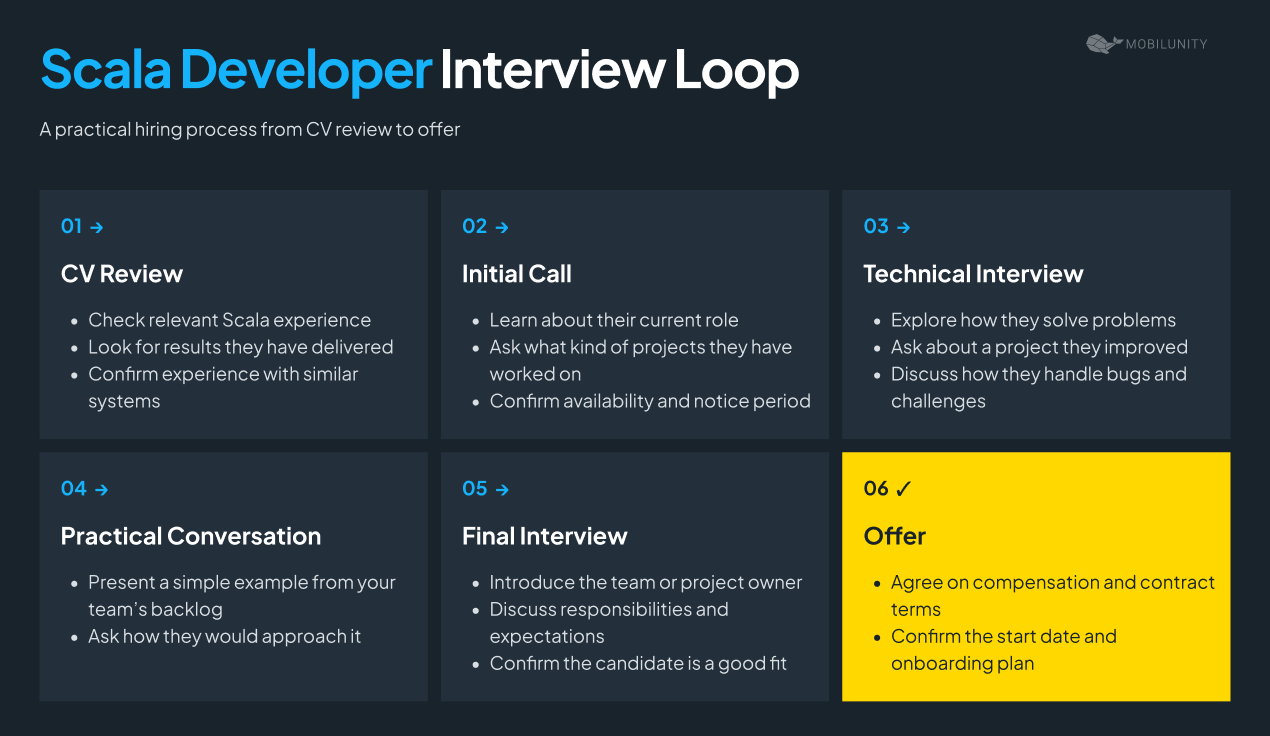
A typical process with Mobilunity looks like this:
- First week: we clarify requirements, source and screen candidates, and send the first shortlist.
- Following weeks: you interview the candidates you want to meet, while we gather feedback and refine the search where needed.
- If the first shortlist is not the right fit: broadening the role profile to include strong JVM engineers with functional-programming experience can open up the candidate pool and help the search move faster.
Dedicated Team vs Freelancer vs In-house Hire
How you hire Scala developers matters more in a thin market, because the 3 routes below fail in different ways, and only 1 suits any given project.
In-house hiring is the slowest route by a long shot. The local pool is small in almost every city, and the candidates who exist are usually employed and comfortable. What you get in return is somebody who learns your platform and stays with it.
A freelancer is the right answer more often than vendors admit. A bounded data job, a migration with a defined finish, a performance audit: all suit somebody who arrives, delivers, and leaves. Agree on ownership and documentation first. The arrangement fails on long-lived platforms, because the code stays with you for years while the only person who understands it leaves at the end of the contract.
A dedicated development team covers the middle ground, where the work continues and you want the engineers inside your own processes while somebody else handles employment and payroll. Here’s the honest limitation: the bench for this language is small everywhere. Ask any provider how many engineers with this stack are on the bench right now and when they’re free, and treat a vague answer as an answer.
| Dedicated Team | Freelancer | In-house Hire | |
| Cost structure | Monthly provider rate | Hourly or project fee | Salary plus employer load |
| Ramp time | Sourcing and onboarding handled for you | Fastest for bounded work | Slowest, because the local pool is thin |
| Retention | Built for ongoing engagement | Ends with the project | Yours to manage |
| IP | Defined in the service agreement | Must be written into the contract | Covered by the employment agreement |
| Management overhead | You run delivery, we run employment | You run scope and handover | You run employment and delivery |
There’s a fourth route the market underuses: staff a strong JVM engineer and budget a quarter of ramp. It’s often cheaper than the specialist premium and almost always faster than waiting, and it works under a dedicated model or through IT staff augmentation equally well.
Pick on project length and on who needs to own the knowledge afterward, not on the monthly figure. Hiring twice for one seat costs far more than any difference in rate.