IT Recruitment Lithuania: Market Overview and Hiring Guide

Serbia is rapidly emerging as one of the most dynamic and fast-growing technology hubs in Europe.
With a maturing IT ecosystem, highly skilled engineering talent, and an increasingly supportive business environment, the country has become an attractive destination for global tech companies seeking cost-efficient, high-quality development capacity or regional innovation centers.
Outsourcing to Serbia is attracting global IT companies for several reasons:
In this article, you’ll find everything you need to know before opting for devs recruitment Serbia. We’ll review the key factors shaping the country’s tech talent market, explore why global companies choose Serbia for hiring and team expansion, and highlight what businesses should know to hire developers in Serbia efficiently.
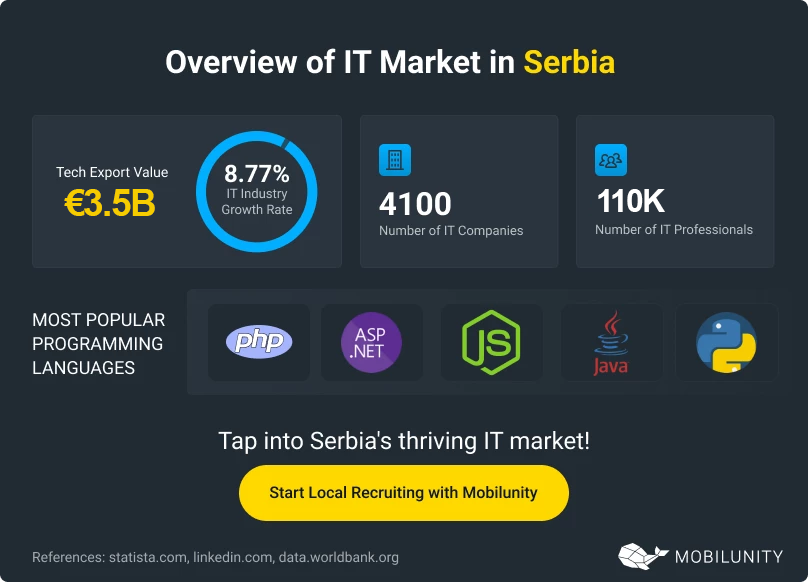
Serbia’s ICT exports have nearly tripled over the last 12 years and are projected to reach an astounding $8 billion by 2030. Therefore, these numbers serve as solid proof of its rapid digital growth and undeniable status as the emerging European tech powerhouse.
Serbia’s ICT Sector Growth Timeline And Projections | |||
| Year | ICT Export Revenue | Growth vs Previous Period | IT Workforce Size |
| 2012 | $0.43 billion | 40,000 | |
| 2024 | $4.3 billion | 20% | 111,000 |
| 2025 | $4.8 billion | 10% | 115,000+ |
| 2030 | $8 billion | 11.32% | 130,000 |
Fueled by strong tech talent and global nearshoring demand, Serbia is rapidly solidifying its position as one of the fastest-growing technology hubs in Central and Eastern Europe, currently featuring 115K+ IT specialists across various domains.
Among CEE peers, Serbia shows the highest projected CAGR, which is, on average, 140% higher than neighboring countries such as Poland, Romania, Hungary, and others. See more details on the country benchmarking in the table below.
| Country | Annual Growth Rate (CAGR 2025-2030) | Expected Revenue 2025 | Expected Revenue 2030 |
| Hungary | 5.28% | $2.06 billion | $2.67 billion |
| Poland | 5.16% | $11.28 billion | $14.50 billion |
| Romania | 4.88% | $1.36 billion | $1.73 billion |
| Bulgaria | 4.66% | $0.46 billion | $0.58 billion |
| Czech Republic | 3.86% | $6.14 billion | $7.42 billion |
| Serbia | 11.32% | $4.48 billion | $8.07 billion |
This, again, proves its highly dynamic growth in the IT sector. But what are the factors driving such rapid growth? Let’s explore.
Rather than a single factor, there is an entire ecosystem of favorable conditions that help the Serbian IT sector advance. These include:
Through initiatives like the Digital Serbia Initiative, the government offers incentives for R&D, reduced corporate taxes on IP-derived income, and other benefits.
Serbia, working toward EU accession, leverages funds that help the country modernize its public infrastructure, promote digitalization, and support local startup projects. For example, EBRD/EU SME support programs provide financing in the sum of up to 10% for investments in digital and green technologies.
In 2023 alone, over €135 million allocated to boost local IT hubs and upgrade the local IT infrastructure.
An 18% increase in investment funds in recent years is a strong signal of investor confidence. Over the last years, major venture and innovation investors such as South Central Ventures, TS Ventures, ICT Hub Venture, the Serbian Innovation Fund, and others continue to expand their portfolios, thus supporting early-stage and scaling tech companies.
In recent years, there’s been an impressive 68% growth in freshmen enrolled for ICT-related academic programs in Serbia. Key universities offer various IT-related specializations and consistently develop highly skilled engineering talent.
Since 2015, Serbia has built several science and IT hubs called Science Technology Parks in cities like Belgrade, Novi Sad, Niš, Čačak), offering workspace, research facilities, and supportive infrastructure for startups, R&D teams, and tech companies.
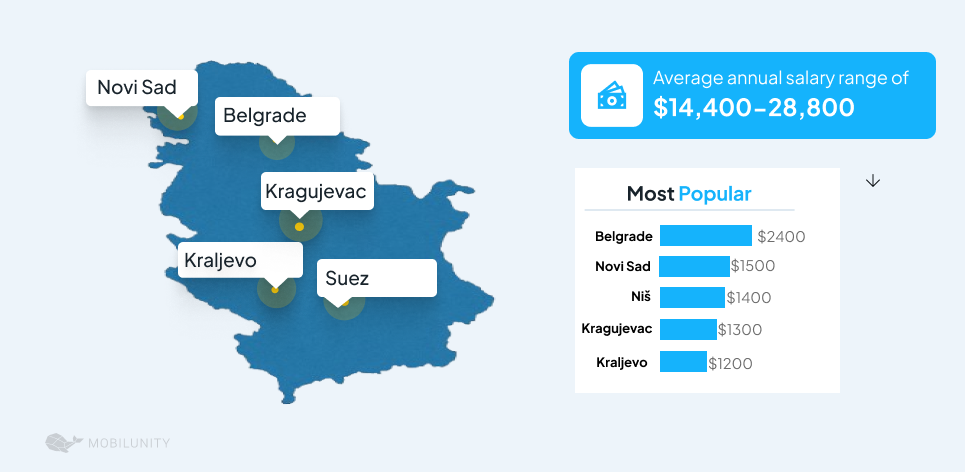
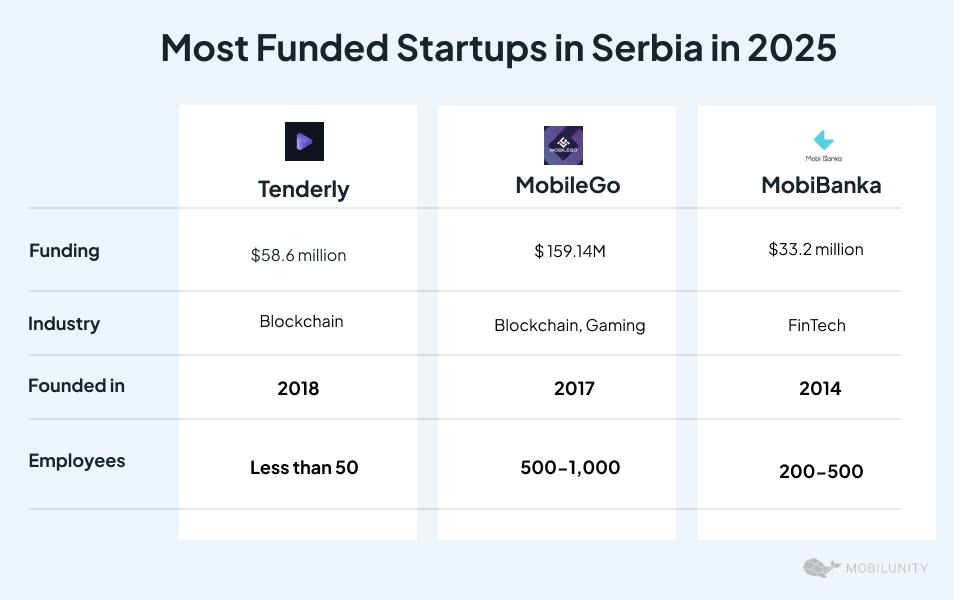
As shown below, the country’s startup ecosystem is highly diverse, with some of the most popular and actively growing startups in Serbia.
The rankings show that leading positions are held by companies from different industries, founded across different years, and ranging from small teams to large-scale organizations. First and foremost, it means favorable conditions for businesses from various domains and backgrounds.
Top Hiring Startups in Serbia by Employee Number | ||
| Officebite | Eipix | PUMBLE |
Industry: FoodTech Founded in:2025 Employees:Less than 50 | Industry: Gaming Founded in:2005 Employees:200-500 | Industry: SaaS Founded in:2020 Employees:50-200 |
Most Famous Startups in Serbia for 2025 | ||
| Numbeo | ManageWP | VideoBolt |
| Industry: Financial Services Founded in:2009 Employees:Less than 50 | Industry: ComTech Founded in:2010 Employees:Less than 50 | Industry: SaaS Founded in:2016 Employees:Less than 50 |
Source: Startupblink | ||
Besides, Serbia seems to stay ahead of the curve with the AI revolution, too. According to recent research, 41% of Serbian startups operate in the AI field, most of them offering outsourcing services.
Similar to the popularity of outsourced services, Serbia is increasingly attracting attention not only from investors but also from global investors and technology companies pursuing strategic acquisitions. Recent examples include:
The above mentioned actively growing Serbian companies and the IT sector overall prove the country’s strong tech talent and expertise. This is reinforced by a robust educational system welcoming and educating 45,000+ IT students and counting. Let’s dive more into their specialties, skills, and tech specializations.
Major Universities in Serbia with IT Specialties | ||
| Institution | Approx. Number of Students | Main Specializations |
University of Belgrade | 4,690+ 2,198 | ✔ Computer Science & Software Engineering ✔ Electrical Engineering ✔ Telecommunications & Networks ✔ Electronics |
University of Novi Sad | 17,163 | ✔ Software Engineering ✔ Computer Engineering ✔ Information Systems ✔ Mechatronics |
University of Niš | 23,235 | ✔ Electronics ✔ Computer Engineering ✔ Automation & Control ✔ Telecommunications ✔ Microelectronics |
University of Kragujevac | 1,656 | ✔ Mechanical & Industrial Engineering ✔ Mechatronics ✔ Production Engineering ✔ Computer Engineering ✔ Electrical & Power Engineering |
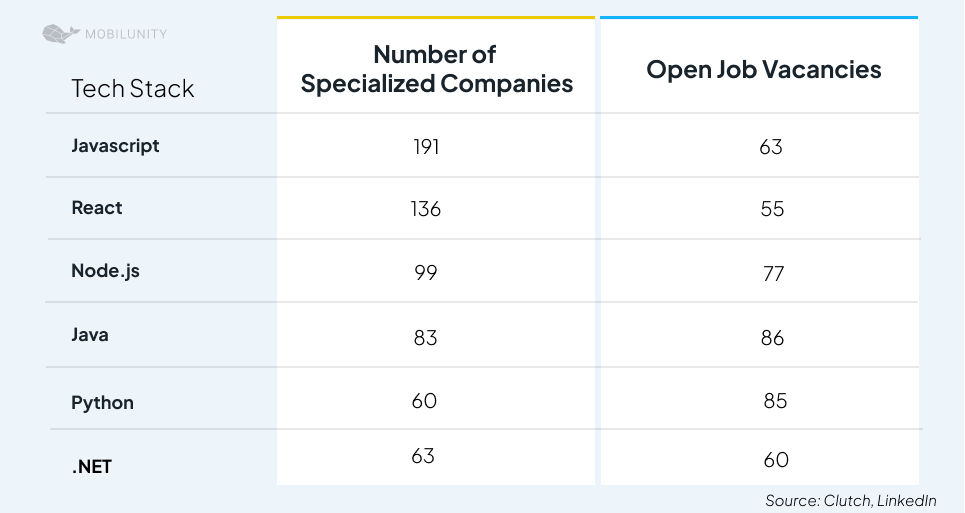
Overall, judging from the hiring statistics and IT company representation, there are several clear aspects that are hard to notice. First of all, the leading positions are taken by frontend technologies (JavaScript and React). This, in turn, reflects a strong specialization in building modern web applications and product interfaces.
Meanwhile, backend and full-stack technologies also have strong representation. So, if you want to hire Java developers in Serbia, you can be confident in securing skilled talent. This indicates the versatility of skills and the ability of Serbian developers to cover a wide range of business needs.
Serbian developers are known for being proactive contributors who take responsibility for outcomes, identify issues early, and propose improvements rather than just executing assigned tasks.
Strong educational foundations make IT experts proficient in mathematics, engineering, and algorithms. This enables them to think strategically, design optimal solutions, and efficiently resolve many technical bottlenecks efficiently.
Companies can scale teams significantly faster than in saturated markets like Germany, the UK, or the U.S., where recruitment cycles can take months, enabling faster product delivery and iteration.
Serbian engineers understand business goals, prioritize impact, and often actively participate in shaping user experience and overall product vision.
When evaluating global talent sourcing from the cost perspective, Serbia continues to stand out as a highly attractive destination. In doing so, it maintains a strong balance between affordable employment costs and high engineering quality across all seniority levels.
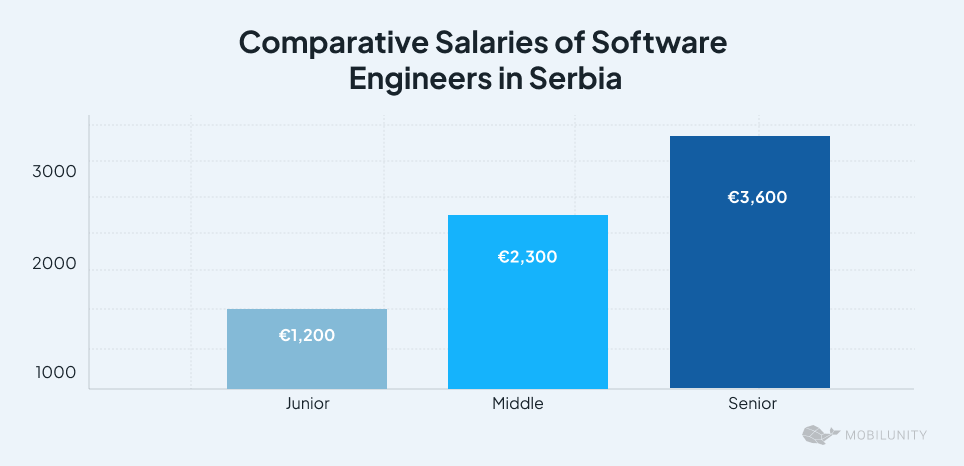
Besides, hiring developers in Serbia is still way more cost-effective than in Western Europe or the U.S., and the differences can be drastic. For example, in many cases, Serbian developer rates are 3 times lower than in Germany and 3-5 times lower than in the U.S.
In particular, the cost gap widens dramatically at mid-level, where expertise becomes mission-critical, and competition increases. See the table below for more details.
Salary Comparison of Hiring Developers in Serbia vs Western Markets | ||||
| Position | Salary per month | |||
| Serbia | Germany | USA | Ukraine | |
| PHP | ||||
| PHP Junior | $1,100 | $1,750 | $4,300 | $900 |
| PHP Middle | $2,100+ | $4,000+ | $7,500+ | $2,000+ |
| Java | ||||
| Java Junior | $2,000 | $3,000 | $4,800+ | $850 |
| Java Middle | $4,000+ | $4,500+ | $8,500+ | $2,500+ |
| .NET | ||||
| .NET Junior | $1,500 | $3,000 | $5,000 | $800 |
| .NET Middle | $2,000+ | $4,500+ | $8,500+ | $2,000+ |
| Python | ||||
| Python Junior | $1,400 | $1,500 | $5,100 | $800 |
| Python Middle | $2,000+ | $3,500+ | $9,000+ | $1,800+ |
| JavaScript | ||||
| JavaScript Junior | $1,000 | $2,500 | $4,900 | $800 |
| JavaScript Middle | $2,000+ | $3,500+ | $9,000+ | $1,500+ |
| Cloud | ||||
| Cloud Engineer Junior | $2,000 | $4,500+ | $7,000+ | $3,000 |
| Cloud Engineer Middle | $4,500+ | $6,900+ | $10,000+ | $4,000+ |
| Source: Glassdoor | ||||
*Salary data is based on Mobilunity’s Recruitment Team research of local job markets. All salaries are net (excluding service fees) and intended for comparison purposes. Actual costs may vary depending on factors like skill level, city, engagement model, and others.
Contact us to get an exact quote for hiring a developer that matches your specific requirements.
Today, businesses typically evaluate three primary engagement models (in-house hiring, nearshoring, and offshore software development Serbia), and Serbia is no different. So, how to land with the right one?
Each of these models offers unique advantages depending on goals, budget, and project complexity. Below is a concise comparison to help determine the best fit.
| Hiring Models Comparison | ||||
| How It Works | Pros | Cons | Best For | |
| In-House Team | Employees work directly for the company under local employment contracts, usually onsite or hybrid in the company office. | – Full control over culture, processes & priorities – Strong collaboration & knowledge retention – Better alignment with long-term vision | – Highest cost (salaries, office, taxes, benefits) – Longer time-to-hire – Limited access to wide global talent pool | – Companies building long-term core teams or IP-sensitive products – High-coordination environments |
| Remote / Distributed Team | Employees or contractors work remotely from Serbia or globally, hired directly or through EOR/PEO. | – Access to wider talent pool – Lower hiring cost vs. onsite teams – High flexibility & scalability – Attractive to candidates | – Requires strong remote-work culture & management – Harder onboarding & team cohesion – Time zone management | – Fast-growing product companies – Global tech firms hiring specialized talent – Teams prioritizing flexibility |
| Outsourcing / Nearshoring Partner | A third-party vendor provides developers or full delivery teams to build and support projects. | – Rapid scaling & fast onboarding – Reduced HR/admin complexity – Lower risk & cost predictability – Access to specialized expertise | – Less direct control over culture & delivery – Potential dependency on vendor – Quality varies by provide | – Early-stage companies needing speed – Companies lacking internal tech expertise – Short-term or project-based work |
While the benefits of hiring Serbian developers are numerous, potential bottlenecks exist as well. Let’s review them.
Top engineers, especially in DevOps, cloud, data, and backend, are heavily competed. This drives longer hiring cycles and higher salary expectations.
Skills such as AI/ML, embedded/automotive, cybersecurity, and advanced cloud architecture are limited, making sourcing difficult and often requiring international recruiting.
Universities deliver strong theoretical foundations, but practical and product experience is often lacking, requiring additional training or onboarding time.
Communication, English proficiency, and product thinking are increasingly important, making screening more complex beyond technical testing. A recruitment agency in Serbia can help you with that.
Foreign companies without local reputation or brand recognition may struggle to attract talent compared to well-known outsourcing firms or global R&D centers.
While the hiring process in Serbia is generally more accessible and faster compared to highly saturated Western markets, it still requires thoughtful preparation and a structured approach. Don’t forget to factor in a range of aspects, from taxes to mandatory benefits and beyond. This will not only help you stay compliant but also attract top talent more easily.
Hiring in Serbia must comply with the national Labor Law, which regulates employment conditions such as working hours, paid leave, termination procedures, and mandatory social contributions.
According to local rules, employers are responsible for correctly managing payroll, taxes, and social security obligations throughout the employment lifecycle. See the table below depicting what exactly it includes.
Hiring in Serbia: Top Things to Know | |
| Payment frequency | Once per month, most commonly at the end of the month. |
Mandatory employer contributions | Pension & disability insurance 10% of the gross salary Health insurance 5.15% of the gross salary Unemployment insurance 0.75% of the gross salary |
| Minimum wage | $3.05 per hour |
| Overtime rules | Regulated by labor law, must be compensated at a higher rate than standard hourly pay. |
Standard employee benefits | – Access to public healthcare – Annual paid vacation – Retirement benefits via the state pension system |
| Potential Additional Costs | – Meal vouchers – Private health insurance – Equipment & remote-office stipends – Training & certification budgets – Performance bonuses / 13th salary – Payroll & accounting fees – PEO/EOR provider fees (if applicable) |
Work Permits for Foreigners (If Hiring Expats)
To legally hire expats in Serbia, employers must obtain a single work & residence permit, follow compliance steps through the National Employment Service, and ensure proper documentation. Once approved, foreigners receive the same labor protections and obligations as local workers.
A few practical considerations for efficient process:
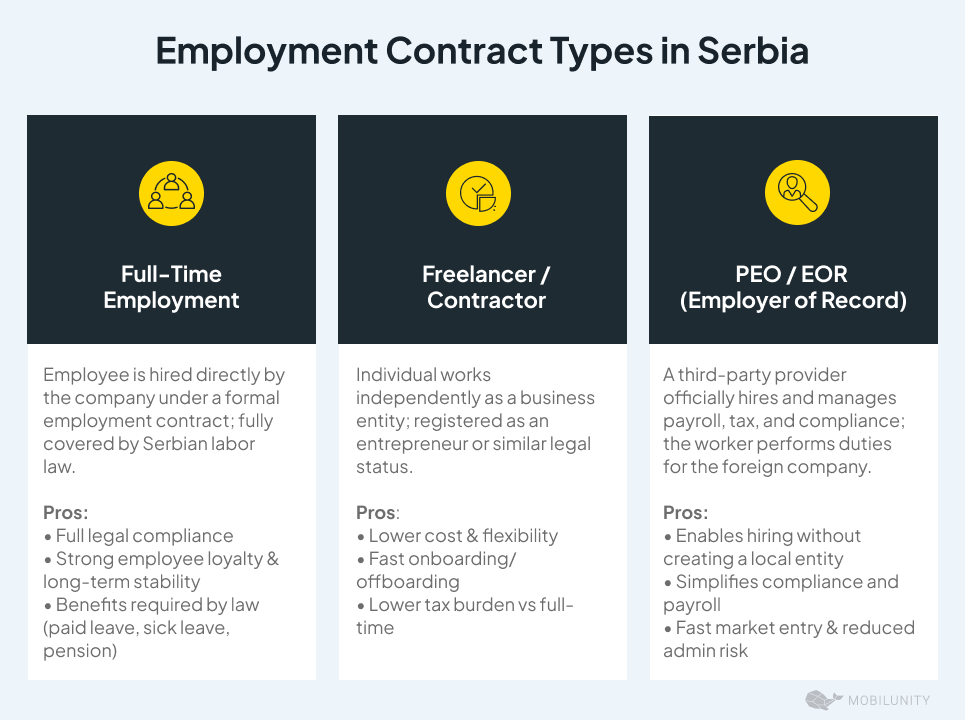
Over the years of working in IT recruitment in Serbia, we’ve accumulated a range of best practices. Check out our checklist on how to attract local top tech talent.
A strong compensation package is the foundation of successful hiring, and top developers expect transparency and competitiveness aligned with global remote-work standards.
To ensure that, follow these steps:
Above all, developers value purposeful and technically challenging work combined with clear growth pathways. In most cases, it matters much more than surface-level perks.
To meet such demands, do this:
Strong employers attract strong talent. To become the brand your candidates would dream of working with, follow several best practices:
Expanding sourcing options, especially through local channels, can significantly speed up hiring and improve access to skilled developers.
To do it efficiently, consider this:
The future of work and tech recruitment will be defined by several transformative forces. AI, global mobility, and the new standard of remote-first collaboration will all have an immense effect on how companies build and retain engineering talent.
In this landscape, Serbia is positioned to strengthen its role within the European tech ecosystem. With rising interest from international investors and companies moving toward nearshoring models, Serbia is expected to become an increasingly attractive destination for building scalable remote development teams and advancing product innovation throughout 2025 and beyond.

Disclaimer: All salaries and prices mentioned within the article are approximate numbers based on the research done by our in-house Marketing Research Team. Please use these numbers as a reference for comparison only. Feel free to use the contact form to inquire on the specific cost of the talent according to your vacancy requirements and chosen model of engagement.
Client Testimonial
Mobilunity provides an excellent and efficient tech talent service. All my staffing requests, even for niche technologies, were fulfilled in a 2 to 4-week time period, with top-notch candidates. Besides that, I like the caring environment that the Mobilunity team provides for the developers and ensures that everybody is able to work without distractions.
I strongly recommend Mobilunity as a tech talent partner!

Waldemar Biller
Head of Technology






Fulltime dedicated teams, FLEX on-demand model, consultancy, recruitment, EOR