How to Build a Platform Engineering Team Offshore

Key takeaways:
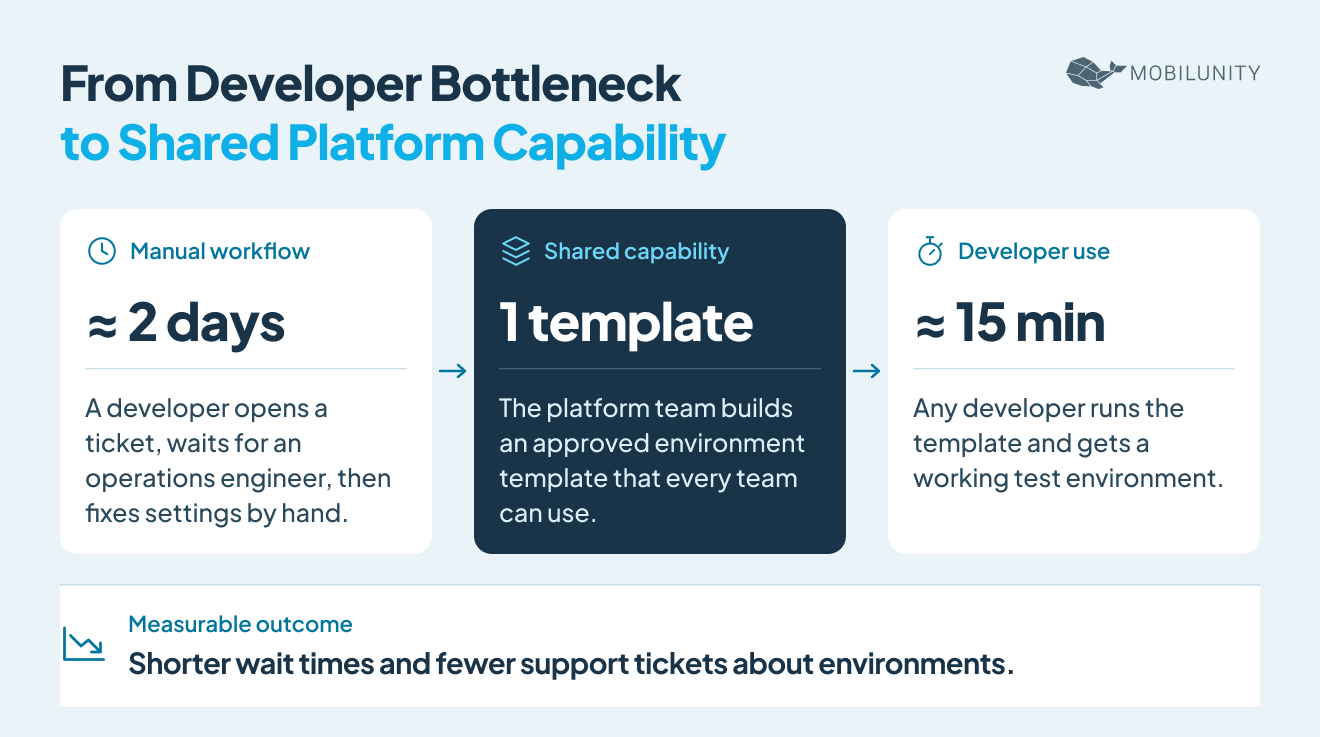
Software teams lose hours to work unrelated to the product. Platform engineering services help a company build and improve the shared tools its developers use to build, test and release software. Take a test environment as an example. Instead of asking an operations engineer and waiting 2 days, a developer picks a ready template and gets a working copy of the app in about 15 minutes.
Picture a company with 4 product teams. Each team sets up its own build pipeline, writes its own deployment scripts and messages the same 2 operations engineers whenever something breaks. The work gets done, but every team repeats it, and the operations engineers become a queue.
Platform engineers replace that repetition with shared ways of working. They build templates, automated pipelines and self-service tools once, so every team can use them. According to the CNCF Platforms White Paper, an internal platform should be designed around what its users need, and in this case the users are your own developers.
An external platform engineering consultancy brings people who have built these tools at other companies. Depending on the agreement, they review your current setup, build specific capabilities, run them for you or join your team as extra engineers.
Developers, QA engineers and data teams use the results every day. Managers see the effect indirectly, through shorter waits, fewer failed releases and less time spent on support requests between teams.
Most platform engineering solutions cover a handful of everyday tasks. The table below shows what each task involves and what your company gets from it.
| Task | What platform engineers do | Practical benefit |
| Setting up development environments | Templates that create a working copy of the product for coding or testing | Developers start work in minutes instead of waiting for someone to prepare a server |
| Automating repetitive tasks | Scripts and pipelines for builds, tests and routine fixes | Fewer manual steps and fewer mistakes caused by copy-paste work |
| Making software releases more consistent | One standard release process that every team follows | Releases happen on a predictable schedule, and failed releases are easier to roll back |
| Helping teams investigate problems | Shared logs, dashboards and alerts | Teams find the cause of an outage faster instead of searching several tools |
| Documenting shared tools | Short guides and examples for every template and pipeline | New hires get productive sooner, and fewer questions reach senior engineers |
Few companies need all 5 at once. Ask your engineering lead which of these tasks costs the most time today, and start there.
Good platform engineering consulting services also leave your team able to change the tools later. Ask for documentation and a handover session as part of any agreement.
Some signs are easy to spot even without a technical background:
If you recognize 2 or more of these, a platform engineering service provider may save time. Before you start a search, ask your engineering lead 4 questions. Which task wastes the most time, and how many people does it affect? What has been tried already, and who would own the new tools afterward?
The answers become your first brief. They also show whether you need advice, a defined project or extra engineers for the long term. If you later plan your own in-house team, the same answers are a good starting point for deciding how to build a platform engineering team around your developers.
Timing matters too. Platform work pays off best before a big launch, a new product line or a hiring wave. New developers then join a setup that already works instead of copying old workarounds.
Speed improves when developers stop repeating setup work and stop waiting for handoffs between teams. The gain comes from removing small delays that repeat dozens of times a month.
Before: a developer who needs a test environment opens a ticket, waits about 2 days for an operations engineer, then spends another hour fixing settings that don’t match production. After: the developer runs an approved template, gets a matching environment in about 15 minutes and starts testing the same day.
Multiply that by every developer who needs an environment each week, and the saved days add up quickly. The same pattern applies to releases, access requests and routine fixes that currently pass through 1 or 2 busy people.
To check whether the change helped, compare environment wait timeswaiting times for environments before and after the rollout, and count how many related support requests still come in. Then ask developers in a short survey whether the new process is easier, because it only saves time if they actually use it.
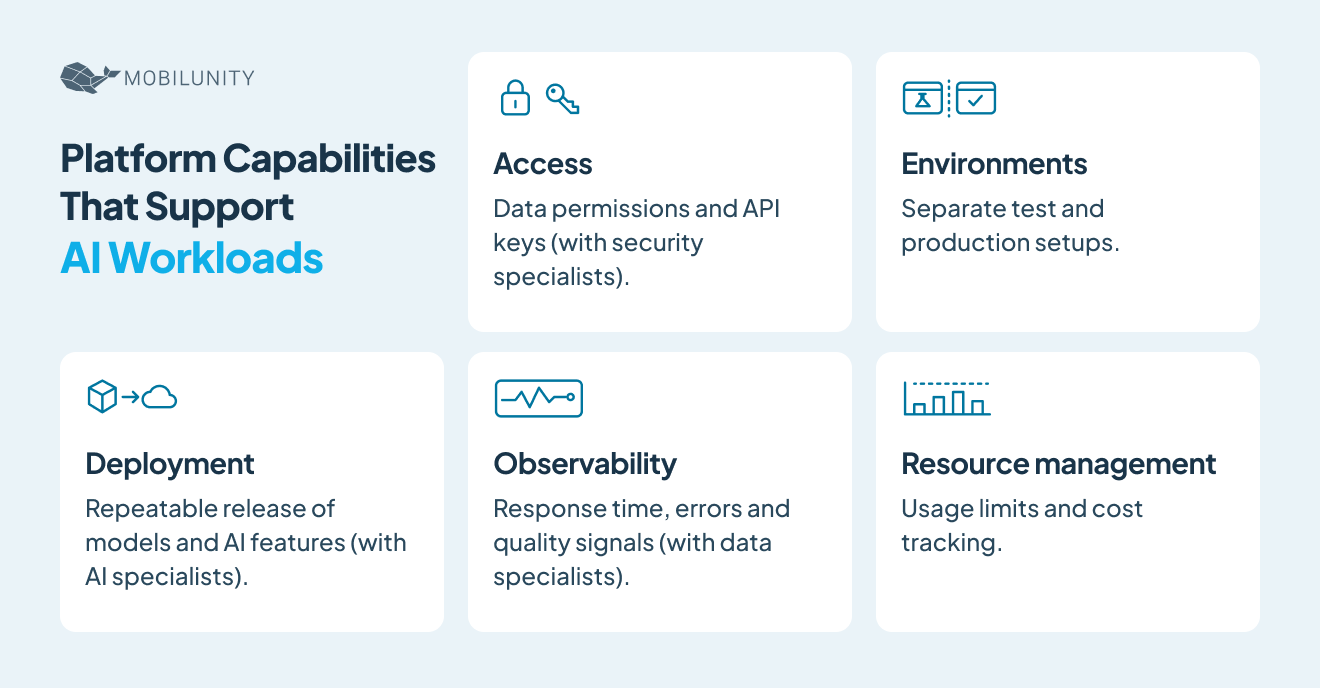
AI readiness means having the technical foundations to introduce and run the AI features your company plans. Say you want to add an AI assistant that answers customer questions inside your product. The model is only one part; it also needs a safe place to run, controlled access to data, monitoring and limits on usage and cost.
Platform engineers prepare those foundations. They set up separate testing and production environments and manage who and what can accessenvironments for testing and production and manage who and what can reach customer data. They also add monitoring for response times and errors, plus usage controls, so a spike in requests doesn’t create an unexpected bill.
They don’t build the AI model itself. AI and data specialists choose and tune the model, and security specialists define the rules. Platform engineers turn those rules into working platform engineering solutions that every team can reuse for the next AI feature.
Before hiring, clarify with your technical team which AI features are planned for the next 6 to 12 months and where the data lives. Agree on which approvals are needed and who will watch costs once the feature is live.
If AI plans are still early, a short assessment is enough. A platform engineer can review your current setup and list what must change before the first AI feature goes live.
External help comes in 4 main forms. They differ in what you receive and who manages the work.
| Option | What it provides | Who manages the work | When it fits |
| Advice from a consultant | An assessment of your current tools and a prioritized plan | You decide and act on the plan | You’re unsure where the biggest delays are |
| Defined project | A specific result, such as an environment template or a release pipeline | The provider, against agreed deliverables | The problem is clear and has an end point |
| Ongoing managed support | A provider runs and updates your shared tools under agreed service levels | The provider, reporting to you | You want the tools kept running without an internal team |
| Dedicated engineers | Engineers who join your team full-time or part-time | Your technical lead | You have a long roadmap and someone to lead the work |
Platform engineering consulting usually starts with advice, then becomes a project or ongoing supportas advice, then turns into a project or ongoing help once the plan is clear.
Large companies often prefer platform engineering as a service for enterprises, where a provider runs the tools long term under a contract. It suits organizations with many teams and strict uptime or compliance needs.
Location is a separate choice from the model. Offshore platform engineering simply means the engineers work from another country, often with partial overlap in working hours, and it can apply to any of the 4 options. If you already run a DevOps team, adding engineers through DevOps staff augmentation is another way to extend it.
A platform engineering consultancy that offers several models can move you from one to another as your needs change, which saves a second search later.
Judging the technical details isn’t your job here. Ask each provider the same questions and compare the answers side by side:
Ask for evidence rather than promises: a short case description, an example of their documentation and the profiles of the engineers who would join. A good platform engineering partner can name a measurable result from a past project, such as a shorter release cycle.
Pass the technical answers to a colleague for review, especially the proposed tools, security approach and effort estimates. Platform engineering consulting services that can’t explain their plan in plain words to you will struggle to explain it to your developers.
A short brief saves both sides several calls. Gather this with your engineering lead:
Start with a focused first assignment, such as one environment template or one release pipeline. A small first step shows how the provider works and helps you compare the platform engineering services and solutions on offer before you commit to more.
Mobilunity provides platform engineering recruitment for companies that want engineers working inside their own team. We recruit DevOps and platform engineers who match your stack, run candidate screening and interviews, and arrange a technical evaluation if you need one.
You select the engineers and manage their technical work. We coordinate onboarding and handle payroll, HR and administrative support, so your managers can focus on priorities and code review.
When you hire platform engineer through Mobilunity, the process is simple. You share the role, stack and preferred working hours, review the profiles we send, interview the candidates you like and decide who joins. Our team then stays in touch with you and the engineers to keep the collaboration running smoothly.
Our recruiters draw on a network of 5,000+ pre-vetted specialists and 16+ years of tech hiring. You see the first engineer profiles within 3 to 5 business days, and a dedicated team usually comes together in 3 to 6 weeks. If you only need help with one task, such as a release pipeline review, a FLEX consultant can join part-time, depending on availability and scope.

Disclaimer: All salaries and prices mentioned within the article are approximate numbers based on the research done by our in-house Marketing Research Team. Please use these numbers as a reference for comparison only. Feel free to use the contact form to inquire on the specific cost of the talent according to your vacancy requirements and chosen model of engagement.
Client Testimonial
Mobilunity provides an excellent and efficient tech talent service. All my staffing requests, even for niche technologies, were fulfilled in a 2 to 4-week time period, with top-notch candidates. Besides that, I like the caring environment that the Mobilunity team provides for the developers and ensures that everybody is able to work without distractions.
I strongly recommend Mobilunity as a tech talent partner!

Waldemar Biller
Head of Technology








Fulltime dedicated teams, FLEX on-demand model, consultancy, recruitment, EOR