

























How to Hire Forward Deployed Engineers: Skills, Interviews, Rates and Timelines
A forward deployed engineer (FDE) works directly with customers to customize, integrate, and deploy software in their environments. Companies need FDEs when customer implementations involve complex integrations, AI solutions, or extensive product customization.
When you hire forward deployed engineer, prioritize software engineering skills, experience with APIs and cloud infrastructure, and strong customer communication. AI-focused roles may also require expertise typically found among AI developers, such as Python, LLM integration, and data engineering expertise.
As a benchmark for AI engineering talent, Mobilunity’s September 2026 recruiting research found monthly rates of $3,450–$4,500 for junior AI engineers, $4,450–$6,500 for mid-level AI engineers, and $6,450–$8,500 for senior AI engineers. We quote АВУroles separately based on seniority, location, technical requirements, and the scope of customer-facing work.
Mobilunity introduces qualified candidates within 5 business days, often even sooner. The full recruitment timeline depends on your requirements, interviews, and candidate availability.
What Does a Forward Deployed Engineer Do?
Imagine a company buys your software but struggles to connect it to its existing systems. The product works as intended, but the customer needs custom integrations, workflow adjustments, or additional functionality to use it effectively.
This is where a forward deployed engineer (FDE) comes in.
An FDE works directly with the customer to understand their business processes, technical environment, and implementation challenges. They then write or modify code, connect applications through APIs, configure the software, and resolve technical issues. Their job is to get your product working within the customer’s existing operations.
For example, an FDE implementing an AI platform might connect it to the customer’s internal database, adjust how it processes information, and test the integration before launch.
The main difference is where FDEs focus their engineering efforts. Traditional software developers primarily build and improve the core product. FDEs adapt that product to individual customer environments and often write production code to support those implementations.
Customer support specialists, meanwhile, typically help users resolve problems with existing functionality. FDEs handle technical requirements that may involve new integrations, custom development, or changes to the deployment environment.
Understanding these differences is important for forward deployed engineer hiring, especially when deciding whether your team needs product development expertise or dedicated support for customer implementations.
What Kind of FDE Does Your Business Need?
Before looking for candidates, think about what your FDE will actually work on. The skills you need depend on your product, the challenges your customers face, and how much responsibility the engineer will take on.
Start by answering five questions:
- What product will the engineer support? Enterprise SaaS, AI applications, and cloud platforms each require different technical expertise
- What problems do your customers face? They may need help with API integrations, data pipelines, software customization, or deployment issues
- How much customer interaction is expected? Decide whether the engineer will communicate with customers daily or mainly work with your internal team
- Do you need AI expertise? Forward deployed AI engineers typically work with LLMs, RAG systems, AI integrations, and model deployment
- Will the engineer travel? Consider on-site customer visits, working hours, and time-zone overlap when choosing a location
Your answers will help you determine the right specialization and experience level. For example, AI-focused projects may require machine learning expertise, while cloud deployments often call for skills typically found among cloud engineers.
A mid-level FDE may be a good fit for routine integrations and deployments with established processes. A senior forward deployed engineer is better suited to complex implementations that require independent decisions, technical planning, and close customer collaboration.
Workload counts, too. If you have occasional customer deployments, part-time support may be enough. For a steady flow of implementations, a dedicated FDE may be more practical. Defining these requirements early helps you focus on candidates whose experience matches the work your customers actually need.
Six Skills to Look for and How to Check Them
Forward deployed engineers need strong technical skills, but their ability to work with customers is just as important. Here are six skills to assess during interviews and what to look for in candidates’ answers.
1. Understanding Customer Needs
Customers often describe what they want to achieve without knowing what the implementation involves. An FDE must ask questions, understand the customer’s workflows, and identify technical requirements.
Ask: “Tell me about a project where the customer wasn’t sure what they needed. How did you approach it?”
Look for: A real example of how the candidate clarified requirements, identified limitations, and agreed on a practical solution.
2. Writing Reliable Code
FDEs write code for integrations, custom features, and production applications. Poor code quality can cause post-deployment failures, so testing, security, and maintainability matter.
Ask: “Can you review this code sample and identify any potential issues?” A technical interviewer should provide the sample and evaluate the candidate’s findings.
Look for: Attention to error handling, security, testing, and code structure. The candidate should explain why their suggested changes matter.
3. Connecting Different Systems
Like API developers, FDEs connect software products to customer applications, databases, and third-party services. They need to understand how data moves between systems, handle authentication requirements, and identify potential integration issues.
Ask: “How would you connect our product to a customer’s existing CRM or database?” Have a technical expert evaluate the candidate’s answer.
Look for: Questions about authentication, data formats, API limitations, and testing. A strong candidate also considers what happens when the connection fails.
4. Solving Implementation Problems
Customer environments can introduce problems that never appeared during development. A forward deployed infrastructure engineer, for example, may need to investigate cloud configurations, network restrictions, or deployment failures.
Ask: “An application works in testing but fails after deployment to a customer’s environment. How would you investigate?” A technical expert should evaluate the candidate’s troubleshooting approach.
Look for: A clear troubleshooting process covering logs, configurations, permissions, and environment differences. The candidate should know when to involve other engineers.
5. Communicating Clearly With Customers
FDEs often explain technical issues to people without an engineering background. They must communicate progress, discuss limitations, and explain delays without confusing customers or making unrealistic promises.
Ask: “How would you explain a deployment delay caused by an API authentication problem to a nontechnical customer?”
Look for: A simple explanation of the problem, its impact, and the next steps. Avoid candidates who rely heavily on technical jargon.
6. Taking Ownership of Customer Implementations
An FDE’s responsibility doesn’t end when the code is written. They need to follow up on technical issues, coordinate with other teams, and confirm that the implementation works.
Ask: “Tell me about an implementation that went wrong. What did you do to resolve the problem?”
Look for: Specific examples of decisions the candidate made, problems they resolved, and actions they took to prevent similar issues.
These questions help you assess how candidates approach customer work. For coding, integrations, and troubleshooting, involve a qualified technical interviewer who can evaluate their technical decisions.
Eight Interview Questions and What Good Answers Include
These questions will help you understand how candidates work with customers, handle technical problems, and manage implementations. You don’t need technical expertise to recognize a strong answer.
1. How do you handle unclear customer requirements?
Ask: “A customer knows what they want to achieve but can’t explain exactly what they need. How would you approach this?”
Good answer: The candidate would ask about the customer’s goals, review their existing processes, and clarify requirements before proposing a solution.
Watch out for: Someone who immediately suggests technical solutions without asking questions.
2. Tell me about a customer implementation you’ve worked on.
Ask: “Can you walk me through a customer implementation you completed and explain your role?”
Good answer: The candidate describes an actual project, the problems they faced, their personal contribution, and the outcome.
Watch out for: General descriptions of team achievements without explaining what they personally did.
3. What would you do if a deployment failed unexpectedly?
Ask: “Your software worked during testing but stopped working after deployment. What would you do first?”
Good answer: The candidate explains how they would investigate the problem, keep the customer informed, and involve other engineers if necessary.
Watch out for: Random troubleshooting attempts or immediately blaming the customer’s infrastructure.
4. How do you explain technical problems to customers?
Ask: “How would you explain an integration problem to a customer who doesn’t have a technical background?”
Good answer: A straightforward explanation of what happened, how it affects the customer, and what the team plans to do.
Watch out for: Too much technical jargon or unrealistic promises about fixing the issue.
5. How do you handle competing customer priorities?
Ask: “Two customers report urgent problems at the same time. How would you decide which one to address first?”
Good answer: The candidate considers how serious each problem is, its business impact, and any agreed service commitments.
Watch out for: Prioritizing whoever complains the most without assessing the actual impact.
6. How do you keep customer data secure?
Ask: “What steps do you take to protect sensitive customer information during an implementation?”
Good answer: The candidate discusses access permissions, secure credentials, approved tools, and following the customer’s security requirements.
Watch out for: Casual attitudes toward sharing credentials or copying sensitive data into personal accounts.
7. How do you use AI tools in your work?
Ask: “Do you use AI coding assistants? How do you make sure their suggestions are reliable?”
Good answer: The candidate reviews AI-generated code, tests it before deployment, and follows company rules for handling confidential information.
Watch out for: Relying on AI-generated code without checking it or sharing customer data with unapproved tools.
8. How do you know an implementation was successful?
Ask: “How do you determine whether a customer implementation is complete and working as expected?”
Good answer: The candidate mentions testing, agreed project requirements, customer feedback, and checking that the software works after launch.
Watch out for: Assuming the job is finished simply because the code has been written.
These questions should give you a clearer picture of how an FDE approaches customer projects. A technical interviewer can then assess their coding skills, system knowledge, and engineering decisions.
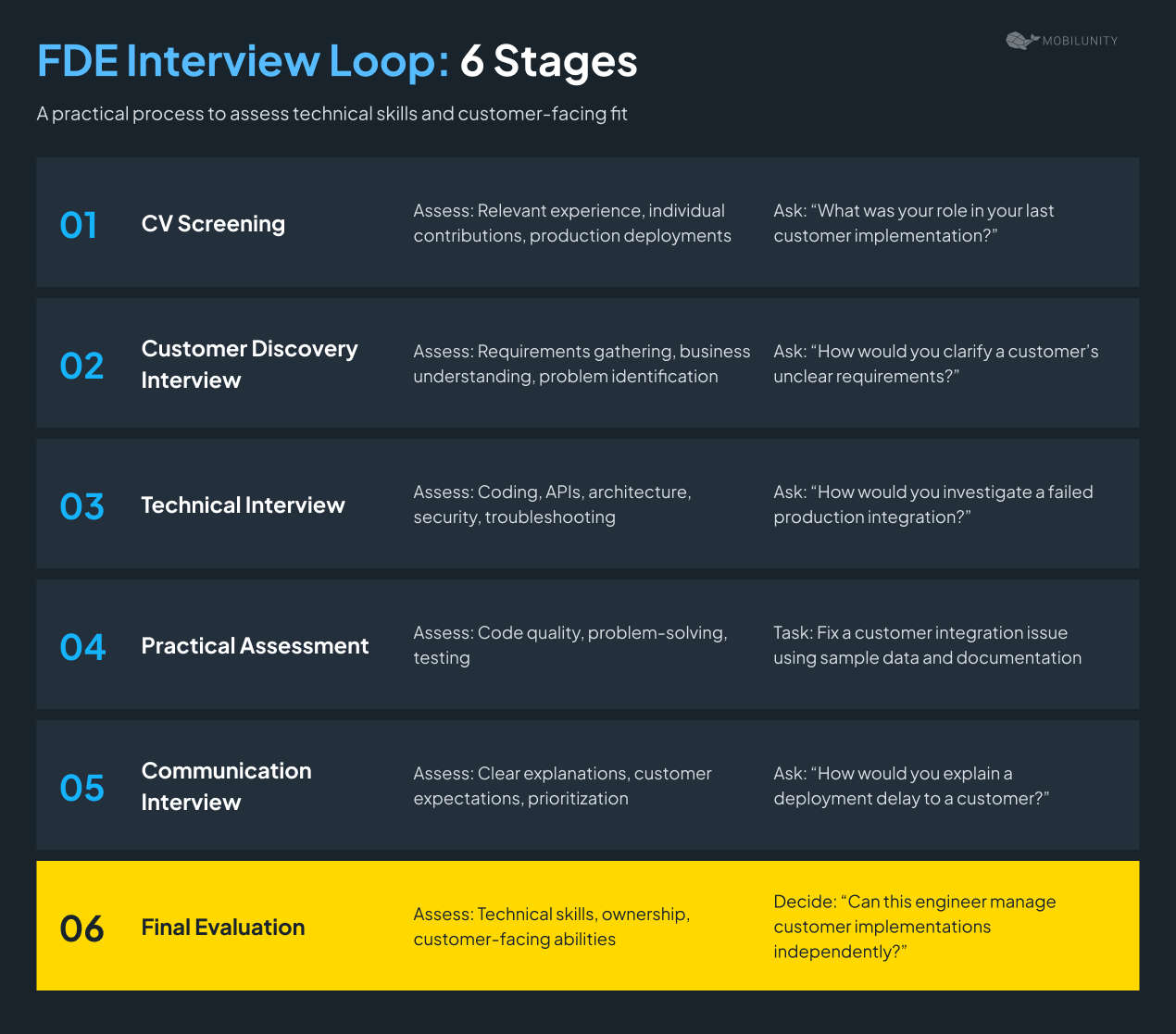
A Practical 90-Minute Task to Assess Candidates
A practical test helps you see how candidates handle real customer problems. Keep it short and relevant to the FDE specialization you’re recruiting for.
Example scenario: A customer reports that some CRM records aren’t appearing in your SaaS platform. They need the integration working before next week’s launch.
Provide sample API documentation, test data, and starter code. Allow approved AI tools, but require candidates to verify their work.
Divide the exercise into three stages:
- Understand the problem (20 minutes): Ask questions, identify missing information, and clarify the customer’s requirements
- Solve the problem (50 minutes): Investigate the issue, implement a fix, and test it against supplied data, including incomplete records
- Explain the solution (20 minutes): Describe the issue, what you changed, and any remaining risks in language the customer can understand
How to Score the Exercise
Assess candidates across four areas:
- Understanding the need: Did they ask useful questions and identify the customer’s priorities?
- Solution quality: Does the fix work, and did they test it properly?
- Problem-solving: Did they investigate errors systematically and recognize potential risks?
- Communication: Could they explain the outcome clearly to a nontechnical customer?
A technical interviewer should evaluate the code, testing, and troubleshooting. The hiring manager can assess customer communication and requirements discovery.
For AI, data, or infrastructure FDE roles, adapt the technical task to the systems candidates would actually work with.
How Much Does It Cost to Hire an FDE?
Forward deployed engineer costs vary by country, experience, and technical specialization. An engineer who handles standard software integrations will typically cost less than a senior FDE with advanced AI expertise.
When researching how to hire forward deployed engineers, pay attention to the type of cost each provider quotes. Employee salaries, contractor rates, and monthly provider charges represent different expenses.
Forward Deployed Engineer Costs by Location
The table below compares 2026 salary benchmarks, contractor rates, and Mobilunity’s monthly client costs.
| Country | Annual Salary Range, USD (Mid-to-Senior FDE) |
| United States | $160,000-$280,000 |
| United Kingdom | $70,000-$146,000 |
| Germany | $65,000-$120,000 |
| Poland | $45,000-$95,000 |
| Ukraine | $36,000-$84,000 |
Sources: Indeed | 6figr.com | Glassdoor | Mobilunity’s internal recruitment research conducted in September 2026.
The US has the highest salary ranges, while Poland and Ukraine offer more affordable options for companies building remote FDE teams. Salary expectations also depend on technical expertise, experience with customer implementations, and the complexity of the role.
What Additional Costs Should You Expect?
The engineer’s salary is rarely your only expense. Your final budget depends on the employment arrangement and which services your provider covers.
Common additional costs include:
- Recruitment: Job advertisements, agency fees, and technical interviews
- Employer contributions: Payroll taxes, social insurance, and mandatory benefits
- Equipment: Laptops, development tools, and software subscriptions
- Travel: Customer visits, accommodation, and transportation
- Administration: Payroll, HR support, and employment-related paperwork
If you plan to hire forward deployed engineers FDEs through a staffing provider, ask for a breakdown of the monthly charges. Find out which expenses are covered and which require separate payments.
Salary vs. Total Employment Cost: An Example
Suppose you employ a US-based FDE with an annual salary of $150,000.
In 2026, employers generally contribute 6.2% toward Social Security and 1.45% toward Medicare. These federal payroll taxes add $11,475 annually.
That brings your annual cost to $161,475, before unemployment insurance, employee benefits, equipment, recruitment, and other expenses.
For context, Mobilunity’s benchmark for a mid-level AI engineer is $4,450–$6,500 per month, or $53,400–$78,000 over 12 months. Forward deployed engineer pricing is quoted separately based on the technical requirements and scope of customer-facing work.
These figures cover different employment models and aren’t directly equivalent. Before choosing between direct employment and a staffing provider, compare the full costs, responsibilities, and services each arrangement involves.
Should You Choose a Dedicated FDE, Freelancer, or In-House Employee?
Your choice depends on how frequently customers need engineering support, your budget, and how much work you can manage internally.
A freelancer may be enough for a single integration. If you regularly implement software for customers, a dedicated engineer or in-house employee may be a better fit.
Dedicated vs. Freelance vs. In-House FDE Comparison
| Factor | Dedicated FDE | Freelance FDE | In-House Employee |
| Best For | Ongoing customer implementations | Short-term projects | Long-term engineering needs |
| Budget | Predictable monthly costs | Hourly or project-based fees | Salary, benefits, and employment costs |
| Availability | Full-time commitment | Depends on other projects | Full-time commitment |
| Management | Client directs daily work | Client manages project deliverables | Company manages all work |
| Continuity | Same engineer across projects | May change between assignments | Consistent long-term support |
| Administration | Provider handles HR and employment administration | Depends on contract terms | Company handles employment administration |
Which FDE Model Fits Your Business?
Dedicated FDE: Works well when customer implementations are a regular part of your business. The engineer works exclusively with your team and develops a strong understanding of your product and customers. This approach follows the dedicated development team model, where you manage engineering work while your provider handles employment administration.
Freelance FDE: A practical option for occasional integrations, troubleshooting, or projects with a defined scope. You pay for specific work, but the engineer may have other clients and limited availability.
In-house employee: Suits companies that want permanent engineering capacity and prefer to manage recruitment, employment, and professional development themselves.
How Mobilunity’s Dedicated Model Works
Mobilunity recruits full-time remote FDEs who work directly with your team. You interview candidates, select your engineers, and set their technical priorities.
Mobilunity handles recruitment, HR support, legal and accounting administration, and ongoing employee assistance. Your team manages customer relationships, project requirements, technical decisions, and the engineer’s daily work.
When comparing staff augmentation vs outsourcing, the distinction is important. Mobilunity’s dedicated model gives you direct control over the engineer’s work rather than transferring project delivery to an external team.
For companies with regular customer deployments, this arrangement provides consistent engineering support without the administrative responsibilities of direct employment.
Red Flags in an FDE CV and the First Interview
Whether you’re recruiting a forward deployed engineer remote or building a dedicated AI development team, technical experience alone isn’t enough. Look for these seven warning signs when reviewing CVs and interviewing candidates.
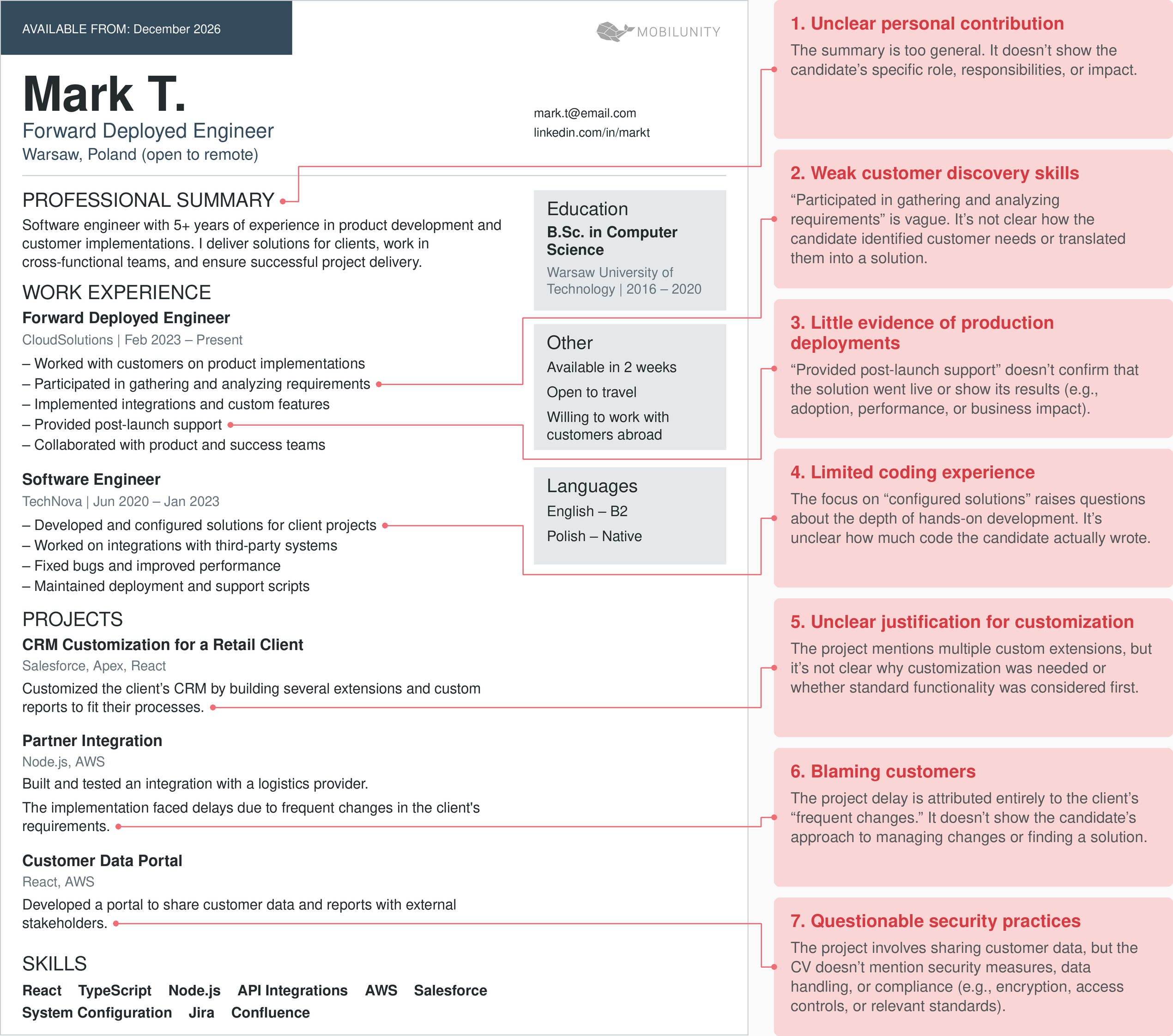
- Unclear personal contribution: The candidate talks about team achievements but rarely mentions their own work. Ask: “Which parts of the project were you personally responsible for?”
- Little evidence of production deployments: They list implementations without explaining the results. Ask: “Did the solution go live, and how did it perform?”
- Limited coding experience: Their background focuses mainly on software configuration. Ask: “What code did you write for your most recent integration?”
- Weak customer discovery skills: They say little about understanding customer requirements. Ask: “How do you establish what a customer actually needs?”
- Too much customization: They recommend custom development without considering existing features. Ask: “When would you choose standard functionality over custom code?”
- Questionable security practices: Their experience doesn’t clearly address data protection. Ask: “How do you protect customer data during development and testing?”
- Blaming customers: They describe failed projects as entirely the customer’s responsibility. Ask: “Looking back, what would you have done differently?”
A missing detail doesn’t automatically mean a candidate lacks the skill. Use these questions to explore their experience before making a decision.
How Long It Takes: From Hiring Brief to First Customer Contribution
Recruiting a forward deployed engineer is one thing. Getting them familiar with your product and ready to work with customers takes additional time. Mobilunity introduces qualified candidates within 5 business days, but the full recruitment process depends on interviews, candidate availability, and onboarding requirements.
How the Recruitment Process Works
These 4 stages show how to hire FDE specialists through Mobilunity.
1. Discuss Your Requirements
Tell Mobilunity about your product, technical stack, and the customer problems your engineer will handle. The recruitment team uses these details to identify suitable candidates.
2. Review and Interview Candidates
You’ll receive qualified candidate profiles within five business days. You can then review their experience, conduct interviews, and choose the engineer who best fits your project. If your team needs help assessing technical skills, Mobilunity offers technical interviews for an additional fee.
3. Finalize the Agreement and Prepare for Onboarding
Once you’ve selected a candidate, Mobilunity handles the agreement and employment administration. Your team prepares the documentation, development tools, and system access the engineer will need. The start date also depends on the candidate’s availability and any notice period.
4. Bring Your FDE Into the Team
Your engineer starts learning about your product, internal processes, and customer requirements. You assign tasks and manage their daily work, while Mobilunity handles ongoing HR and administrative support.
What Can Affect the Timeline?
The time between selecting a candidate and their first customer contribution depends on several factors:
- Candidate availability: Engineers may need to finish their notice period before joining.
- Technical specialization: Finding a forward deployed AI engineer remote with specific LLM or infrastructure experience may take longer.
- Product complexity: Large applications and unfamiliar architectures require more time to understand.
- Customer access: Security approvals and access to customer systems can delay technical work.
- Onboarding preparation: Clear documentation and support from your engineers can shorten the adjustment period.
What Can an FDE Accomplish During the First Weeks?
Don’t expect a new engineer to complete a complex customer deployment immediately. Their first tasks should help them understand your product and become familiar with its technical environment.
First week: The engineer sets up their development environment, reviews documentation, meets the team, and learns about current customer projects.
Following weeks: They may investigate customer issues, review existing integrations, and take responsibility for smaller development tasks.
As they gain experience with your systems, they can move on to more demanding customer implementations.
A useful early milestone is whether the engineer can understand a customer request, suggest a practical solution, and complete a small task with limited supervision. This tells you more about their progress than expecting a production deployment during their first week.


