
17 Best Sites to Hire AI Engineers: A Practical Guide for Your Business

Customer implementations often need engineers who can resolve technical issues, adapt software to specific requirements, and work directly with clients. But building an in-house forward deployed engineering (FDE) team takes time, money, and management resources.
An external or offshore FDE team can handle much of this work if engineers have direct customer access, strong product knowledge, and authority to make technical decisions. Without these, even experienced developers may struggle to deliver results.
This article compares internal, outsourced, and hybrid FDE teams, their costs, and what it takes to manage each arrangement successfully.
A forward deployed engineering team helps customers implement software and make it work with their existing systems. These engineers work directly with clients, understand their technical requirements, and handle technical issues that require custom solutions.
For example, a customer purchases your software but needs to connect it to their CRM and internal databases. Your FDE team works with the customer’s IT staff, develops the necessary integrations, tests them, and resolves any deployment issues.
FDEs may also configure software, write custom code, troubleshoot technical problems, and suggest product improvements based on customer feedback. Their work often requires close coordination with your internal development team, especially when customer requests involve changes to the core product.
To understand the FDE team meaning, it helps to compare FDEs with traditional software developers and customer support specialists. Developers primarily build and maintain the core product, while support teams resolve known issues and answer product questions. Forward deployed engineering experts work directly with customers on technical challenges that require engineering expertise and custom solutions.
It’s important to distinguish between outsourcing (who manages the work), which means assigning project delivery to an external company, and offshoring (where the work happens), which means moving work to another country through your own employees or an external provider.
An offshore FDE team can work directly with customers without being in the same country. Engineers can discuss requirements, develop integrations, and resolve implementation issues remotely. Yet they need reliable communication channels and enough overlapping working hours to collaborate with customers.
With a dedicated offshore team, you manage developers yourself, set priorities, and oversee customer projects. The provider may handle recruitment, payroll, and HR administration without taking responsibility for technical delivery.
To work effectively with customers, offshore FDEs typically need:
You can also keep a customer-facing technical lead in-house while offshore engineers handle integrations, configuration, testing, and deployment. This gives customers a consistent point of contact.
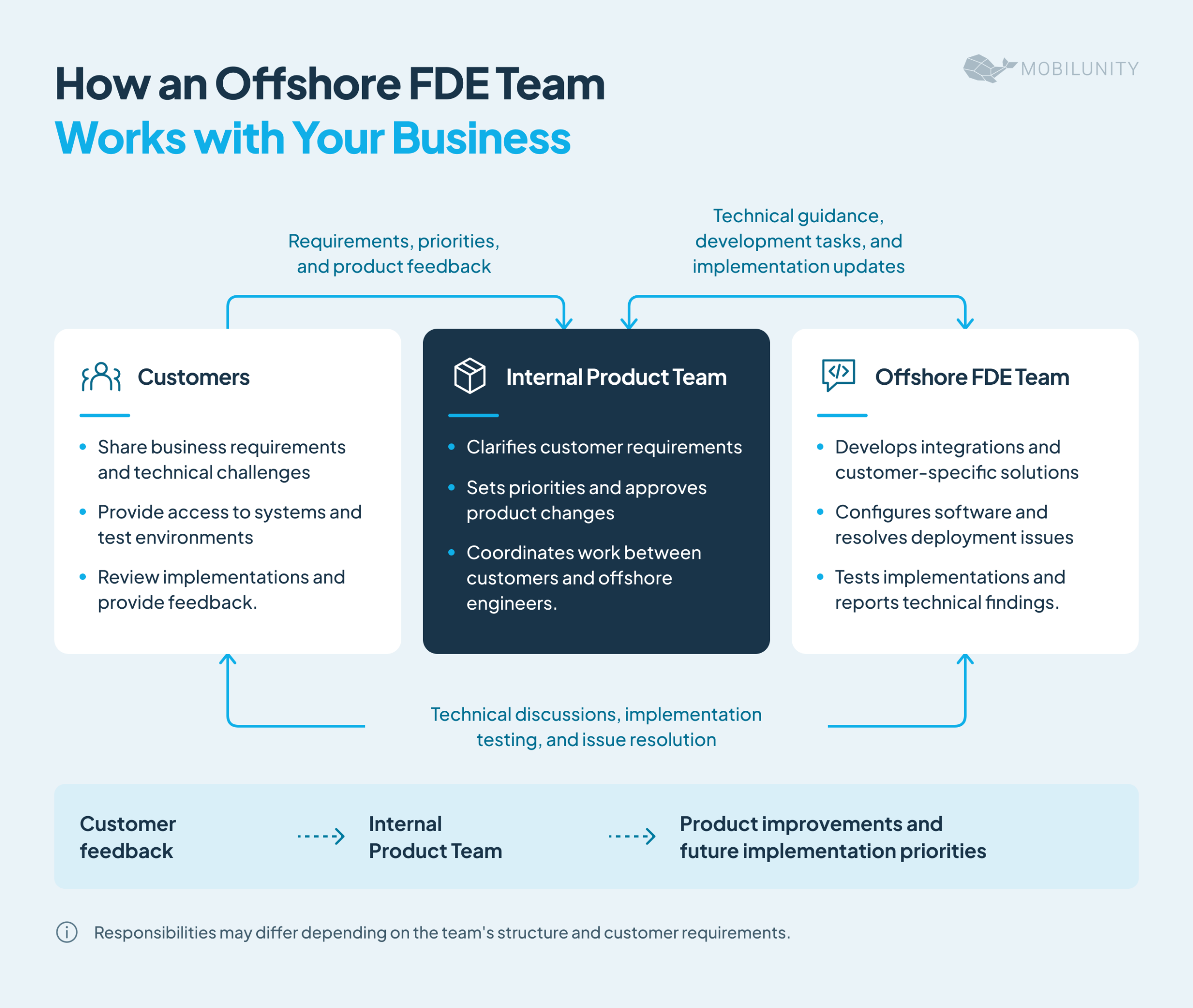
The value of an offshore FDE team depends on the type of customer work you handle, your internal team’s technical expertise, and how predictable your implementation workload is. Here are five situations where this arrangement can help:
Before choosing an offshore FDE team, check whether your customers allow external engineers to access their systems and data. Some projects require on-site work, while security policies may limit remote access to production environments.
Consider your internal management capacity, too. Offshore FDEs need access to product documentation, someone to clarify customer requirements, and a technical lead who can resolve decisions outside their authority. If your team cannot provide this support, outsourcing project delivery to a managed service provider may be a better option.
You can organize an FDE team in several ways, depending on how much engineering work you want to manage internally. The main differences are who employs the engineers, who directs their work, and who handles customer communication.
| Model | Who Manages the Work | Customer Interaction | When It Fits |
| In-house team | Your company hires, employs, and manages engineers directly | Engineers communicate directly with customers | You have steady implementation demand and need full control over the team |
| Dedicated offshore team | A partner recruits and employs engineers; you manage their daily work | Engineers work directly with customers under your guidance | You need a long-term team without establishing an overseas entity |
| Managed external team | The provider manages delivery against an agreed scope | Customer communication follows the agreed process, often through a project lead | You can define deliverables and want external project management |
| Hybrid team | Internal leaders and external engineers share responsibilities | Internal staff may lead customer discussions while external engineers handle technical tasks | You need internal customer ownership and additional engineering capacity |
The distinction between staff augmentation vs outsourcing is critical. With staff augmentation, you direct the engineers’ work. With outsourcing, the provider manages delivery, although your company still approves requirements and results.
Before choosing a model, assess your implementation workload and management capacity. If customer requests change frequently, dedicated engineers may offer more flexibility. If you have a defined project but limited management resources, consider managed delivery.
Whichever model you choose, specify who sets priorities, approves technical changes, communicates with customers, and resolves delivery problems in the contract.
When comparing FDE team models, look at the total cost of running the team, not just developer salaries or provider rates. Each arrangement comes with expenses that may not appear in the initial quote.
Your budget should account for:
Also consider how long you’ll need the team. A single implementation may involve short-term setup and handover costs. Ongoing customer support requires a budget for continued engineering capacity, maintenance, and team coordination.
Building an offshore FDE team requires more than finding developers with the right technical skills. You also need to prepare them for customer-facing work and establish clear responsibilities.
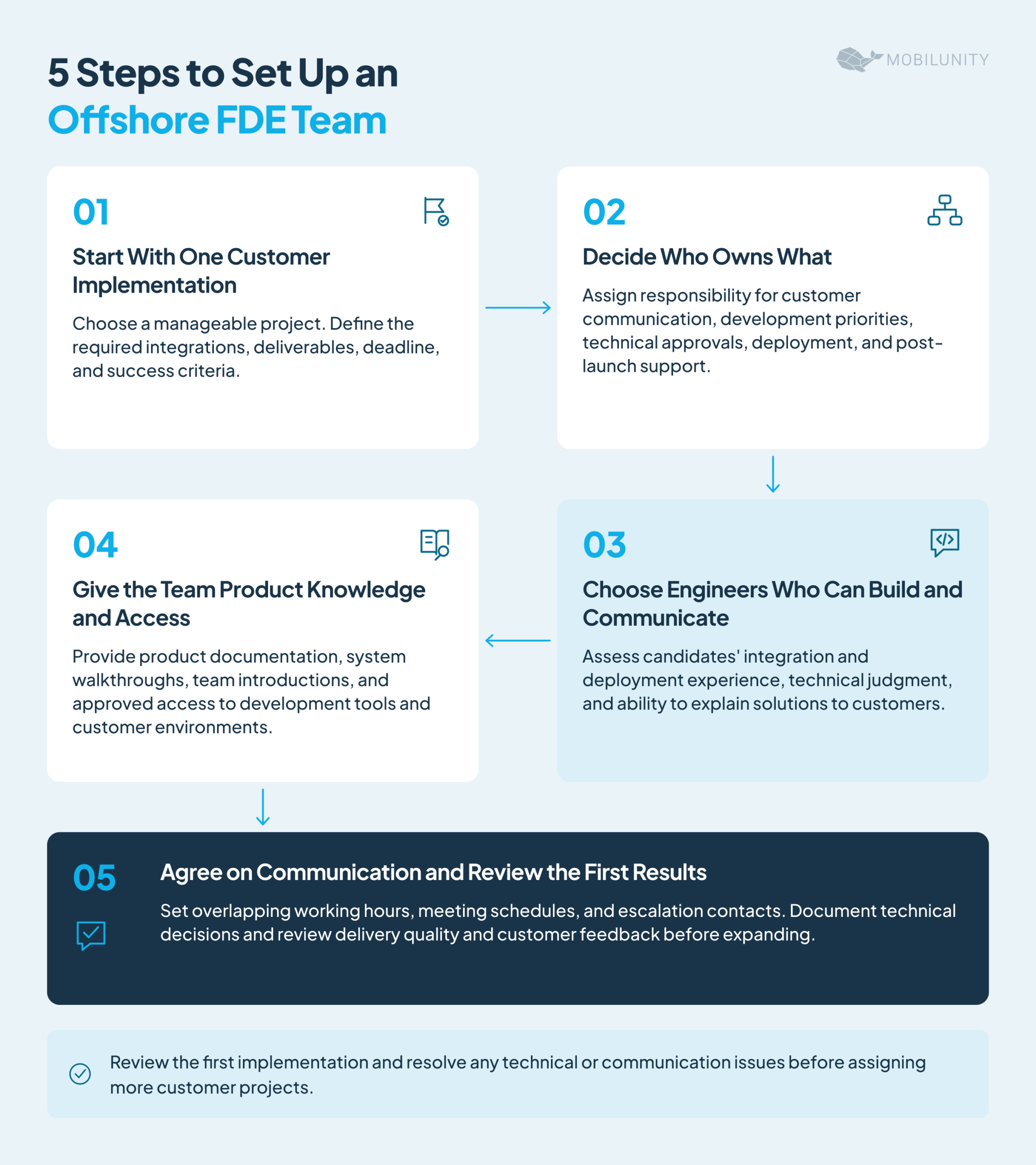
Here’s how to approach the process.
Choose a customer project with a manageable scope, such as connecting your software to an existing CRM. Define the required integrations, expected deliverables, and deadline.
Set measurable goals, such as completing the integration, passing customer acceptance tests, and resolving critical deployment issues. This first project will help you assess the team’s capabilities before assigning more customers.
Before work begins, agree on who will:
With a dedicated offshore team, your company remains responsible for managing customer relationships, setting priorities, and overseeing technical delivery.
FDEs need more than software development experience. Look for engineers who have handled customer integrations, deployment problems, and technical discussions with non-engineering stakeholders.
During interviews, ask candidates to explain a previous implementation challenge and how they resolved it. This helps you assess their technical judgment and communication skills.
Onboarding an offshore team should cover your product architecture, common customer configurations, and existing integration methods.
Provide documentation, system walkthroughs, and introductions to relevant employees. Arrange approved access to development tools, test environments, and customer systems before assigning implementation tasks.
Managing remote teams starts with clear communication arrangements. Agree on overlapping working hours, customer meeting schedules, progress updates, and contacts for urgent technical issues.
Document technical decisions, integration steps, and recurring problems throughout the project. This makes future implementations easier and reduces dependence on individual engineers.
After the first deployment, review delivery quality, customer feedback, and any coordination problems. Address these issues before expanding the team or assigning additional customer implementations.
Mobilunity helps companies build offshore FDE teams by recruiting developers and handling their employment and HR administration. Through our dedicated development team model (DDT), you select the engineers and manage their work, while we cover recruitment and ongoing team support.
When you hire forward deployed engineers through Mobilunity, we start by discussing your product, technical requirements, and customer implementation needs.
We look for engineers with relevant development and integration experience, but technical skills aren’t the only consideration. FDEs often communicate directly with customers, so we also assess candidates’ English proficiency and ability to explain technical issues.
You interview shortlisted candidates and make the final selection. This gives you control over who joins your team and whether their experience matches your requirements.
Once you’ve selected your engineers, Mobilunity helps with onboarding and team integration. We handle employment contracts, payroll, HR administration, and other operational tasks.
Your company remains responsible for:
Mobilunity provides ongoing HR assistance to help developers resolve issues related to workload, communication, and team integration. This support contributes to employee retention, which stands at 94% according to our internal data.
You can start with one FDE and discuss adding engineers as customer demand grows. Mobilunity also offers FLEX collaboration, a part-time arrangement for companies that don’t need full-time engineering capacity.
With 16+ years of global tech talent experience and more than 150 completed projects, Mobilunity supports companies building dedicated remote teams. The DDT model suits businesses that want to manage their own FDEs while leaving recruitment, employment administration, and HR support to an external partner.
Building an offshore FDE team starts with deciding how engineers will work with your customers and internal staff. They’ll need a good understanding of your product, access to customer systems, and clear responsibilities.
Mobilunity helps clients find individual experts or provides dedicated FDE teams for hire. We handle recruitment and HR administration, while you manage development and customer priorities.
Tell us about your product, upcoming customer implementations, required technical skills, and preferred working hours. We’ll help you determine what team structure makes sense and discuss the available engagement options.

Disclaimer: All salaries and prices mentioned within the article are approximate numbers based on the research done by our in-house Marketing Research Team. Please use these numbers as a reference for comparison only. Feel free to use the contact form to inquire on the specific cost of the talent according to your vacancy requirements and chosen model of engagement.
Client Testimonial
Mobilunity provides an excellent and efficient tech talent service. All my staffing requests, even for niche technologies, were fulfilled in a 2 to 4-week time period, with top-notch candidates. Besides that, I like the caring environment that the Mobilunity team provides for the developers and ensures that everybody is able to work without distractions.
I strongly recommend Mobilunity as a tech talent partner!

Waldemar Biller
Head of Technology


Fulltime dedicated teams, FLEX on-demand model, consultancy, recruitment, EOR