
Hire Developers in Hungary

Key takeaways:
Staff augmentation adds specialists to your team, and you manage their priorities, workflows, and output. Project outsourcing buys an agreed result, with the vendor managing the people and daily work needed to deliver it. The second difference in staff augmentation vs outsourcing is delivery risk: you retain responsibility for coordinating delivery with augmented staff, while an outsourcing vendor takes on delivery obligations defined in the contract.
Here, outsourcing means project outsourcing, regardless of the vendoris location. When weighing outsourcing vs staff augmentation, look at what you can manage internally and how clearly you can specify the result. An evolving backlog needs ongoing direction; a defined deliverable needs acceptance criteria and a process for handling changes. Both models still require someone on your side to own business priorities and approve the outcome.
This article compares how each model works and examines delivery responsibility, code ownership, and exit terms to help you choose an arrangement that fits your project and management capacity.
In the staff augmentation model, the vendor handles the employment relationship, while your managers direct the specialists’ day-to-day work. The vendor employs the specialists and handles payroll, benefits, and employment administration. Your team owns the backlog, sets priorities, and reviews their work. Developers join your repositories, planning meetings, and code review process, with you leading technical decisions.
For a company asking “what is staff augmentation?”, the practical answer is additional capacity within an existing delivery structure. For example, two backend developers might join your product team for six months while your engineering lead continues to assign work and approve changes. The vendor provides the people; your organization remains responsible for turning their work into a release.
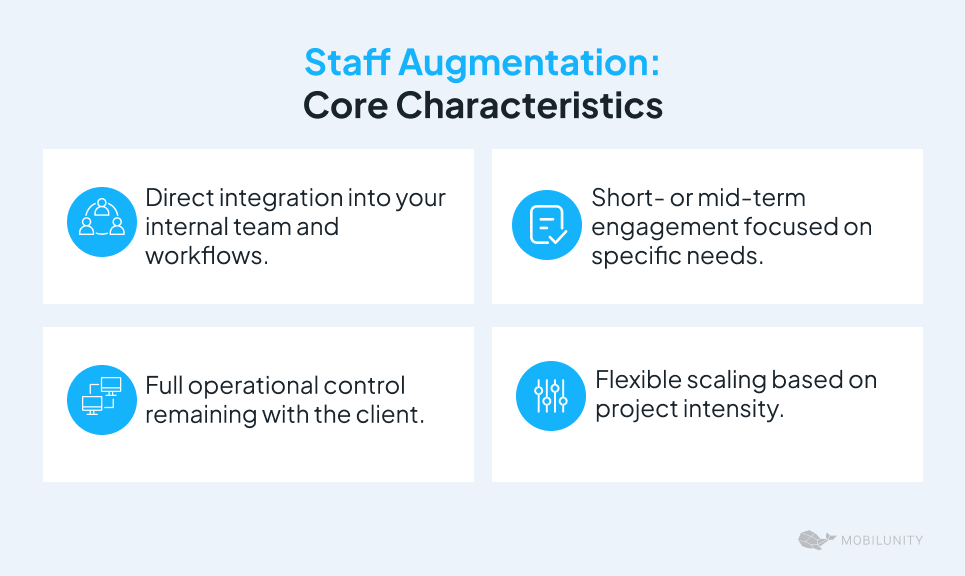
An engagement typically combines a services agreement with an assignment schedule or statement of work covering roles, rates, working hours, and start dates. Billing is usually hourly or monthly per specialist. The agreement also sets expectations for confidentiality, intellectual property, equipment, access, and replacement arrangements.
A notice period determines how much advance warning either party must give before ending an assignment or reducing capacity. Scaling down therefore follows agreed terms rather than happening immediately. Minimum commitments, replacement conditions, and handover obligations affect how flexible the arrangement will be in practice.
The types of staff augmentation can be grouped by duration and team composition. Short-term cover a release testing cycle or a temporary infrastructure task. A long-term extension adds capacity across successive releases while keeping product direction with your internal team.
The seniority mix depends on the support available internally. A senior engineer may handle an unfamiliar integration with limited technical guidance, while a mid-level developer may contribute within an established architecture. Both still need business context, access, and someone who can resolve competing priorities. Seniority changes how much guidance is needed, but it doesn’t remove the need for ownership.
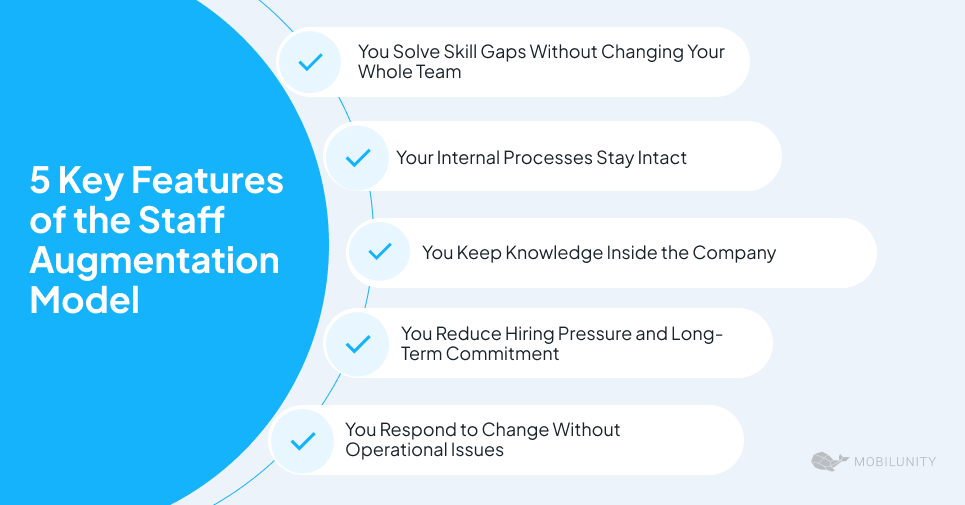
IT staff augmentation provides specialists, but it does not automatically provide project management or technical leadership. Someone on your side still needs time to refine requirements, coordinate dependencies, review output, and make decisions.
Staff augmentation works best when your internal team has enough time to guide the additional developers. If requirements, priorities, or decisions are unclear, new team members may have to wait for answers instead of making progress. Include the time needed to manage and support the extended team when planning the engagement.
Project outsourcing gives an external provider responsibility for planning, executing, and delivering an agreed scope of work. The vendor assigns specialists, organizes workflows, and manages quality and deadlines. Your role centers on defining business requirements, approving milestones, and accepting the result.
For example, a company might outsource a customer portal while its internal developers maintain the main product. The provider manages development and testing against agreed acceptance criteria. Your team supplies access, resolves business questions, and reviews the portal at scheduled checkpoints.
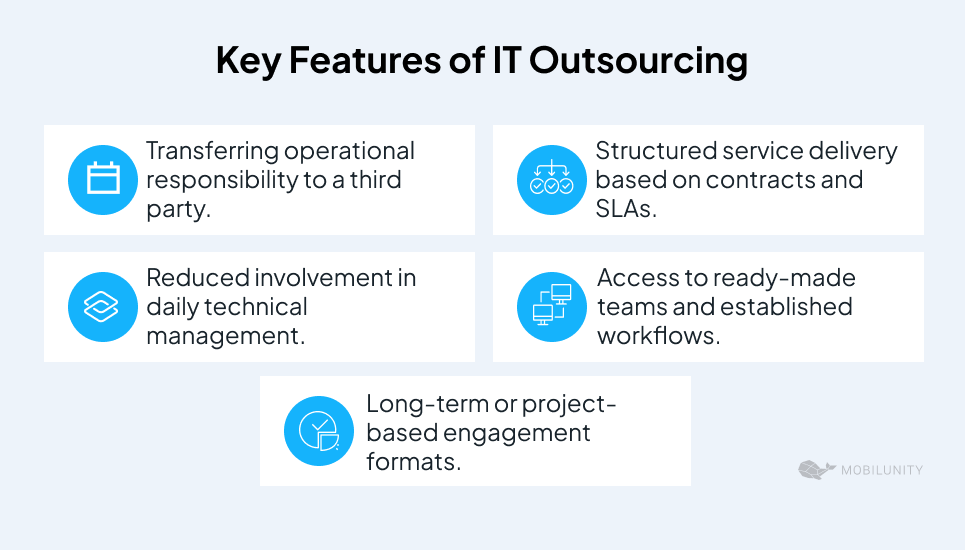
The vendor carries delivery risk within the obligations defined by the contract. If an agreed feature fails acceptance testing, responsibility for correcting it follows those terms rather than simply becoming another task for your engineering manager. The strength of that commitment depends on the scope, acceptance process, remedies, and liability limits.
Part of the vendor’s margin covers this responsibility, along with project management, technical coordination, and quality assurance. A higher effective hourly price can therefore cover work your own managers would otherwise perform. Whether that lowers total cost depends on delivery performance and how much coordination remains on your side.
Outsourcing gives the provider control over daily execution, which makes reporting, repository access, and documented decisions important to your visibility. Dependence grows when the vendor alone holds architecture knowledge, deployment credentials, or unfinished work.
In a fixed-scope engagement without regular requirements review, a specification written once can be wrong by month three, with every subsequent change becoming a change order. A new integration or revised approval workflow may require additional budget and a later delivery date. An agreed change process makes those consequences visible before work begins.
Some companies need more coordination support while retaining control of an evolving backlog. Depending on the agreement, dedicated development teams can sit between the models: you guide product priorities, while a vendor-side lead coordinates delivery.
The distinction rests on the responsibilities in the proposal. A named delivery lead, explicit acceptance criteria, and clear handover terms explain more than the service label alone.
The practical differences show up in how responsibilities are divided and in the contract terms. Two proposals may offer similar technical skills while leaving you with different obligations for managing delivery, handling changes, and taking over the work when the engagement ends.
| Decision Point | Staff Augmentation | Project Outsourcing |
| Who manages the work? | Your managers own the backlog, assign priorities, coordinate dependencies, and review output. | The vendor manages daily execution against agreed requirements. You own business priorities and acceptance. |
| Who carries delivery risk? | You retain responsibility for coordinating delivery. The vendor’s obligations typically concern staffing and service provision. | The vendor takes responsibility for agreed deliverables, subject to acceptance criteria, remedies, and contractual limits. |
| Who owns the IP and repository? | Ownership depends on IP assignment terms. Specialists can work directly in a repository your company controls. | Ownership also depends on the contract. Repository access, IP transfer, and handover timing need explicit agreement. |
| How do you exit, and with what notice? | Assignments end under the agreed notice period, minimum commitment, and handover terms. | Termination terms determine notice, payment for completed or committed work, and transfer of unfinished deliverables. |
| What does a scope change cost? | Reprioritization uses available capacity. Additional hours or specialists increase fees, while displaced work may move to a later release. | Changes outside the agreed scope follow the change-control process and may alter price, resources, or delivery dates. |
The management difference determines whose calendar absorbs coordination work. With augmented developers, your engineering lead still resolves dependencies and reviews implementation decisions; with outsourcing, the vendor’s lead handles that coordination, while business questions still come back to you.
Delivery risk determines what happens when progress falls short. Paying for developer time does not guarantee a completed feature, while an outsourced deliverable provides meaningful accountability only when the agreement explains how defects, delays, and rejected work are handled.
IP ownership and repository control are separate questions. A contract may assign the finished code to you while leaving your team without access to its development history, build configuration, or deployment instructions until handover.
Exit terms determine whether another team can continue the work. A 30-day notice period, for example, offers limited practical flexibility if documentation is incomplete or access to essential systems depends on the departing provider.
Change costs include both money and displaced work. Moving an augmented developer onto a new integration can delay another feature; requesting that integration under a fixed-scope outsourcing contract may require a separately priced change.
Neither column establishes a default winner. The useful comparison is whether each proposal assigns responsibilities clearly and gives your team workable terms for the changes and transitions it expects.
A useful US hiring baseline starts with the Bureau of Labor Statistics median software developer salary of $135,980 in May 2025. BLS also reports that benefits represented 30.0% of private-industry employer compensation costs in June 2026, leaving wages at 70.0%. Applying that split gives $135,980 / 0.70 = $194,257, or approximately $194,000 annually in salary and benefits.
This is an illustrative compensation baseline, calculated using an economy-wide benefits share rather than a developer-specific figure. Recruitment, equipment, and management time sit outside that calculation, so it is a starting point for comparison rather than a complete hiring budget.
Staff augmentation usually carries an hourly or monthly fee per specialist. The vendor handles benefits and recruitment under its commercial arrangement, so you generally don’t administer those expenses separately. Setup and recruitment fees depend on the proposal, while exit costs follow contractual notice and minimum commitments rather than your own employee severance arrangements.
Project outsourcing carries a project or retainer price that includes the vendor’s management and delivery coordination. It can look more expensive per developer hour while costing less per accepted outcome if it reduces internal coordination and rework. Changes outside the agreed scope can increase that price.
| Cost Component | US In-House Hire | Staff Augmentation | Project Outsourcing |
| Pricing basis | Approximately $194,000 annually in illustrative salary and benefits | Hourly rate × billed hours, or monthly fee × engagement length | Agreed project or retainer price |
| Recruitment and benefits | Employer-funded; recruitment is additional to the baseline | Generally covered by the vendor’s fee; separate charges depend on terms | Reflected in the vendor’s pricing |
| Your management time | Daily direction, reviews, and coordination | Substantial: backlog ownership, reviews, and coordination remain internal | Usually lower: requirements, decisions, and acceptance remain internal |
| Changes and exit | Reprioritization, hiring decisions, and applicable employment obligations | Additional capacity, notice-period charges, and handover | Change orders, termination charges, and handover |
Internal management time belongs in both budgets. In an illustrative augmentation scenario, a $6,000 monthly fee plus 20 management hours valued at $100 per hour produces an $8,000 monthly cost before equipment or other expenses. Those figures demonstrate the calculation; they are not a vendor quote.
Outsourcing needs the same treatment, usually with fewer internal coordination hours but additional provision for scope changes. Comparing an equivalent workload over the same period makes the trade-off clearer than comparing headline rates alone.
Service labels can overlap across proposals. The useful distinction is the support each arrangement provides: specialists working under your direction, expert advice, an ongoing service, or a team with its own delivery lead.
In Eastern European contracting, outstaffing often describes the same arrangement as staff augmentation: the provider employs the specialists, while you direct their work. It differs from project outsourcing because responsibility for organizing delivery remains with your team. Our guide to outstaffing companies covers providers using this model.
Managed services place an ongoing function, such as infrastructure monitoring or support, under a provider’s operational management. The agreement defines service levels, reporting, and responsibilities over time, rather than acceptance of a single finished project. For the detailed distinction, see managed services compared.
The central distinction in staff augmentation vs consulting is the purpose of the engagement: additional delivery capacity versus specialist judgment. A consultant might spend several weeks assessing architecture, investigating performance problems, or recommending a migration approach. Implementation can become a separate engagement once your team understands the findings and the work required.
A dedicated team can sit between augmentation and project outsourcing when you retain product direction and the provider supplies a delivery lead. That lead coordinates execution, while your organization owns priorities and business decisions; the contract determines how far delivery accountability extends. Our dedicated vs extended team comparison explains the difference in team structure.
These arrangements can also change over time. An architecture assessment may lead to an IT staff augmentation engagement, while a completed outsourced project may move into managed support. Each transition benefits from a fresh agreement on ownership, responsibilities, and handover.
The choice depends on how work reaches your team, who can direct it, and what your organization needs to retain. These four questions connect the contract model to the way your project actually runs.
1. Is the Work Defined Week to Week or Once?
An evolving backlog generally favors augmentation. Two backend developers joining successive releases can follow your existing planning process as customer feedback changes priorities. Short-term QA or DevOps support can fill a specific gap within that same structure.
Outsourcing fits better when you can describe a separate result and agree on acceptance criteria. A customer portal with defined integrations gives a vendor a clearer delivery commitment than an open-ended request to improve your product.
2. Do You Have Someone Who Can Own the Outcome?
Both models need an internal owner who understands the business goal and can approve decisions. Augmentation also needs technical leadership with time to coordinate work and review code. Outsourcing shifts daily management to the vendor, but requirements and acceptance still need an accountable person on your side.
If nobody can provide that ownership, neither arrangement resolves the gap. Establishing it first gives external specialists a direction and the vendor someone authorized to resolve questions.
3. What Happens When the Scope Changes?
Frequent changes make a fixed-scope agreement expensive through repeated estimation, approval, and change orders. Augmentation lets your team reprioritize available capacity, although moving a developer onto a new integration still delays other work.
For a stable deliverable, outsourcing can make the budget easier to assess. The proposal becomes more useful when it explains what counts as a change and how that change affects price and timing.
4. What Has to Stay In-House When the Engagement Ends?
If your team needs to maintain the architecture and continue development, augmentation creates more opportunities for shared learning through daily collaboration. That advantage depends on documentation, internal participation in reviews, and a planned handover.
Outsourcing can also preserve knowledge when repository access, deployment instructions, and technical walkthroughs are agreed deliverables. The deciding question is whether your team can operate the result after the provider leaves.
Local hiring is another option, but it adds a recruitment process and the approximately $194,000 annual salary-and-benefits baseline calculated above from BLS data. Geography also does not guarantee office-based collaboration: Stack Overflow’s 2025 survey reports that 45% of US respondents work remotely, the highest share among its top-reporting countries. A locally hired developer may therefore need the same remote coordination practices as an external specialist.
Management capacity remains central whichever location you choose. If augmentation fits your answers, staff augmentation best practices can help explain how to prepare your team for the engagement.
A contractor needs the technical skills to perform the work and a delivery arrangement your team can support. Relevant experience, compatible workflows, and clear communication help establish that fit. The proposal should also explain who handles recruitment, employment administration, onboarding, and decisions when work stalls.
Technical evaluation becomes more useful when it reflects your project. For augmentation, an interview or code discussion can show how a specialist approaches the systems they would join. For outsourcing, a walkthrough of a comparable project can reveal how the vendor handles requirements, testing, and acceptance.
Working arrangements deserve the same attention as technical ability. Shared working hours, review responsibilities, access requirements, and escalation routes affect whether a qualified team can contribute effectively. A credible onboarding plan identifies what both sides need to provide before productive work begins.
A useful recommendation connects the model to your backlog, internal leadership, and expected changes. A vendor who only sells one model will recommend that model, so its advice reflects its commercial offering.
That applies to Mobilunity too: its focus on staff augmentation and dedicated teams shapes the arrangements it can propose. A recommendation carries more weight when the provider also explains which requirements fall outside its offer.
Moving from outsourced delivery to an augmented team, or the reverse, changes responsibilities as well as billing. A clear answer explains whether specialists can stay, how rates and commitments change, and who takes over management.
Repository access, unfinished work, documentation, and acceptance obligations also need a transition plan. Agreement on these points makes the proposed flexibility assessable before signing.
Our guide to choosing an offshore company covers the broader vendor-selection process. For this decision, the strongest evidence is a proposal that makes ownership, delivery responsibilities, and exit arrangements explicit.
The right shortlist depends on which responsibilities you want a provider to take on. At Mobilunity, we focus on staff augmentation and dedicated development teams: helping you add technical capacity while keeping product direction within your organization.
Founded in 2010 and based in Kyiv, we hold a 4.8 rating on Clutch (as of October 2026). We have hired more than 1,000 technical experts for our clients, and 97% of our developers complete probation. Our staff augmentation services help clients meet project goals on timelines 25% shorter. Here are some of our
We handle recruitment, payroll, taxes, HR, equipment, and retention, while you manage the engineers directly, set priorities, and review their work. This structure suits a product team that needs additional backend capacity, a specialist skill, or support across successive releases. Our role is to help build the team around those requirements.
What you get with Mobilunity:
If you want a fixed-price result with contractual delivery risk transferred to the provider, we may not be the right fit. Project outsourcing is not our primary offering, and adding developers under your direction does not provide the same commitment as purchasing an accepted deliverable.
For a broader shortlist, our guide to staff augmentation providers covers companies offering team extension services. A project outsourcing shortlist calls for a different evaluation, centered on delivery ownership, acceptance terms, and change control.

Disclaimer: All salaries and prices mentioned within the article are approximate numbers based on the research done by our in-house Marketing Research Team. Please use these numbers as a reference for comparison only. Feel free to use the contact form to inquire on the specific cost of the talent according to your vacancy requirements and chosen model of engagement.
Client Testimonial
Mobilunity provides an excellent and efficient tech talent service. All my staffing requests, even for niche technologies, were fulfilled in a 2 to 4-week time period, with top-notch candidates. Besides that, I like the caring environment that the Mobilunity team provides for the developers and ensures that everybody is able to work without distractions.
I strongly recommend Mobilunity as a tech talent partner!

Waldemar Biller
Head of Technology


Fulltime dedicated teams, FLEX on-demand model, consultancy, recruitment, EOR