Best Platforms to Hire Forward Deployed Engineers, Compared

Key takeaways:
Buying software or developing an AI prototype doesn’t guarantee that people will use it successfully. Your solution still needs to connect with existing systems, process real customer data, fit business workflows, and meet security requirements. These tasks explain why companies seek forward deployed engineering services: they need engineers who understand their product and the customer’s environment. This article explains the approach, the work involved, and when you might need additional engineering capacity for customer implementations.
Forward deployed engineering (FDE) is a software development approach in which engineers work directly with customers or business teams to understand a technical problem, develop a solution, and implement it in the customer’s environment.
A forward deployed engineer combines software development experience with customer-facing responsibilities. They investigate existing systems, clarify business requirements, identify technical limitations, write code, and adapt applications to meet customer needs. They also communicate with internal product and engineering teams when an implementation requires changes to the main product.
Consider a company introducing an AI assistant for employees. The prototype works with sample documents, but the production version needs approved access to internal information, integration with existing applications, and testing with actual users. An FDE works with the company’s IT and business teams to address these requirements and prepare the solution for everyday use.
You can apply the same approach to non-AI projects, including enterprise software implementations, legacy modernization, and custom application development. Engineers may work inside your existing development processes, collaborate remotely, visit customer sites, or combine these arrangements depending on the project.
Their involvement also helps you identify gaps between what your product currently does and what customers need. They can bring implementation findings back to your product team so recurring customer requests inform future development decisions.
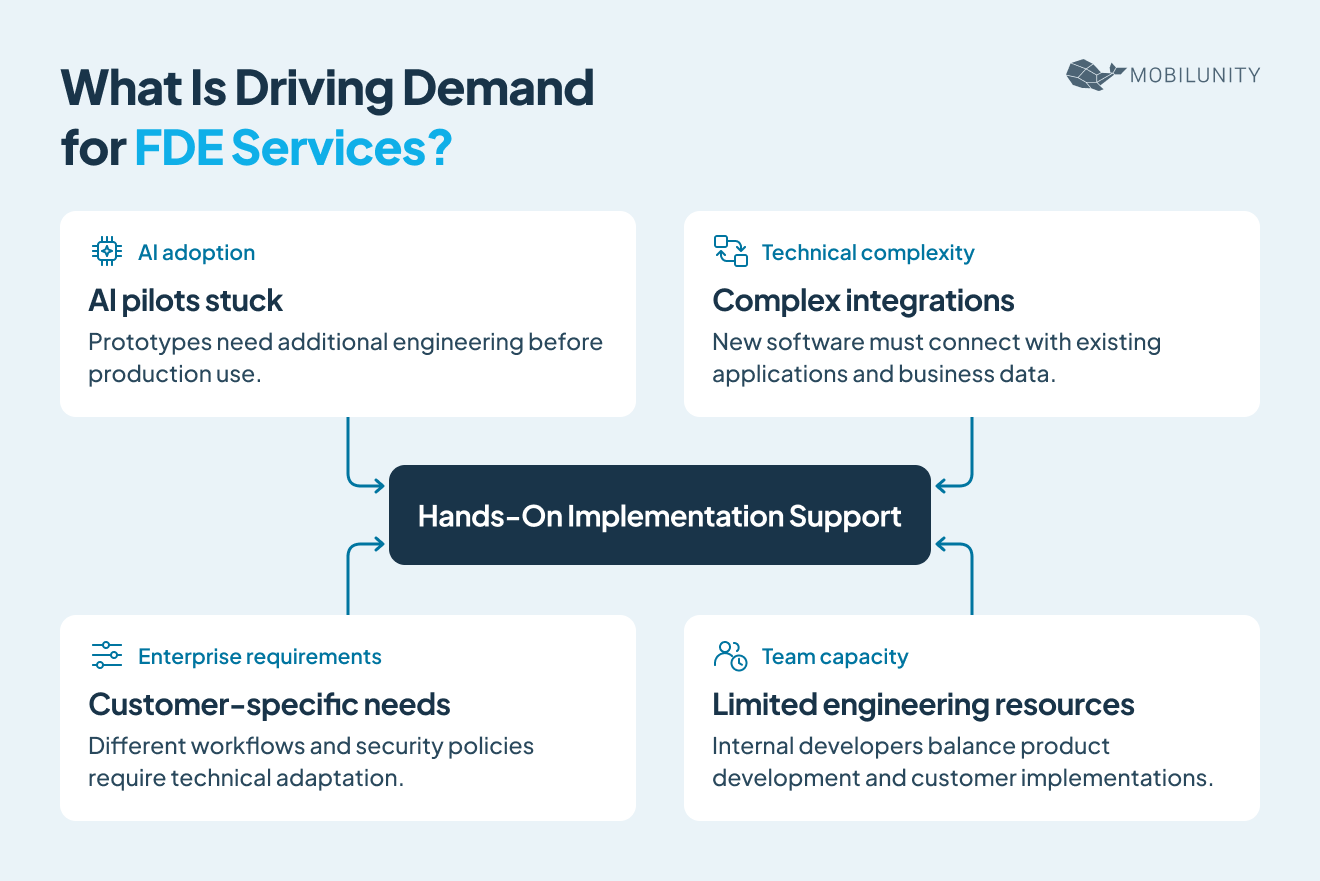
Companies seek this support when software implementation requires more customer-specific engineering than their internal teams can provide. Four common pressures explain the demand.
A controlled demonstration rarely faces the data, permissions, exceptions, and performance requirements of a production system. An AI agent that processes support requests, for example, needs approved access to customer records and must handle failed API calls and incomplete information.
Hiring data also points to growing interest in FDE roles. Indeed’s FDE job-posting index rose approximately 729% year over year between April 2025 and April 2026, according to Business Insider. These figures are index values, not actual posting counts.
New software must work with the applications a business already uses. A manufacturer’s order platform, for example, may need to exchange product data with its ERP, stock updates with its warehouse system, and invoice information with its accounting application. An FDE can investigate these data flows and build the required connections.
Engineers also need to account for inconsistent records, different update schedules, and failures that affect connected systems.
Publicis Sapient’s 2026 survey of 1,550 enterprise AI decision-makers found that 38% cited system integration and 36% cited data fragmentation as barriers to scaling AI. Only 18% said AI was fully integrated across their enterprise.
Enterprise customers often have their own security policies, approval processes, and infrastructure. A financial services company, for example, may require authentication through its identity provider, department-level access controls, and specific audit records. Engineers working directly with customer teams can clarify these requirements and determine whether configuration or custom development is needed.
Your product engineers must maintain existing applications, fix defects, and develop new features. Customer-specific integrations compete for the same engineering time.
Dedicated implementation engineers give your core team more room to focus on the product roadmap while handling customer deployments and sharing recurring feedback with product managers.
FDE engineering services give your business access to engineers who work on customer-specific development and implementation. Some providers offer a forward deployed engineer as a service, giving businesses access to engineering expertise for customer-specific development and implementation. Others recruit dedicated engineers who work under the client’s management.
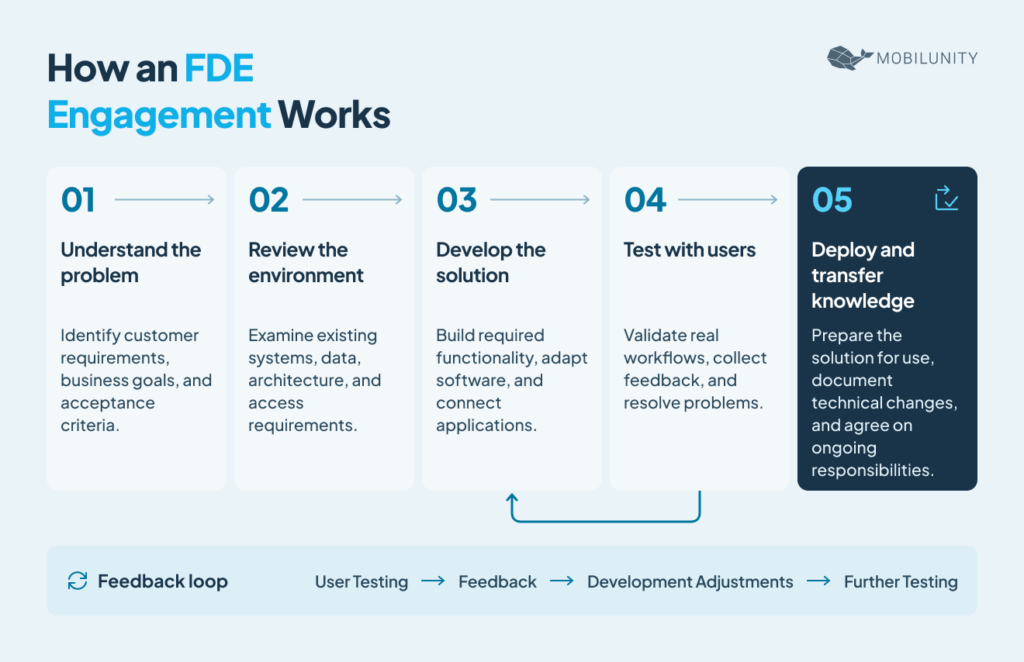
You can understand the work by following a customer implementation from the initial requirements to the point when your internal team can operate the solution.
| Activity | Practical Result |
| Understand the customer problem | Documented business requirements and agreed success criteria |
| Review the existing environment | Knowledge of applications, data, architecture, and access restrictions |
| Develop the required solution | Custom code, adapted functionality, and application integrations |
| Validate with users | Tested workflows, feedback, and resolved implementation issues |
| Prepare for deployment | Deployment assistance and agreed operational responsibilities |
| Document and transfer knowledge | Technical documentation and guidance for internal teams |
During discovery, engineers work with your product owners, customer representatives, internal developers, IT administrators, and security specialists. Each group provides information needed to implement the solution.
For example, your product owner explains the expected workflow, while IT staff provide information about system access and integration restrictions. Your internal developers review code changes and confirm that custom functionality follows the product’s architecture.
Development may take place within your repositories and existing engineering processes. Depending on the project, engineers may adapt application functionality, create API connections, configure data exchange, or prepare an AI feature to work with approved business information.
The implementation then needs validation against actual user requirements. Your team and the engineers test workflows, investigate errors, and confirm that the solution meets the agreed acceptance criteria.
Depending on the agreement, the engagement may also include production deployment, CI/CD configuration, monitoring, and post-launch troubleshooting. Across these stages, forward deployed engineering services connect customer discovery with practical development in the customer’s environment.
You should identify deliverables, system access requirements, deployment responsibilities, and ownership of future maintenance before starting. Don’t assume every provider includes continuous support.
You have several options for obtaining external engineering expertise. The main differences concern the work performed, who manages the engineers, and who accepts responsibility for delivery.
| Support Model | Typical Work | Who Manages the Work? | Delivery Responsibility |
| Consulting | Technical assessment, recommendations, and architecture planning | Consulting provider manages its consultants | Usually the client, unless implementation is included |
| FDE engagement | Customer discovery, technical problem-solving, development, and implementation | Provider or client, depending on the agreement | Defined by the delivery agreement |
| Development outsourcing | Software development against an agreed scope and deliverables | External provider manages the development team | Provider is accountable for contracted deliverables |
| Dedicated engineers | Ongoing development, integrations, testing, and customer implementation tasks | Client manages daily work and priorities | Client directs engineering work; staffing provider handles employment administration |
FDE consulting often combines technical assessment with practical implementation. Consulting firms may also develop and deploy solutions, while outsourcing providers may work closely with end users. The service label alone doesn’t determine the actual responsibilities.
Dedicated engineers follow a different arrangement. They work under your direction, participate in your development processes, and contribute to ongoing product or customer implementation work.
Additional implementation capacity may help when your product works technically but customer adoption repeatedly encounters obstacles.
Look for these situations:
You should also consider how frequently these problems occur. One difficult integration may need a specialist for a limited period, while repeated customer-specific deployments may justify a dedicated engineer who builds knowledge of your product, architecture, and implementation processes.
An FDE engagement may be unnecessary for standard product configuration, routine technical support, or a small development task with clearly defined requirements. An existing implementation specialist or short-term developer contract may be enough.
Before hiring, appoint an internal business owner who can clarify requirements and approve decisions. Arrange access to relevant users, obtain approved access to the required systems, and define acceptance criteria. Your engineers need these prerequisites to understand the problem, perform the work, and confirm that the implementation meets the expected outcome.
Mobilunity helps you recruit dedicated engineers based on your product, technical requirements, implementation challenges, and customer-facing responsibilities. The dedicated hiring model gives your company additional engineering capacity while keeping daily development management and customer priorities under your control.
Recruitment starts with a discussion about your product, technical stack, deployment environment, and the work the engineer will perform. Mobilunity uses these requirements to identify candidates with relevant technical experience, integration skills, and customer communication abilities.
Your team interviews shortlisted candidates and makes the final selection. Mobilunity then supports onboarding and handles employment documentation, HR administration, and ongoing employee assistance.
The responsibility split is straightforward. Your company assigns tasks, sets engineering priorities, manages customer communication, reviews code, and makes technical decisions. Mobilunity supports recruitment and team operations.
You can choose full-time dedicated engineers for recurring customer implementations or the part-time FLEX model for specific integrations, deployment tasks, and temporary workloads. This gives you flexibility when implementation demand changes.
Mobilunity’s figures provide additional context about its recruitment and AI talent operations:
If you plan to hire forward deployed engineer, discuss your product, integration requirements, and customer-facing responsibilities with the recruitment team.
For companies considering building an offshore FDE team, dedicated engineers offer a way to establish ongoing implementation capacity while keeping engineering decisions and customer relationships within the organization.
Start by identifying the customer problem, the engineering work required, the internal project owner, and the expected outcome. Specify the technical skills, experience with integrations or production deployments, and level of customer interaction the role requires.
Also decide whether you need a full-time engineer for recurring implementations or part-time support for specific technical tasks. Share these details with Mobilunity to discuss suitable dedicated engineering support and recruitment options.
These answers cover the responsibilities, engagement arrangements, hiring costs, and provider selection criteria.

Disclaimer: All salaries and prices mentioned within the article are approximate numbers based on the research done by our in-house Marketing Research Team. Please use these numbers as a reference for comparison only. Feel free to use the contact form to inquire on the specific cost of the talent according to your vacancy requirements and chosen model of engagement.
Client Testimonial
Mobilunity provides an excellent and efficient tech talent service. All my staffing requests, even for niche technologies, were fulfilled in a 2 to 4-week time period, with top-notch candidates. Besides that, I like the caring environment that the Mobilunity team provides for the developers and ensures that everybody is able to work without distractions.
I strongly recommend Mobilunity as a tech talent partner!

Waldemar Biller
Head of Technology


Fulltime dedicated teams, FLEX on-demand model, consultancy, recruitment, EOR