
IT Recruitment Lithuania: Market Overview and Hiring Guide

In today’s dynamic IT outsourcing landscape, companies often face a critical decision between two popular engagement models: Staff Augmentation and Managed Services. While both approaches offer unique advantages, they differ significantly in terms of control, responsibility, and resource management. This article provides a side-by-side comparison to help you determine which model best aligns with your project goals and organizational needs.
Staff augmentation is when a company hires additional specialists to fill gaps in roles or skills for a specific period or project. These workers become a part of the core team, integrating with your workflows and enhancing the internal resources with expertise. A distinct feature between managed services vs staff augmentation services is that the latter means these workers are fully under your direction.
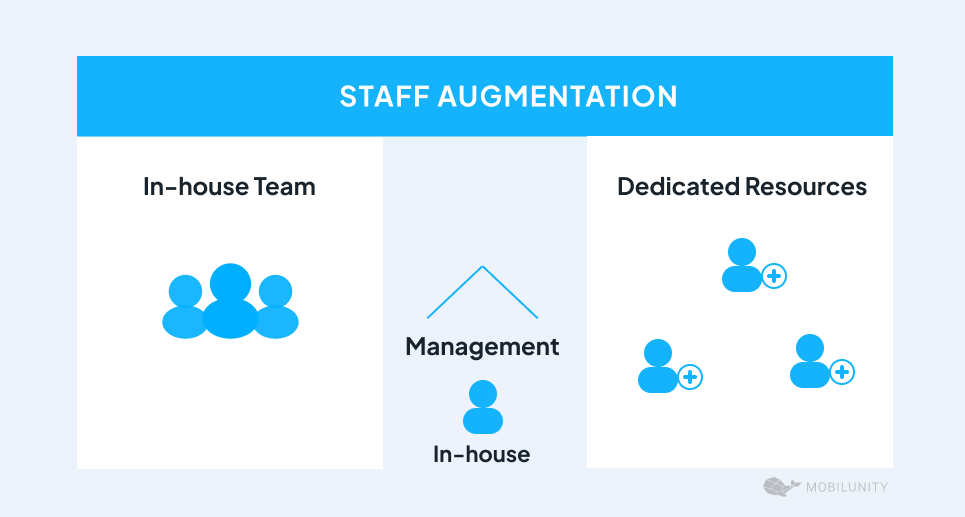
While this approach raises some concerns with miscommunication, onboarding timelines, and security, staff augmentation benefits often outweigh the risks.
| Advantages | Consideration |
| – Cost optimization. It helps lower costs since you don’t need to go through lengthy hiring cycles, pay taxes and benefits for the new workers. – Time to market. Filling the gaps in your team with missing resources helps launch and scale projects faster. – Global talent market. You can augment your team with staff from abroad, choosing countries with expertise that the local one lacks. – Flexibility and scalability. Organizations can scale their teams up and down based on project demands, without the burden of long-term commitments. – Control and collaboration. It allows companies to oversee project execution and quality fully without relying onthird parties for the outcomes. | – Management overhead. Staff augmentation requires a strong internal management capacity, and could lead to a management style that doesn’t plan for resource consumption. – Project duration. It’s more suited for short-term projects, since the benefit derived from avoiding hiring costs may be lost over time. – Accountability. The client assumes full responsibility for the deliverables, project success, workflows, and deadlines. – Knowledge control. Contractors accumulate information that the company may depend on, requiring a solid knowledge sharing strategy, so it’s not lost when the employee leaves. |
There are different types of such engagement depending on the project scope, duration, and skills needed. Here’s the typical categorization of services that IT staff augmentation companies can provide:
Managed services means outsourcing responsibilities to an external provider to increase automation, improve operational efficiency, and decrease costs. Staff augmentation and managed services are really two strategic approaches to handling tasks when a company doesn’t have relevant resources and to reduce expenses. However, managed service providers (MSP) work independently and are rather proactive.
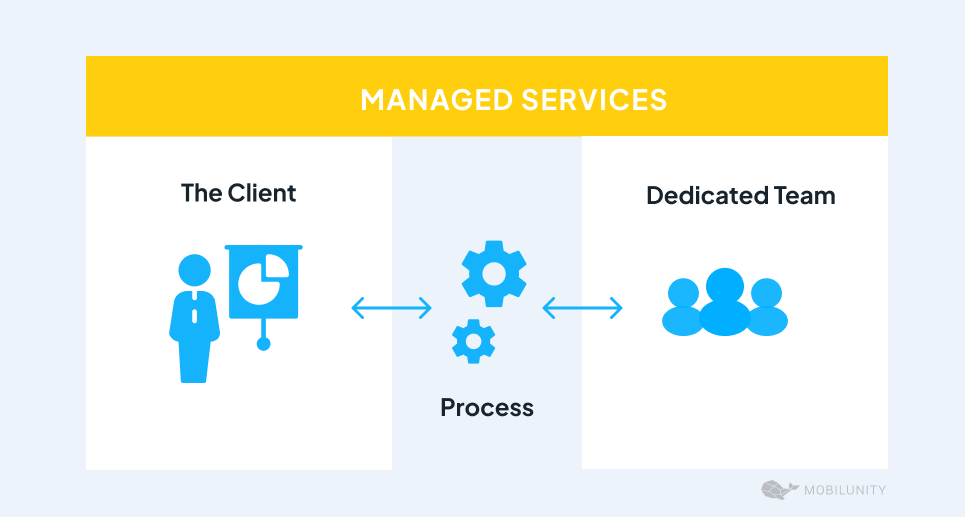
Also, if we compare staff augmentation vs outsourcing, the former isn’t an on-demand or break-fix solution, when the provider bills only for the work done.
Unlike traditional outsourcing, which typically focuses on delivering tasks or hours of work, the managed services model is outcome-based. The MSP commits to meeting predefined service levels (SLAs), proactively managing your environment, and ensuring that systems run efficiently and securely.
In short, you’re not just buying labor. You’re buying reliability, continuity, and measurable results.
| Advantages | Considerations |
| – Proactive support. MSPs detect and resolve issues before they cause downtime using continuous monitoring and automation. – Predictable costs. Fixed monthly or per-user/device pricing makes budgeting easier and reduces unexpected expenses. – Reduced operational risk. The MSP assumes responsibility for meeting SLAs and delivering outcomes, shifting operational risk away from the client. – Increased productivity. Stable systems, fast support, and reduced downtime help employees work more efficiently. – Standardized processes. Documentation, best practices, and automation ensure consistency and minimize knowledge loss. | – Less direct control. The client has limited control over day-to-day execution because the MSP manages the entire function. – Long-term contracts. Managed services typically require monthly or yearly commitments with less flexibility than ad-hoc outsourcing. – Dependency on the provider. Companies may become dependent on the MSP’s reliability, expertise, and responsiveness. – Upfront planning required. The model requires detailed requirements and clear SLAs; a poorly defined scope can increase costs later. – Limited short-term flexibility. Not ideal for temporary or fast-changing projects that require rapid adjustments or hands-on oversight. |
A big difference between staff augmentation model and managed services is that businesses work with MSPs to handle entire segments of their tech stack, from infrastructure to cloud and cybersecurity. Most providers may be categorized into five core types:
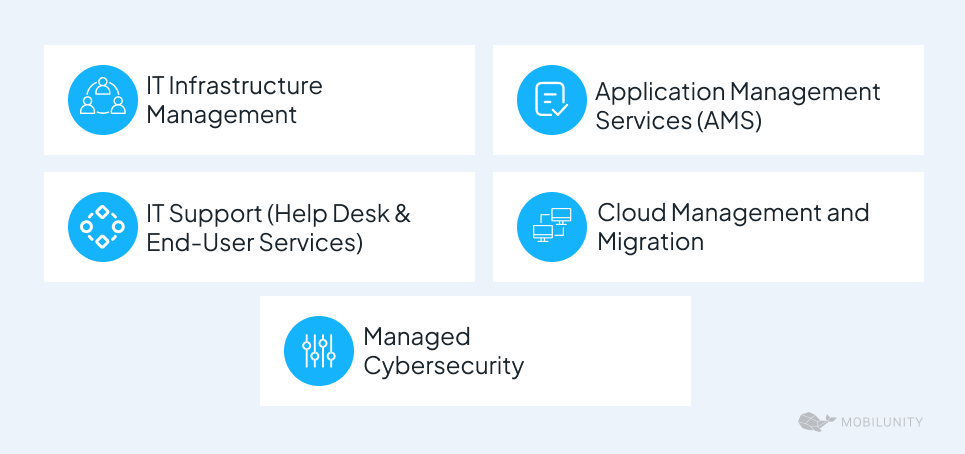
Modern environments are complex, and managing them manually is difficult, if not impossible. MSPs ensure infrastructure components are secure and always available. They help businesses avoid outages, reduce downtime, and keep mission-critical systems stable. Such services include:
As applications grow more distributed and cloud-native, maintaining them becomes an ongoing challenge. AMS providers ensure they stay healthy, updated, and aligned with business needs, without burdening internal IT teams. Their services include:
User experience is the backbone of business success, and a well-run support function helps ensure clients aren’t frustrated with app operation. Managed IT support provides a stable, responsive layer of assistance for employees, eliminating bottlenecks and productivity blockers. Such services include:
Cloud environments are as flexible as they are complex. MSPs help businesses migrate to the cloud and ensure optimized, secure, and cost-efficient workloads. Such services include:
Attack surfaces are expanding, threats are becoming more sophisticated, and most organizations lack the talent and tools to keep up. Managed security service providers (MSSPs) deliver continuous monitoring, threat detection, and rapid incident response to protect businesses from constantly evolving threats. MSSPs cover a wide range of tasks, but generally include:
Both models help companies fill resource gaps, cut costs, and boost delivery speed – but they work in fundamentally different ways. Understanding these differences helps businesses choose the right engagement model based on control, complexity, skills needed, and desired outcomes.
Here’s a clear comparison of the managed services model and staff augmentation:
| Criteria | Staff Augmentation | Managed Services |
| Core Purpose | Add extra talent to extend your existing team. | Outsource responsibility for a function or process to an external provider. |
| Engagement Type | Input-based: the client buys talent and hours. | Outcome-based: the client buys results and service levels (SLAs). |
| Responsibility & Ownership | The client manages workflows, quality, deadlines, and deliverables. Full delivery risk stays in-house. | The MSP owns planning, execution, delivery, and SLAs. Delivery risk shifts to the provider. |
| Control Level | High. The client has full day-to-day control over augmented staff. | Lower. The MSP manages operations, tools, and execution independently. |
| Team Integration | External specialists join the internal team and follow the client’s processes. | The MSP operates as an independent entity with its own processes and tools. |
| Best For | Short-term projects, skill gaps, meeting deadlines, and scaling development quickly. | Long-term operational needs, ongoing maintenance, proactive monitoring, and stable service delivery. |
| Cost Structure | Pay per hour or per resource. Costs scale with hours worked. | Subscription-based or fixed monthly fee tied to outcomes and SLAs. |
| Flexibility | Highly flexible – scale talent up or down as needed. Ideal for fast-changing scopes. | Less flexible – contract terms are more stable and long-term. |
| Time to Ramp Up | Requires onboarding, access setup, and integration into workflows. | Fast start once the scope is defined – MSP already has established processes and tools. |
| Tools & Processes | Provided by the client. Contractors rely on the client’s environment. | Provided by the MSP – monitoring, automation, ticketing, reporting, etc. |
| Knowledge Retention | Knowledge often stays with individuals and may be lost when they leave. | MSP provides documentation and standardized processes that stay with the client. |
| Security & Compliance | Managed by the client; more risk if contractors have wide access. | MSP provides security controls, compliance policies, and continuous monitoring. |
| Scalability | Scales by adding or removing people. | Scales by adjusting service levels, automation, processes, and tooling. |
| Ideal For Companies That… | Have strong internal management and need extra hands or niche expertise. | Lack internal resources or want to offload a full function (e.g., security, infrastructure, help desk). |
When comparing staff augmentation to managed services, it’s the kind of company and the particular situation that dictate which model makes more sense. First, try answering these questions:
This model works well for companies with strong internal management when extra hands or specialized skills are needed, for a definite period, and handled internally. Typically these are
Staff augmentation helps cover temporary workload spikes, fill skill gaps, or provide short-term consulting or expert input.
Businesses choose MSPs when they’re looking for outcomes, reliability, and ongoing support, but don’t want to manage the details. Typically these are
Managed services help cover continuous monitoring and uptime, lack of internal IT and DevOps resources, when cybersecurity demands exceed internal capabilities, and if you’re looking to decrease operational risk.
Ultimately, the choice between the two models hinges on control, scope, duration, and internal capabilities.
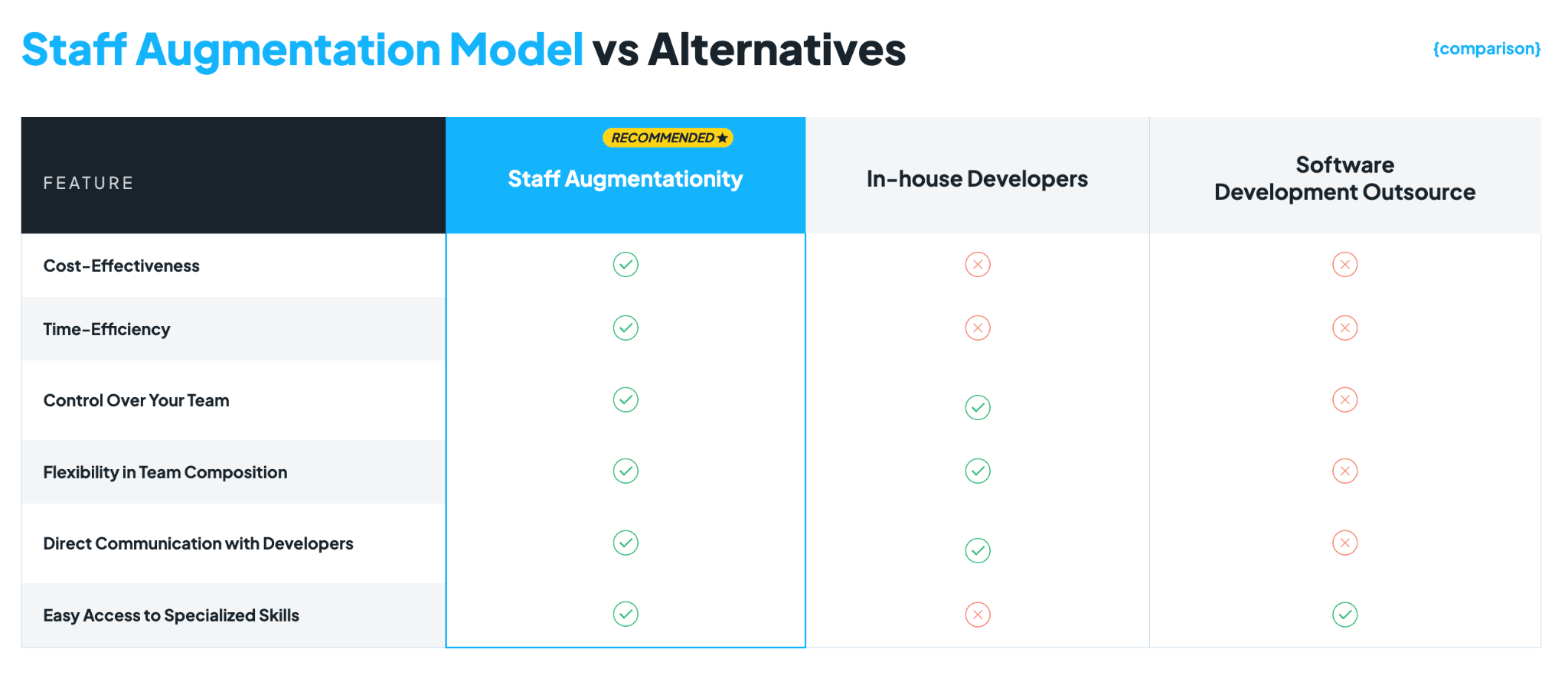
Both models offer a strategic path to significantly strengthening your delivery capabilities, but they solve different problems. So, in some cases, they can work as complementary solutions for one company.
The hybrid approach can benefit companies that need temporary staff on one project and ongoing support on another. While an MSP ensures stable operations, augmented staff help the internal team innovate, modernize, or deliver new initiatives faster.

Disclaimer: All salaries and prices mentioned within the article are approximate numbers based on the research done by our in-house Marketing Research Team. Please use these numbers as a reference for comparison only. Feel free to use the contact form to inquire on the specific cost of the talent according to your vacancy requirements and chosen model of engagement.
Client Testimonial
Mobilunity provides an excellent and efficient tech talent service. All my staffing requests, even for niche technologies, were fulfilled in a 2 to 4-week time period, with top-notch candidates. Besides that, I like the caring environment that the Mobilunity team provides for the developers and ensures that everybody is able to work without distractions.
I strongly recommend Mobilunity as a tech talent partner!

Waldemar Biller
Head of Technology







Fulltime dedicated teams, FLEX on-demand model, consultancy, recruitment, EOR