Hire Developers in Hungary

Key takeaways:
Outstaffing, outsourcing, and in-house employment offer three ways to expand a software development team. Outstaffing suits companies that already manage development internally but need additional developers. Outsourcing works better when you want an external provider to take responsibility for project delivery. In-house employment makes sense when you need a permanent team that works directly for your company.
The main difference comes down to who manages the developers, how much each model costs, and how quickly you can build a team.
This guide compares 13 outstaffing companies, reviews each model’s costs and responsibilities, and explains how to choose the right provider.
The table below offers a quick comparison of 13 outstaffing companies, covering their service models, talent locations, pricing, and engagement terms. Some specialize in dedicated developers, while others also offer fully managed outsourcing services. You’ll find a closer look at each provider in the company profiles that follow.
| Company | Service Model | Talent Locations | Typical Rate or Fee | Time to First Candidate | Best For |
| Mobilunity | Dedicated teams, staff augmentation | Ukraine, Eastern Europe, LATAM | Custom monthly rates | First-matching CV is provided within 5 business days, in the majority of cases – even sooner | Building dedicated development teams |
| Devico | Staff augmentation, dedicated teams | Europe | Not published | 48 hours | Adding experienced European developers to existing teams |
| NeoWork | Staff augmentation, managed services | Latin America, Philippines | Not published | Under 48 hours | Expanding development teams |
| Tecla | Staff augmentation, dedicated self-managed teams (pods), hired under Tecla’s EOR | 18+ Latin American countries | Up to 60% less than equivalent US talent; rolling monthly terms; first 2 weeks free, pay only after hire | Shortlist in as soon as 3 days; full-cycle hire in as little as 3 weeks | AI-fluent nearshore tech talent on US hours |
| Winged IT | Recruitment, staff augmentation, outsourcing | Poland, Europe | Not published | 1-2 weeks | Building development teams with Polish IT specialists |
| Zallpy Digital | Staff augmentation, outsourcing | Latin America | Not published | Not published | Nearshore engineering teams |
| Ancient | Staff augmentation, dedicated teams, outsourcing | Latin America | Not published | Not published | Building nearshore development teams in Latin America |
| rtCamp | Staff augmentation, managed development | India | Not published | Not published | Expanding existing teams with specialized web developers |
| Implex | Staff augmentation, dedicated teams, outsourcing | Eastern Europe | Not published | Not published | Expanding development teams and building software products |
| Rootstack | Staff augmentation, outsourcing | Latin America | Not published | Not published | Building nearshore development teams in Latin America |
| Atrax | Dedicated teams, outsourcing | Eastern Europe | Not published | Not published | Building dedicated development teams with Eastern European engineers |
| Beetroot AB | Dedicated teams, team extension | Ukraine, Poland, Bulgaria, Vietnam | Not published | Not published | Building long-term development teams with dedicated specialists |
| Mind Studios | Dedicated teams, custom development | Ukraine | Not published | Not published | Building dedicated development teams or outsourcing custom software development |
Outstaffing can reduce development costs by 30-50% and shorten recruitment timelines, according to Mobilunity’s internal research. These savings depend on developer location, seniority, and your existing engineering resources.
Unlike outsourcing, outstaffing gives you direct control over developers without the administrative responsibilities of local employment. But how does it compare financially with other development models?
| Factor | Outstaffing | Outsourcing | In-House |
| Typical costs* | Varies by provider, developer location, tech stack, and seniority | $4,000-$7,840/month equivalent | $8,083-$13,167/month in US total compensation, plus employer costs |
| Pricing model | Monthly developer fee | Hourly or fixed-project fee | Salary, taxes, benefits, overhead |
| Time to Recruit or Start** | 2-6 weeks | Varies by project and provider | 2,5 months median to fill a technical role |
| Employment risk | Provider handles local employment obligations | Provider employs its staff | Your company assumes direct employment obligations |
| Daily management | Your engineering team | Outsourcing provider | Your engineering team |
| Delivery responsibility | Your company owns project delivery | Provider, subject to contract | Your company |
| Best for | Long-term development capacity | Complete projects | Permanent engineering teams |
*Costs reflect data collected in October 2026 from Clutch’s hourly rates and Glassdoor’s US compensation estimates. Actual costs vary by provider, location, and employment expenses.
**Timelines reflect data available in October 2026. Outstaffing figures come from Mobilunity, while in-house recruitment data comes from Ashby’s 2026 report. Outsourcing timelines vary by project. Figures measure different stages and aren’t directly comparable.
With outstaffing, you get developers who join your existing engineering team, while the provider handles recruitment, contracts, payroll, and local employment requirements. This saves time on administrative work and lets you add specialists without setting up a local entity.
There are three ways to organize the cooperation:
All three options let you adjust team size without taking on direct employment responsibilities. You still manage the developers’ daily work, make technical decisions, and remain accountable for project delivery.
With outsourcing, you hand over project development to an external company. Its team handles technical tasks, coordinates developers, and takes responsibility for delivering the agreed results.
You typically pay an hourly rate or a fixed project fee, depending on the contract. The final cost depends on the project’s complexity, required expertise, and developer location.
You don’t need to manage individual developers, but you also have less say in their daily work. Outsourcing is a good option for companies without an internal engineering team or those with clearly defined projects. Keep in mind that changes to the original scope can increase costs, especially with fixed-price contracts.
With in-house employment, you hire developers directly and manage their salaries, benefits, and day-to-day work. You also have full control over technical decisions and how your team works.
According to Glassdoor, software developers in the US earn an estimated $97,000-$159,000 annually, with a median total pay of $124,000. That’s about $8,100-$13,250 per month, before additional employer expenses like payroll taxes, equipment, and recruitment.
Finding experienced developers can take several months, especially for specialized roles. The investment makes sense when you need a permanent team that knows your product well and can support its long-term development.
Outstaffing works well when you already have an engineering team and need more developers without the responsibilities of local employment. Outsourcing is a better fit when you want an external company to handle project delivery. In-house employment makes sense when you’re building a permanent team.
Before deciding, look at the full annual cost, recruitment time, and management effort. A lower hourly rate won’t necessarily save you money in the long run.
Understanding outstaffing vs outsourcing helps you choose the right development partner. Outstaffing gives you direct control over external developers, while outsourcing delegates project delivery. We compared 13 companies offering outstaffing services, including providers that support both models.
Best for: IT staff augmentation and dedicated development team services for long-term projects.
Founded in 2010, Mobilunity recruits developers for fintech, e-commerce, SaaS, marketing technology, education, and other industries. Its 3Rs approach focuses on Relationships, Recruitment, and Retention.
You manage development directly, while Mobilunity handles recruitment, HR, administrative support, and talent retention. You’ll need your own technical lead to oversee delivery, but Mobilunity can also help you find one. Our recruitment experience extends to senior technical leadership roles, such as CTOs.
Year founded: 2010
Headquarters: Kyiv, Ukraine
Talent locations: Eastern Europe, the Balkans, and LATAM
Typical rate or fee: Custom monthly rates
Time to first candidate: First-matching CV is provided within 5 business days, often even sooner
Key technologies/stacks: React, Node.js, Scala, Java, JavaScript, Ruby, .NET, Angular
Key clients’ domains: Fintech and Finance, E-commerce, Real Estate and PropTech
Named clients: Zenchef, FinExpert, Klevu, Paidy, Camptocamp, Booqable, CheMondis
Best for: Startups and enterprises seeking experienced European developers.
Founded in 2010, Devico is an IT staff augmentation and custom software development company that helps businesses expand their engineering capacity without the delays and overhead of traditional hiring. With more than 250 engineers and access to a pan-European talent pool, Devico provides vetted specialists and dedicated development teams tailored to each client’s technical requirements.
Devico works with companies of all sizes, from early-stage startups and growing scaleups to established enterprises. Its project portfolio spans healthcare, telecom, AdTech, MarTech, fintech, EdTech, retail, blockchain, eCommerce, dental technology, and other industries. Clients include organizations such as Abbott, Tipalti, and BP. The company’s core expertise includes JavaScript and Node.js development, React, Angular, Vue.js, and quality assurance.
Devico can provide suitable engineering profiles within 48 hours and onboard specialists in as little as 5-10 days. Its flexible engagement models, strong English proficiency, transparent pricing, and distributed delivery infrastructure help clients scale teams quickly while maintaining seamless collaboration and business continuity.
Year founded: 2010
Headquarters: 521 Fifth Ave, NY 10175, New York
Number of employees: 250 – 500
Developers based in: Warsaw, London, and Lviv offices, supported by a pan-European talent network
Key technologies/stacks: JavaScript, Node.js, React, Angular, Java, Typescript, Vue, QA
Key clients’ domains: Healthcare, fintech, AdTech, MarTech, telecom, EdTech, retail, blockchain, and dental technology
NeoWork stands out for its retention-first outstaffing model focused on long-term partnerships, with teammates integrated fully into client operations rather than working as short-term contractors. Founded in 2017 and based in Miami, the company built its model specifically to fix the churn problem common in traditional outstaffing, where clients lose momentum every time a developer rotates off a project.
NeoWork offers outstaffing across IT & Development, data science, and cloud architecture, plus adjacent operations functions like customer experience and virtual assistance, helping companies scale multiple departments through a single partner instead of managing several vendor relationships. Its hiring process is highly selective – only 3.2% of applicants are accepted – and it reports a 91% annualized teammate retention rate, well above the roughly 60% industry average. Clients consistently cite straightforward pricing, hands-on HR management, and the ability to stand up specialized teams within weeks.
Year founded: 2017
Headquarters: Miami, FL, USA
Number of employees: 100–250
Developers based in: Colombia, Philippines
Key technologies/stacks: Product Development, Web Development, Data Science, Cloud Architecture
Key clients’ domains: HealthTech, E-commerce, Media & Entertainment, Gaming
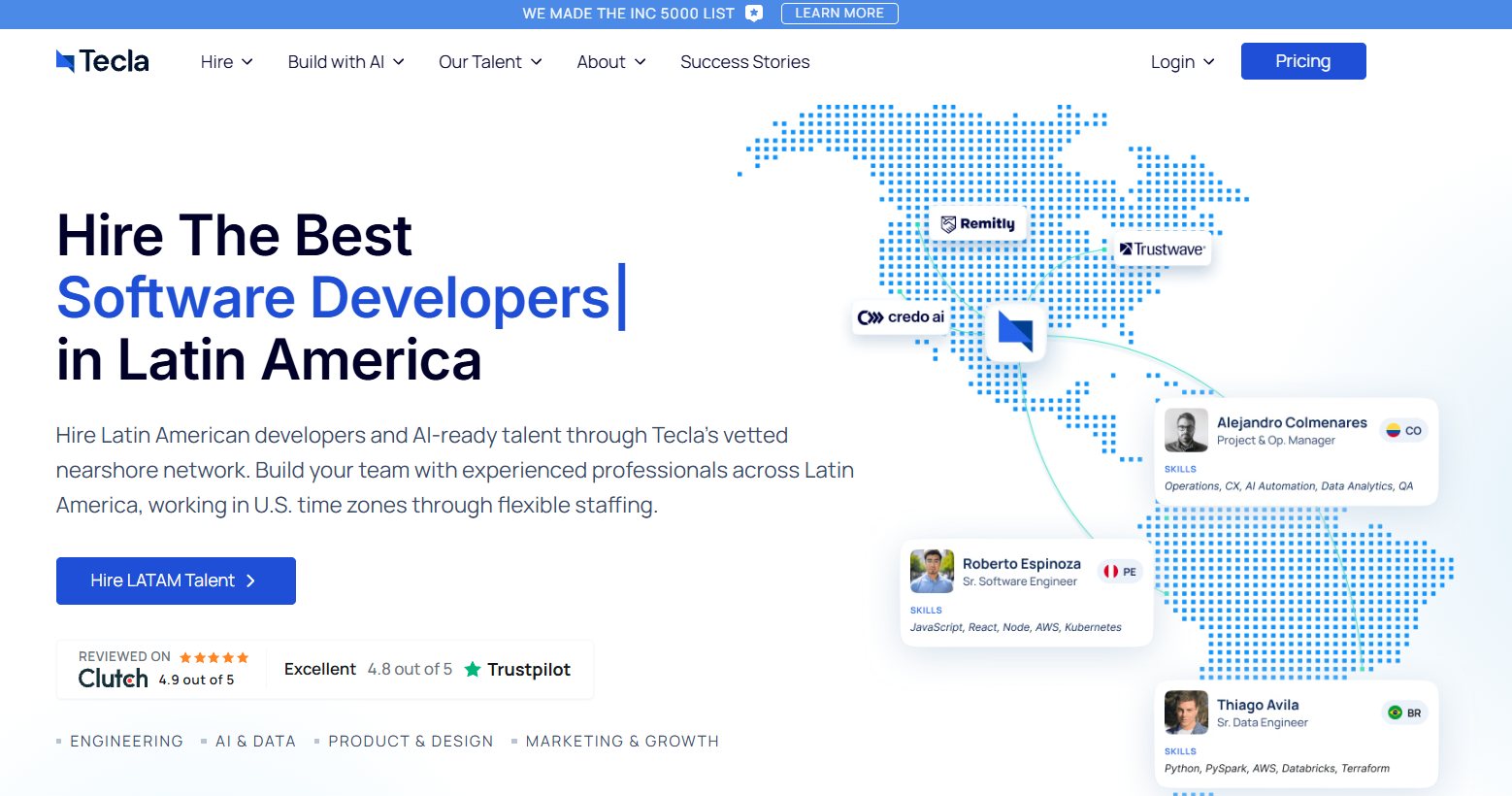
Best for: US teams building with AI that need AI-fluent nearshore tech talent on their hours.
Founded in 2013, Tecla recruits engineers, data specialists, designers, and marketers from Latin America for US companies. The nearshore staffing company supports teams through staff augmentation and dedicated, self-managed pods, with talent hired under Tecla’s EOR so payroll, benefits, and compliance are handled.
Tecla’s pricing is positioned as up to 60% below equivalent US talent, with a full-cycle hire taking as little as 3 weeks. Factor in that it’s built for ongoing team augmentation, so it’s less suited to a freelancer for a short, one-off task or to talent based in the US.
Year founded: 2013
Headquarters: Not published
Talent locations: 18+ Latin American countries
Typical rate or fee: Up to 60% less than equivalent US talent; rolling monthly terms; first 2 weeks free, pay only after hire
Time to first candidate: Shortlist in as soon as 3 days
Key technologies/stacks: AI-fluent engineering, data, design, and marketing talent; AI agents and automations via Tecla Labs

Best for: Companies seeking Polish IT and cybersecurity specialists.
Founded in 2017, Winged IT recruits developers, DevOps engineers, and cybersecurity professionals. The outstaff company supports startups and enterprises through staff augmentation, recruitment, and remote team setup.
Winged IT estimates that a specialist takes about two months on average to join your team, including interviews and the candidate’s notice period. Factor that in if you need someone to start sooner.
Year founded: 2017
Headquarters: Katowice, Poland
Talent locations: Poland and Eastern Europe
Typical rate or fee: Contractor costs plus agreed markup
Time to first candidate: 1-2 weeks
Key technologies/stacks: Java, .NET, Angular
Key clients’ domains: Healthcare, Finance, Retail
Named clients: Not publicly disclosed

Best for: Enterprises seeking nearshore engineering teams in Latin America.
Founded in 2009, Zallpy Digital is an IT outstaffing agency that specializes in software engineering, data analytics, and UX research. The company works with financial institutions and retailers on software modernization projects.
If you only need one or two developers for a short project, ask Zallpy about availability and any minimum commitment before you shortlist it.
Year founded: 2009
Headquarters: Frisco, USA
Talent locations: Brazil and Latin America
Typical rate or fee: Not published
Time to first candidate: Not published
Key technologies/stacks: React, Vue.js, Node.js, PHP
Key clients’ domains: Fintech, Healthcare, Telecommunications
Named clients: BMW, Bunge, FlavorHawk, Sicredi, Ticket Log, TKE

Best for: US companies seeking nearshore software developers in Latin America.
Ancient is one of the outstaffing companies that offer staff augmentation, dedicated engineering teams, and custom software development. Its developers work with web and mobile applications, cloud technologies, and data engineering.
Ancient is worth considering if you want to work with developers in Latin American time zones. Its regional focus may be less suitable for businesses that prefer to source talent from Europe or Asia.
Year founded: 2016
Headquarters: Mexico City, Mexico
Talent locations: Latin America
Typical rate or fee: Not published
Time to first candidate: Not published
Key technologies/stacks: JavaScript, Python, Java, React, Node.js
Key clients’ domains: Fintech, Healthcare, E-commerce, and Telecommunications
Named clients: Thomson Reuters, Mattermost, Bupa Seguros, Liverpool, Pomelo, Matterport, Grupo Salinas

Best for: Companies seeking WordPress and WooCommerce development expertise.
Founded in 2009, rtCamp specializes in enterprise WordPress development, migrations, and ongoing support. Unlike many outstaff companies, it also offers managed development services.
rtCamp suits media companies and other organizations with complex WordPress websites, but may be less suitable for projects built with other technologies.
Year founded: 2009
Headquarters: Pune, India
Talent locations: India
Typical rate or fee: Not published
Time to first candidate: Not published
Key technologies/stacks: WordPress, PHP, JavaScript, React, WooCommerce
Key clients’ domains: Media and Publishing, E-commerce, Enterprise Technology
Named clients: Meta, Al Jazeera, Cox Automotive, Penske Media Corporation, Grist, The Indian Express

Best for: Startups and SMEs seeking experienced developers and product development support.
Founded in 2020, Implex is a tech outstaffing company that provides dedicated teams, staff augmentation, and custom software development. Its developers specialize in React Native, Flutter, and Node.js, with experience in fintech, healthcare, and retail.
If you only need help recruiting developers or handling payroll and employment administration, confirm whether Implex offers those services separately from its engineering engagements.
Year founded: 2020
Headquarters: Kraków, Poland
Talent locations: Eastern Europe
Typical rate or fee: Not published
Time to first candidate: Not published
Key technologies/stacks: React Native, Flutter, Node.js
Key clients’ domains: Fintech, Retail, Healthcare
Named clients: ercona, ENESTECH, Olpe, Yoy, Best of Masters, Admit.me

Best for: Businesses seeking nearshore developers and custom software development.
Founded in 2010, Rootstack is an IT outstaffing agency that also offers software development and technology consulting. Its developers work on web applications, mobile products, and enterprise systems.
Rootstack can add engineers to your existing team or provide a managed team to handle technical delivery. Its staff augmentation page doesn’t list developer rates, so you’ll need to request a quote to compare costs.
Year founded: 2010
Headquarters: Panama City, Panama
Talent locations: Latin America
Typical rate or fee: Not published
Time to first candidate: Not published
Key technologies/stacks: React, Angular, Java, Python
Key clients’ domains: Financial Services, Healthcare, Retail
Named clients: Hyundai, Caterpillar, Heineken, WPP, Global Bank, The Vitamin Shoppe

Best for: European startups and agencies seeking dedicated software engineers.
Founded in 2015, AtraX is an IT outstaffing services company that provides developers with expertise in React, Node.js, and .NET. Its dedicated teams work closely with clients’ engineers and share overlapping European business hours.
AtraX also offers end-to-end product development and modernization for existing software. If you need several engineers to start at the same time, confirm availability and onboarding timelines with AtraX upfront.
Year founded: 2015
Headquarters: Tirana, Albania
Talent locations: Eastern Europe
Typical rate or fee: Not published
Time to first candidate: Not published
Key technologies/stacks: Node.js, React, .NET
Key clients’ domains: Technology, Manufacturing, Financial Services
Named clients: Toyota, Siemplify, Seraphic, Microsoft, PODKI, Markenometry, Gruppo Toscano

Best for: Companies seeking long-term development teams with a focus on social responsibility.
Founded in 2012, Beetroot AB is an IT outstaffing company that builds dedicated development teams for education, healthcare, and green technology businesses. The company also supports tech education through its social enterprise initiative, Beetroot Academy.
Beetroot handles recruitment, payroll, and HR, while you manage the developers’ daily work. This model works best for companies with internal technical leadership that can oversee development.
Year founded: 2012
Headquarters: Stockholm, Sweden
Talent locations: Ukraine, Poland, Bulgaria, Vietnam
Typical rate or fee: Not published
Time to first candidate: Not published
Key technologies/stacks: Python (Django), React, AWS
Key clients’ domains: Finance, Education, NGOs
Named clients: Monocl, Land Life, Inspera, Skanska, Continental, Svea Solar

Best for: Startups and growing businesses seeking custom software development.
Founded in 2013, Mind Studios develops mobile apps, SaaS platforms, and web products. The company offers product discovery, UI/UX design, and dedicated development teams.
Mind Studios can add specialists to your existing engineering team or take on end-to-end product development. The company provides a tailored proposal after an initial consultation, so you’ll need to discuss your requirements before you can compare costs.
Year founded: 2013
Headquarters: Dnipro, Ukraine
Talent locations: Ukraine
Typical rate or fee: Not published
Time to first candidate: Not published
Key technologies/stacks: Flutter, React Native, Node.js, Python
Key clients’ domains: Healthcare, Education, Finance
Named clients: FITR, Envol, Wise Up, Mulki, MyMP3Pool, Chapp
Developer rates are only one factor when choosing an outstaffing company. You also need to consider its technical expertise, communication practices, and ability to keep your team stable.
Here are six steps to help you assess potential partners.
First, outline what you want to build, which technologies the project requires, and when you expect to finish it. Then assess your current team’s skills to identify gaps and determine how many additional developers you need. This will give potential providers enough information to suggest suitable candidates and prepare realistic cost estimates.
Your choice depends on how much development work you have, your budget, and the resources available to manage external developers. For long-term projects, a dedicated team may be the best fit. Staff augmentation works when you only need a few specialists, while a hybrid model lets you expand an existing external team as workloads increase.
Check whether the provider has worked with your technology stack and companies in your industry. Look through its case studies and client reviews to see what projects it has handled. Ask how it evaluates developers’ technical skills and whether it has filled similar positions before. Industry experience can also make onboarding easier, especially if your project involves specific regulations or business processes.
Find out how the provider recruits developers, calculates fees, and keeps clients informed. Ask who your main contact will be, how often you can expect updates, and what happens when problems arise. It’s also worth checking how many working hours your teams will share, especially if the developers are in a different time zone.
Make sure the provider complies with employment laws in every country where its developers work. Review its contracts, intellectual property rights, confidentiality terms, and data protection policies. If your project involves personal data subject to GDPR, ask how the company handles compliance. Before signing, confirm who takes responsibility for payroll, employment disputes, and other contractual obligations.
Ask how long developers typically stay with the provider and how often they leave. Find out what the company does to support employees, develop their skills, and review their performance. You should also know how quickly it can replace a developer if needed. Frequent team changes mean more time spent on onboarding and less time on development.
Before making your choice, weigh these factors alongside pricing and technical expertise. A reliable partner should offer clear contract terms, good communication, and a stable development team.
Which model works best for you depends on your team’s skills, how long you’ll need developers, and who will manage their work. Let’s look at four common situations and the best option for each.
Recommended model: Staff augmentation
If your team knows the product but lacks certain technical skills, staff augmentation may be the right choice. You can bring in Python, React, DevOps, or other specialists without changing your team’s structure. An outstaffing company finds the developers and handles their employment, while your engineering manager oversees their work. This model also works well when you need extra developers for a limited period.
Recommended model: Dedicated development team
If you have a product that needs ongoing development, a dedicated team may be a good choice. An outstaffing agency can find developers with the right mix of skills who work exclusively on your project. You oversee their work and make technical decisions, while the provider handles employment and team support. This way, you can keep the same developers throughout the project without managing their employment directly.
Recommended model: Hybrid outstaffing
If your development workload changes throughout the year, a hybrid model may work well. You keep a core team and bring in extra developers when projects demand more resources. IT staff augmentation companies can help you scale the team up or down without adding permanent employees. This approach makes sense for businesses with seasonal workloads, frequent product releases, or shifting priorities.
Recommended model: Managed outsourcing
If you don’t have someone to lead development, outstaffing may leave you with more responsibilities than you can handle. Most outstaffing companies provide developers, but you still need to set priorities, assign tasks, and review their work. In this case, managed outsourcing may be a better fit. The provider takes charge of planning, team coordination, and project delivery.
Your choice largely depends on whether you have someone to manage the developers. If you do, outstaffing gives you more control over the work. If you don’t, look for a provider that can manage the project for you.
Not every experienced provider will be a good fit for your company. Here are five warning signs to look out for before signing a contract.
Unclear Pricing or Suspiciously Low Rates
Low rates can be attractive, but make sure you understand exactly what you’re paying for. Ask whether the monthly fee covers recruitment, payroll, equipment, and developer replacements. If the provider cannot give you a clear breakdown of costs in writing, consider other options.
Poor Communication and Limited Time Zone Overlap
Even experienced developers can struggle to deliver results if communication is poor. Check whether their working hours overlap with yours and how your teams will stay in touch. Ask how often you’ll receive updates and who will handle urgent issues. If the provider cannot give clear answers, daily collaboration may become difficult.
Missing or Incomplete Legal Agreements
Before signing, carefully review the statement of work (SOW), nondisclosure agreement (NDA), and any applicable service-level agreement (SLA). Make sure these documents clearly define each party’s responsibilities, intellectual property rights, confidentiality obligations, and service expectations. Unclear or missing terms can lead to costly disputes later.
Reputation Without Evidence
A well-known provider isn’t necessarily the right choice for your project. Check its client references, review similar projects, and ask how it evaluates developers’ technical skills. If the company cannot explain its recruitment process or how it supports clients, don’t rely on its reputation alone.
No Clear Developer Retention Strategy
When developers leave frequently, projects lose momentum, and your team spends more time onboarding. Ask about employee turnover, retention practices, and how the provider replaces developers who leave. If the company has no clear approach to keeping its developers, maintaining a stable team could be difficult.
Before signing a contract, make sure the provider answers your questions clearly and puts its commitments in writing. You should also understand how it will handle problems if they arise.

Disclaimer: All salaries and prices mentioned within the article are approximate numbers based on the research done by our in-house Marketing Research Team. Please use these numbers as a reference for comparison only. Feel free to use the contact form to inquire on the specific cost of the talent according to your vacancy requirements and chosen model of engagement.
Client Testimonial
Mobilunity provides an excellent and efficient tech talent service. All my staffing requests, even for niche technologies, were fulfilled in a 2 to 4-week time period, with top-notch candidates. Besides that, I like the caring environment that the Mobilunity team provides for the developers and ensures that everybody is able to work without distractions.
I strongly recommend Mobilunity as a tech talent partner!

Waldemar Biller
Head of Technology


Fulltime dedicated teams, FLEX on-demand model, consultancy, recruitment, EOR