

























How to Hire Platform Engineers – Skills, Interviews, and Timelines
A platform engineer helps development teams spend less time dealing with infrastructure and more time building software. They create shared tools, automate deployments, and make it easier for developers to manage their environments without constant support.
Hire platform engineer if your developers regularly struggle with deployment failures, manual infrastructure tasks, or inconsistent workflows across teams.
Before interviewing candidates, decide which problems you need them to solve. Check their experience with cloud infrastructure, Terraform, CI/CD, and relevant platform tools. Ask about projects they’ve delivered, technical decisions they’ve made, and how their work improved developers’ daily tasks.
What Does a Platform Engineer Do?
A software platform engineer creates shared tools and infrastructure that development teams rely on to build, test, and deploy applications. Their work helps developers spend less time on routine setup and infrastructure tasks and more time writing code.
Without these tools, developers may need help from infrastructure specialists every time they set up an environment, configure a deployment pipeline, or launch a new service. Platform engineers make these tasks easier through shared tools, reusable templates, and automation.
With a well-designed internal developer platform, your teams can:
- Launch new services: Create repositories with predefined configurations, CI/CD pipelines, and monitoring.
- Provision environments: Set up development and testing infrastructure through approved self-service workflows.
- Deploy applications: Release software through standardized pipelines with automated checks and rollback options.
- Monitor performance: Access shared dashboards, logs, and alerts to identify application issues.
Platform engineers primarily focus on building and improving internal developer platforms. A DevOps platform engineer may also handle deployment automation and infrastructure operations. Companies often hire dedicated DevOps engineers specifically to improve CI/CD pipelines and software delivery processes. A site reliability engineer (SRE) focuses on production stability, system availability, and incident response. These responsibilities often overlap, depending on how your company structures its engineering teams.
What Kind of Platform Engineer Do You Need?
Companies hire platform engineers for different reasons, from building internal platforms to improving existing development workflows. Building a platform from scratch requires different experience than expanding or maintaining an existing one.
Here’s how to find the right specialist for each situation.
Building a Platform from Scratch
If you’re starting from scratch, look for a senior platform engineer who can design the architecture and build the foundation for future development. They should have experience with cloud infrastructure, developer portals, CI/CD automation, and infrastructure as code.
First assignment: Assess how your teams currently build and deploy applications, then design a pilot platform for one development team.
Expanding an Existing Platform
If you already have an internal platform, you may need an engineer to add new features or make it available to more development teams. A mid-level specialist can usually handle these improvements, but major architectural changes may require senior expertise. If your platform runs containerized applications, look for an engineer with relevant Kubernetes DevOps expertise.
First assignment: Build reusable service templates so another development team can deploy applications through your existing platform.
Maintaining a Mature Platform
As more developers use your platform, you’ll need someone to keep it running smoothly and address issues as they arise. A platform support engineer can handle maintenance, monitor shared services, and troubleshoot problems. A junior platform engineer can also take on some of these responsibilities with guidance from a senior colleague.
First assignment: Analyze recurring support requests and automate a repetitive task, such as setting up development environments.
Improving a Specific Platform Capability
If your team already manages the platform, you may only need outside expertise for a specific problem. Platform engineering consultants can review the issue, recommend a solution, and help your engineers implement it. You can also consider DevOps staff augmentation when you need temporary support with infrastructure or deployment improvements.
First assignment: Review your existing CI/CD pipelines, identify why deployments fail, and recommend changes to prevent recurring issues.
Choose an engineer based on your platform’s needs and the work involved. Senior specialists suit complex projects, while junior engineers can handle routine tasks. For short-term improvements, part-time support may be more cost-effective.
Six Skills to Look For and How to Check Them
Platform engineer experts should know more than cloud technologies and automation tools. They need to understand your developers’ daily challenges, find ways to reduce repetitive work, and create tools that make software delivery easier.
We’ve outlined six skills worth checking during interviews, along with questions to help you assess them. You’ll also see what strong answers should cover and which questions require someone with technical expertise.
1. Understanding Developer Workflows
You don’t need a technical interviewer to check whether a candidate understands developers’ daily challenges and can identify problems worth solving.
Interview question: “How would you identify the biggest problems in our current development workflow?”
What to look for: Good candidates will explain how they’d gather feedback from developers, review deployment data, and examine support requests. They should also describe how they’d identify recurring issues and decide which ones to address first.
2. Infrastructure as Code
You’ll need a technical interviewer to assess a candidate’s experience with tools like Terraform, OpenTofu, or Pulumi. The engineer should know how to create reusable infrastructure configurations and update them without disrupting existing systems.
Interview question: “How would you organize Terraform modules that several development teams need to use?”
What to look for: A good answer should cover how to structure and version modules, manage infrastructure state, control access, and test changes. The candidate should also explain how they’d prevent updates from affecting other teams’ environments.
3. CI/CD and Deployment Automation
A technical interviewer should check whether the candidate can build reliable deployment pipelines that different teams can reuse and adapt to their needs.
Interview question: “How would you improve a deployment process that requires several manual approvals and frequently fails?”
What to look for: Good candidates will explain how they’d investigate pipeline failures, automate testing, and introduce checks before deployment. They should also discuss safe releases and rollback procedures, while recognizing which manual approvals are necessary for security or compliance.
4. Kubernetes and Container Management
When interviewing Kubernetes platform engineers, focus on how they troubleshoot production issues rather than how many commands they know. For platforms that don’t use Kubernetes, this expertise may not be necessary.
Interview question: “How would you investigate an application that repeatedly restarts after deployment to Kubernetes?”
What to look for: A good candidate will explain how they’d check pod status, logs, resource limits, and health probes to identify the problem. Pay attention to their troubleshooting approach. They should investigate possible causes systematically rather than simply list Kubernetes commands.
5. Platform Reliability and Security
A technical interviewer should assess whether the candidate can keep shared infrastructure reliable and protect sensitive systems without slowing down development.
Interview question: “What would you put in place before allowing multiple teams to deploy through a shared platform?”
What to look for: Good candidates will discuss access permissions, secure credentials storage, monitoring, alerts, and recovery procedures. They should also explain how they’d assign incident ownership and help teams identify and resolve failures.
6. Platform Adoption and Developer Support
You don’t need a technical interviewer to assess whether a candidate understands developers’ needs and can encourage teams to adopt new platform tools.
Interview question: “What would you do if development teams continued using their old deployment processes after a new platform launched?”
What to look for: Good candidates will explain how they’d find out why developers prefer their old workflows and address their concerns. They should also discuss documentation, onboarding, and ways to track adoption. Look for someone who values developer feedback rather than forcing teams to use tools that don’t meet their needs.
These questions can help you understand how candidates apply their technical skills to real problems. When interviewing senior engineers, ask about their past decisions, why they chose certain solutions, and what they’d do differently today.
Eight Interview Questions and What Good Answers Include
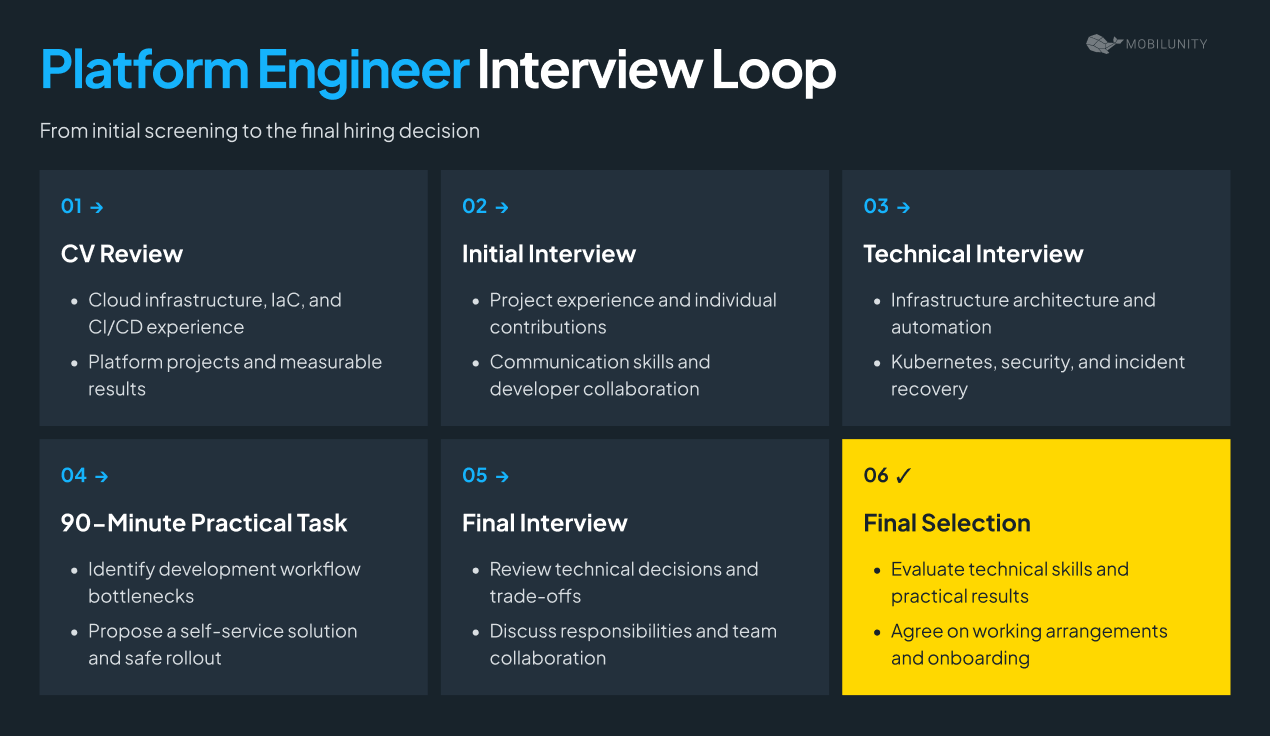
These eight questions will help you see how candidates solve platform problems, make technical decisions, and collaborate with developers. Ask them to share examples from previous projects and explain why they chose a particular approach.
1. What Would You Focus on During Your First Month?
Listen for: Candidates who want to understand your infrastructure, development workflows, and current challenges before suggesting changes. They should explain how they’d gather feedback from developers, review existing tools, and choose a realistic first improvement.
Follow-up: How would you decide which problem to address first?
2. How Do You Decide Whether to Build or Buy a Platform Tool?
Listen for: Candidates who consider the time and cost of building a tool, its ongoing maintenance, and how well it integrates with existing systems. They should also know when a commercial or open-source solution makes more sense than developing something from scratch.
Follow-up: Tell us about a tool you decided not to build and why.
3. What Should a Reusable Service Template Include?
Listen for: Candidates who understand what a service template should provide, from repository setup and CI/CD pipelines to testing, monitoring, and security settings. They should explain how templates save developers time while leaving room for project-specific requirements.
Follow-up: How would you keep templates up to date across existing services?
4. How Would You Roll Out a Platform Change Safely?
Listen for: Candidates who explain how they’d test changes, start with a small pilot, and monitor results before expanding the rollout. They should also have a clear rollback plan in case something goes wrong.
Follow-up: What problems would make you stop a rollout or reverse a change?
5. How Would You Manage Access to Shared Platform Resources?
Listen for: Candidates who understand how to give developers the access they need without exposing sensitive systems. They should discuss role-based permissions, secure credential management, and audit logs that track who accesses or changes critical resources.
Follow-up: How would you grant developers temporary production access while keeping security risks under control?
6. How Would You Investigate Repeated Deployment Failures?
Listen for: Candidates who explain how they’d investigate failed deployments by checking pipeline logs, recent configuration changes, infrastructure issues, and application errors. They should focus on finding the root cause rather than repeatedly restarting deployments.
Follow-up: What steps would you take to prevent the same failure from happening again?
7. What Would You Do If Developers Disliked a New Platform Feature?
Listen for: Candidates who actively seek developer feedback and use it to improve platform tools. They should explain how they’d identify usability problems, understand why developers struggle with certain features, and adjust their approach when necessary.
Follow-up: Can you describe a time when developer feedback led you to change your original solution?
8. How Would You Measure Platform Adoption and Success?
Listen for: Metrics such as active users, service onboarding time, deployment frequency, and support requests. Candidates should connect these measures to developer experience and delivery improvements.
Follow-up: What would you investigate if adoption increased but deployment times stayed the same?
When interviewing senior engineers, ask them to explain the reasoning behind their past decisions and the alternatives they considered. Look for real project experience and an ability to explain why certain solutions worked or failed.
A Practical 90-Minute Task to Assess Candidates
A practical assignment can help you see how candidates solve platform problems and make technical decisions. You don’t need to ask them to build anything. Instead, give them a realistic scenario and see how they approach it.
The scenario: A fictional company has four development teams, each with its own CI/CD pipelines. Developers must submit support tickets for infrastructure changes, and deployments often require manual intervention.
Give candidates a sample pipeline configuration, a basic architecture diagram, and a few recent support tickets.
Allow 90 minutes to complete three tasks:
- Find the main bottleneck: Identify which part of the workflow causes the most delays and explain how they’d verify the problem.
- Suggest a self-service solution: Outline a practical improvement that would let developers complete routine tasks without waiting for infrastructure support.
- Plan a pilot: Explain how they’d test the solution with one team, reduce deployment risks, and measure whether the change saves time.
How to Score the Assignment
Score each candidate against the same four criteria to make your evaluations more consistent. Give the most weight to technical judgment, but also consider how well they understand the problem and manage risks.
| Assessment Area | Weight | What to Look For |
| Problem framing | 25% | Identifies the main issue without jumping to solutions |
| Technical judgment | 30% | Proposes a practical solution that fits the existing infrastructure |
| Rollout safety | 25% | Considers testing, access controls, rollback, and pilot scope |
| Clarity | 20% | Explains decisions, assumptions, and tradeoffs clearly |
Ask a senior platform or infrastructure engineer to review the candidate’s proposal. Focus on how well they explain their decisions and whether their solution addresses the team’s needs, not which tools they choose.
Dedicated, Part-Time, or In-House?
The right collaboration model depends on how much work your platform needs and who will manage it long-term. A full-time engineer makes sense for ongoing development and maintenance, while a part-time platform engineer remote position may be enough for a specific project or improvement.
Here’s how the three options compare:
| Criteria | Dedicated Platform Engineer | Part-Time FLEX Model | In-House Platform Engineer |
| Ownership | You direct the engineer’s work, while Mobilunity handles HR and administrative tasks | Your team manages the platform, while the specialist handles agreed tasks | You manage the engineer’s work, employment, and HR |
| Continuity | Works full-time on your platform’s development and maintenance | Provides support for specific projects or recurring tasks | Supports long-term platform development and daily operations |
| Weekly capacity | Typically 40 hours per week | Flexible hours based on your needs and agreement | Typically 40 hours per week |
| Best fit | Building or expanding a platform that needs regular engineering work | Infrastructure audits, automation tasks, CI/CD improvements, and platform pilots | Long-term platform ownership, close internal collaboration, and operational support |
When Does Part-Time Support Make Sense?
Mobilunity’s part-time FLEX model is a practical option if you already have an infrastructure team but need extra expertise for a specific project. For example, you can bring in a specialist to improve Terraform configurations, update CI/CD pipelines, or create reusable service templates. These tasks have a clear scope and don’t usually require a senior platform engineer full time remote.
When Do You Need Full-Time Ownership?
A dedicated remote platform engineer can handle ongoing development and maintenance while your internal team retains architectural control. You should also consider who will handle production incidents, especially outside regular working hours. A part-time offshore platform engineer may not be enough if your platform requires urgent troubleshooting or frequent intervention.
Before choosing a model, agree on on-call responsibilities, response times, and incident management. Even a full-time dedicated engineer won’t automatically be available 24/7.
You don’t have to rely on a single model. For example, your in-house platform lead can manage architecture and technical decisions while a dedicated remote engineer handles development and maintenance. When you need additional expertise for a specific task, a FLEX part time platform engineer can join temporarily. This approach lets you keep platform ownership within your company while adjusting engineering capacity as your needs change.
Red Flags in a Platform Engineer CV and First Interview
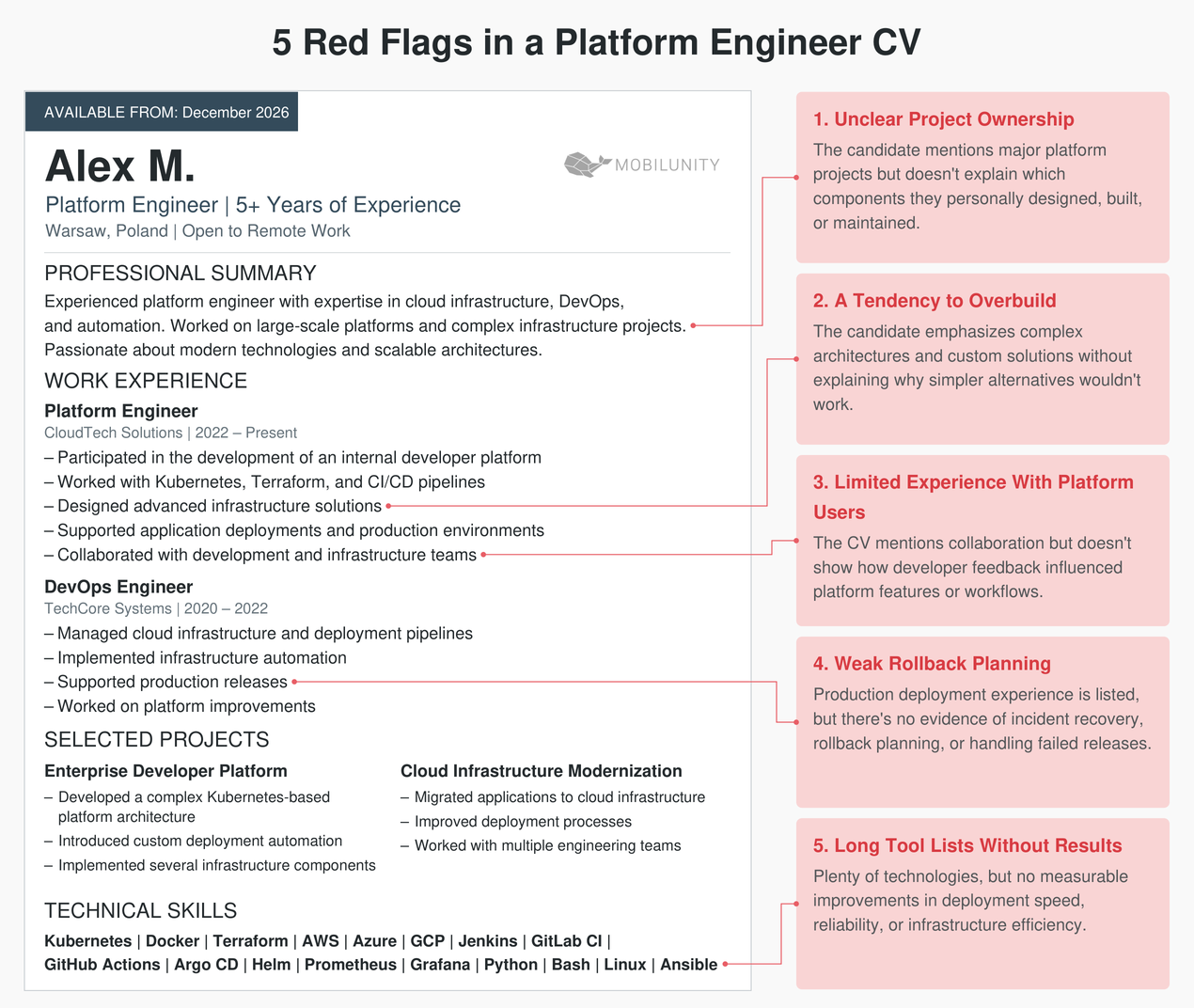
Technical skills alone don’t guarantee that an engineer can build a platform that meets your developers’ needs. When reviewing CVs and interviewing candidates, look for these five warning signs that may point to gaps in their practical experience.
1. Unclear Project Ownership
Some candidates mention large platform projects on their CVs but give little detail about their own contributions. Find out what they were responsible for, which technical decisions they made, and what they actually delivered.
Ask: “Which parts of the platform did you personally design, build, or maintain?”
2. Long Tool Lists Without Results
A CV filled with Kubernetes, Terraform, and CI/CD tools doesn’t tell you how well a candidate used them. Look for examples of problems they solved and improvements they achieved, such as faster deployments or fewer infrastructure issues.
Ask: “What improvements did you achieve with these tools, and how did you measure the results?”
3. A Tendency to Overbuild
Be cautious of candidates who propose complex architectures before asking what your development teams actually need. An overly complicated platform can create more maintenance work without making developers’ jobs easier.
Ask: “Can you describe a situation where you chose a simpler solution instead of building a custom platform component?”
4. Weak Rollback Planning
Successful deployments are important, but you also need someone who knows what to do when things go wrong. Look for candidates who can explain how they handled production failures, restored service, and prevented similar incidents.
Ask: “Tell us about a deployment that failed. What went wrong, and how did you restore service?”
5. Limited Experience With Platform Users
A platform engineer should understand how developers work and what slows them down. Be wary of candidates who focus only on infrastructure and can’t explain how they’ve addressed developer frustrations or improved daily workflows.
Ask: “How did you collect feedback from developers, and what changes did you make based on their input?”
These warning signs deserve closer attention, but none should automatically disqualify a candidate. Some top platform engineering experts struggle to describe their contributions clearly on a CV or during an initial interview. Ask follow-up questions and request examples from past projects to understand what they actually did.
Pay particular attention to how candidates explain their decisions, discuss mistakes, and describe the results of their work. If their answers remain vague after several questions, you may be looking at a genuine experience gap rather than poor interview skills.
How Long It Takes to Hire and Onboard a Platform Engineer
At Mobilunity, we typically build dedicated development teams within 3–6 weeks. This reflects our general experience across technical roles, so timelines for individual platform engineers may vary.
Recruitment is only one part of the process. You’ll also need time to onboard your new engineer and prepare them for their first tasks. The platform engineer recruiting timeline depends on your technical requirements, internal approval processes, and how well you’ve documented your existing infrastructure.
1. Recruitment and Candidate Selection
Our platform engineer staffing process starts by discussing your technical needs, current infrastructure, and preferred collaboration model. Our recruiters then search for candidates who match your requirements and coordinate interviews with your team. You’ll have the opportunity to assess each candidate’s technical skills and relevant project experience before making the final decision.
What affects the timeline: The skills and experience you need, how quickly your team can conduct interviews, and your candidate’s notice period.
2. Onboarding and System Access
Once you’ve chosen your platform engineer, we handle the administrative arrangements and HR onboarding. Your team can then introduce the engineer to your infrastructure, development workflows, and internal processes. You’ll also need to provide access to the systems they’ll work with, such as code repositories, cloud environments, CI/CD pipelines, and monitoring tools.
What affects the timeline: Security requirements, access approvals, available technical documentation, and your infrastructure complexity.
3. First Engineering Contribution
Your new platform engineer doesn’t need to start with a major infrastructure project. A smaller, well-defined task gives them time to understand your systems while keeping production risks low. For example, they could review a deployment pipeline, investigate recurring failures, or improve an existing Terraform module. How quickly they deliver their first improvement depends on your platform’s complexity, existing processes, and their experience with your technology stack.
What affects the timeline: Code quality, technical documentation, existing automation, and the availability of experienced engineers who can answer questions.
At Mobilunity, we coordinate recruitment and HR onboarding, while your team manages technical access and sets engineering priorities.