Hire Developers in Hungary

Key takeaways
Offshore teams are a common approach for businesses that want to innovate quickly while reducing operational costs for server-side programming. Node.js development services put a team in charge of building and running that server side in JavaScript, so the first question is whether you need a new service built or an existing one kept running. The second is the version, because only Node 22 ‘Jod’ and Node 24 ‘Krypton’ are supported with long-term security fixes.
Node.js is known for its event-driven design, which lets one server handle many requests at once, and for scaling well as traffic grows. With remote work now routine, offshore Node.js talent can add both innovation and growth to a project.
Whether you need an offshore development team for long-term projects, flexible part-time experts for burst needs, or specialized services for urgent requirements, offshore development can offer a reliable, cost-effective solution, as long as the team matches the work. The usual gains are agile scalability, a wider range of expertise, and a faster time to market.
The work splits into two jobs that providers price differently: building something new and maintaining something that already runs. Mixing them in one quote is how budgets drift.
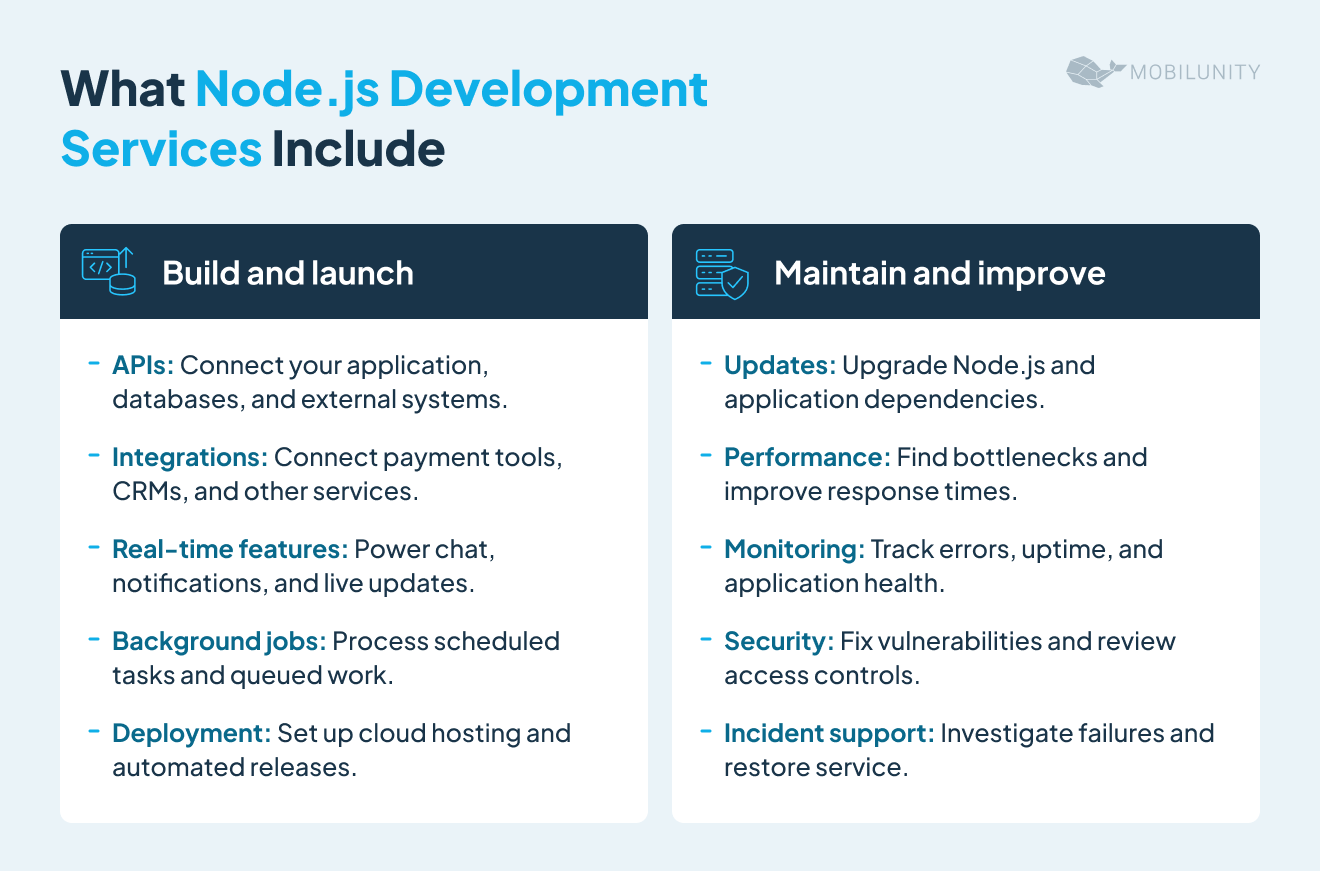
Building covers the APIs other systems call, including REST and GraphQL, integrations with third-party services and databases, background workers that run tasks out of sight, and cloud deployment. It also covers real-time work, such as chat and messaging platforms, live streaming for video and gaming, and collaborative tools, which run on open WebSocket connections so updates arrive instantly.
Larger builds often break one big application into microservices, small, independent services that can be changed and scaled separately, packaged in Docker containers, and managed with Kubernetes. Serverless development can lower infrastructure costs by running code only when something triggers it. Typical projects also include moving an older system from PHP, Python, or .NET to Node.js and modernizing legacy applications.
Delivery and safety work run alongside the code: automated deployment pipelines, cloud hosting on AWS, Azure or Google Cloud, monitoring and logging, and security work such as authentication, data encryption, security audits and GDPR or HIPAA compliance. Much of it starts in the build and stays on the list afterward.
Maintenance covers dependency upgrades, runtime upgrades, performance work, and on-call support, which means someone is reachable when the service fails at night. Performance work keeps an application responsive under any load through load balancing, caching, code optimization, and memory management. It’s routine work, and it’s what keeps a service fast, patched, and secure.
Maintenance is usually part-time and runs for years, while building is full-time and has an end date. A quote that bundles both into a single team price usually means you overpay for upkeep or underestimate the build.
Companies outsource Node JS development in two main ways. A Node JS development agency takes the project and delivers it with its own managers, while a talent partner finds the developers and lets them work inside your team.
Front-end work, design, and database administration are usually separate jobs. For user-facing interfaces, check our guide to JavaScript development services.
Node.js handles many simultaneous connections well, which suits services that spend most of their time waiting on databases, networks, or other systems. That covers APIs, chat, live dashboards, and streaming, and it’s where most Node.js projects succeed.
Good examples are the API behind a booking platform, a notification service, a chat feature, or a service that connects three vendors’ systems. In each case, the service mostly moves information around and waits for replies. Node.js also suits microservices and serverless setups, where many small services each do one job.
Choosing Node.js because your front-end developers already know JavaScript is a legitimate reason. It’s the most common reason, even though vendor pages often present the choice as a performance argument, and it makes cross-training between your teams easier. Setups such as the MEAN stack, which pairs Node.js with Express, Angular, and MongoDB, and its React-based cousin MERN build on that idea.
It’s a weaker fit for work that spends its time calculating rather than waiting, such as video processing, heavy data crunching, and machine learning. Node.js runs your code on one main thread, so a long calculation can hold up every other request, and teams usually move that work to a separate service in Python or another language. Node.js compared with Python covers the trade-offs.
A simple test helps: if the service mostly moves data between systems and users, it fits, and if it mostly transforms large volumes of data, look elsewhere. Node.js projects also depend on many small open-source packages, and each one needs regular updates, which is the main ongoing cost of choosing it.
Whatever runs behind it, the screen on top matters too. Since 12 Mar 2024, a metric called INP has measured how fast a page reacts when someone clicks or taps, according to web.dev, and it’s the delay your users actually feel. Ask each provider for your site’s current INP before they propose a plan.
Seniority drives most of the price. The table shows Ukrainian rates for September 2026: what a developer earns in gross salary and what the engagement costs you per month.
| Seniority | Developer gross salary (monthly)* | Developer monthly cost* |
| Junior | $1,000 to $2,100 | $2,450 to $3,600 |
| Middle | $2,100 to $4,100 | $3,550 to $5,600 |
| Senior | $4,100 to $5,600 | $5,550 to $7,100 |
*According to Mobilunity’s in-house tech recruiting team research done in September 2026
These are estimates for comparing options, so request an exact quote for your role and engagement model.
For a fair comparison, start with the full cost of a US in-house developer, benefits included. Two US Bureau of Labor Statistics releases give you the numbers.
Set against the loaded US cost of about $16,200 a month, a middle developer at $3,550 to $5,600 comes to roughly 22% to 35%. A senior at $5,550 to $7,100 comes to roughly 34% to 44%.
Read that gap as a rough guide. Read that gap as a rough guide. The US figure is a median across all experience levels, so it doesn’t match any single seniority in the table exactly. An offshore team also takes more of your time for planning, handovers, and reviews. Pay by country is covered in our guide to Node.js developer salaries.
Specialized expertise such as full-stack development, DevOps, microservices, and cloud technologies commands higher salaries, and developers with experience in fintech, healthcare, or blockchain often ask for more because of industry complexity. Hiring in North America or Western Europe costs more than in Eastern Europe, Latin America, or Asia.
Long-term contracts can sometimes secure lower rates, while short-term or urgent projects may come at a premium. Dedicated full-time teams, flexible part-time developers, and freelancers also provide different cost options, depending on the project’s requirements and timeline.
Building and upkeep also bill differently. Upkeep is often handled by one part-time developer, so monthly costs are lower than for a full-time build team, though the work runs much longer.
The lowest rate rarely gives the best value. A cheaper developer who leaves after three months costs more than a pricier one who stays, so seniority, reliability, and the cooperation model matter as much as the rate.
There are three ways to staff a Node.js project: an in-house team, an offshore team, or a mix of the two. A useful way to compare them is overlap hours, the hours when your people and the developers are both at their desks.
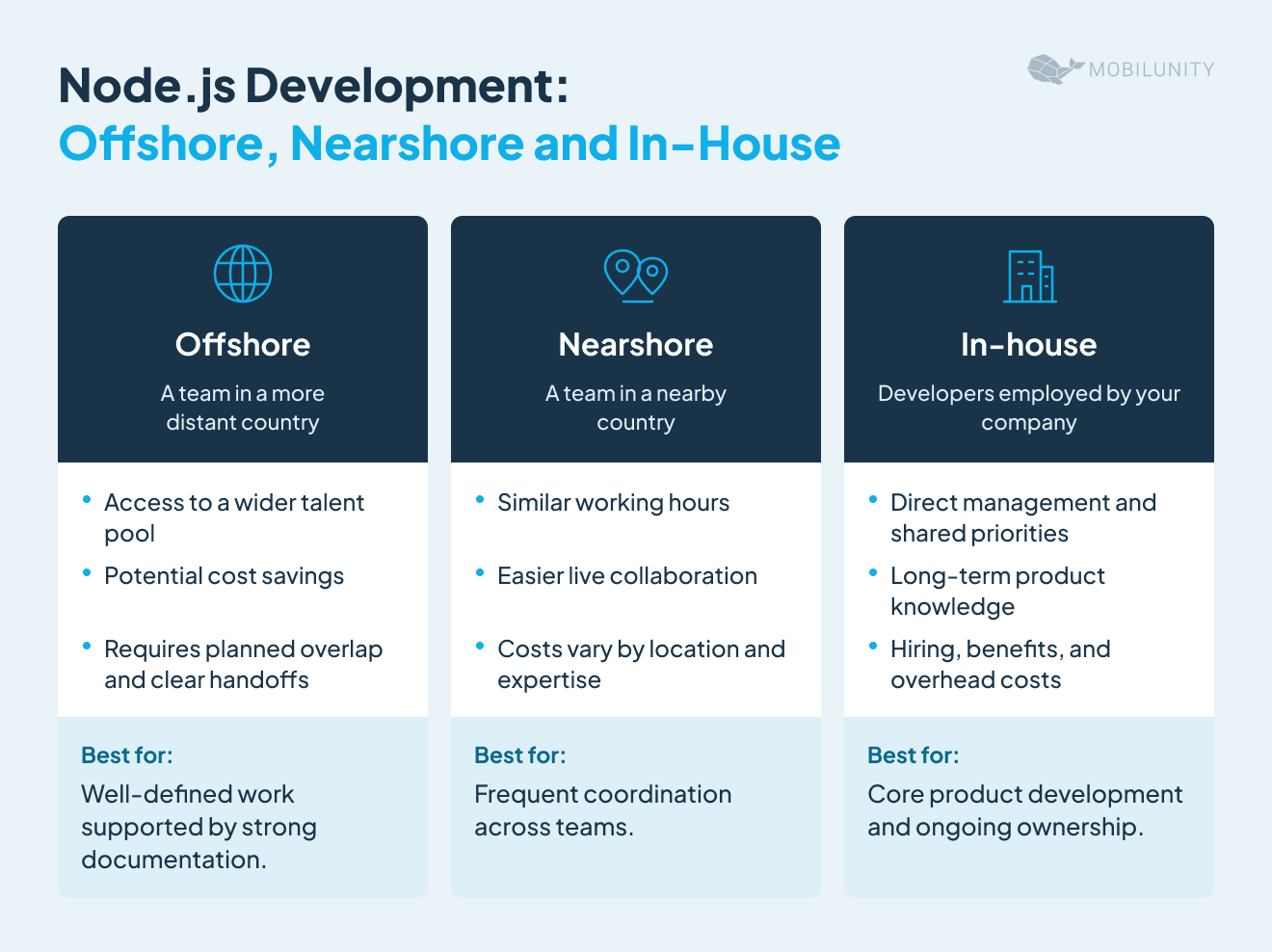
For most of the year, Kyiv runs 2 hours ahead of London and 7 hours ahead of New York. A London team therefore overlaps a full workday, while a US East Coast team gets about 3 usable hours if both sides adjust their schedules a little.
| Option | Hours you share with the team | Typical cost | Fits best when |
| In-house | Full overlap in the same office or time zone | Highest, because of salaries and overhead | The service is the product and the knowledge has to stay |
| Offshore | A full workday with London, about 3 hours with New York | Lower monthly cost for the same seniority | The work is well defined and can run asynchronously |
| Hybrid | Full overlap with the in-house core, partial with the offshore team | In between | You need direct oversight and extra capacity |
Offshore Node JS development reduces hiring, infrastructure, administrative, and operational expenses, and it gives you access to developers with specialized skills that may not be available locally. You can scale the team up or down as needed, keeping resources allocated efficiently while your in-house team stays focused on strategic goals. Offshore teams also bring experience with Node.js frameworks, microservices and cloud solutions.
Offshore teams bring their own trade-offs. Time-zone and cultural differences can create communication barriers, remote management needs the right tools and trust in an autonomous style, and integration may take extra effort to align with your culture and internal processes.
Remote work is mainstream too. In the Stack Overflow Developer Survey 2025, 45% of US respondents work fully remotely, the highest share of any top-reporting country, so in-house comparisons often end up being remote vs. remote.
In-house developers are fully integrated into your company culture, work closely with other departments and benefit from direct supervision, which makes collaboration and quality control easier. The cost is higher salaries and overhead, longer hiring cycles and a smaller talent pool for specialized skills. In-house wins when the service is the product and the company needs to keep the knowledge in-house.
If you plan to hire offshore Node.js developers, match the model to how long the work runs. A dedicated full-time team suits ongoing services, and part-time experts can extend it during short bursts.
Every Node.js version has a support status that decides whether it still gets security fixes. LTS means long-term support, which typically guarantees critical fixes for about 30 months, and Current is the newest line before it earns that status.
End-of-life means a version gets no fixes at all. This table comes from Node’s own release schedule, checked on 16 Oct 2026.
| Node line | Codename | First released | Last updated | Status |
| Node 26 | None | 5 May 2026 | 14 Oct 2026 | Current |
| Node 24 | Krypton | 6 May 2025 | 14 Oct 2026 | LTS |
| Node 22 | Jod | 24 Apr 2024 | 23 Sep 2026 | LTS |
| Node 20 | Iron | 17 Apr 2023 | 24 Mar 2026 | End-of-life |
| Node 18 | Hydrogen | 18 Apr 2022 | 27 Mar 2025 | End-of-life |
An application on Node 18 or Node 20 is running unpatched, whatever else a vendor is discussing. Node 26 was released on 5 May 2026 and is still in its first six months as Current, which makes Node 22 and Node 24 the safe versions to quote against.
Even-numbered releases such as Node 22 and Node 24 move to long-term support after their first six months as Current. Odd-numbered ones are short-lived: Node 25 was released on 15 Oct 2025, was last updated on 31 Mar 2026, and is already end-of-life. According to Node’s release info, the cycle becomes annual from Node 27, and every major version will then reach long-term support.
Unpatched means any security flaw found after end-of-life stays open, so the exposure grows with every month the application stays put. Hosting platforms also retire old runtime versions on their own schedules, which can force an inconvenient upgrade.
To find out where you stand, ask your team to run the command node – version on the server, which prints the version number. Then ask any developer which line your application runs on before you ask for a price, because a developer that doesn’t ask is quoting blind.
The upgrade is usually cheap and often postponed. Major upgrades rarely break application code; what breaks is native dependencies, add-on packages that include compiled code, so scope those first.
When a developer scopes an upgrade, it should list what it will check: native dependencies, the automated test suite, the deployment setup, and the version your hosting platform supports. A quote that skips that list is a guess.
A strong CV and a list of completed projects don’t tell you how a Node.js developer handles real production problems.
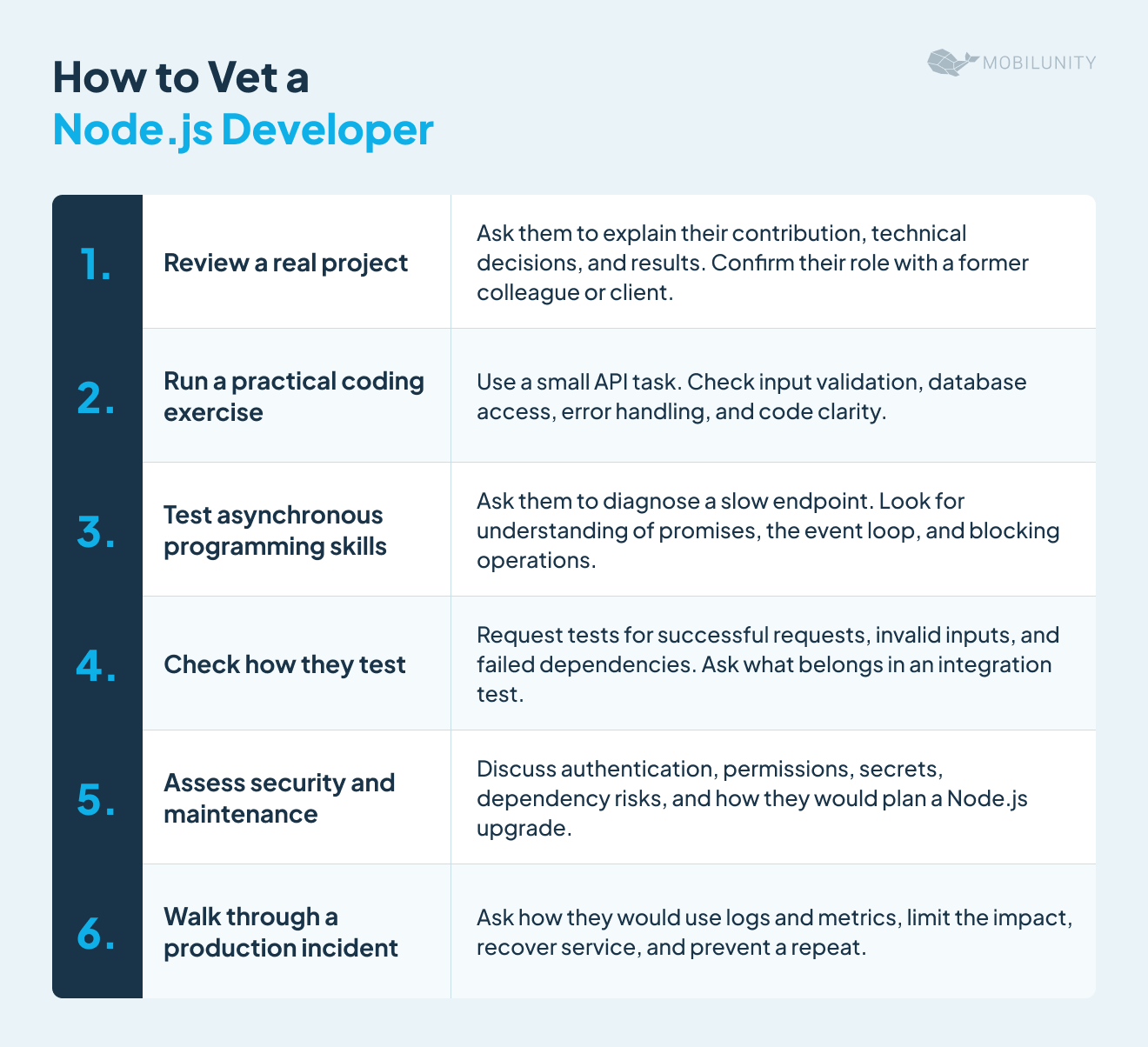
To assess their skills without reading code yourself, focus on how they approach technical challenges, maintain applications, and respond to failures.
For the first check, choose a problem your own team has already solved, such as speeding up a slow report or connecting two systems. Ask the candidate to outline their approach, explain how they would test the result, and identify potential trade-offs. Compare their reasoning with your team’s solution rather than expecting one specific answer.
Look for concrete examples throughout the interview. A developer with production experience should be able to explain their role in diagnosing failures, prioritizing fixes, and preventing similar issues. If you can’t assess the technical details yourself, ask an independent senior developer to join the interview and evaluate the answers.
Pay attention to how the candidate approaches your product, too. Someone who recommends frameworks before understanding the requirements may rely on familiar solutions rather than assess the actual problem.
Extending your in-house team with dedicated remote developers or flexible part-time software experts lets you combine the strengths of both, creating a dynamic and efficient development force. Core in-house professionals drive strategy and maintain direct oversight, while offshore experts provide specialized skills and scalable support. The result is a balanced team with greater flexibility, cost savings and faster project delivery.
In-house developers ensure alignment with company culture, manage day-to-day operations and maintain quality standards. Offshore developers come from a global talent pool at competitive rates, allowing rapid scaling as demand changes. A blend of onshore and offshore professionals also brings varied perspectives to complex technical challenges.
A mix of full-time in-house staff, dedicated developers, and flexible part-time experts can match your project’s evolving needs. With the right communication tools, clear processes, and dedicated account managers, hybrid teams overcome geographical challenges and work as one.
Hybrid is the wrong shape for a maintenance engagement. In that case, one long-running developer beats a split team because they learn the service’s quirks and stay on call.
If you want two developers rather than a development company, our guide on how to hire Node.js developers is a great starting point.
Choosing a Node.js development partner starts with deciding how you want to work. Some Node JS development companies take responsibility for delivering a project, while others help you add developers to your existing team. Mobilunity follows the second model: we recruit and vet developers who work under your direction, with your priorities and product goals guiding their day-to-day work.
This approach fits companies that already have product management in place and need additional engineering capacity. If you want a provider to manage the entire project independently, a different engagement model may be a better fit.
Founded in 2010 and based in Kyiv, Mobilunity offers several ways to add developers to your team. You can hire a dedicated development team for ongoing work, use staff augmentation to fill specific skill gaps, or choose FLEX developers for part-time support.
Mobilunity works with clients in fintech and finance, e-commerce and retail, SaaS, marketing and advertising, media and entertainment, education, insurance, logistics, and other industries. Each client has a dedicated account manager to coordinate communication and keep processes running smoothly. Developers undergo quality checks before being introduced to clients, and companies can also use a technical interview service for additional expert input when assessing candidates.
The cooperation with BYG-E shows how this model works over time. The Danish company has worked with Mobilunity developers since 2017, extending its development team as its needs have evolved. This long-running collaboration shows how external developers can become part of an established team rather than join for a single, short-term project. Read the BYG-E case study for more details about the engagement.
Mobilunity typically presents an initial shortlist within 5 business days of starting a search. Its approach centers on three Rs: Recruitment, Relationship, and Retention, covering candidate selection, ongoing collaboration, and developer retention.
No ranking of top Node JS development companies can tell you which one suits your project, and the best Node JS development company for someone else may be a poor match for you. Build a shortlist from any list you like, then run the checks to see if developers match your requirements.

Client Testimonial
Mobilunity provides an excellent and efficient tech talent service. All my staffing requests, even for niche technologies, were fulfilled in a 2 to 4-week time period, with top-notch candidates. Besides that, I like the caring environment that the Mobilunity team provides for the developers and ensures that everybody is able to work without distractions.
I strongly recommend Mobilunity as a tech talent partner!

Waldemar Biller
Head of Technology


Fulltime dedicated teams, FLEX on-demand model, consultancy, recruitment, EOR