
Hire Developers in Hungary

Key takeaways:
When a company looks for JavaScript development services, it’s choosing between three kinds of work: front-end development, Node back-end development, or full stack, where one team covers both. Your choice determines how many developers you need, what they cost, and which providers make your shortlist.
JavaScript is one of the most widely used programming languages in the world, and it serves as the foundation for frameworks such as React, Ember and Node.js. Offshore teams are a common way to staff these roles, and Ukraine remains an attractive destination for West European companies building dedicated development teams abroad.
Before you compare companies and providers, two dated facts are worth knowing because they show up in almost every 2026 quote. Node 20 ‘Iron’, a version of the Node server platform, no longer gets security fixes, so new work should run on Node 22 ‘Jod’ or Node 24 ‘Krypton’, the two versions with long-term support, according to the Node.js release schedule. Since 12 Mar 2024, Google’s own tools score how quickly a page reacts to a click or tap with a metric called INP, which makes a slow-feeling site easy to spot, according to web.dev.
JavaScript development services fall into 3 groups, and many proposals blur them together.
Typical projects include custom web applications, content management systems, e-commerce platforms and progressive web apps (PWAs), which visitors can install on a phone and open from the home screen. Teams also add features to existing products, write plug-ins and migrate older systems, so the work isn’t limited to new builds.
Some things are left outside the scope almost every time. Visual design, infrastructure beyond the application (servers, networks, monitoring), and native mobile apps are separate pieces of work.
If mobile is what you need, the offshore React Native development guide is the better starting point. If you’re still deciding which tools your product should be built with, our JavaScript frameworks compared article covers that.
How you work with a provider matters as much as the work itself. JavaScript development agencies typically take your brief, run the project with their own managers and hand back a finished product.
Talent partners work differently: they recruit and vet the developers, and those developers join your team and take their daily direction from you.
A simple test helps you choose. If you want to hand over a project and not manage it, an agency fits. If you already have a product owner and a backlog and simply need more skilled hands, a talent partner usually costs less and keeps you closer to the work.
Choosing between front end, Node and full stack is a staffing question more than a technical one. For each type of work, ask whether someone on your team already handles it and whether there’s enough of it to keep a specialist busy. If you can answer both in a sentence, you’re ready to talk to providers, and if you can’t, a good provider will help you work it out while a bad one will quote you a team anyway.
Start with the front end. The framework you choose decides the hiring pool, not the other way round, because a React developer and an Angular developer are different searches. If your framework is already chosen, the React development services and Angular development companies materials might be more useful for you.
The server side is its own decision. If your product needs APIs, background jobs or live data, read the Node.js development services guide next. Node developers are hired for what they know about servers and data, and that’s a different skill from building screens.
If your project needs fewer than about 4 engineers, full stack developers are usually the best choice. One person who can work on both the screens and the systems behind them saves you hand-offs and meetings. Above that size, each side needs real depth, and the person who speeds up page loading is rarely the one who tunes the database.
In practice, the split looks like this. A startup with one product and a small team usually needs full stack. A company with a mature API and a redesign on the way needs front-end, and one with a dozen services behind a thin interface needs Node.
If you’re still weighing the individual hire against a team, our guide on how to hire JavaScript developers walks through that choice.
The numbers below come from Mobilunity’s in-house tech recruiting team, who researched Ukrainian JavaScript developer rates in September 2026. They show what a developer earns in gross salary and what the engagement costs you per month. Senior engineers aren’t listed because they usually specialize in one framework and not pure JavaScript.
| Seniority | Developer gross salary (monthly)* | Developer monthly cost* |
| Junior | $1,000 to $1,800 | $2,450 to $3,300 |
| Middle | $1,800 to $3,500 | $3,250 to $5,000 |
*According to Mobilunity’s in-house tech recruiting team research done in September 2026
These figures are approximate, so treat them as a reference for comparison. For an exact quote, share your vacancy and the engagement model you prefer.
To compare fairly, look at what a US in-house developer costs once benefits are included. Two US Bureau of Labor Statistics sources supply the inputs.
Over a full year, a middle developer at $3,250 to $5,000 a month comes to $39,000 to $60,000. That’s roughly 20% to 31% of the loaded US figure.
The comparison isn’t perfect, since the US number is a median across all experience levels and offshore teams need more coordination from you. For a country-level view, see our analysis of JavaScript developer costs.
Two costs remain outside any rate table: your own management time and the cost of a bad hire. A developer who leaves after 3 months resets the clock on onboarding, which is why the vetting steps matter more than a small difference in rate.
Offshore JavaScript development brings a handful of advantages that companies mention again and again: a wider talent pool, a lower monthly cost for the same seniority, a faster start than a local search allows and room to scale. None of them is new, but each one is worth checking against your own situation before you commit.
The talent pool is the biggest. Hiring locally limits you to people within commuting distance or inside your time zone, and a specialist skill can mean months of searching. A hub like Kyiv gives you a large community of software engineers, many with STEM degrees, and a choice between several candidates instead of one.
Cost is the second advantage, and the rates table above shows its size. A middle developer through a Ukrainian partner costs a fraction of a loaded US hire, and you skip the long recruitment cycle. The savings start on the first day the developer works, not the day the contract is signed.
Remote work is no longer an experiment, either. The Stack Overflow Developer Survey 2025 reports that 45% of US respondents work fully remotely, the highest share among the top-reporting countries. If your own developers are already remote, adding people in another country changes less than it sounds.
A fourth benefit is an outside view of your product. Developers who’ve worked across other markets and industries often spot gaps and partnership opportunities an in-house team has stopped noticing, helping you reach new customers.
Finally, offshore gives you flexibility. You can start with one developer, grow to a dedicated team, or use part-time help for a single release, and you can scale back down when the work does.
Two technical facts decide how much a JavaScript project really costs over time, and you don’t need to be a developer to follow either. The first is which version of Node your product runs on. The second is how fast your pages respond when a visitor clicks.
Node is the engine that runs JavaScript on servers, and each version has a support status. “LTS” means long-term support: the version keeps getting security fixes for years.
“Current” is the newest line, which hasn’t yet reached long-term status, and “end-of-life” means the version no longer gets any fixes. This table comes from Node’s own release schedule, checked on 16 Oct 2026.
| Node line | Codename | First released | Last updated | Status |
| Node 26 | None | 5 May 2026 | 14 Oct 2026 | Current |
| Node 24 | Krypton | 6 May 2025 | 14 Oct 2026 | LTS |
| Node 22 | Jod | 24 Apr 2024 | 23 Sep 2026 | LTS |
| Node 20 | Iron | 17 Apr 2023 | 24 Mar 2026 | End-of-life |
| Node 18 | Hydrogen | 18 Apr 2022 | 27 Mar 2025 | End-of-life |
Node’s own guidance is that production applications should run only on an LTS line, which gets critical fixes for about 30 months. Node 26 is the newest version, but it was released on 5 May 2026 and is still in its first six months, after which an even-numbered release like it normally moves to long-term support. Until then, Node 22 and Node 24 are the safe versions to quote against, and both shipped updates in the past month, on 23 Sep and 14 Oct 2026.
End-of-life means no more security patches, which turns every known weakness into a permanent one. If a firm quotes you work on Node 20 or 18 and doesn’t mention an upgrade, it’s either not looking or not telling. Many JavaScript development firms will price the old version happily, because the upgrade is a separate bill that arrives later.
The second fact is INP, short for Interaction to Next Paint, which measures how long a page takes to react after a visitor taps or clicks. According to web.dev’s announcement, it replaced First Input Delay as a stable Core Web Vital on 12 Mar 2024. Heavy JavaScript front ends are exactly where it tends to fail.
In web.dev’s guidance, an INP is good when at least 75% of visits respond to input in under 200 milliseconds. You can check your own site for free by entering its URL into PageSpeed Insights.
Ask any firm or developer what your current INP is before they propose anything. If they haven’t measured it, they’re guessing. A guess about performance gets expensive once the build has started.
The most useful way to compare offshore and nearshore is overlap hours: the hours when your team and the developers are both at their desks. Everything that needs a conversation must fit within that window.
Nearshore teams are located in the same or a nearby time zone, while offshore teams sit several zones away. The cooperation model is otherwise the same, so the real difference is how many working hours you share.
Kyiv is 2 hours ahead of London and 7 hours ahead of New York for most of the year. A London team shares a full working day with Kyiv. A US East Coast team gets about 3 usable overlap hours if both sides flex their start and end times a little.
| Your team’s location | Kyiv compared with your time | Shared working time |
| London | 2 hours ahead | A full working day |
| Berlin | 1 hour ahead | A full working day |
| New York | 7 hours ahead | About 3 hours, with flexed start and end times |
| Los Angeles | 10 hours ahead | Almost none, so work is asynchronous |
Three things have to fit inside the overlap: the daily standup, code review and any decision that blocks someone. A review that waits until tomorrow slows every task behind it. A developer stuck on a question for 18 hours is simply waiting.
Everything else can happen asynchronously. Written specs, recorded demos and clear tickets let developers work while you sleep, and many teams find that’s the real advantage of a different time zone. With good management, a New York manager can post tasks in the evening and find them done in the morning.
When is a nearshore team worth the premium? When the work is discovery and not delivery. Discovery means working out what to build, and that needs live conversation, whiteboards and fast back-and-forth.
Delivery means building something already defined, and that works well across time zones. If you’re past discovery, offshore is usually the better value.
Interviewing a developer normally takes a developer, so many managers rely on portfolios and previous projects alone. That is why this step feels so hard.
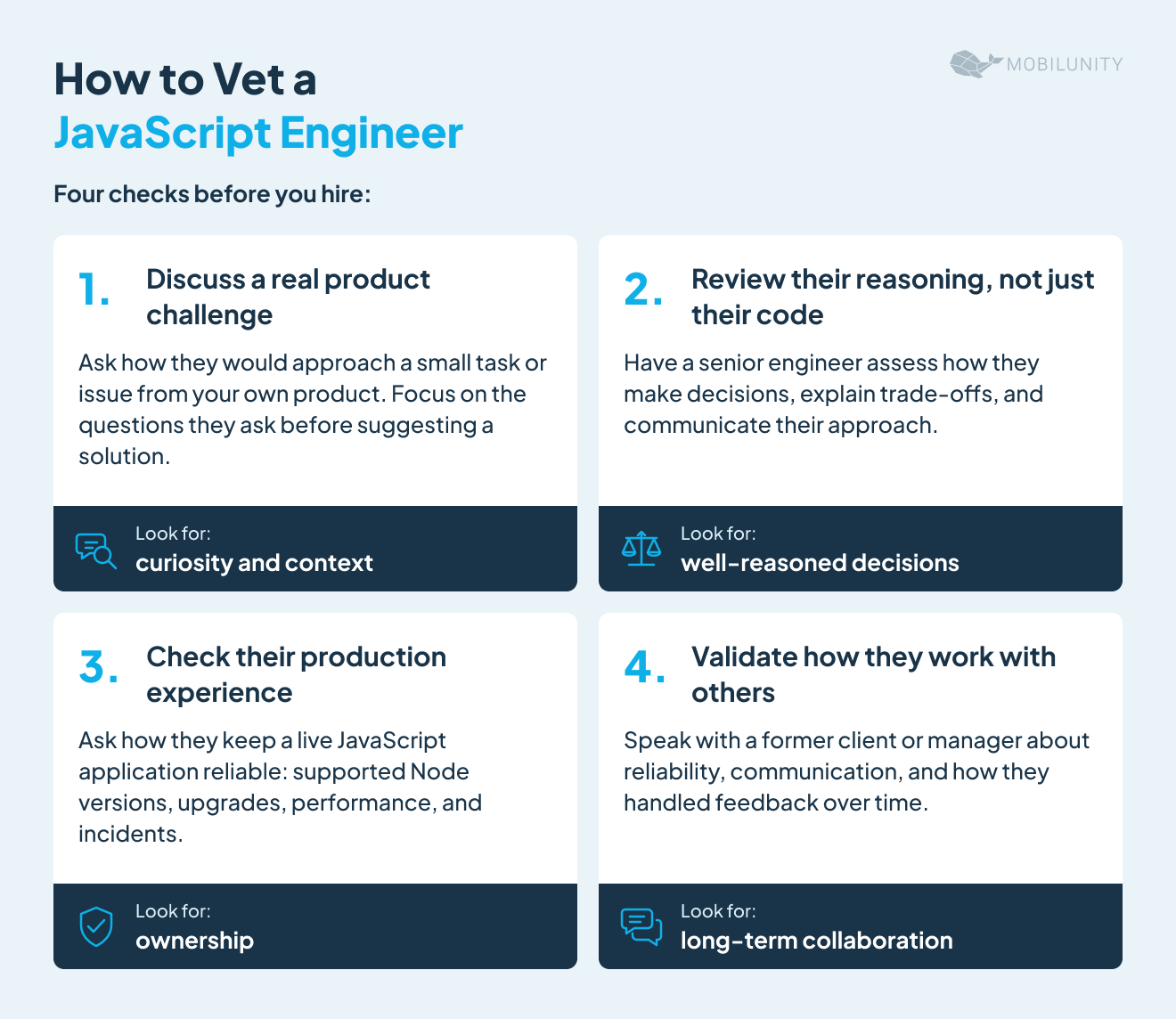
The good news is that you don’t need to judge code. You need four checks that anyone can run.
Generic coding quizzes tell you little about real work, and good candidates are tired of them. A better route is to give them something closely related to a real problem your company has run into. You’ll learn more from how candidates ask questions than from the answer they give.
The simplest fix is a pair coding exercise run by a real developer you trust. If nobody in your company can do that, book two hours of an independent senior JavaScript developer’s time and let them sit in on the interview. It’s a small cost against a six-figure hiring decision.
Ask for references or recommendations from the project where the developer spent more than one year, if you require long-term commitment.
One red flag is worth memorizing: a proposal that names a framework before anyone has asked what your application does. It usually means the firm or a provider is selling the team it has available, not the team you need. Good providers ask about your users, your data and your deadline first, and only then talk tools.
If you’re comparing JavaScript development companies, check first which type each one is. Mobilunity is a talent partner: we find, vet and hire the developers, and they work as part of your team under your direction. That makes us a good fit when you already own the product and want skilled people around it.
Mobilunity was founded in 2010 and is based in Kyiv. On Clutch we hold a 4.7 rating (as of October 2026). We offer dedicated development teams for ongoing work, staff augmentation to add individual developers to a team you already have, and FLEX, which is part-time developers for smaller jobs.
Our recruitment team typically needs around 2 to 3 weeks to find suitable JavaScript developers, send you a shortlist and help you choose. Many clients also spend 1 to 2 weeks working side by side with the team before they commit, and we can run technical interviews for you through our technical interview service.
A client story shows how this works in practice. QRATES, a platform built on React.js, has worked with a Mobilunity team for more than 3 years. QRATES is a vinyl platform from the Tokyo-based company TDMS, where musicians and labels fund, press and distribute records without large production commitments. It started with a single part-time engineer, and we scaled its dedicated team to 5 people in under 1.5 years. The platform now has less downtime during releases and ships features on schedule. You can read the QRATES case study to see how the team grew alongside the product.
Our nearshoring service is built for companies that want quality to match their expectations, with time-zone overlap you can actually use. We match you with developers who fit your stack, your hours and your way of working. Our approach rests on three Rs: Recruitment, Relationship and Retention.

Disclaimer: All salaries and prices mentioned within the article are approximate numbers based on the research done by our in-house Marketing Research Team. Please use these numbers as a reference for comparison only. Feel free to use the contact form to inquire on the specific cost of the talent according to your vacancy requirements and chosen model of engagement.
Client Testimonial
Mobilunity provides an excellent and efficient tech talent service. All my staffing requests, even for niche technologies, were fulfilled in a 2 to 4-week time period, with top-notch candidates. Besides that, I like the caring environment that the Mobilunity team provides for the developers and ensures that everybody is able to work without distractions.
I strongly recommend Mobilunity as a tech talent partner!

Waldemar Biller
Head of Technology


Fulltime dedicated teams, FLEX on-demand model, consultancy, recruitment, EOR