Fiverr Alternatives for Businesses That Need More Than Quick Fixes

Key takeaways:
Choosing a provider for offshore software development means deciding who will manage the engineers, carry employment responsibilities, and control the code. Staff augmentation adds individual specialists to your existing team, while a dedicated team gives you a group assigned to your business, with day-to-day direction typically staying on your side. Project outsourcing puts the vendor in charge of delivering an agreed scope, so you need to evaluate its delivery process as well as its people.
Start by matching that responsibility split to the capacity you have internally. If your technical lead can assign tasks and review code, you can focus on hiring support, candidate quality, and replacement terms. If you need a finished product, check who owns planning, testing, and acceptance.
Then compare the full cost, interview the engineers you would actually work with, and agree on access and handover before signing. Those checks help you choose a company whose commitments match what you need.
Offshore software development companies give you access to engineers in another country, but the contract determines what you buy: individual specialists, a dedicated group, or delivery of an agreed outcome. Before comparing proposals, decide who will assign tasks, manage execution, and accept the work.
Offshore describes location; outsourcing describes how you transfer work and responsibility. Software development outsourcing companies can operate domestically or overseas, while an offshore provider can supply people you manage directly. Stack Overflow’s 2025 survey reports that 45% of US respondents work remotely, the highest share among its top-reporting countries. For buyers already managing distributed work, that makes the provider’s working arrangements a practical starting point for comparison.
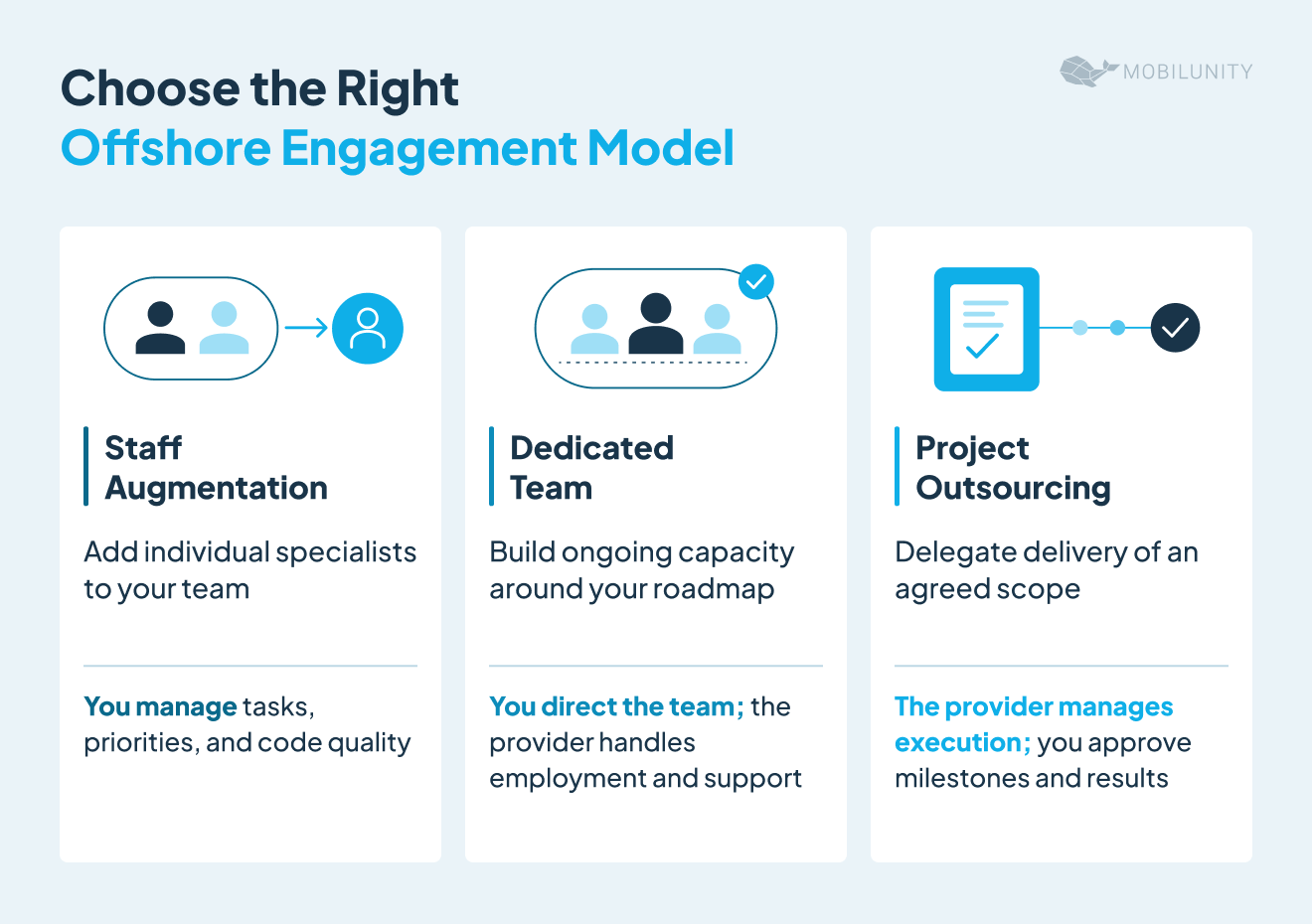
With IT staff augmentation, individual engineers join your team, attend your standups, and work on tasks you assign. The vendor employs them and handles the administrative responsibilities defined in your agreement. You manage priorities, technical decisions, and code quality.
Choose staff augmentation when you need additional hands and already have people who can direct their work. For example, a backend developer can help your existing team build an API while your technical lead owns the architecture and reviews contributions. Confirm which recruitment, onboarding, and replacement services the fee covers.
Dedicated development teams provide a group assigned exclusively to your business. A delivery lead may coordinate execution, but you still direct priorities and retain the responsibilities agreed in the contract. Ask whether that leadership role is included or requires a separate hire.
Choose a dedicated team when you need sustained capacity across several roles and can provide product and technical direction. You might combine developers, QA engineers, and a DevOps specialist around an ongoing roadmap. Mobilunity recruits and onboards specialists; your side manages development and accepts their work.
Project outsourcing makes the provider responsible for delivering software against an agreed specification. Its team manages execution, while you clarify requirements, provide feedback, and approve deliverables. The contract defines scope, acceptance criteria, and the process for changes.
Choose project outsourcing when you need a finished deliverable and can define what successful completion looks like. For software still being designed, a fixed-price scope creates a risk: requirement changes can trigger change orders, additional charges, and revised deadlines. Explore the offshore development models for a fuller comparison, then shortlist providers whose responsibilities match your needs.
Offshore services can cover several engineering functions, but a provider’s service menu doesn’t define your contract. Confirm which roles you’re hiring, what work they will perform, and who will manage them. Access to a QA engineer, for example, doesn’t automatically mean the provider owns your release testing process.
Use the following scope menu to identify the capabilities you need before requesting a quote:
For each function, distinguish the specialist’s responsibilities from the provider’s obligations. A DevOps engineer can maintain your deployment pipeline while your technical lead approves production changes. A designer can prepare prototypes while your product owner decides which customer problems to solve.
Product management, independent security reviews, and on-call coverage outside agreed business hours often require separate arrangements. Hiring an engineer doesn’t automatically provide someone who owns the roadmap, conducts penetration testing, or responds to a production incident at midnight. Specify the responsible person, coverage hours, and any additional charges before work starts.
Roles outside the original agreement also need explicit approval. If you initially hire two developers and later need a QA specialist, ask how recruitment, fees, and onboarding will change. Avoid assuming that the provider will supply additional capabilities within the existing budget.
An offshore development center is a longer-running arrangement built around dedicated engineering capacity for your business. It can bring several functions together, but the name alone doesn’t establish management responsibility or support coverage.
When comparing dedicated development teams, document the roles, responsibilities, working hours, and process for adding specialists. That scope gives you a basis for comparing quotes and identifying which responsibilities your own team must cover.
Compare the provider’s full quote with the full cost of employing someone internally. A salary figure leaves out benefits, recruitment, equipment, and management time. An offshore quote also needs context: which roles, working hours, and support services does it cover?
The U.S. Bureau of Labor Statistics reports a median annual wage of $135,980 for software developers in May 2025. Its Employer Costs for Employee Compensation release puts benefits at 30.0% of total private-industry compensation costs in June 2026, leaving wages at 70.0%. Applying that share gives an illustrative calculation: $135,980 / 0.70 = approximately $194,257 annually, or $16,188 monthly.
This is a planning estimate combining an occupation-specific median wage with a benefits share for private industry overall. It isn’t a measured average employment cost for developers, and it excludes recruitment, equipment, office space, and management overhead.
Mobilunity provides an individual quote based on your staffing requirements rather than a universal rate card. Specify the roles, seniority, hiring locations, allocation, and expected duration so the proposal reflects the capacity you need. Ask which costs are recurring and which apply to setup, replacement, or ending the arrangement.
Use this table to compare proposals without assuming that every model has the same billing structure or termination terms.
| Model | Monthly Cost or Billing Basis | Who Carries Employment Responsibilities? | Notice Period |
| Staff augmentation | Individual quote per specialist and agreed allocation | Provider for its employees; confirm the contractual allocation of responsibilities | Confirm in the agreement |
| Dedicated team | Individual quote for the agreed team composition and services | Provider for its employees; you retain development management under a client-directed model | Confirm in the agreement |
| Project outsourcing | Agreed project fee or time-and-materials billing; monthly spend depends on the schedule | Delivery provider for its personnel | Confirm termination rights and payment for completed work |
Treat these as comparison categories. Project outsourcing involves buying delivery, while staffing arrangements involve hiring capacity you direct.
Your internal management time sits outside the provider’s invoice. Someone must prepare tasks, explain the architecture, review code, and resolve questions; those responsibilities remain with you in a client-directed arrangement.
For example, five hours of technical leadership each week adds roughly 20 hours to your monthly budget. Multiply those hours by your internal cost, then add the result to the quote. Comparing equivalent capacity and responsibilities gives you a more useful decision than comparing headline rates.
A provider’s recruitment process is only part of the picture. Your decision also depends on the proposed engineers, the working arrangements, and what happens when something changes. These eight checks help you compare providers using evidence and written commitments.
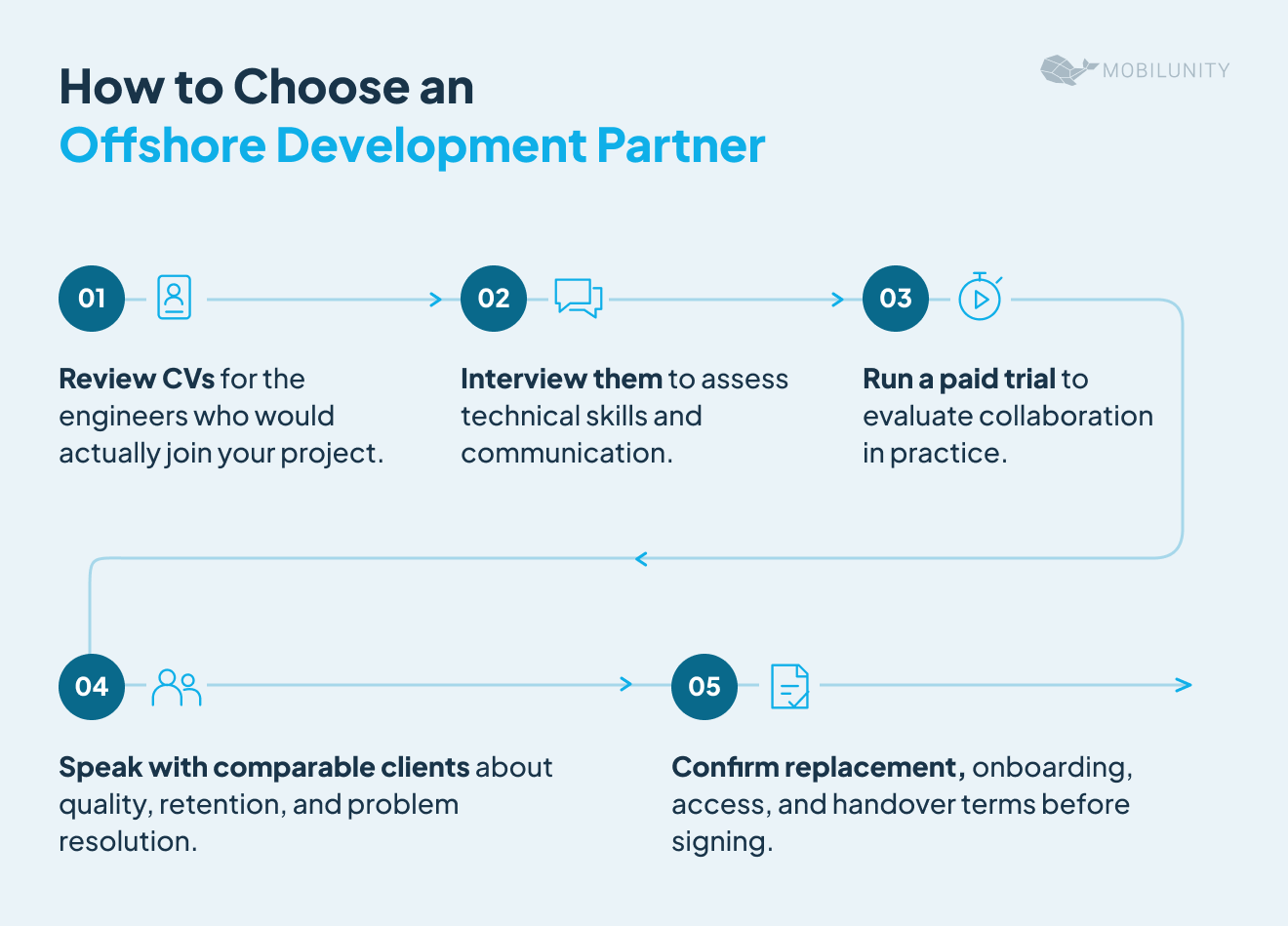
1. Request CVs for the Actual Candidates
Profiles of the engineers proposed for your engagement show you more than sample CVs from a talent database. Relevant experience, availability, and expected allocation help you assess whether someone fits the work ahead. A useful profile also explains the candidate’s contribution to a comparable project.
2. Arrange a Paid Trial
A short paid trial can give both sides practical experience before a long-term commitment. Separate written terms can define the task, payment, confidentiality, access, and ownership of the resulting work.
A bounded exercise, such as extending a sample endpoint, makes the result easier to evaluate. It also shows how the engineer communicates, handles unclear requirements, and responds to feedback.
3. Speak with the Engineers
Conversations with the proposed engineers complement the account manager’s explanation of the service. Discussing a technical tradeoff, your stack, or a recent project gives you a sense of their reasoning and working communication. You can also clarify how they raise blockers and what context they need from you.
4. Get Probation and Replacement Terms in Writing
A written policy makes probation and replacement expectations easier to compare. Relevant details include the number of probation days, how a mismatch is reported, and the provider’s next steps.
Candidate presentation and replacement start dates are separate commitments. Clear terms also explain approval rights, overlap or ramp-up charges, and what happens when suitable replacements aren’t available.
5. Call Two Relevant References
References are more informative when their company size, product stage, and engagement model resemble yours. An enterprise buying managed delivery may have different expectations from a small business extending its own engineering team.
Two reference calls can provide examples of candidate quality, turnover, unexpected costs, and problem resolution. The most useful answers describe a specific situation and how the provider handled it.
6. Confirm Repository and Cloud Account Control
Repositories and cloud accounts within your organization give your administrators control from the start. Individual permissions let external engineers contribute while your team retains the ability to grant access, revoke it, and retrieve the work.
The agreement can record these arrangements before onboarding begins. IP assignment deserves separate attention, since operational access and legal ownership address different questions.
7. Examine Retention in Comparable Engagements
Retention figures become useful when the provider explains their context. The share of engineers who have stayed with their current client for more than a year needs a total headcount, a measurement period, and comparable engagements behind it.
Separating planned project endings from resignations or replacements makes the picture clearer. The discussion can also cover documentation and knowledge transfer when someone leaves.
8. Assign Onboarding Responsibilities
An onboarding plan connects the provider’s employment support with your team’s technical preparation. Repository access, architecture documentation, initial tasks, and a named contact on your side all affect how quickly an engineer can contribute.
Assigning owners and dates helps both sides prepare. Candidate availability is one milestone; the start of productive coding also depends on your readiness to integrate that person.
A clear agreement helps you retain control during the engagement and continue work when it ends. Ownership, access, replacement, and handover terms deserve attention before signing, while both sides can still adjust their commitments. They give your team a defined process if an engineer leaves or you decide to change providers.
An IP assignment clause establishes your rights to the custom work product created for you, including contributions from the provider’s employees and subcontractors. Pre-existing tools and third-party components need separate treatment, with their licenses and any usage restrictions identified. The U.S. Copyright Office’s guidance explains that work-made-for-hire ownership depends on specific conditions, making explicit ownership provisions preferable to assumptions about commissioned work.
Repository access answers a different question: can your team administer and continue the work independently? Code in the provider’s GitHub may belong to you legally, while transferring or administering the repository still depends on its cooperation. Repositories and cloud accounts within your organization give your administrators direct control, with external engineers joining through individual accounts and agreed permissions.
The five terms below connect legal commitments with everyday working arrangements. Regardless of the offshore destinations compared, each becomes more useful when the agreement identifies the responsible party, relevant deadlines, and any additional charges.
| Contract Term | What Good Looks Like |
| IP assignment | Custom work product is assigned to you, employee and subcontractor contributions are covered, and exceptions and licenses are identified. |
| Repository and cloud control | Accounts sit in your organization, your administrators retain control, and provider personnel receive individual, revocable access. |
| Notice and handover | A defined notice period includes a named handover owner, required documentation, continued client access, and an agreed schedule for revoking provider access. |
| Replacement | Separate deadlines cover candidate presentation and replacement start, with approval rights, ramp-up costs, and a process if you reject two candidates. |
| Data location and access | Approved hosting and access locations, production permissions, and subcontractor access align with your customer commitments. |
A handover clause is more practical when it names the materials your team will receive: outstanding tasks, deployment instructions, dependencies, and credential locations. An agreed completion check also helps both sides understand when the transfer is finished and how unresolved items will be handled.
Data provisions benefit from distinguishing storage location from access location. A database hosted in one country may be accessed by engineers in another. Recording both arrangements, along with an approval process for changes, helps you assess whether the engagement meets your customers’ contractual requirements.
Problems can begin before an engineer writes the first line of code. Unclear requirements, missing decision-makers, and unrealistic cost assumptions create conditions that even capable people struggle to work within. Understanding those risks helps you assess both the provider and your own readiness for the engagement.
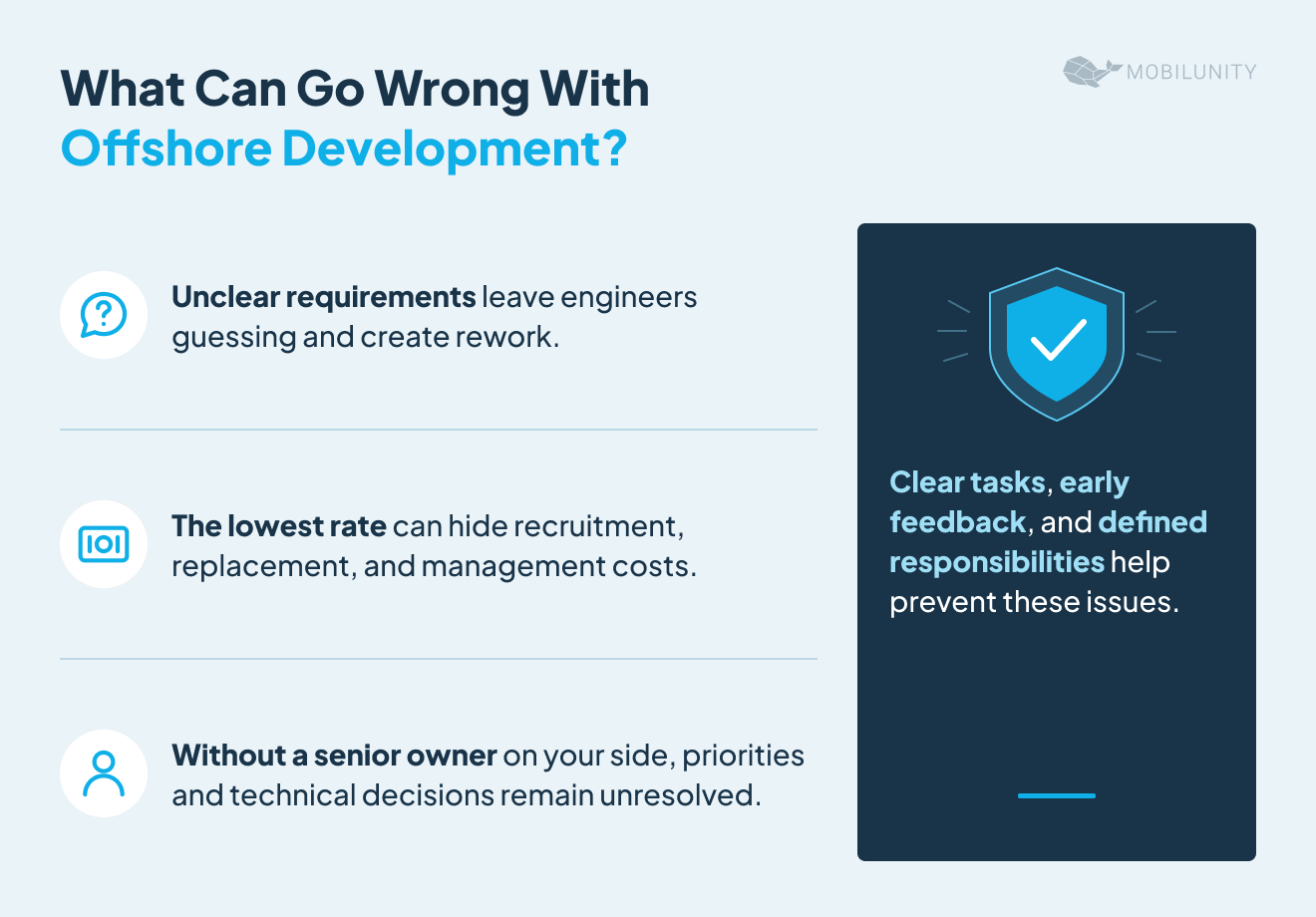
A task such as “improve checkout” leaves questions about expected behavior, payment failures, and acceptance criteria unanswered. Engineers then make assumptions that may differ from yours, and the mismatch becomes visible during review.
Workable requirements don’t need to describe every future feature. They do need enough detail for the next task, with someone available to resolve questions. Offshore hiring is the wrong answer when no usable specification exists and nobody on your side can develop one: additional engineers won’t fill that ownership gap.
A lower development bill can lose its appeal when your senior engineers spend hours correcting contributions. Defects discovered late can also require changes to dependent features, tests, and deployment plans.
A code review gate owned by someone on your side helps catch problems while changes are still small. Agreed acceptance criteria, automated checks, and early feedback give contributors a clearer standard to work toward. Reviewing the first few tasks closely also reveals whether the engineer needs more product context or technical guidance.
An hourly rate tells you what time costs, but it doesn’t show how much internal support the arrangement requires. A proposal can look inexpensive while leaving recruitment charges, replacement costs, or substantial review work outside the headline figure.
The loaded-cost comparison in the previous section provides a better starting point. Adding your management time and expected overhead to each proposal helps you compare equivalent responsibilities. A paid trial can then provide evidence about the quality and communication behind the quoted price.
Engineers need someone who can settle priorities, approve technical choices, and address a mismatch with the provider. Without that authority, questions accumulate and work can continue in the wrong direction.
A named internal owner makes escalation clearer, particularly when that person can pause work until a problem is resolved. The guide to managing an offshore team covers the ongoing coordination in more detail.
Certifications may support a provider’s credentials, but they don’t establish whether the proposed people can deliver your work. Relevant shipped projects, direct technical conversations, and reviewed trial contributions provide more specific evidence for that decision.
Mobilunity fits companies that want to extend their engineering capacity while retaining control of development. Founded in 2010 and based in Kyiv, our Clutch profile shows a 4.8 rating (as of October 2026). We handle recruiting and onboarding specialists and provide the agreed employment and administrative support; your side directs their work.
You’ll find that our database of pre-vetted experts for dedicated development teams totals more than 5,000 specialists and we have an average client partnership duration of 4.2 years. These figures provide background for your evaluation.
Candidate interviews and relevant references still help establish whether the proposed people fit your requirements. The BYG-E case study illustrates an ongoing team extension. The Danish software vendor needed additional capacity for a mature construction-market product, including documentation and maintenance of a complex system. Our partnership began in 2017 and remains ongoing.
For a narrower capacity gap, Mobilunity FLEX offers part-time specialist engagement, with allocation and rates depending on your requirements. Availability, selection, and your own technical onboarding determine when that person can contribute to the code.
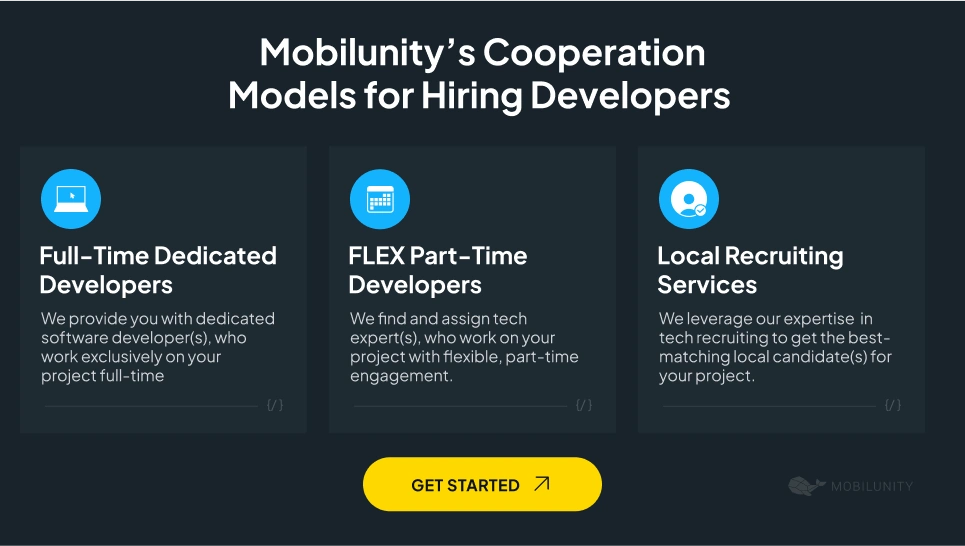
The strongest fit is a business with someone who can set priorities, explain the architecture, review contributions, and accept results. You might need one specialist alongside an existing team or several roles supporting an ongoing roadmap. In either case, recruitment support complements your internal development leadership.
The following comparison identifies three situations where a different arrangement would better match your expectations.
| Your Situation | What Model Is a Fit |
| You have development leadership and need additional engineering capacity | A suitable model to evaluate: Mobilunity recruits and supports specialists while you manage their work. |
| You need a finished product for a fixed price, with the provider accountable for delivery | A project-outsourcing provider is a better fit. |
| You want an external partner to own planning, task assignment, and delivery control | A managed delivery arrangement better matches those responsibilities. |
| You have nobody available to provide context, organize work, and accept contributions | Internal leadership or a partner responsible for delivery is needed before adding client-directed specialists. |
An individual quote can establish the cost of the roles and support you need.

Disclaimer: All salaries and prices mentioned within the article are approximate numbers based on the research done by our in-house Marketing Research Team. Please use these numbers as a reference for comparison only. Feel free to use the contact form to inquire on the specific cost of the talent according to your vacancy requirements and chosen model of engagement.
Client Testimonial
Mobilunity provides an excellent and efficient tech talent service. All my staffing requests, even for niche technologies, were fulfilled in a 2 to 4-week time period, with top-notch candidates. Besides that, I like the caring environment that the Mobilunity team provides for the developers and ensures that everybody is able to work without distractions.
I strongly recommend Mobilunity as a tech talent partner!

Waldemar Biller
Head of Technology








Fulltime dedicated teams, FLEX on-demand model, consultancy, recruitment, EOR