Hire Developers in Hungary

Key takeaways
For an application you already run, Ruby on Rails development services usually mean keeping it current, and your first question should be which Rails version you’re on. The Rails maintenance policy sets October 10, 2026, as the end of bug-fix support for Rails 8.1.x and May 7, 2026, for Rails 8.0.x.
Security fixes continue through October 10, 2027, for 8.1.x and November 7, 2026, for 8.0.x. Your version therefore helps determine what you need to buy: ongoing maintenance, an upgrade, or a broader effort to replace outdated dependencies. The starting point is a review of your Rails and Ruby versions, Gemfile, and existing tests.
Ask the provider to explain which changes must happen first, what could disrupt production, and how it will verify the result. That assessment gives you a basis for comparing proposals and deciding how much feature work your team can safely take on alongside maintenance.
For an existing Ruby on Rails product, development services typically combine 3 areas: keeping the application reliable and secure, updating its technology, and building new features. The balance depends on the codebase’s condition.
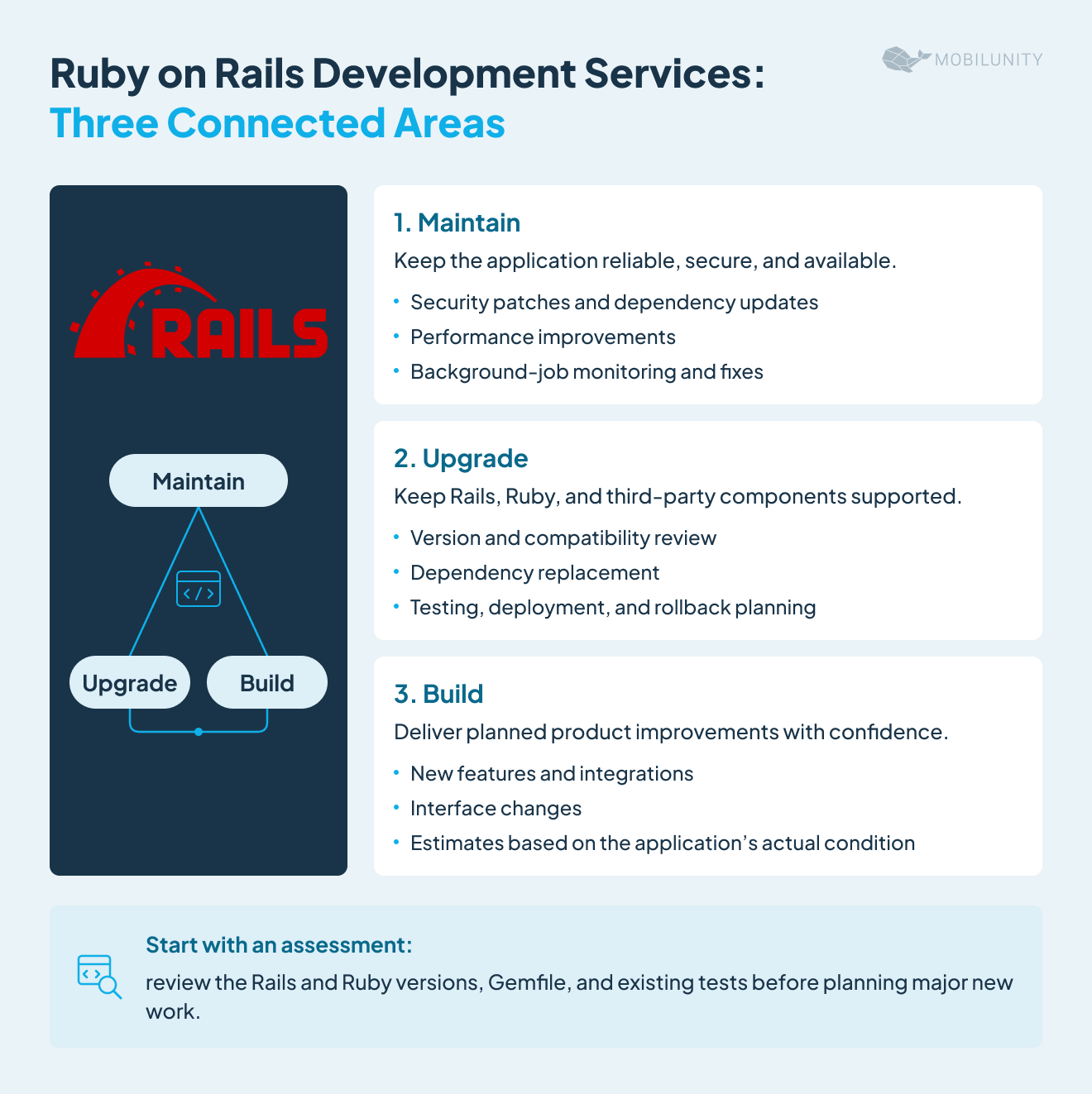
Before committing to major new features, a team should assess whether the application needs updates first. An older version of Rails or Ruby, or an unsupported third-party component, can make new work slower, riskier, and more expensive.
Rails and Ruby need to be updated together because they follow separate release schedules and may not work with every version of the other. A good upgrade plan should state the target versions, required changes, testing, release approach, and rollback plan. The official Rails upgrade guide recommends careful testing and staged upgrades.
Third-party software packages called “gems” in Ruby also need review. One outdated package can block an upgrade or create security risk. Replacing it may require application changes and testing key journeys such as sign-in or payments.
Ongoing maintenance includes applying security fixes, monitoring known issues, and keeping dependencies current. Performance work addresses real user problems, such as slow pages or delayed checkouts, and should be measured before and after changes.
Rails applications also run background tasks, such as sending emails, generating invoices, or importing data. These need maintenance to prevent failures, delays, or duplicate actions.
Once the application’s health and technical risks are clear, the team can estimate new features, integrations, and interface changes with more confidence. Reviewing dependencies early helps prevent upgrade work from being missed in the budget or schedule.
Some work may fall outside a standard Rails engagement, such as managing cloud infrastructure, building a separate front-end application, or creating a data warehouse. These boundaries should be clear in every proposal.
Offshore Ruby on Rails developers can handle this work through dedicated development teams. The engagement also defines how priorities, release approvals, and incident response are shared with your staff. Those responsibilities help keep maintenance moving after the initial upgrade is complete.
Ruby on Rails is quite often considered as a starting point for programming, as it is flexible and allows newcomers to gain their programming experience easily. Let’s explore how Ruby on Rails development outsourcing benefits startups.
RoR has a short learning curve, so Ruby developers have many gems ready to handle the next task. Since most startups need fast results, RoR-based projects are delivered quickly and effectively, without spending much time learning and practicing.
No expenditure is needed for RoR utilization as it is supported by MIT license. Moreover, developers can add features and functionalities developing such from scratch. Due to a large selection of RoR gems, an offshore Ruby on Rails developer has an extensive framework, thus enabling the startups to run the project on a shoestring budget.
Although RoR is an open-source framework, it has strong security. The Security Development Lifecycle helps programmers respond if breaches occur. With this in mind, startups don’t have to invest additional resources to keep their code protected.
Rails is one of the frameworks that can detect and remove bugs, so developers don’t need to scan the entire codebase and then look for ways to fix them. As a result, startups don’t spend extra money on bug-hunting platforms.
Ruby developer salaries depend on seniority, team size, and whether you need ongoing maintenance or a defined development project. Mobilunity’s in-house tech recruiting team provides the following monthly bands, based on its September 2026 research. These are costs per developer; a complete team budget depends on the roles you need.
| Engagement Shape | Maintenance or Build | Monthly Cost (USD) |
| Dedicated junior developer | Either, with appropriate supervision | $2,850–$4,100 |
| Dedicated middle developer | Either, depending on scope | $4,050–$6,500 |
| Dedicated senior developer | Either, depending on scope | $6,450–$8,000 |
Source: Mobilunity in-house recruiting team research, September 2026.
These bands aren’t separate maintenance and build rates. A maintenance engagement might combine patching, upgrades, and incident support, while development adds capacity for planned features. The proposal needs to define availability, responsibilities, and any additional roles. A mid-level and senior developer together would cost about $14,500 per month using these bands.
For an in-house comparison, the BLS Occupational Outlook Handbook reports a median annual software developer wage of $135,980 in May 2025. The BLS Employer Costs for Employee Compensation release reports that benefits accounted for 30.0% of private-industry employer compensation costs in June 2026.
Using that broad benefits share, wages represent 70% of compensation: $135,980 ÷ 0.70 = $194,257, or about $194,000 annually. This is an illustrative salary-plus-benefits estimate for one US hire, before recruiting and equipment. It combines occupation-wide pay with an economy-wide benefits share, so it provides a budgeting benchmark rather than a Rails-specific compensation figure.
Rails draws from a smaller developer pool than JavaScript or Python. That makes experienced candidates harder to substitute and can keep rates firm even when your application has a modest feature backlog. A specialist with relevant upgrade experience may command more than the general developer median; the premium depends on the role and location.
The lowest price can lead to higher costs later. If a developer cannot work effectively with your existing tools or production process, you may need to hire a replacement and spend time transferring project knowledge. For a smaller talent pool, finding that replacement can take longer than for more common technologies.
The difference between nearshore and offshore Ruby on Rails development is often the working day you share with your team. Travel distance tells you little about whether developers are available when a release needs approval or an incident needs attention. Shared hours determine how quickly those decisions can happen.
Kyiv is 2 hours ahead of London and 7 ahead of New York for most of the year. With both teams working 9 a.m. to 5 p.m. locally, that means 6 hours of overlap with London and one with New York. Different US and European daylight-saving dates briefly change the New York overlap.
Team based in Kyiv can therefore work alongside a London business for much of its day, while a New York client may need an agreed schedule adjustment. When you outsource Ruby on Rails development, shared hours, response expectations, and release coverage shape the arrangement. Tasks that do not require an immediate response can be handled asynchronously through clear written updates and documentation.
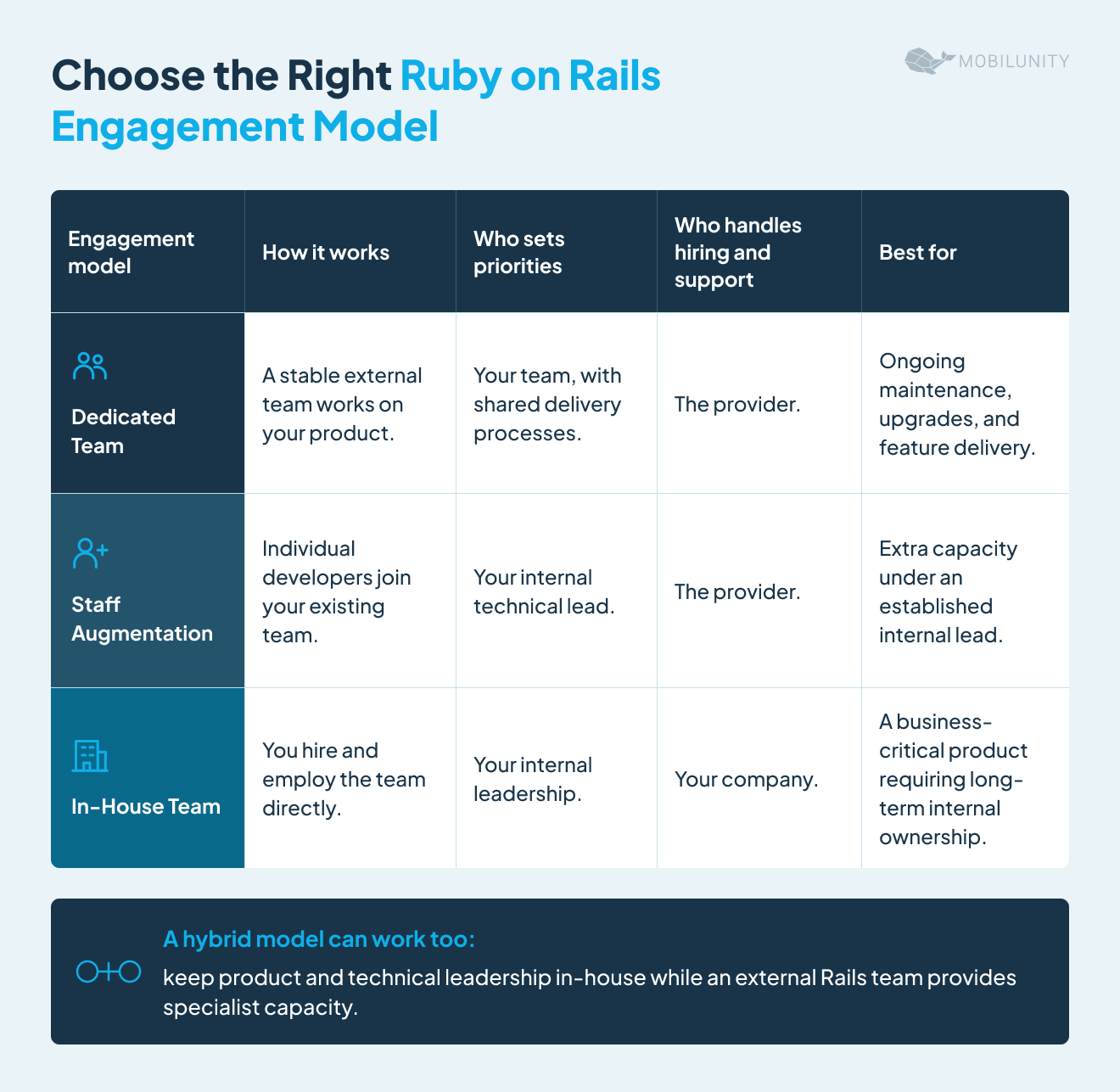
The engagement model also affects who manages delivery. A dedicated team can provide several roles, with responsibilities defined in the agreement. Rails staff augmentation adds developers to the team you already manage, so your technical lead continues to set priorities and review work. This can suit businesses that have internal leadership but need additional capacity.
In-house wins when the Rails application is your product and critical knowledge needs to remain within your organization. Your employees retain responsibility for architecture, product decisions, and the application’s history, which matters most when behavior is hard to document or closely tied to your business model.
A combination can also work: an internal lead retains that knowledge while external developers handle agreed tasks. The choice depends on how much daily collaboration you need and where long-term responsibility for the application should sit.
Ruby on Rails support has two separate deadlines. Under the official Rails maintenance policy, each minor release series receives bug fixes for one year and security fixes for two years after its first release. A security-supported version can therefore already be outside its general bug-fix window.
As of October 14, 2026, both bug-fix deadlines below have passed. The policy still lists Rails 8.1.x and 8.0.x for security support, with the following end dates:
| Rails Release | Bug-Fix Support Ends | Security Support Ends |
| 8.1.x | October 10, 2026 (ended) | October 10, 2027 |
| 8.0.x | May 7, 2026 (ended) | November 7, 2026 |
Rails 7 and earlier are outside both windows under this policy. Your application may continue running, but responsibility for addressing new framework bugs and security issues falls to whoever maintains it. For Rails 8.0.x, the November 7, 2026, security deadline makes an upgrade a near-term planning item.
The official Rails upgrade guide recommends moving one minor version at a time, fixing deprecated behavior and checking tests at each step. That makes version distance a major part of the budget. An application several releases behind can require multiple rounds of code changes, dependency updates, and validation before reaching the target version.
Missing tests add another layer of work because the team needs a way to confirm that existing behavior survives each change. For example, checkout, authentication, and scheduled billing may all need checks during an upgrade. The version gap provides the starting estimate; dependency compatibility and test coverage determine how much work sits between those steps.
The Rails 8 announcement also makes a hosting decision relevant to companies: the framework comes with tooling for deployment without a platform-as-a-service provider, including Kamal 2 for cloud servers or your own hardware. This gives your team another hosting option. Potential platform savings need to be weighed against server operations, backups, and incident response, so an upgrade doesn’t automatically justify moving away from your current provider.
Ruby follows its own release calendar. The Ruby project’s release notes state that Ruby 3.4.0 arrived on December 25, 2024, with Prism becoming the default parser, the component that reads Ruby code. That change illustrates why the language runtime deserves its own compatibility review alongside the framework.
A complete upgrade quote therefore identifies both the Rails and Ruby targets, even when the two upgrades happen separately. It also explains which dependencies need changes and how the team will verify the application’s behavior. If the runtime is already suitable, the assessment can say so; leaving it unexamined makes the scope incomplete.
Comparing Ruby on Rails consulting companies is easier when the discussion centers on your application and the work it needs. A provider’s answers should connect its experience to your versions, dependencies, and release process.
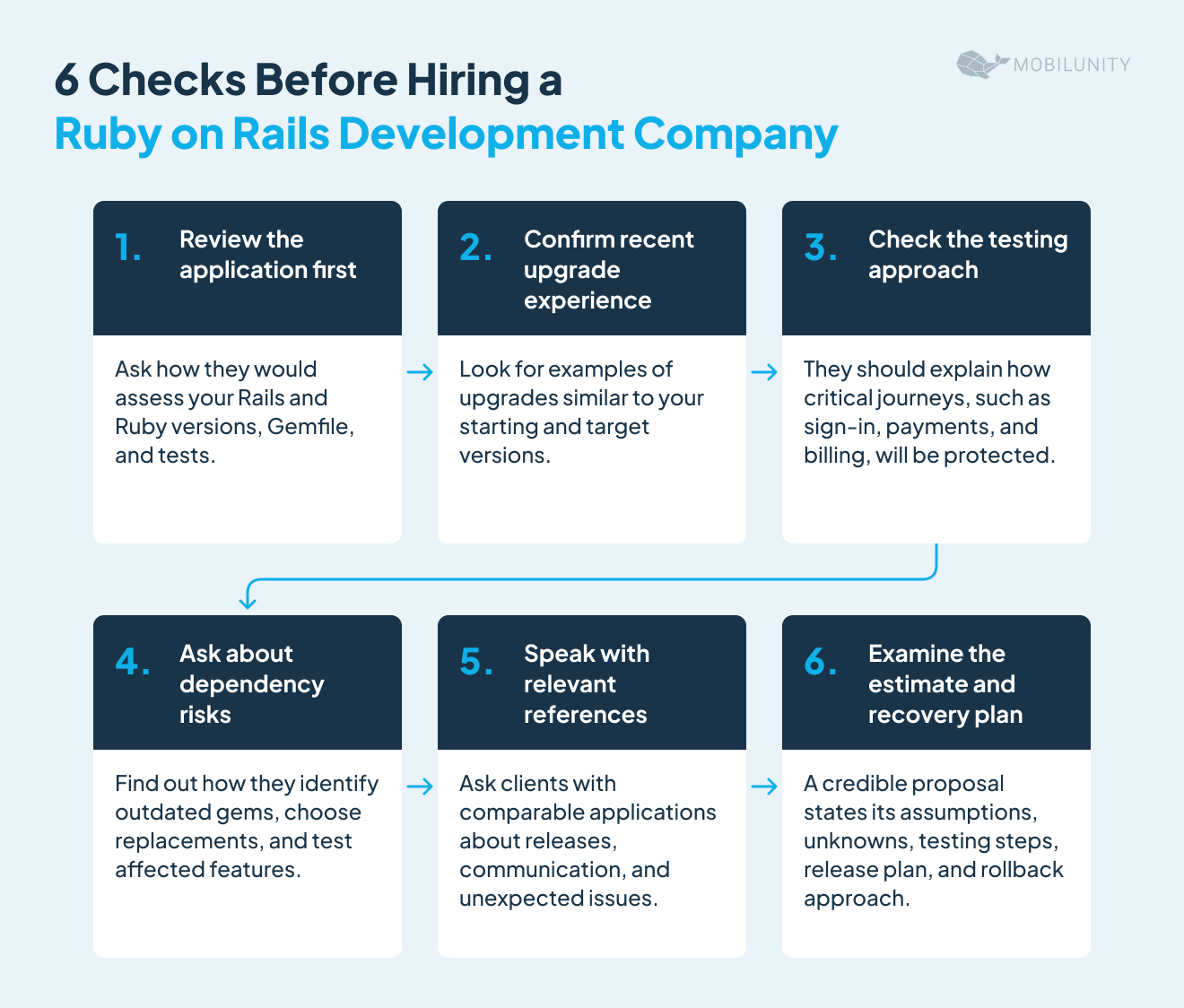
These six checks help turn a general sales conversation into an assessment you can use.
1. Gemfile Review
Your Gemfile lists the application’s dependencies and declared version requirements. A useful first discussion covers what the provider would upgrade first, why that change takes priority, and which dependencies could block it. The explanation should distinguish what the team can see immediately from what requires a closer look at the application.
2. Experience Across Versions
The Rails versions used in the provider’s last three projects give context to its experience. A team maintaining recent applications may have a different background from one that has completed major upgrades. An explanation of the starting version, target version, and problems encountered makes that experience easier to judge.
3. Test Coverage Expectations
The official Rails upgrade guide recommends good test coverage before an upgrade. The provider’s assessment should explain whether your existing suite is sufficient and where additional checks are needed. For example, authentication, checkout, and billing workflows may need coverage before framework changes begin, with that work included in the estimate.
4. Unsupported Gem Replacement
An upgrade can expose a dependency with no maintained release compatible with the target version. The provider should be able to describe how it evaluates replacements, identifies affected code, and verifies that the application’s behavior is preserved. An example from a previous project helps show how the team handles this work.
5. References at Your Scale
Two references from businesses with applications and teams similar to yours can provide a more useful comparison than a long client list. A direct conversation can cover how the provider handled releases, unexpected work, and communication. Details about an actual upgrade or production issue help you assess how the relationship worked.
6. Estimate and Release Plan
A credible estimate identifies its assumptions, the work already assessed, and the uncertainties that remain. The release plan should also cover validation, deployment, and recovery if the change causes problems. A fixed price for a Rails upgrade before anyone has reviewed the Gemfile is a warning sign: the dependency work has yet to be assessed.
Together, these checks give you a clearer basis for comparing scope, delivery responsibilities, and price. They also reveal which questions still need answers before the engagement begins.
For businesses maintaining a Ruby on Rails application, offshore hiring can help address gaps in specialist experience and delivery capacity. The benefits depend on how well the provider’s recruitment and staffing approach matches your versions, dependencies, and planned work. Broader considerations for choosing an offshore company belong in the general offshore guide, including provider responsibilities and contract terms.
A provider that already recruits Rails engineers can assess candidates against the work your application needs. Experience with framework upgrades, dependency replacement, and production maintenance gives you a more useful shortlist than familiarity with Ruby alone.
Because Rails developers are scarce, the provider’s available bench can be more valuable here than on a mainstream stack. That value depends on whether the engineers have relevant experience and are available for your engagement.
The pricing advantage comes from matching seniority and allocation to the application. A complex upgrade may need a senior engineer to resolve compatibility issues, while routine changes can be handled by other team members with appropriate review.
An offshore arrangement can provide that mix without making every role a permanent internal hire. The rate bands above offer a starting point for budgeting the composition you need.
Your staffing needs can change during a Rails upgrade. Dependency replacement and regression testing may require additional capacity for a defined period, followed by a smaller team for maintenance and feature work.
A provider can support that transition when recruitment, notice, and handover terms allow it. Keeping engineers familiar with the application involved through the change helps preserve knowledge of its dependencies and release process.
If you’re looking for individual engineers, our guide to hire Ruby on Rails developers covers that hiring path.
Founded in 2010 and based in Kyiv, we at Mobilunity provide dedicated Ruby on Rails developers and teams. Our Clutch profile lists a 4.8 rating (as of October 2026), an hourly range of 25–49, and a minimum project size of $10,000+. If you’re evaluating us as a Rails development company, these provider-wide figures offer a starting point; your scope and staffing mix determine the actual quote.
In our Ruby hiring guide, we recommend a 90-minute screening task covering database queries, background jobs, and testing. We also report a 97% consultant trial-period success rate and 94% retention across client projects over the preceding 12 months. These are company-wide results, best considered alongside references relevant to your application.
With our dedicated model, you work with engineers assigned to your product while your team directs development. We handle recruitment, candidate pre-screening, onboarding, and back-office support. This arrangement suits businesses with internal technical leadership that need additional capacity for maintenance, upgrades, or feature delivery.
Our Camptocamp case study illustrates this staffing model through a dedicated ERP team from Ukraine. The Swiss company’s first team members supplied by us started in early 2017. Our ongoing collaboration involves application maintenance and expanded ERP functionality, providing an example of how a dedicated team supports an established product.

Disclaimer: All salaries and prices mentioned within the article are approximate numbers based on the research done by our in-house Marketing Research Team. Please use these numbers as a reference for comparison only. Feel free to use the contact form to inquire on the specific cost of the talent according to your vacancy requirements and chosen model of engagement.
Client Testimonial
Mobilunity provides an excellent and efficient tech talent service. All my staffing requests, even for niche technologies, were fulfilled in a 2 to 4-week time period, with top-notch candidates. Besides that, I like the caring environment that the Mobilunity team provides for the developers and ensures that everybody is able to work without distractions.
I strongly recommend Mobilunity as a tech talent partner!

Waldemar Biller
Head of Technology


Fulltime dedicated teams, FLEX on-demand model, consultancy, recruitment, EOR